Within Haiti Cryptids
Is the Lougawou Haiti's Werewolf?
The lougawou is Haiti's best-known shapeshifter, a night monster shaped more by social fear than wolf biology.
On this page
- From loup garou to Haitian shapeshifter
- Why the creature changes form
- Protection customs and neighbourhood fears
Page outline Jump by section
Introduction
The lougawou is the most famous shapeshifting monster in Haitian folklore, but calling it a “Haitian werewolf” only tells part of the story. The name comes from the French loup-garou (“werewolf”), yet the Haitian creature is not defined by wolves, full moons or wilderness attacks. Haiti has no native wolf population, and traditional accounts focus instead on hidden human beings who transform at night, travel in supernatural forms, drain life from victims, and conceal their true nature within ordinary communities. The lougawou occupies a unique place between monster legend, social warning, spiritual belief and neighbourhood fear. Rather than representing an undiscovered animal, it reflects anxieties about secrecy, illness, vulnerability and the possibility that danger may come from someone already known and trusted.[digitalcommons.oberlin.edu]digitalcommons.oberlin.edufaculty scholAuthors. George Eaton Simpson, Oberlin College. Repository Citation. Simpson, George Eaton. Oct. – Dec. 1942.Read more…
For readers interested in cryptids and monster traditions, the lougawou is particularly revealing because it shows how a creature can become culturally powerful without being tied to a specific species. Stories vary widely from region to region, but the central theme remains remarkably consistent: an apparently normal person acquires the ability to leave human form after dark and prey upon others. The legend has survived from the colonial period into the twenty-first century and continues to influence popular fears during periods of social stress and uncertainty.[digitalcommons.oberlin.edu]digitalcommons.oberlin.edufaculty scholAuthors. George Eaton Simpson, Oberlin College. Repository Citation. Simpson, George Eaton. Oct. – Dec. 1942.Read more…
From Loup-Garou to Haitian Shapeshifter
The word lougawou ultimately derives from the French loup-garou, a term associated with European werewolf traditions. During the colonial era, French folklore mixed with African religious traditions and local Caribbean beliefs, producing a creature that became distinctly Haitian rather than simply imported from Europe. Scholars studying Haitian folklore have noted that the resulting figure differs substantially from the classic European wolf-man. Instead of a cursed individual transforming into a wolf, the Haitian lougawou became a supernatural shapeshifter capable of assuming many forms.[digitalcommons.oberlin.edu]digitalcommons.oberlin.edufaculty scholAuthors. George Eaton Simpson, Oberlin College. Repository Citation. Simpson, George Eaton. Oct. – Dec. 1942.Read more…
One of the most important early studies is George Eaton Simpson’s 1942 article Loup Garou and Loa Tales from Northern Haiti, based on folklore collected in northern Haiti. Simpson documented stories in which the creature appeared within a broader landscape of spirits, magic and supernatural dangers familiar to rural communities. His work demonstrates that the lougawou was already deeply embedded in Haitian oral tradition by the early twentieth century rather than being a recent invention.[digitalcommons.oberlin.edu]digitalcommons.oberlin.edufaculty scholAuthors. George Eaton Simpson, Oberlin College. Repository Citation. Simpson, George Eaton. Oct. – Dec. 1942.Read more…
The transformation from European werewolf to Haitian shapeshifter is significant. In Haiti, the creature is not primarily associated with forests, packs of wolves or animal behaviour. Instead, it is associated with people, households and villages. The threat comes from social proximity. The monster may be a neighbour, an elderly woman, a stranger passing through town or someone who appears completely ordinary during daylight hours.[digitalcommons.oberlin.edu]digitalcommons.oberlin.edufaculty scholAuthors. George Eaton Simpson, Oberlin College. Repository Citation. Simpson, George Eaton. Oct. – Dec. 1942.Read more…
Why the Creature Changes Form
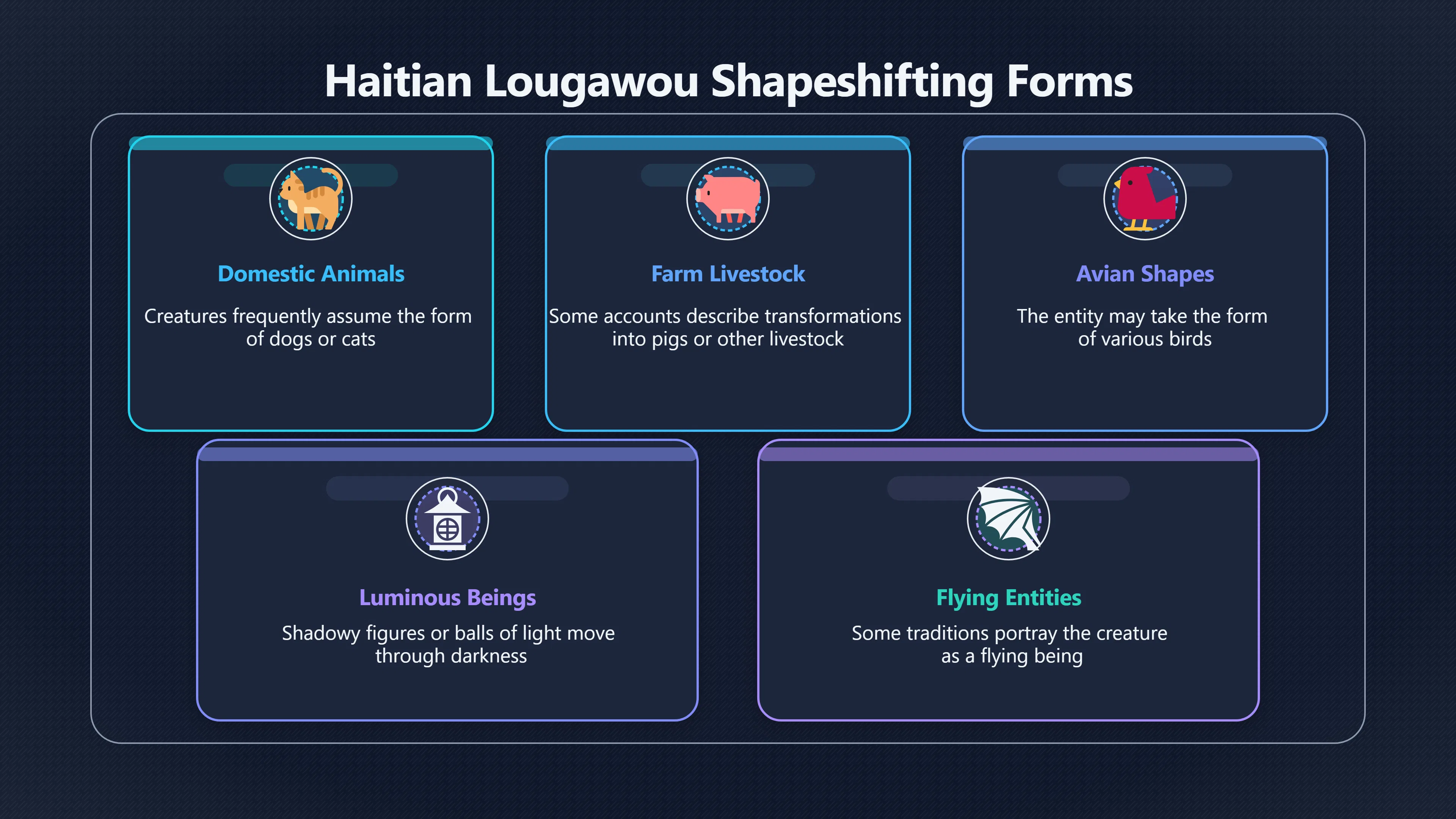
Unlike many monster traditions that centre on a single recognisable appearance, the lougawou is deliberately fluid. Different accounts describe transformations into dogs, birds, pigs, cats or other animals. Some stories portray the creature as becoming a flying being, a shadowy figure or even a ball of light moving through darkness. The inconsistency is not a weakness of the legend; it is one of its defining features.[Wikipedia]WikipediaOpen source on wikipedia.org.
Folklore researchers generally interpret this flexibility as evidence that the story is less concerned with zoology than with hidden identity. The fear is not that a particular animal exists but that a human being can conceal a dangerous second nature. Transformation allows the creature to cross boundaries between the familiar and the unknown. By day, the suspected lougawou participates in ordinary life. By night, it becomes something else entirely.[digitalcommons.oberlin.edu]digitalcommons.oberlin.edufaculty scholAuthors. George Eaton Simpson, Oberlin College. Repository Citation. Simpson, George Eaton. Oct. – Dec. 1942.Read more…
In many accounts, the creature targets sleeping victims. Some traditions describe it drinking blood or draining vitality from people while they sleep, especially children. Other versions emphasise illness, weakness or unexplained exhaustion rather than obvious physical attacks. These themes place the lougawou closer to vampire-like folklore than to the wolf-centred werewolf stories of Europe.[wikipedia.org]WikipediaOpen source on wikipedia.org.
The shapeshifting mechanism also serves an important social purpose. It provides an explanation for mysterious events that otherwise appear difficult to understand. Unexplained sickness, livestock losses, strange noises at night or fears about vulnerable children can all be interpreted through the framework of a hidden predator capable of changing form.[digitalcommons.oberlin.edu]digitalcommons.oberlin.edufaculty scholAuthors. George Eaton Simpson, Oberlin College. Repository Citation. Simpson, George Eaton. Oct. – Dec. 1942.Read more…
The Night-Time World of the Lougawou
Many traditional Haitian stories draw a sharp distinction between daytime and night-time. Daylight belongs to ordinary social life; darkness belongs to uncertainty. The lougawou is fundamentally a creature of the night.
Accounts collected by folklorists often describe rural communities becoming quiet after sunset. Lauren Derby’s discussion of historical Haitian folklore cites observations from researchers who found that peasants frequently avoided travelling at night because of fears involving spirits, magical attacks and shapeshifting beings. The lougawou occupied an important place within this wider landscape of nocturnal danger.[ScienceDirect]sciencedirect.comStealing the Citadelby L Derby · 2024 · Cited by 4 — George Eaton Simpson,Loup Garou and Loa Tales from Northern HaitiJourna…
This context helps explain why the creature became associated with children. Children are among the most vulnerable members of any community and are often the focus of cautionary folklore. Caribbean traditions related to the lougawou and its regional relatives frequently warn children against wandering after dark. Similar stories appear across the French-speaking Caribbean, where related shapeshifters are said to hunt at night and target the young or unwary.[Wikipedia]WikipediaOpen source on wikipedia.org.
The emphasis on darkness also means that eyewitness reports are rarely presented as straightforward monster sightings. Instead, stories often involve hearing unusual sounds, glimpsing an indistinct figure, noticing unexplained illness or discovering evidence that seems to suggest supernatural visitation. The uncertainty is part of the fear. The creature is dangerous precisely because it cannot be easily identified.[digitalcommons.oberlin.edu]digitalcommons.oberlin.edufaculty scholAuthors. George Eaton Simpson, Oberlin College. Repository Citation. Simpson, George Eaton. Oct. – Dec. 1942.Read more…

Protection Customs and Neighbourhood Fears
One reason the lougawou has remained culturally important is that the legend is accompanied by practical protective traditions. Across Haiti, stories about the creature are often linked to rituals intended to prevent attacks or reveal the monster’s identity. These customs vary by region and family tradition, but they generally reflect an attempt to create safety in an uncertain world.[digitalcommons.oberlin.edu]digitalcommons.oberlin.edufaculty scholAuthors. George Eaton Simpson, Oberlin College. Repository Citation. Simpson, George Eaton. Oct. – Dec. 1942.Read more…
Common themes include:
- Keeping children close after dark.
- Using protective prayers.
- Employing herbal baths or cleansing rituals.
- Placing protective objects around homes.
- Watching for suspicious nocturnal activity.
- Seeking help from religious specialists when supernatural harm is suspected.[wikipedia.org]WikipediaHaitian VodouHaitian Vodou
The social dimension is particularly important. The lougawou is often discussed not as a distant monster but as a potential member of the community. Suspicion therefore becomes a recurring feature of the tradition. A person believed to possess unusual powers, display strange behaviour or be connected with harmful magic might become the subject of rumours. In this sense, the creature functions less like a hidden animal and more like a mechanism through which communities identify and discuss perceived threats.[Wikipedia]WikipediaHaitian VodouHaitian Vodou
When Folklore Meets Real-World Crisis
The strongest modern evidence for the continuing power of the lougawou legend emerged after Haiti’s devastating 2010 earthquake. As hundreds of thousands of people were displaced into temporary camps, fears spread that lougawous were prowling among survivors and targeting children. Reuters reported widespread concern about “child-eating spirits” and documented stories circulating in camps about shapeshifters attacking the young.[Reuters]reuters.comHaiti quake raises fears of child-eating spiritsHaiti quake raises fears of child-eating spiritsJanuary 27, 2010 — 27 Jan 2010 — "The loup-garou is profiting from the earthquake…
These fears did not emerge in a vacuum. The earthquake left many children orphaned or separated from their families. International organisations warned about trafficking, exploitation and other dangers facing vulnerable minors in the chaotic aftermath of the disaster. Real threats existed, but folklore supplied a familiar language through which people could discuss them.[Time]content.time.comThe Haiti EarthquakeThe Haiti EarthquakeJanuary 27, 2010 — 27 Jan 2010 — The quake that has killed 150,000 people has left thousands of children orphaned…
Reports indicated that some individuals accused of being lougawous were attacked by vigilante groups. Reuters quoted residents who believed patrols had confronted or even killed suspected shapeshifters. Whether such accusations were true mattered less than what they revealed: the lougawou remained a living part of the social imagination powerful enough to influence behaviour during a national emergency.[reuters.com]reuters.comHaiti quake raises fears of child-eating spiritsHaiti quake raises fears of child-eating spiritsJanuary 27, 2010 — 27 Jan 2010 — "The loup-garou is profiting from the earthquake…
For folklorists, this episode illustrates how monster traditions can become active during moments of uncertainty. Rather than disappearing in the modern world, old legends may gain renewed relevance when communities search for explanations for danger, loss and vulnerability.[Reuters]reuters.comHaiti quake raises fears of child-eating spiritsHaiti quake raises fears of child-eating spiritsJanuary 27, 2010 — 27 Jan 2010 — "The loup-garou is profiting from the earthquake…

Is There a Real Animal Behind the Legend?
From a cryptozoological perspective, the evidence for a biological creature is extremely weak. Lougawou stories lack the consistency normally associated with reports of an unknown animal. Witnesses do not describe a stable appearance, a specific habitat or a reproducible pattern of behaviour. Instead, accounts change according to local beliefs, social circumstances and storytelling traditions.[digitalcommons.oberlin.edu]digitalcommons.oberlin.edufaculty scholAuthors. George Eaton Simpson, Oberlin College. Repository Citation. Simpson, George Eaton. Oct. – Dec. 1942.Read more…
Individual scares may sometimes have ordinary explanations. Dogs, feral animals, nocturnal birds, poor visibility, illness and rumour can all contribute to frightening experiences. Yet these explanations only address isolated incidents. They do not explain why the broader legend has endured for centuries.[HowStuffWorks]science.howstuffworks.comLougawou: A Haitian Vodou Werewolf16 Jun 2025 — Haitian folklore describes lougawou lurking around houses at night in search…
The lougawou survives because it answers questions that biology cannot. It gives form to fears about hidden enemies, unexplained misfortune and the vulnerability of children at night. That is why the creature remains one of Haiti’s most recognisable monsters despite the absence of evidence for any unknown species.
In the end, the lougawou is not Haiti’s werewolf in the strict European sense. It is something more culturally distinctive: a shapeshifter whose power comes from uncertainty itself. Its true habitat is not the forest but the boundary between trust and suspicion, daylight and darkness, neighbour and stranger.[oberlin.edu]digitalcommons.oberlin.edufaculty scholAuthors. George Eaton Simpson, Oberlin College. Repository Citation. Simpson, George Eaton. Oct. – Dec. 1942.Read more…
Amazon book picks
Further Reading
Books and field guides related to Is the Lougawou Haiti's Werewolf?. Use these as the next step if you want deeper reading beyond the article.
The Werewolf Book
Provides comparative shapeshifter traditions relevant to the lougawou.
The Book of Imaginary Beings
Places shapeshifting legends in a wider folklore context.
eBay marketplace picks
Marketplace Samples
Live-tested eBay searches with available results related to this page.
Endnotes
1.
Source: digitalcommons.oberlin.edu
Title: faculty schol
Link:https://digitalcommons.oberlin.edu/faculty_schol/305/
Source snippet
Authors. George Eaton Simpson, Oberlin College. Repository Citation. Simpson, George Eaton. Oct. – Dec. 1942.Read more...
2.
Source: Wikipedia
Title: Haitian Vodou
Link:https://en.wikipedia.org/wiki/Haitian_Vodou
3.
Source: science.howstuffworks.com
Link:https://science.howstuffworks.com/science-vs-myth/strange-creatures/lougawou.htm
Source snippet
Lougawou: A Haitian Vodou Werewolf16 Jun 2025 — Haitian folklore describes lougawou lurking around houses at night in search...
4.
Source: Wikipedia
Link:https://en.wikipedia.org/wiki/Loogaroo
5.
Source: sciencedirect.com
Link:https://www.sciencedirect.com/org/science/article/pii/S1382237324000187
Source snippet
Stealing the Citadelby L Derby · 2024 · Cited by 4 — George Eaton Simpson,Loup Garou and Loa Tales from Northern HaitiJourna...
6.
Source: accademiabelleartiverona.it
Title: Trees in Vodou: An Arbori-cultural Explorationlougawou; lougawou ka poze sou
Link:https://accademiabelleartiverona.it/wp-content/uploads/2024/04/TreesinVodouHaitiAndrewTarter.pdf
Source snippet
Simpson, George Eaton. 1942. 'Loup Garou and Loa Tales from Northern Haiti'. Journal of American Folklore 55.218: 219-27...
7.
Source: reuters.com
Title: Haiti quake raises fears of child-eating spirits
Link:https://www.reuters.com/article/world/haiti-quake-raises-fears-of-child-eating-spirits-idUSTRE60Q3V2/
Source snippet
Haiti quake raises fears of child-eating spiritsJanuary 27, 2010 — 27 Jan 2010 — "The loup-garou is profiting from the earthquake...
Published: January 27, 2010
8.
Source: content.time.com
Title: The Haiti Earthquake
Link:https://content.time.com/time/specials/packages/article/0%2C28804%2C1953379_1953494_1957160%2C00.html
Source snippet
The Haiti EarthquakeJanuary 27, 2010 — 27 Jan 2010 — The quake that has killed 150,000 people has left thousands of children orphaned...
Published: January 27, 2010
9.
Source: reuters.com
Title: i dont know what well do haiti quake survivors fear childrens future 2021 08 23
Link:https://www.reuters.com/world/americas/i-dont-know-what-well-do-haiti-quake-survivors-fear-childrens-future-2021-08-23/
Source snippet
'They are hungry': Haiti quake survivors fear for children's...24 Aug 2021 — Many survivors of an earthquake that killed more than 2200...
10.
Source: reuters.com
Link:https://www.reuters.com/news/picture/children-of-haiti-idJPRTXWHKM/
11.
Source: Wikipedia
Title: Haitian mythology
Link:https://en.wikipedia.org/wiki/Haitian_mythology
Source snippet
Haitian mythologyLougawou - A werewolf-like shapeshifter. Lwa - Haitian Vodou spirit... ↑ Simpson, George Eaton (1942). "Loup Garou a...
12.
Source: taipeitimes.com
Link:https://www.taipeitimes.com/News/world/archives/2010/01/29/2003464612
Source snippet
Haitians fear 'child-eating spirits'29 Jan 2010 — The earthquake that shattered Haiti has unleashed fears that child-eating spirits, myth...
13.
Source: natureandsupernaturalnature.wordpress.com
Title: loup garou
Link:https://natureandsupernaturalnature.wordpress.com/tag/loup-garou/
Source snippet
wordpress.comLoup-garouGeorge Eaton Simpson, “Loup Garou and Loa Tales from Northern Haiti”, The Journal of American Folklore, Vol. 55, N...
14.
Source: reutersconnect.com
Link:https://www.reutersconnect.com/item/haitian-children-sleep-on-the-ground-in-front-of-the-destroyed-government-palace-in-downtown-port-au-prince/dGFnOnJldXRlcnMuY29tLDIwMTA6bmV3c21sX0dNMUU2MkcwMkg1MDE?lastViewed=dGFnOnJldXRlcnMuY29tLDIwMTA6bmV3c21sX0dNMUU2MkUwMUYyMDE&position=2
Source snippet
Haiti urgently needs tarpaulins, tents and 25,000 toilets one month after a magnitude 7 earthquake killed more than 200...
Additional References
15.
Source: visithaiti.com
Link:https://visithaiti.com/haiti-up-close/haitian-mermaids-lougawou-folklore/
Source snippet
From Mermaids to Lougawou: Uncover Haitian FolkloreJourney through Haitian folklore, where the mysterious lougawou and mesmerizing Haitia...
16.
Source: lemon8-app.com
Link:https://www.lemon8-app.com/%40meekamonroe/7486677417629663786?region=us
Source snippet
Unveiling Haiti's Terrifying Shapeshifter & Ancient FolkloreIt is believed to be a supernatural entity or an evil spirit that can shape-s...
17.
Source: theguardian.com
Title: gangs cholera and political turmoil leave half haitis children relying on aid
Link:https://www.theguardian.com/global-development/2023/feb/07/gangs-cholera-and-political-turmoil-leave-half-haitis-children-relying-on-aid
Source snippet
Gangs, cholera and political turmoil leave half Haiti's...7 Feb 2023 — Triple threat sees Caribbean country in worst crisis since 2010 e...
18.
Source: haitianstudies.ucsb.edu
Link:https://haitianstudies.ucsb.edu/sites/default/files/KOSANBA_Bibliography_7_12_2022.pdf
Source snippet
"Loup Garou and Loa Tales from Northern Haiti." The Journal of American Folklore 55, no. 218 (1942): 219-227. ———. "Magical Practices...
19.
Source: pmc.ncbi.nlm.nih.gov
Title: PMCChronic aftershocks of an earthquake on the well-being
Link:https://pmc.ncbi.nlm.nih.gov/articles/PMC3001506/
Source snippet
by J Gupta · 2010 · Cited by 33 — In this analysis, we describe the extent of the health and safety risks faced by Haiti's most vulner...
20.
Source: instagram.com
Link:https://www.instagram.com/p/Cfb3aS5LOpP/?hl=en
Source snippet
He drags a coffin of souls and will feed on the liver and blood of whoever is in his path.Read more...
21.
Source: standardmedia.co.ke
Title: The Standard Haiti quake raises fears of child-eating spirits
Link:https://www.standardmedia.co.ke/world/article/2000001867/haiti-quake-raises-fears-of-child-eating-spirits?pageNo=2
Source snippet
Haiti quake raises fears of child-eating spirits - The Standard28 Jan 2010 — The earthquake that shattered Haiti has unleashed fears that...
22.
Source: researchgate.net
Title: 277075444 Trees in Vodou An Arbori cultural Exploration
Link:https://www.researchgate.net/publication/277075444_Trees_in_Vodou_An_Arbori-cultural_Exploration
Source snippet
Haiti: Éditions. Quitel). Simpson, George Eaton. 1942. 'Loup Garou and Loa Tales from Northern Haiti'. Journal of American Folklore 55.2...
23.
Source: jgoodwin.net
Link:https://jgoodwin.net/folklore-browser/535864.html
Source snippet
0.17 George Eaton Simpson, Loup Garou and Loa Tales from...0.17 George Eaton Simpson, Loup Garou and Loa Tales from Northern Haiti, The...
24.
Source: facebook.com
Link:https://www.facebook.com/tikozelakayofficiel/posts/in-haitian-folklore-the-lougawou-werewolf-is-one-of-the-most-feared-and-mysterio/122251135394160732/
Source snippet
In Haitian folklore, the Lougawou (werewolf) is one of the...She is a haunting figure from Haitian folklore, known particularly for inst...
Topic Tree