Creature Lore of Namibia's Wildest Landscapes
Namibia does not have a single world-famous monster in the way Scotland has Nessie, but it has a surprisingly interesting cryptid map: a northern “dog-headed pig” scare, a giant flying-snake tradition, scattered “living pterosaur” claims, internet-era sea-monster imagery off the coast, and a background of real desert animals strange enough to feed...
Page outline Jump by section
The dog-headed pig: Namibia’s clearest modern monster scare
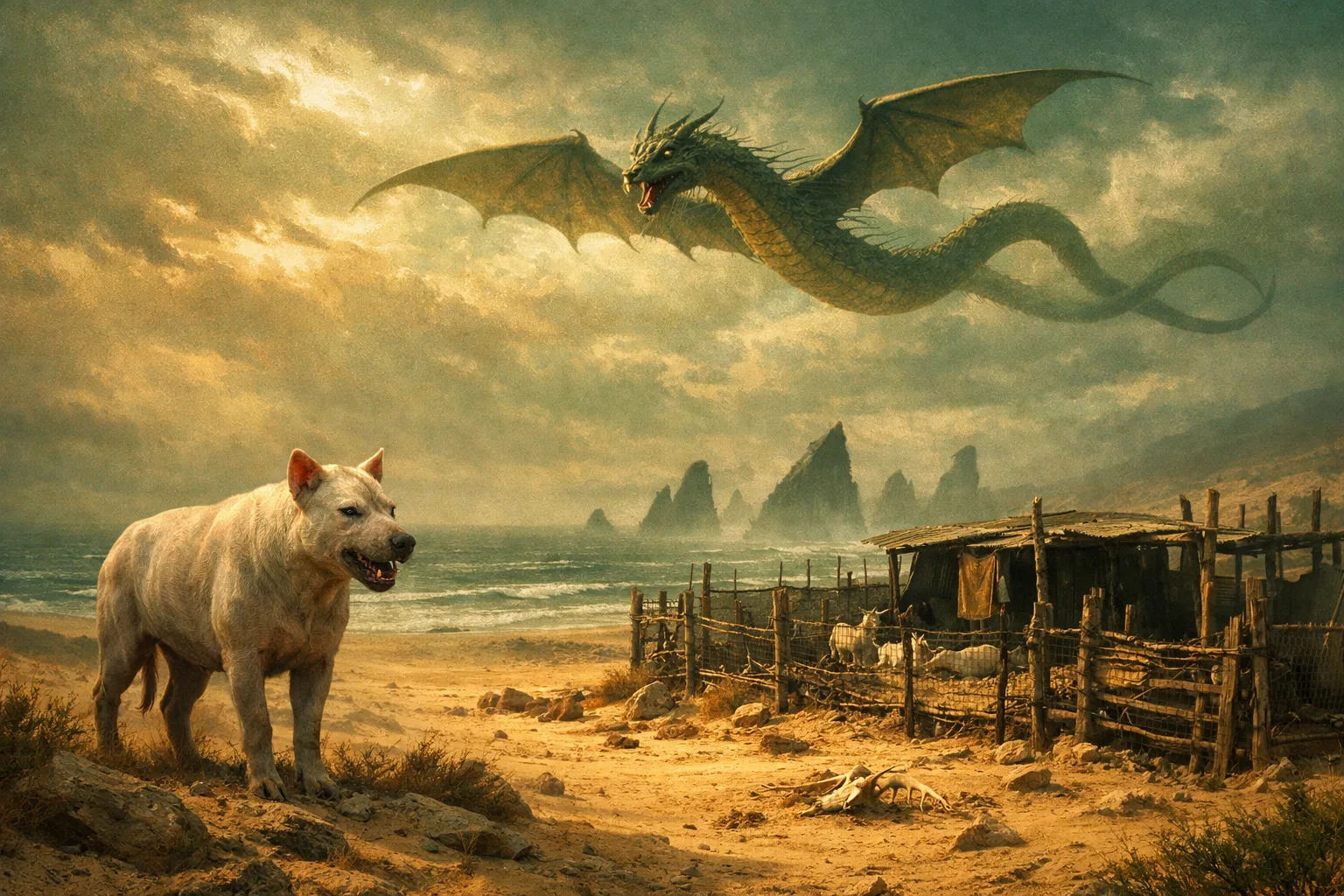
The most widely reported Namibian cryptid case is the so-called “dog-headed pig monster”, publicised internationally in 2012 after villagers in northern Namibia described a pale, aggressive animal with a doglike head and the broad, almost hairless body of a large pig. Reports said it had been chasing or attacking domestic animals, especially goats and dogs, and that some residents interpreted the creature through witchcraft or other supernatural explanations. The Namibian carried Benjamin Radford’s sceptical account of the scare, while ABC News framed the story as dangerous less because of the animal itself than because of the social fear and accusations that could follow.[The Namibian]namibian.com.naThe Namibian Mysterious 'dog-headed pig monster' terrorises NorthRESIDENTS in northern Namibia have reported being terrorised by a bizarre dog-pig hybrid…Read more…
As a monster story, the dog-headed pig sits close to the “chupacabra” pattern: livestock are found dead or injured, the culprit is described as a strange hybrid, and ordinary predator behaviour becomes a rumour with a supernatural edge. Later cryptid summaries added details such as a whitish-grey colour, hairless shoulders, canine-looking tracks and a heavy body, but the strongest contemporary reporting did not produce a carcass, clear photograph, DNA sample, or expert-confirmed new animal.[THE PINE BARRENS INSTITUTE]pinebarrensinstitute.comTHE PINE BARRENS INSTITUTECryptid Profile: The Namibian MonsterAugust 18, 2018 — 18 Aug 2018 — The Namibian Monster (aka The dog-headed pig monster) is described as having a head that resembles that o…
The most plausible explanations are ordinary but still vivid. A hyena, jackal, dog, warthog, aardvark, honey badger, or diseased carnivore could appear unfamiliar in poor light or after partial hair loss. Livestock-predator conflict is not a fringe issue in Namibia: studies and conservation reporting repeatedly identify hyenas, jackals, leopards, cheetahs and other carnivores as animals blamed for losses in rural areas. One 2023 Conservation Namibia summary of national conservancy data reported elephants as the largest source of recorded damage, followed by hyenas, jackals, cheetahs and leopards; a peer-reviewed study on communal and resettled land found that farmers most often perceived jackals as predators of goats and sheep, wild cats of chickens, leopards of horses and spotted hyenas of cattle.[Conservation Namibia]conservationnamibia.comnational hwc conservancies 2023Conservation NamibiaWhat drives human-wildlife conflict in communal…8 Feb 2023 — Elephants reportedly cause most of the damages (22%)…
That does not make the villagers foolish. It shows how quickly a real rural problem can become a monster. In a place where goats, dogs and other domestic animals matter economically, a nocturnal predator is not just a curiosity; it is a threat to food, income and safety. The “dog-headed pig” is best understood as a local predator scare that international media and cryptid websites turned into Namibia’s headline mystery beast.
The giant flying snake: a desert dragon with thin evidence
Namibia’s strangest traditional-style cryptid is the giant flying snake, usually described in cryptozoology sources as a huge winged serpent associated with the Goageb area. The common summary says that, in the late 1950s, farmers or missionaries found several dead sheep with paired puncture marks, soot-like material nearby and blackened patches on the wool. Later retellings describe a snake-like creature with wings, horns, a crest, an unpleasant smell, and even smoke or tar-like associations.[Cryptid Wiki]cryptidz.fandom.comCryptid Wiki Namibian Flying SnakeCryptid Wiki Namibian Flying Snake
The story became better known outside Namibia through cryptozoological writing and a 1995 South African television documentary, In Search of the Giant Flying Snake of Namibia. Karl Shuker’s later overview notes that the programme included alleged eyewitness testimony and estimates of the creature’s length ranging from about 9 to 15 feet, along with a specially prepared drawing based on those accounts.[ShukerNature]karlshuker.blogspot.comShuker Nature SNAKES WITH WINGSShukerNatureSNAKES WITH WINGS - AND OTHER STRANGE THINGS!22 Sept 2021 — A South African television documentary by Angus Whitty Production…
This is the kind of case where the monster is more stable in retelling than in evidence. The “flying snake” has no clear specimen, no dependable photograph, and no documented biological trail. The details also pile up in a way that often happens in folklore: wings, horns, lights, smell, smoke, livestock deaths and uncanny calls all gather around one creature. Fortean discussions of the tradition note that different narrators stress different traits, including a killing stench, sheep- or goat-like calls, a shining feature on the forehead, horns, ears, or a partly human face.[Fortean Zoology]forteanzoology.blogspot.comOpen source on blogspot.com.
Natural explanations are not perfect, but they are more likely than a giant flying serpent. Southern Africa has dangerous snakes, large birds, scavengers and predators that can leave confusing traces. Fear of snakes is also culturally and practically powerful, especially where venomous species occur. A Namibian conservation blog aimed at reducing snake persecution notes that many snakes are feared because of stories about dangerous species, while only a minority of southern African snakes are deadly.[The Narrative]narrativenamibia.comThe Narrative Keep calm….it is just a snakeThe Narrative Keep calm….it is just a snake
The flying snake therefore reads less like a missed zoological discovery than like a desert dragon: a powerful mixture of livestock anxiety, snake fear, odd tracks or carcasses, and the human habit of turning scattered clues into a single unforgettable animal.
Living pterosaurs and other flying monsters
Namibia also appears in the wider African “living pterosaur” tradition, where large featherless flying animals are sometimes linked to the better-known kongamato stories of Zambia and neighbouring regions. Cryptid archives describe a Namibian “neopterosaur” as a large, featherless flying animal with a wingspan of around 30 feet, but the sourcing is weak and the reports are usually treated as derivative or hard to verify.[Cryptid Archives]cryptidarchives.fandom.comCryptid Archives Neopterosaurs in NamibiaCryptid Archives Neopterosaurs in Namibia
This is important because the pterosaur label often says more about modern interpretation than about the original sighting. Once a witness says “big wings” or “no feathers”, later writers may import prehistoric imagery. Cryptozoologists and palaeontology-minded readers then connect the report to pterosaurs, even when the first account is vague. One cryptozoological summary of East African “neopterosaur” material notes that Bernard Heuvelmans regarded some related Namibian and East African claims as probable hoaxes or too vague to credit.[Cryptid Archives]cryptidarchives.fandom.comOpen source on fandom.com.
Real Namibian skies offer plenty of candidates for exaggeration: large raptors, vultures, bustards, storks, hornbills and other birds can look startling at distance, especially over open country where scale is hard to judge. Namibia’s bird lists include large and distinctive species such as ostriches, kori bustards, storks, ground hornbills and coastal seabirds, any of which can seem more dramatic when glimpsed briefly or described later from memory.[Wikipedia]WikipediaList of birds of NamibiaList of birds of Namibia
The pterosaur thread is therefore best treated as an imported cryptozoological overlay rather than a deep Namibian folk tradition. It survives because Namibia’s landscapes feel prehistoric to outsiders: immense deserts, dry riverbeds, remote mountains and broad skies make a living-dragon story emotionally plausible even when the evidence is not.
Sea monsters on the Skeleton Coast and the Namibia “ningen”
Namibia’s coastline has a natural monster atmosphere. The Skeleton Coast is famous for fog, shipwrecks, seal colonies, whale and seal bones, and long stretches of cold Atlantic water beside desert. Even sober travel and ecology sources describe the coast as a place where wreckage, bones and marine life shape the imagination.[EBSCO]ebsco.comOpen source on ebsco.com.
The most internet-shaped sea monster linked to Namibia is not originally Namibian at all: the “ningen”, a Japanese online legend of a pale humanoid sea creature usually associated with Antarctic or sub-Antarctic waters. In 2007, the Japanese paranormal magazine Mu discussed a Google Earth image said to show a large white form off the coast of Namibia, connecting it to the ningen or hitogata idea. Academic work on ningen “media-lore” describes this Namibian image as a purported 19-metre white, limbed figure and places it within Japanese internet culture, whaling debates, anime imagery and later Anglophone monster websites.[pinktentacle.com]pinktentacle.comningen humanoid sea creatures of the antarcticningen humanoid sea creatures of the antarctic
For a Namibia page, the key point is that this is not a local coastal tradition in the same sense as a village monster or inherited animal tale. It is a global internet legend that briefly used Namibian waters as a backdrop. The image was not followed by biological evidence, local testimony, or a documented marine discovery. Later summaries of the ningen repeatedly stress that no solid evidence has confirmed the creature’s existence.[Wikipedia]WikipediaNingen (folkloreNingen (folklore
Still, Namibia’s coast is exactly the kind of place where sea-monster stories can attach themselves. Brown hyenas patrol beaches and ghost towns, seals gather in huge colonies, fog obscures distance, and whale or seal remains can create strange shapes. The Brown Hyena Research Project describes its work on the ecologically unusual brown hyena population of the coastal Namib Desert, including areas around seal colonies, while other conservation writing notes that seals are central food sources for coastal brown hyenas in the Sperrgebiet.[Strandwolf]strandwolf.orgBrown Hyena Research Project: Research on Brown Hyenascoastal Namib Desert in Namibia. Our research on brown hyenas and the conservation of the ecologically unique brown hyena population…
Why Namibia produces believable “monster” ingredients
The best sceptical explanation for Namibia’s cryptid tradition is not that “nothing strange exists there”. It is almost the opposite: the country’s real animals and landscapes are strange enough to make monster stories easy to start.
Namibia contains desert-adapted elephants, lions, rhinos, hyenas and other wildlife in settings that many visitors do not expect. Official tourism messaging calls the Namib the oldest desert and notes that Namibia is unusual for having large mammals such as elephants, rhinos, lions and giraffes in desert environments.[Visit Namibia]visitnamibia.com.naOpen source on com.na.
Several real animals could become mystery beasts under the right conditions:
Brown hyenas are shaggy, nocturnal, powerful-looking scavengers and predators. Along the Namibian coast they move through seal colonies, abandoned mining areas and even ghost-town settings. Their appearance is odd enough that a brief sighting could easily become a “monster” report.[Strandwolf]strandwolf.orgBrown Hyena Research Project: Research on Brown Hyenascoastal Namib Desert in Namibia. Our research on brown hyenas and the conservation of the ecologically unique brown hyena population…
Jackals and wild dogs are common suspects in livestock-loss stories because they are active, adaptable carnivores. In Namibia and southern Africa more broadly, jackals are repeatedly linked with small-stock predation and with trickster folklore, which makes them both practical and symbolic troublemakers.[Cambridge University Press & Assessment]cambridge.orgOpen source on cambridge.org.
Aardvarks, honey badgers and warthogs can all look bizarre to someone expecting an ordinary dog or antelope. Aardvarks have long snouts and powerful claws; honey badgers have a pale mantle and fearless behaviour; warthogs have a heavy, bristly body. Any of these could help explain a “dog-pig” impression, especially if seen at night or in panic.
Snakes and large birds help explain flying-serpent and dragon-like imagery. A snake story gains force from real venom fears, while a large bird seen badly can become something much more dramatic in memory.
This does not mean every report has a neat one-animal answer. Monster reports often combine several elements: a real predator attack, a rumoured footprint, a half-seen animal, a frightening noise, and a story already circulating in the area. Namibia’s ecology supplies the raw material; folklore and media supply the shape.
Folklore, fear and the animal trickster tradition
Namibian monster stories sit beside a broader southern African habit of telling animal stories in which jackals, hyenas, lions, snakes and other creatures behave as tricksters, fools, predators or moral actors. Scholarship on Afrikaans stories of Jackal and Hyena traces a long oral and written tradition in southern Africa, including debates over Khoi, San, Bantu and European influences in different versions.[SciELO]scielo.org.zaOpen source on scielo.org.za.
This matters because a cryptid is rarely just an animal-shaped claim. It is also a story form. The jackal can be a real livestock predator, a clever folklore figure and a suspicious shape moving at the edge of a kraal. The hyena can be a biological scavenger, a feared night visitor and a symbol of disorder. A snake can be a real danger, a spiritual warning, or a dragon-like being with impossible powers.
Modern monster reports often borrow this older emotional grammar. The dog-headed pig became alarming not only because it might attack animals, but because it was interpreted by some residents as black magic or an unnatural thing. The flying snake is frightening not only because it is large, but because it combines venom, flight, smell, smoke and livestock death. These are not neutral zoological descriptions; they are descriptions shaped by fear, memory and explanation.
Hoax, misidentification or unresolved report?
A fair Namibia cryptid page should not flatten every case into one category. The stories differ.
The dog-headed pig is a modern rural scare with real social context and plausible predator explanations. It is not well evidenced as an unknown species, but it probably began with genuine concern over livestock and domestic animals.[The Namibian]namibian.com.naThe Namibian Mysterious 'dog-headed pig monster' terrorises NorthRESIDENTS in northern Namibia have reported being terrorised by a bizarre dog-pig hybrid…Read more…
The giant flying snake is more folkloric and cryptozoological. It has recurring motifs and a few alleged eyewitness strands, but the evidence is too thin for a biological claim. Its power lies in the image: a desert serpent that has absorbed dragon features.[ShukerNature]karlshuker.blogspot.comShuker Nature SNAKES WITH WINGSShukerNatureSNAKES WITH WINGS - AND OTHER STRANGE THINGS!22 Sept 2021 — A South African television documentary by Angus Whitty Production…
The Namibian pterosaur is the weakest as a country-specific tradition. It mostly appears in cryptid catalogues and broader African “living pterosaur” discussions, with little firm local documentation.[Cryptid Archives]cryptidarchives.fandom.comCryptid Archives Neopterosaurs in NamibiaCryptid Archives Neopterosaurs in Namibia
The Namibia ningen is an internet-era attachment rather than a local legend. It belongs mainly to Japanese media-lore and global online cryptid culture, with Namibia’s coast used as a striking setting for a Google Earth interpretation.[pinktentacle.com]pinktentacle.comningen humanoid sea creatures of the antarcticningen humanoid sea creatures of the antarctic
The strongest sceptical pattern is misidentification under pressure. Livestock predation, night sightings, partial carcasses, unusual tracks, disease-related hair loss and cultural expectation all create good conditions for monster reports. The strongest believer’s argument is not a single piece of hard evidence, but recurrence: people in different places keep describing animals that seem wrong. The problem is that recurrence alone cannot tell us whether the cause is an unknown animal, a known animal seen badly, a rumour, or a story reshaped in transmission.
Namibia’s cryptid afterlife
Namibia’s mystery creatures now live in several overlapping worlds. Locally, animal fears are tied to livestock, snakes, predators and rural safety. In cryptozoology, the country is a source of catalogue entries: the dog-headed pig, flying snake, possible pterosaur and occasional sea-monster link. In tourism and pop culture, Namibia’s real landscapes do much of the work. The Namib Desert, Skeleton Coast, ghost towns, seal colonies and desert-adapted wildlife already feel like settings where a strange animal might plausibly appear.
That is why the Namibian cryptid tradition is worth treating carefully. Its creatures are not supported by strong mainstream zoological evidence, but they reveal how people make sense of dangerous animals, remote landscapes and unexplained losses. Namibia’s monsters are most convincing not as hidden species waiting to be announced, but as border creatures: part predator, part rumour, part folklore, part media invention, and part genuine wonder at a country where the real wildlife is already extraordinary.
Amazon book picks
Further Reading
Books and field guides related to What Creatures Haunt Namibia's Wildest Landscapes?. Use these as the next step if you want deeper reading beyond the article.
Field Guide To Bigfoot, Yeti, & Other Mystery Primates Worldwide
Provides context for how cryptids are catalogued and discussed.
The Beasts That Hide from Man
Covers reports of unknown animals and global mystery-creature traditions.
Abominable Science!
Explains how monster reports emerge from folklore, misidentification and media.
eBay marketplace picks
Marketplace Samples
Live-tested eBay searches with available results related to this page.
Endnotes
1.
Source: strandwolf.org
Title: Brown Hyena Research Project: Research on Brown Hyenas
Link:https://www.strandwolf.org/
Source snippet
coastal Namib Desert in Namibia. Our research on brown hyenas and the conservation of the ecologically unique brown hyena population...
2.
Source: pinebarrensinstitute.com
Title: THE PINE BARRENS INSTITUTECryptid Profile: The Namibian Monster
Link:https://pinebarrensinstitute.com/cryptids/2018/8/18/cryptid-profile-the-namibian-monster
Source snippet
August 18, 2018 — 18 Aug 2018 — The Namibian Monster (aka The dog-headed pig monster) is described as having a head that resembles that o...
Published: August 18, 2018
3.
Source: cambridge.org
Link:https://www.cambridge.org/core/journals/environmental-conservation/article/cost-of-carnivore-coexistence-on-communal-and-resettled-land-in-namibia/142960101075A81193D3EEBA8E0E6229
4.
Source: Wikipedia
Title: List of birds of Namibia
Link:https://en.wikipedia.org/wiki/List_of_birds_of_Namibia
5.
Source: ebsco.com
Link:https://www.ebsco.com/research-starters/science/namib-desert-ecosystem
6.
Source: pinktentacle.com
Title: ningen humanoid sea creatures of the antarctic
Link:https://pinktentacle.com/2010/01/ningen-humanoid-sea-creatures-of-the-antarctic/
7.
Source: Wikipedia
Title: Ningen (folklore)
Link:https://en.wikipedia.org/wiki/Ningen_%28folklore%29
8.
Source: Wikipedia
Link:https://zh.wikipedia.org/zh-cn/%E7%BA%B3%E7%B1%B3%E6%AF%94%E4%BA%9A%E6%80%AA%E5%85%BD
9.
Source: Wikipedia
Link:https://zh.wikipedia.org/zh-tw/%E7%BA%B3%E7%B1%B3%E6%AF%94%E4%BA%9A%E6%80%AA%E5%85%BD
10.
Source: Wikipedia
Link:https://ja.wikipedia.org/wiki/%E6%9C%AA%E7%A2%BA%E8%AA%8D%E7%94%9F%E7%89%A9%E4%B8%80%E8%A6%A7
11.
Source: namibian.com.na
Title: The Namibian Mysterious ‘dog-headed pig monster’ terrorises North
Link:https://www.namibian.com.na/mysterious-dog-headed-pig-monster-terrorises-north/
Source snippet
RESIDENTS in northern Namibia have reported being terrorised by a bizarre dog-pig hybrid...Read more...
12.
Source: karlshuker.blogspot.com
Title: Shuker Nature SNAKES WITH WINGS
Link:https://karlshuker.blogspot.com/2021/09/snakes-with-wings-and-other-strange.html
Source snippet
ShukerNatureSNAKES WITH WINGS - AND OTHER STRANGE THINGS!22 Sept 2021 — A South African television documentary by Angus Whitty Production...
13.
Source: conservationnamibia.com
Title: national hwc conservancies 2023
Link:https://conservationnamibia.com/blog/national-hwc-conservancies-2023.php
Source snippet
Conservation NamibiaWhat drives human-wildlife conflict in communal...8 Feb 2023 — Elephants reportedly cause most of the damages (22%)...
14.
Source: cryptidz.fandom.com
Title: Cryptid Wiki Namibian Flying Snake
Link:https://cryptidz.fandom.com/wiki/Namibian_Flying_Snake
15.
Source: cryptidarchives.fandom.com
Title: Cryptid Archives Namibian flying snake
Link:https://cryptidarchives.fandom.com/wiki/Namibian_flying_snake
16.
Source: forteanzoology.blogspot.com
Link:https://forteanzoology.blogspot.com/2009/10/muirheads-mysteries-flying-snake-of.html
17.
Source: narrativenamibia.com
Title: The Narrative Keep calm….it is just a snake
Link:https://narrativenamibia.com/blogs/news/keep-calm-it-is-just-a-snake?srsltid=AfmBOorh28-mSd5lCtYol2hbnZwW9NhEeCdOpe74fJtcT_JufqD3GCW2
18.
Source: cryptidarchives.fandom.com
Title: Cryptid Archives Neopterosaurs in Namibia
Link:https://cryptidarchives.fandom.com/wiki/Neopterosaurs_in_Namibia
19.
Source: cryptidarchives.fandom.com
Title: Cryptid Archives Kongamato
Link:https://cryptidarchives.fandom.com/wiki/Kongamato
20.
Source: cryptidarchives.fandom.com
Link:https://cryptidarchives.fandom.com/wiki/Neopterosaurs_in_East_Africa
21.
Source: visitnamibia.com.na
Link:https://visitnamibia.com.na/
22.
Source: cryptidz.fandom.com
Title: Cryptid Wiki Ningen | Cryptid Wiki
Link:https://cryptidz.fandom.com/wiki/Ningen
23.
Source: gondwana-collection.com
Link:https://gondwana-collection.com/blog/jackal
24.
Source: scielo.org.za
Link:https://scielo.org.za/scielo.php?pid=S0041-476X2018000300008&script=sci_arttext
25.
Source: jstor.org
Link:https://www.jstor.org/stable/24774363
26.
Source: cryptidz.fandom.com
Title: Namibian pterosaur
Link:https://cryptidz.fandom.com/wiki/Namibian_pterosaur
27.
Source: cryptidarchives.fandom.com
Title: List of sea serpent sightings in the Indian Ocean (1914–1945)
Link:https://cryptidarchives.fandom.com/wiki/List_of_sea_serpent_sightings_in_the_Indian_Ocean_%281914%E2%80%931945%29
28.
Source: cryptidz.fandom.com
Title: Category:Dinosaurs and Pterosaurs
Link:https://cryptidz.fandom.com/wiki/Category%3ADinosaurs_and_Pterosaurs
29.
Source: cryptidarchives.fandom.com
Link:https://cryptidarchives.fandom.com/wiki/Category%3ANeopterosaurs
30.
Source: cryptidz.fandom.com
Title: Category:African dinosaurs
Link:https://cryptidz.fandom.com/wiki/Category%3AAfrican_dinosaurs
31.
Source: cryptidarchives.fandom.com
Title: Les Derniers Dragons d’Afrique
Link:https://cryptidarchives.fandom.com/wiki/Les_Derniers_Dragons_d%27Afrique
32.
Source: cryptidarchives.fandom.com
Title: Still In Search Of Prehistoric Survivors
Link:https://cryptidarchives.fandom.com/wiki/Still_In_Search_Of_Prehistoric_Survivors
33.
Source: cryptidz.fandom.com
Link:https://cryptidz.fandom.com/wiki/Category%3AAfrica
34.
Source: instagram.com
Title: The ningen
Link:https://www.instagram.com/reel/DQKMC1YD79F/
35.
Source: pinebarrensinstitute.com
Link:https://pinebarrensinstitute.com/cryptids/tag/namibia
36.
Source: pinebarrensinstitute.com
Link:https://pinebarrensinstitute.com/cryptids/tag/dog%2Bheaded%2Bpig%2Bmonster
37.
Source: pinebarrensinstitute.com
Link:https://pinebarrensinstitute.com/cryptids/tag/africa
38.
Source: youtube.com
Link:https://www.youtube.com/watch?v=7w8Eqq6pC94
39.
Source: conservationnamibia.com
Title: epic struggle 2025
Link:https://conservationnamibia.com/articles/epic-struggle-2025.php
40.
Source: youth.conservationnamibia.com
Title: snakes in namibia
Link:https://youth.conservationnamibia.com/snakes-in-namibia/
41.
Source: tumblr.com
Link:https://www.tumblr.com/1001hauntedplacestovisit-blog/tagged/Namibia
42.
Source: mythfolklore.blogspot.com
Link:https://mythfolklore.blogspot.com/2014/06/myth-folklore-unit-south-african.html
43.
Source: oneearth.org
Link:https://www.oneearth.org/ecoregions/namib-desert/
44.
Source: creativehistorystories.blogspot.com
Title: monsters men and victorian media story
Link:https://creativehistorystories.blogspot.com/2022/07/monsters-men-and-victorian-media-story.html
Additional References
45.
Source: livescience.com
Link:https://www.livescience.com/animals/haunting-image-of-a-rare-hyena-lurking-in-a-mining-ghost-town-wins-2025-wildlife-photographer-of-the-year-award
Source snippet
The image was also awarded first place in the Urban Wildlife category. Jury chair Kathy Moran praised its eerie atmosphere and unconventi...
46.
Source: abcnews.com
Title: dog headed pig monster
Link:https://abcnews.com/blogs/headlines/2012/02/dog-headed-pig-monster
Source snippet
By Bazi Kanani February 28, 2012. What residents in a rural African village report...Read more...
Published: February 28, 2012
47.
Source: facebook.com
Link:https://www.facebook.com/groups/704609660332475/posts/1328285144631587/
48.
Source: researchgate.net
Link:https://www.researchgate.net/publication/231830903_Human-wildlife_conflict_in_northern_Botswana_livestock_predation_by_Endangered_African_wild_dog_Lycaon_pictus_and_other_carnivores
49.
Source: researchgate.net
Link:https://www.researchgate.net/publication/277849817_Predatory_and_Foraging_Behaviour_of_Brown_Hyenas_Parahyaena_brunnea_Thunberg_1820_at_Cape_Fur_Seal_Arctocephalus_pusillus_pusillus_Schreber_1776_Colonies
50.
Source: reddit.com
Link:https://www.reddit.com/r/Cryptozoology/comments/1hti2ll/a_drawing_of_the_winged_flying_snake_of_namibia/
51.
Source: instagram.com
Link:https://www.instagram.com/p/DP5i1GCCOLJ/?hl=en
52.
Source: instagram.com
Link:https://www.instagram.com/p/DYedlxiCgEB/
53.
Source: reddit.com
Link:https://www.reddit.com/r/HighStrangeness/comments/186spr2/across_the_world_there_have_been_reports_of/
54.
Source: mythfolklore.net
Link:https://mythfolklore.net/3043mythfolklore/reading/africa/pages/05.htm
Topic Tree
Follow this branch
Related pages 192
- Antigua Cryptids
- Maldives Monsters
- Malta Monsters
- Qatar Monsters
- Argentina Monsters
- +187 more in sidebar