Within Uzbekistan Cryptids
Which Real Animals Could Become Uzbek Monsters?
Bears, snow leopards and desert monitor lizards can become convincing monsters when seen briefly in remote terrain.
On this page
- Desert monitors and dragon like sightings
- Bears and distant human shaped silhouettes
- How terrain and poor visibility distort encounters
Page outline Jump by section
Introduction
Most Uzbek “monster” stories become less mysterious when viewed through the lens of the country’s real wildlife. Uzbekistan contains rugged mountain ranges, vast deserts and sparsely populated landscapes where animals are often seen only briefly, at long distances or in poor light. In such conditions, a large lizard can resemble a dragon, a bear standing upright can look uncannily human, and an elusive snow leopard can seem almost supernatural. Rather than proving the existence of unknown creatures, many reports show how ordinary animals can become extraordinary when filtered through distance, surprise and local storytelling. The most convincing candidates behind Uzbek monster reports are not undiscovered beasts but real species that are genuinely difficult to observe.[Mongabay News]news.mongabay.comsnow leopards and other mammals caught on camera trap in uzbekistan photosMongabay NewsSnow leopards and other mammals caught on camera trap…16 Jan 2014 — Camera traps in the Gissar Nature Reserve took photos…
Desert monitors and dragon-like sightings
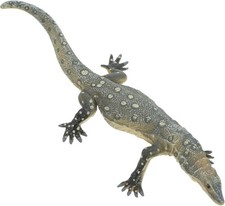
Among Uzbekistan’s most striking reptiles is the desert monitor, one of Central Asia’s largest lizards. The Caspian desert monitor occurs across parts of Uzbekistan and can exceed 1.4 metres in total length, making it an impressive sight in a region where many people rarely encounter large reptiles.[Wikipedia]WikipediaList of largest extant lizardsdesert monitor (Varanus griseus), specifically Caspian monitor (Varanus griseus caspius) with a max.total length of 1.4 m (4.6 ft), a SVL…
For a traveller crossing dunes or rocky desert terrain, a desert monitor can appear surprisingly dragon-like:
- It has a long neck and powerful body.
- It moves quickly across open ground.
- Its tail can seem almost serpent-like from a distance.
- It often emerges suddenly from burrows or vegetation.
In folklore-rich environments, these characteristics can encourage stories of dragons, giant reptiles or dangerous desert monsters. The effect is strongest when sightings occur at dawn, dusk or during brief encounters in harsh heat haze. A witness may only glimpse movement and shape rather than clear anatomical details.
Importantly, there is no evidence that Uzbek dragon traditions originated directly from monitor lizards. Dragons in Central Asian folklore are far older and more symbolic than any single animal. Yet when modern witnesses describe strange reptilian creatures in remote landscapes, the desert monitor provides one of the most plausible real-world explanations.[zool.kz]zool.kzor emerges from its winter shelters in March (Uzbekistan and Turkmenistan; Bogdanov, 1960…Read more…
Bears and distant human-shaped silhouettes
Stories of hairy wild men appear across Central Asia, including regions neighbouring Uzbekistan. Although well-documented Uzbek case clusters are scarce, reports of upright, human-like figures in mountain terrain often invite comparison with the wider Central Asian “wild man” tradition.
One possible source of confusion is the brown bear. When a bear rises onto its hind legs, it briefly acquires a remarkably human silhouette. At a distance, especially through mist, snowfall or uneven mountain light, observers may notice only a dark upright shape moving across a slope. The animal’s head can blend into its shoulders, reinforcing the impression of a large, broad-shouldered person. Brown bears are among the species recorded in Uzbekistan’s mountain reserves alongside snow leopards and other elusive mammals.[UzDaily.uz]uzdaily.uzbbc news to air episode on snow leopards in uzbekistan27 Feb 2026 — In the reserve, one of the key ecosystems in Central Asia, over 270 animal species are monitored using 75 camera traps, inc…
Several factors make misidentification more likely:
- Encounters are often unexpected.
- Mountain observers frequently lack a stable point of comparison for size.
- Bears may stand upright to investigate scents or sounds.
- Witnesses often view animals across valleys rather than at close range.
A brief sighting can therefore produce a memory that feels much stranger than the original event. By the time the story is retold, a bear may have become a mysterious mountain hominid.
Why snow leopards feel like supernatural animals
Few animals are better suited to generating mystery than the snow leopard. Conservationists regularly describe it as the “ghost of the mountains” because even experienced researchers struggle to observe it directly. Camera traps are often far more successful than human observers.[Digital Camera World]digitalcameraworld.comThese cats are notoriously difficult to observe, making research efforts particularly challenging. Since 2022, WWF's ongoing camera surve…
In Uzbekistan, snow leopards survive in remote southern mountain regions, including the Gissar area. Despite extensive camera-trap programmes, sightings remain rare. Researchers and wildlife teams can spend long periods searching without seeing a single animal.[Gazeta.uz]gazeta.uzsnow leopardssnow leopards
That rarity helps explain why reports sometimes acquire a legendary quality. A witness may glimpse:
- A large cat crossing a ridge.
- A pale shape vanishing into rocks.
- Tracks without a visible animal.
- A distant movement too brief for identification.
Because snow leopards are naturally secretive and exceptionally well camouflaged, they can appear and disappear in ways that seem almost impossible. Their real behaviour already resembles folklore. No unknown predator is required; the genuine animal is mysterious enough.[digitalcameraworld.com]digitalcameraworld.comThese cats are notoriously difficult to observe, making research efforts particularly challenging. Since 2022, WWF's ongoing camera surve…
How terrain and poor visibility distort encounters
The landscapes of Uzbekistan play a major role in creating monster stories. Mountains, deserts and steppe environments produce visual conditions that are notoriously deceptive.
Size becomes difficult to judge
In open terrain, people often lack familiar objects for comparison. A monitor lizard on a ridge may seem much larger than it really is. A bear viewed across a valley can appear taller than a person. Distances are frequently underestimated, making animals look larger and stranger than they are.
Heat haze changes shapes
Desert air can shimmer and distort outlines. Objects appear to ripple, stretch or blur. Under these conditions, witnesses may struggle to identify even familiar animals correctly.

Brief encounters encourage imagination
Most wildlife sightings last only seconds. The human brain naturally fills gaps in incomplete information. A witness remembers the unusual features and forgets the missing details, producing a creature that seems more extraordinary than the original animal.
Folklore supplies ready-made explanations
When communities already know stories about dragons, wild men or mountain spirits, unusual sightings often get interpreted through those traditions. The landscape provides the encounter, while folklore provides the narrative framework.
Why ordinary animals often explain extraordinary reports
The strongest pattern in Uzbekistan’s monster traditions is not the discovery of unknown species but the interaction between elusive wildlife and difficult environments. Large desert monitors can inspire reptilian monster tales. Brown bears can resemble upright hairy beings. Snow leopards can seem almost supernatural because they are so rarely seen. Remote terrain, poor visibility and existing folklore then amplify those impressions into memorable stories.
That does not make the stories uninteresting. In many cases, the real animals are as fascinating as the monsters they inspire. Uzbekistan’s wildlife includes some of Central Asia’s most elusive predators and largest reptiles, precisely the kinds of creatures that encourage legends to flourish where observation is difficult and imagination has room to roam.
Amazon book picks
Further Reading
Books and field guides related to Which Real Animals Could Become Uzbek Monsters?. Use these as the next step if you want deeper reading beyond the article.
The Snow Leopard
Relevant to elusive mountain wildlife often linked to mystery sightings.
The Desert and the Sown
Provides context for how remote environments inspire unusual animal stories.
eBay marketplace picks
Marketplace Samples
Live-tested eBay searches with available results related to this page.
Endnotes
1.
Source: news.mongabay.com
Title: snow leopards and other mammals caught on camera trap in uzbekistan photos
Link:https://news.mongabay.com/2014/01/snow-leopards-and-other-mammals-caught-on-camera-trap-in-uzbekistan-photos/
Source snippet
Mongabay NewsSnow leopards and other mammals caught on camera trap...16 Jan 2014 — Camera traps in the Gissar Nature Reserve took photos...
2.
Source: uzdaily.uz
Title: bbc news to air episode on snow leopards in uzbekistan
Link:https://www.uzdaily.uz/en/bbc-news-to-air-episode-on-snow-leopards-in-uzbekistan/
Source snippet
27 Feb 2026 — In the reserve, one of the key ecosystems in Central Asia, over 270 animal species are monitored using 75 camera traps, inc...
3.
Source: Wikipedia
Title: List of largest extant lizards
Link:https://en.wikipedia.org/wiki/List_of_largest_extant_lizards
Source snippet
desert monitor (Varanus griseus), specifically Caspian monitor (Varanus griseus caspius) with a max.total length of 1.4 m (4.6 ft), a SVL...
4.
Source: Wikipedia
Title: Desert monitor
Link:https://en.wikipedia.org/wiki/Desert_monitor
5.
Source: zool.kz
Link:https://zool.kz/eng/institute-publications-eng/some-compilations-and-articles/gis-and-remote-sensing/species-distribution-model-of-varanus-griseus-caspius-eichwald-1831-in-central-asia-an-insight-to-the-species-biology-2/
Source snippet
or emerges from its winter shelters in March (Uzbekistan and Turkmenistan; Bogdanov, 1960...Read more...
6.
Source: gazeta.uz
Title: snow leopards
Link:https://www.gazeta.uz/en/2026/03/22/snow-leopards/
7.
Source: digitalcameraworld.com
Link:https://www.digitalcameraworld.com/photography/nature-and-wildlife-photography/wwf-uses-trail-cameras-to-shed-new-light-on-the-worlds-most-elusive-big-cat-the-ghost-of-the-mountain
Source snippet
These cats are notoriously difficult to observe, making research efforts particularly challenging. Since 2022, WWF's ongoing camera surve...
8.
Source: reptile-database.reptarium.cz
Link:https://reptile-database.reptarium.cz/Varanus/caspius
9.
Source: reptile-database.reptarium.cz
Link:https://reptile-database.reptarium.cz/Varanus/griseus
10.
Source: reptilia.club
Title: Desert Monitor
Link:https://reptilia.club/m/v2taxon.php?l=en&s=44
11.
Source: reptilia.club
Title: Desert Monitor
Link:https://reptilia.club/m/v2video.php?l=en&s=6&si=rep
12.
Source: journal.asu.ru
Link:https://journal.asu.ru/biol/article/view/18219
13.
Source: wild-life.kz
Link:https://wild-life.kz/en/seryj-varan/
Additional References
14.
Source: gallotia.de
Link:https://gallotia.de/AF/Bibliografie/BIB_13523.pdf
Source snippet
• Desert monitor Varanus griseus (Daudin, 1803)... and functional morphology of four species of sympatric agamid lizards in the...Read...
15.
Source: youtube.com
Title: Searching for Reptiles in Uzbekistan!
Link:https://www.youtube.com/watch?v=T6No63E_stg
Source snippet
The Wildlife of Uzbekistan – An Expedition to the Deserts of Central Asia...
16.
Source: youtube.com
Title: The Wildlife of Uzbekistan – An Expedition to the Deserts of Central Asia
Link:https://www.youtube.com/watch?v=uRyndsLP2bs
Source snippet
Mountain Kings of Uzbekistan — The Rare Markhor of Central Asia...
17.
Source: youtube.com
Title: 12 Animals in Uzbekistan | Beast challenge Stories
Link:https://www.youtube.com/watch?v=IL5uBYkhaZU
Source snippet
Searching for Reptiles in Uzbekistan! - Endemic Agamas, Beautiful Snakes and Monitors (PART III)...
18.
Source: youtube.com
Title: Mountain Kings of Uzbekistan — The Rare Markhor of Central Asia
Link:https://www.youtube.com/watch?v=UyoD9J3NwQ4
Source snippet
Uzbekistan's Reptile Kingdom: Snakes, Lizards, and Tortoises...
19.
Source: biogeography.pensoft.net
Link:https://biogeography.pensoft.net/article/138199/
Source snippet
Sanchooli N (2018) Notes on the lizard's fauna of Sistan region in eastern Iran.Read more...
20.
Source: instagram.com
Link:https://www.instagram.com/reel/DVQ1zINk1N9/?hl=en
21.
Source: researchgate.net
Link:https://www.researchgate.net/publication/299605346_Reptiles_and_Amphibians_of_Semi_deserts_Mountains_and_other_habitats_of_South_Central_Uzbekistan
22.
Source: researchgate.net
Link:https://www.researchgate.net/publication/337750950_The_Status_of_the_Desert_Monitor_Varanus_griseus_caspius_Squamata_Varanidae_in_the_Mangistau_region_of_the_Republic_of_Kazakhstan_and_some_features_of_the_preimaginal_stages_of_the_longhorn_beetles_Ne
23.
Source: animalia.bio
Link:https://animalia.bio/uzbekistan-animals?__cf_chl_tk=_xi9sjuytfrb4wqnpk3dijalu9kc_f7uogw7edo2m7c-1781330892-1.0.1.1-terokg6sjqd3f4dingmd10tvthv3mew.lfqtns.mrka
Topic Tree