Strange Creatures of Romania's Monster Country
Romania has no single, well-documented mystery animal comparable with Scotland’s Loch Ness Monster or North America’s Bigfoot.
Page outline Jump by section
Introduction
The evidence divides into three very different categories. Folklore creatures such as the many-headed dragon and the shape-changing undead are culturally real but were never presented as zoological discoveries. Lake and river monsters survive mainly through local stories and occasional newspaper features, not sustained chains of sightings. Meanwhile, Romania’s Carpathian forests genuinely contain bears, wolves, lynx, wildcats and jackals—large, elusive animals capable of generating alarming encounters without requiring an unknown species.[wikipedia.org]WikipediaOpen source on wikipedia.org.
The most useful way to explore Romania’s monsters, therefore, is not to ask which one has been “proved”. It is to ask how folklore, dangerous wildlife, dramatic landscapes, newspaper storytelling and international vampire tourism have repeatedly reshaped one another.
Why Romania became monster country
Romania’s reputation as a land of monsters rests heavily on Transylvania, the Carpathian Mountains and Bram Stoker’s 1897 novel Dracula. Stoker set part of his story in Transylvania and drew on published information about Eastern Europe, but his Count Dracula was a literary construction rather than a faithful portrait of Romanian belief. The novel uses the region as a distant Gothic frontier where modern science confronts superstition, aristocratic decay and the apparently impossible.[britishlibrary.cn]britishlibrary.cnBritish LibraryBram Stoker's Dracula | The British LibraryBram Stoker's novel Dracula, published in May 1897, is one of the outstanding w…
That distinction matters because international popular culture often compresses several separate subjects into one package:
- Vlad III, the fifteenth-century Wallachian ruler later called Vlad the Impaler;
- Stoker’s fictional vampire count;
- Romanian traditions concerning dangerous or restless dead people;
- Bran Castle, marketed worldwide through its association with Dracula;
- a much broader body of Romanian dragons, giants, spirits and animal-shaped beings.
Bran Castle is now the physical centre of much Dracula tourism, despite the weakness of its direct connections to either Stoker or Vlad. The site’s appeal comes from its appearance, mountain setting and the accumulated power of film, publishing and travel marketing. Recent reporting describes it as Romania’s most visited attraction, receiving more than a million visitors a year, which shows how thoroughly a literary monster has become attached to a real national landscape.[bran-castle.com]bran-castle.comHome – Bran CastleExplore Bran Castle in an exclusive and unique way – through a private tour scheduled outside of visiting hours, guided…
Romania’s older creature lore is not simply an early draft of Dracula. It includes heroic dragon battles, weather monsters, shape-changing enemies and dangerous water beings. The modern vampire image is only the most commercially successful layer.
Dragons, giants and creatures from older folklore
The clearest monsters in Romanian traditional stories are not hidden animals awaiting scientific recognition. They are supernatural opponents whose appearance and behaviour change according to the needs of the tale.
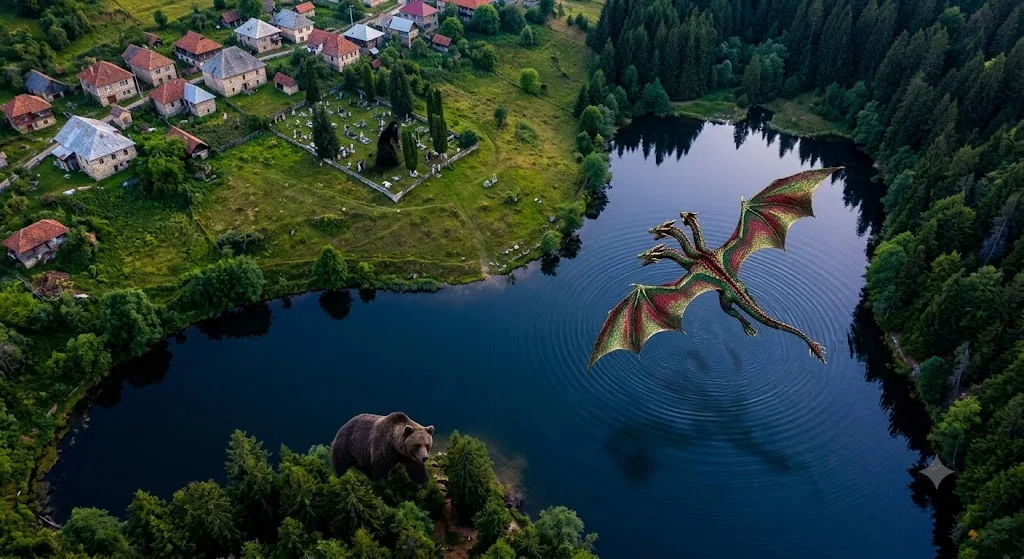
The balaur is generally portrayed as a gigantic serpent or dragon, often winged and possessing several heads. It may guard treasure, demand victims or abduct a young woman before being defeated by a heroic figure. Some traditions also connect the creature with storms, clouds and water. Dragons are sometimes imagined as living beneath lakes until summoned into the sky by magical weather-makers, linking the monster to hail, violent winds and sudden changes in the landscape.[Wikipedia]WikipediaOpen source on wikipedia.org.
The zmeu is harder to classify. English retellings often call it a dragon or ogre, but Romanian discussions commonly emphasise its partly human character. It speaks, uses weapons, owns possessions and desires marriage or status. In some stories it flies or displays reptilian features; in others it behaves more like a superhuman kidnapper than an animal. This flexibility explains why attempts to list it as a biological “cryptid” are misleading. It belongs to folktale structure, where the monster represents violent power and must be overcome by courage, intelligence or magical assistance.[Reddit]reddit.comMy country's (Romania) most well known Cryptids. WhatMy country's (Romania) most well known Cryptids. What
These beings nevertheless matter to cryptid history. Modern monster reports rarely arise in a cultural vacuum. A witness who sees an unclear shape over water, an animal in a storm or lights moving above a mountain already possesses a vocabulary of dragons, devils and unnatural beasts. Older folklore supplies the form into which an ambiguous experience can be placed.
It is also easy for neighbouring traditions to merge online. Romanian, Slavic and wider Balkan dragons share names and characteristics, but they are not interchangeable. Popular cryptid lists often flatten these regional differences, turning distinct story characters into a generic Eastern European “dragon species”.
The undead tradition behind the vampire image
Romania’s most famous monster tradition concerns the strigoi, a category of harmful beings associated with witchcraft, restless death, illness and the draining of life. Historical descriptions do not present one standard creature. A strigoi might be a living person believed to possess dangerous powers or a dead person thought to return and trouble relatives, livestock or the wider community. Stories attribute animal transformation, invisibility and blood-drinking to some forms, although these details vary by place and period.[wikipedia.org]WikipediaOpen source on wikipedia.org.
This is closer to a social explanation of misfortune than to a mystery-animal report. Suspicion could arise after an unexpected death, recurring illness, bad weather, livestock problems or disturbing dreams. The suspected being was not usually glimpsed roaming a forest like an undiscovered ape. It was identified through relationships: a recently dead relative, a feared outsider or a person whose life and death seemed abnormal.
The most striking modern example occurred in the village of Marotinu de Sus after the death of Petre Toma. In 2004, several relatives exhumed his body, removed the heart, burnt it and used the ashes in a ritual intended to protect a woman who believed the dead man was harming her. Police investigated the grave desecration, while participants maintained that the treatment had ended the supposed attacks. Contemporary reporting noted claims of blood at the corpse’s mouth and other signs traditionally interpreted as evidence of vampirism.[pbs.org]pbs.orgOpen source on pbs.org.
None of this provides evidence for a physically returning corpse. Ordinary post-mortem processes can produce bloating, dark fluids around the mouth and apparently fresh-looking tissue, especially when decomposition is poorly understood. The incident is important because it shows that monster belief can remain socially active even when the creature itself is not a plausible animal. Fear, illness, family tension and inherited ritual can reinforce one another until extraordinary action appears reasonable.
The worldwide Dracula industry has altered how outsiders interpret such cases. Romanian traditions that once addressed death, disease and village disorder are routinely translated into the familiar language of capes, fangs and castles. Academic work on Romanian vampire representation stresses that the local strigoi tradition and imported Western vampire fiction influenced one another over time; they should not be treated as identical or frozen in the past.[ResearchGate]researchgate.netResearch Gate The Trope of the Vampire (and Strigoi) in RomanianResearch Gate The Trope of the Vampire (and Strigoi) in Romanian
Romania’s lake and river monsters
Romania does possess local water-monster stories, but they do not form a single national legend supported by a consistent archive of sightings. Most are attached to particular lakes, reservoirs or river stretches and combine genuine hazards with folklore about bottomless depths, drowned settlements, unusually large fish and supernatural punishment.
Tarnița Lake
Tarnița, a reservoir in Cluj County, has accumulated stories about enormous creatures in its depths and unexplained disappearances. A Romanian newspaper exploration of the legend treated the “monster” theme with deliberate humour, including an absurd suggestion that a whale inhabited the lake. The tone is revealing: even local commentators presented the creature less as a serious zoological claim than as an urban legend produced by deep water, accidents and repeated storytelling.[Adevărul]adevarul.roAdevărul Legendele Clujului (IV): Monştrii din lacul TarniţaAdevărul Legendele Clujului (IV): Monştrii din lacul Tarniţa
A large reservoir offers ideal conditions for exaggeration. Distance removes scale, waves conceal most of an object, and floating timber can appear to move independently. Large catfish or other fish seen briefly near the surface may seem far larger than they are, particularly when witnesses already expect something unusual.
The “bottomless” lake in the Șureanu Mountains
The glacial lake known as Iezerul Șureanu is associated with a story that a monster inhabits its depths. The lake is small—reported as roughly 94 metres long and 91 metres wide—and lies within a mountain hollow formed by glacial action. Its supposedly immeasurable depth belongs to legend rather than geography.[Adevărul]adevarul.rolegenda lacului fara fund din muntii sureanu un 1677701legenda lacului fara fund din muntii sureanu un 1677701
This is a common pattern in lake folklore. A dark mountain pool looks deeper than it is, especially when cold water, steep slopes and poor visibility discourage exploration. The monster helps explain why the place feels dangerous while also warning children, travellers or livestock keepers away from the water’s edge.

Cincis Lake
Cincis is an artificial reservoir created after settlements and burial places were displaced. Later accounts describe frightening creatures beneath the water and connect drownings with a curse pronounced by uprooted villagers. Yet residents interviewed about the story have also dismissed many of the supernatural details as inventions, remembering instead the anger of people forced from their homes during the Communist period.[Adevărul]adevarul.rofenomenele stranii semnalate pe lacul cincis 2259536fenomenele stranii semnalate pe lacul cincis 2259536
Here the monster legend performs historical work. The true source of unease is not an unidentified aquatic animal but a flooded human landscape: former houses, graves and community memory submerged by a state project. Imagined creatures give that loss a visible form.
Giant fish of the Prut
Reports from the Prut River are more zoologically plausible. Fishermen tell of exceptionally large fish and repeat stories, some dating from the Communist era, about “monsters” in the water. Such claims need not imply an unknown species. The wels catfish, native to large European river systems, can reach impressive sizes and has a broad head, long body and surface movements capable of startling observers. Romanian reporting on the Prut mixes fishermen’s testimony about giant specimens with older local legend rather than establishing evidence for a separate animal.[Adevărul]adevarul.romonstrii din apele prutului intre legenda si 2257445monstrii din apele prutului intre legenda si 2257445
Of Romania’s water-monster traditions, giant-fish stories require the least supernatural explanation. Fish regularly appear larger through distorted water, incomplete views and the tendency for memorable catches to grow during retelling.
Could real wildlife explain beast reports?
Romania’s ecology makes mistaken or exaggerated animal reports particularly likely. The Carpathians support substantial populations of brown bears, wolves and Eurasian lynx, along with European wildcats, foxes, jackals and other medium-sized carnivores. Habitat studies show that forest cover, roads, pasture and human disturbance influence where these animals occur, so encounters are concentrated around particular valleys, forest edges and settlements rather than being evenly distributed.[nih.gov]pmc.ncbi.nlm.nih.govBrown bears occurred primarily where national roads with high traffic volumes…Read more…
A bear briefly standing upright can look human-like. A wet bear may appear strangely thin or hairless. A lynx viewed at dusk can resemble a much larger cat because its long legs and ear tufts distort familiar proportions. Wolves and jackals seen without a size reference are easily confused, while eye-shine from headlights makes almost any nocturnal animal seem unnatural.
Romania’s bears are especially important to the country’s modern beast imagery because encounters are frequent and sometimes fatal. In 2024, Reuters reported an official estimate of as many as 8,000 bears, although conservation groups cautioned that the exact population remained uncertain. The same report noted hundreds of sightings, repeated entry into towns and 26 human deaths over the preceding two decades. Bears conditioned to obtain food from bins, roadside feeding or settlements may behave in ways that witnesses interpret as abnormal or unusually bold.[Reuters]reuters.comThis decision follows the death of a 19-year-old hiker after a bear attack. Romania, with up to 8,000 brown bears, hosts the largest bear…
This does not mean every unexplained report can be assigned to a known animal. It means Romania has an unusually strong supply of plausible candidates before an unknown species is considered. Dense forest, broken terrain and poor night-time visibility do the rest.
Environmental change also alters what people see. Logging, new roads, expanding settlements, unmanaged rubbish and deliberate feeding can bring animals into unfamiliar settings. Reintroduced European bison may likewise surprise observers in areas where such huge animals disappeared generations ago. Romania’s Southern Carpathians have hosted a major bison restoration programme since 2014, meaning that a massive, dark silhouette in the forest might be rare and unexpected without being mysterious.[Le Monde.fr]lemonde.frThe WWF and other conservationists have fostered community engagement through eco-tourism and sustainable development, including the crea…
Newspapers, tourism and the making of a monster
Romanian monster stories often grow through local journalism rather than formal investigation. A typical article begins with a striking comparison—“Romania’s Loch Ness Monster”—then gathers fishermen’s memories, drownings, oversized fish and supernatural legends around one body of water. The result can be entertaining and culturally valuable, but it is not the same as a dated sighting archive with named witnesses, measurements, photographs and independent follow-up.
The reporting on lakes in Prahova County illustrates this pattern. Stories of giant trout, huge carp, animal-shaped devils and waters that demand human victims are presented together as part of a landscape of dangerous lakes. The effect is cumulative: each ordinary accident or large fish strengthens the atmosphere surrounding every other tale.[Adevărul]adevarul.romonstrul din loch ness are un frate in prahova 1616946monstrul din loch ness are un frate in prahova 1616946
Modern tourism uses the same process on a larger scale. Dracula-themed castles, Halloween festivals and horror events combine Romanian settings with globally familiar monster imagery. At Bucharest’s Lacul Morii, an artificial lake created during the Communist period, stories of disturbed graves and strange lights helped make the site a suitable venue for a Halloween festival that drew more than 80,000 visitors in 2023. The event did not prove the old stories, but it gave them a new public life through costume, spectacle and entertainment.[AP News]apnews.comOpen source on apnews.com.
This commercial afterlife can preserve folklore while also simplifying it. Visitors may leave believing that every Romanian undead tradition concerns Count Dracula, every mountain castle belonged to Vlad the Impaler and every dangerous lake has a resident prehistoric reptile. In reality, the stories are more local, more changeable and often more closely tied to drowning, disease, political displacement or real wildlife.
What evidence would a Romanian cryptid need?
No Romanian mystery animal currently rests on the combination of evidence needed to make an unknown-species claim persuasive. The country’s best-known creatures are documented as folklore, while its lake monsters are supported mainly by anecdotes, newspaper retellings and place legends.
A stronger case would require:
- multiple independent witnesses describing the same animal without consulting one another;
- reports recorded close to the time of the event;
- clear photographs or video with reliable scale and location data;
- tracks, hair, tissue, droppings or environmental DNA that exclude known species;
- repeated observations consistent with a breeding population;
- serious examination of bears, fish, floating objects, escaped animals and deliberate fabrication.
Large lake creatures face an additional ecological problem. One enormous animal cannot persist for generations without parents, offspring and a dependable food supply. A viable population would leave more traces than a few ripples or distant shapes. Small reservoirs and glacial pools are especially poor candidates for concealing large vertebrates.
Folklore should not be judged by that biological standard. A dragon story can be historically important without describing a flesh-and-blood dragon. The Marotinu de Sus incident can reveal enduring beliefs about dangerous dead people without demonstrating that the dead physically returned. Cincis Lake can carry authentic memories of displacement even if its underwater monsters are inventions.
The most credible reading of Romania’s monsters
Romania’s creature landscape is best understood as several overlapping traditions rather than a catalogue of undiscovered animals. The Carpathians supply real predators, darkness and difficult terrain. Rivers and reservoirs supply drownings, giant fish and deceptive views. Older folktales supply dragons, giants and beings that cross the boundary between human and animal. Dracula tourism supplies an international visual language that packages all of them as Gothic Romania.
The strongest historical evidence concerns what people believed, feared and did—not the existence of unknown beasts. The strongest zoological explanations are known wildlife, unusually large fish, poor observation conditions and folklore attached to hazardous places. Yet the absence of a confirmed cryptid does not make the stories empty. They preserve memories of dangerous forests, disrupted villages, family deaths, violent weather and encounters with animals powerful enough to seem monstrous.
Romania’s real distinction is therefore not that it hides one famous beast. It is that monsters appear wherever the country’s human history and wild landscape meet: beneath reservoirs, along mountain paths, in family graves, above storm clouds and behind the carefully managed doors of Dracula’s castle.
Amazon book picks
Further Reading
No matched book cards were available for What Really Haunts Romania's Monster Country?, so this fallback keeps a direct Amazon reading path visible.
Topical books
Cincis Lake folklore guide
Browse books, explainers and reference titles related to this topic.
Search AmazonRelated search
Strigoi folklore guide
Browse books, explainers and reference titles related to this topic.
Search AmazonRelated search
Romanian vampire history
Browse books, explainers and reference titles related to this topic.
Search AmazonEndnotes
1.
Source: Wikipedia
Link:https://en.wikipedia.org/wiki/Balaur
2.
Source: pmc.ncbi.nlm.nih.gov
Link:https://pmc.ncbi.nlm.nih.gov/articles/PMC6430102/
Source snippet
Brown bears occurred primarily where national roads with high traffic volumes...Read more...
3.
Source: reuters.com
Link:https://www.reuters.com/world/europe/romanian-lawmakers-more-than-double-allowed-bear-kills-prevent-attacks-2024-07-15/
Source snippet
This decision follows the death of a 19-year-old hiker after a bear attack. Romania, with up to 8,000 brown bears, hosts the largest bear...
4.
Source: research.library.kutztown.edu
Link:https://research.library.kutztown.edu/dracula-studies/vol7/iss1/5/
Source snippet
Moreover, Stoker was selective in his representation of the various...Read more...
5.
Source: time.com
Title: Bram Stoker Claimed That Parts ofDracula Were Real
Link:https://time.com/5411826/bram-stoker-dracula-history/
Source snippet
Here's What We Know About the Story Behind the NovelBram Stoker claimed that parts of his novel "Dracula" were based on real events and p...
6.
Source: bran-castle.com
Link:https://www.bran-castle.com/en/
Source snippet
Home – Bran CastleExplore Bran Castle in an exclusive and unique way – through a private tour scheduled outside of visiting hours, guided...
7.
Source: people.com
Link:https://people.com/u-s-businessman-purchases-majority-stake-in-dracula-s-castle-11973940
Source snippet
The property itself remains owned by the Habsburg family, but Ad Populum’s involvement includes managing daily operations and expanding i...
8.
Source: reddit.com
Title: My country’s (Romania) most well known Cryptids. What
Link:https://www.reddit.com/r/wendigoon/comments/1bl0y0m/my_countrys_romania_most_well_known_cryptids_what/
9.
Source: Wikipedia
Link:https://en.wikipedia.org/wiki/Strigoi
10.
Source: jstor.org
Link:https://www.jstor.org/stable/24774382
11.
Source: pbs.org
Link:https://www.pbs.org/wnet/secrets/vampire-legend-vampire-slaying-ritual-romania/2343/
12.
Source: researchgate.net
Title: Research Gate The Trope of the Vampire (and Strigoi) in Romanian
Link:https://www.researchgate.net/publication/382976560_The_Trope_of_the_Vampire_and_Strigoi_in_Romanian_Culture_and_Cultural_Products_Imported_to_Romania
13.
Source: luchs-thueringen.de
Link:https://luchs-thueringen.de/en/projekt/partnerland-rumaenien
14.
Source: Wikipedia
Title: List of mammals of Romania
Link:https://en.wikipedia.org/wiki/List_of_mammals_of_Romania
15.
Source: jstor.org
Link:https://www.jstor.org/stable/30035396
16.
Source: jstor.org
Link:https://www.jstor.org/stable/1061939
17.
Source: Wikipedia
Title: Lake monster
Link:https://en.wikipedia.org/wiki/Lake_monster
18.
Source: Wikipedia
Title: Phantom cat
Link:https://en.wikipedia.org/wiki/Phantom_cat
19.
Source: Wikipedia
Title: Category:Romanian legendary creatures
Link:https://en.wikipedia.org/wiki/Category%3ARomanian_legendary_creatures
20.
Source: Wikipedia
Link:https://en.wikipedia.org/wiki/Dracula
21.
Source: Wikipedia
Title: Bran Castle
Link:https://en.wikipedia.org/wiki/Bran_Castle
22.
Source: researchgate.net
Link:https://www.researchgate.net/publication/320079033_ANALYSIS_OF_THE_CONNOTATIVE_AND_DENOTATIVE_MEANINGS_OF_THE_TERM_DRAGON_BALAUR_AS_IT_APPEARS_IN_THE_ROMANIAN_PHYTONYMY
23.
Source: reddit.com
Link:https://www.reddit.com/r/czech/comments/s8sgd0/what_are_your_favorite_czech_mythological_beasts/
24.
Source: reddit.com
Title: Humanoid Creature in Romanian Zoo
Link:https://www.reddit.com/r/Cryptozoology/comments/24vzqk/humanoid_creature_in_romanian_zoo_what_is_this/
25.
Source: reddit.com
Link:https://www.reddit.com/r/interestingasfuck/comments/1ilh0jw/melanocetus_black_sea_monster_emerging_from_the/
26.
Source: reddit.com
Link:https://www.reddit.com/r/AskEurope/comments/iypwgn/what_is_your_local_folklore_beastmonster/
27.
Source: bran-castle.com
Link:https://www.bran-castle.com/en/dracula/
28.
Source: britishlibrary.cn
Link:https://www.britishlibrary.cn/en/works/dracula/
Source snippet
British LibraryBram Stoker's Dracula | The British LibraryBram Stoker's novel Dracula, published in May 1897, is one of the outstanding w...
Published: May 1897
29.
Source: theguardian.com
Link:https://www.theguardian.com/world/2005/jun/19/theobserver
30.
Source: adevarul.ro
Title: Adevărul Legendele Clujului (IV): Monştrii din lacul Tarniţa
Link:https://adevarul.ro/stiri-locale/cluj-napoca/legendele-clujului-iv-monstrii-din-lacul-1201209.html
31.
Source: adevarul.ro
Title: legenda lacului fara fund din muntii sureanu un 1677701
Link:https://adevarul.ro/stiri-locale/alba-iulia/legenda-lacului-fara-fund-din-muntii-sureanu-un-1677701.html
32.
Source: adevarul.ro
Title: fenomenele stranii semnalate pe lacul cincis 2259536
Link:https://adevarul.ro/stiri-locale/hunedoara/fenomenele-stranii-semnalate-pe-lacul-cincis-2259536.html
33.
Source: adevarul.ro
Title: foto blestemul lacului cincis cat adevar se 1568844
Link:https://adevarul.ro/stiri-locale/hunedoara/foto-blestemul-lacului-cincis-cat-adevar-se-1568844.html
34.
Source: adevarul.ro
Title: monstrii din apele prutului intre legenda si 2257445
Link:https://adevarul.ro/stiri-locale/botosani/monstrii-din-apele-prutului-intre-legenda-si-2257445.html
35.
Source: lemonde.fr
Link:https://www.lemonde.fr/en/summer-reads/article/2024/09/02/bison-are-back-in-europe-a-century-after-they-were-driven-to-extinction_6724418_183.html
Source snippet
The WWF and other conservationists have fostered community engagement through eco-tourism and sustainable development, including the crea...
36.
Source: adevarul.ro
Title: monstrul din loch ness are un frate in prahova 1616946
Link:https://adevarul.ro/stiri-locale/ploiesti/monstrul-din-loch-ness-are-un-frate-in-prahova-1616946.html
37.
Source: apnews.com
Link:https://apnews.com/article/cee0bbc6a996de83d696f390e330a390
38.
Source: cryptidz.fandom.com
Link:https://cryptidz.fandom.com/wiki/Zmeu
39.
Source: cryptidz.fandom.com
Title: Lake Monsters
Link:https://cryptidz.fandom.com/wiki/Lake_Monsters
40.
Source: the-demonic-paradise.fandom.com
Link:https://the-demonic-paradise.fandom.com/wiki/Balaur
41.
Source: adevarul.ro
Title: povestile lacurilor blestemate 1282874
Link:https://adevarul.ro/stil-de-viata/povestile-lacurilor-blestemate-1282874.html
42.
Source: adevarul.ro
Title: lacul miresei din campina in topul celor mai 1642004
Link:https://adevarul.ro/stiri-locale/ploiesti/lacul-miresei-din-campina-in-topul-celor-mai-1642004.html
43.
Source: adevarul.ro
Title: Misterele singurului lac vulcanic din România
Link:https://adevarul.ro/stiri-locale/brasov/misterele-singurului-lac-vulcanic-din-romania-1603091.html
44.
Source: adevarul.ro
Title: cele mai ciudate legende ale brasovului de la 1880840
Link:https://adevarul.ro/stiri-locale/brasov/cele-mai-ciudate-legende-ale-brasovului-de-la-1880840.html
45.
Source: draculacastlebran.ro
Title: Bran Castle
Link:https://draculacastlebran.ro/en/
46.
Source: facebook.com
Link:https://www.facebook.com/groups/1331722814218106/posts/1753581715365545/
Additional References
47.
Source: ft.com
Link:https://www.ft.com/content/93d94c5b-d066-424f-90d1-335e0f24ef81
Source snippet
The journey includes wildlife encounters, stays in eco-lodges like Equus Silvania and the historic Zabola Estate, and visits to visitor c...
48.
Source: youtube.com
Title: Dracula From Romanian Folklore (Completely Explained)
Link:https://www.youtube.com/watch?v=iZfgRkv9GWc
Source snippet
The Strigoi: From Romanian Folklore to Vampire Panic...
49.
Source: youtube.com
Title: The Strigoi: From Romanian Folklore to Vampire Panic
Link:https://www.youtube.com/watch?v=_o2JBNlQ_N4
Source snippet
The First Vampires | Romanian Folklore Explained...
50.
Source: academia.edu
Link:https://www.academia.edu/29757783/Dracula_Tourism_in_Romania_From_National_to_Local_Tourism_Strategies
51.
Source: academia.edu
Link:https://www.academia.edu/113967875/The_Trope_of_the_Vampire_and_Strigoi_in_Romanian_Culture_and_Cultural_Products_Imported_to_Romania_18391947
52.
Source: avalonlibrary.net
Link:https://avalonlibrary.net/ebooks/Matt%20Lamy%20-%20100%20Strangest%20Mysteries.pdf
53.
Source: facebook.com
Link:https://www.facebook.com/itamilradar/posts/a-rare-presence-over-the-black-seadetails-in-the-first-comment-/1620376362533949/
54.
Source: instagram.com
Link:https://www.instagram.com/p/DXe561ukkZU/
55.
Source: facebook.com
Link:https://www.facebook.com/ancientoriginsweb/posts/as-shown-in-numerous-existing-romanian-legends-and-testimonies-the-main-measure-/6677028982337989/
56.
Source: thedarkatlas.com
Link:https://thedarkatlas.com/posts/bran-castle-dracula-romania
Amazon book picks
Further Reading
Books and field guides related to What Really Haunts Romania's Monster Country?. Use these as the next step if you want deeper reading beyond the article.
The World of Lore: Monstrous Creatures
Explores monster traditions similar to those found in Romania.
Topic Tree
Follow this branch
Related pages 192
- Antigua Cryptids
- Maldives Monsters
- Malta Monsters
- Qatar Monsters
- Argentina Monsters
- +187 more in sidebar