Within Slovak Monsters
What Monsters Lived in Slovakia's Mountains?
Dragons, wild women and other mountain beings reveal how Slovak landscapes became homes for monsters long before modern cryptid reports.
On this page
- Dragons in caves and heroic tales
- Wild women, witches and forest dwellers
- Carpathian landscapes as monster territory
Page outline Jump by section
Introduction
Long before anyone spoke of lake monsters in the High Tatras, Slovak folklore had already populated its mountains with dragons, wild women, witches and other uncanny beings. These creatures were not usually presented as hidden animals waiting to be discovered. Instead, they were part of a living landscape of caves, forests, cliffs and remote valleys where danger, weather, wilderness and human imagination met.
For readers interested in Slovakia’s monster traditions, these older stories matter because they provided the cultural foundations on which later mystery-creature tales were built. The mountains of the Slovak Carpathians were often portrayed as places where ordinary rules weakened, heroes faced dragons in caves, and strange human-like beings watched travellers from the forest edge. In many cases, the legends reveal as much about how people understood wild country as they do about the monsters themselves.[Academia]academia.eduSlovak folk tradition in ethnolinguistic studies of the Carpathian Balkan areaAcademia(PDF) Slovak folk tradition in ethnolinguistic studies of the…January 1, 2013 — Slovak folk traditions reveal significant cult…
Dragons in Caves and Heroic Tales
Among the most important monsters in Slovak folklore is the dragon. Dragons appear repeatedly in Slovak fairy tales, folk narratives and oral traditions collected during the nineteenth and twentieth centuries. They are typically depicted not as rare cryptids but as powerful adversaries inhabiting caves, mountains, underground chambers or ruined strongholds.[library.upol.cz]library.upol.czin Slovak and English tales, such as giants, dragons,Character Protoypes in Traditional English and Slovak…December 13, 2012 — The aim of this thesis is to compare prototypical characters…
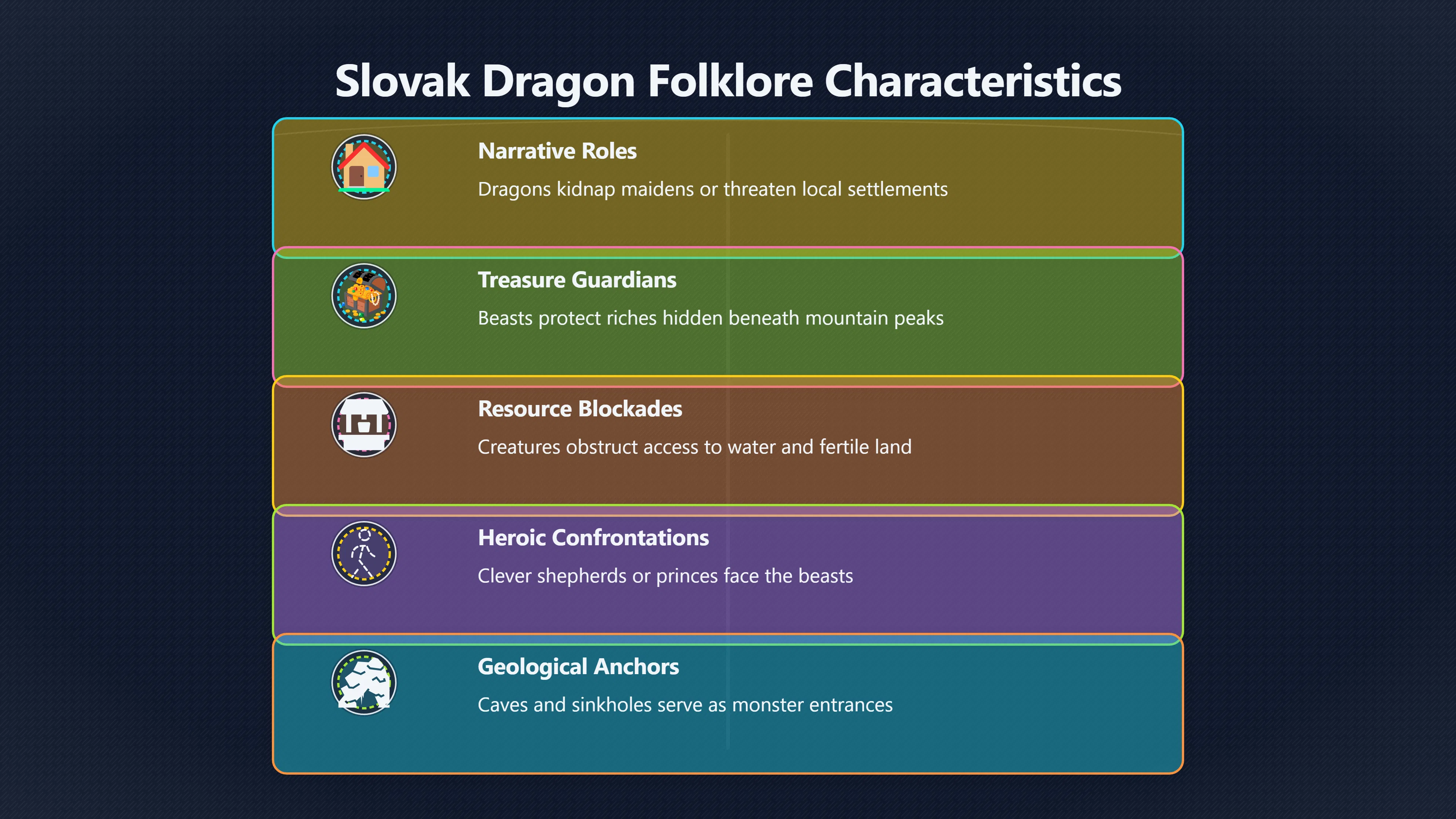
In many stories, the dragon serves a narrative role familiar across Central and Eastern Europe:
- It kidnaps maidens or threatens settlements.
- It guards treasure hidden beneath mountains.
- It blocks access to water, roads or fertile land.
- It is eventually confronted by a clever shepherd, prince or wandering hero.
The dragon’s home is often significant. Rather than dwelling in distant fantasy kingdoms, Slovak tales frequently place these creatures within recognisable mountain landscapes. Caves, sinkholes and rocky ridges become entrances to a dangerous hidden world beneath the Carpathians. This close connection between geology and folklore helped make dragons feel like part of the local environment rather than purely mythical inventions.[isfnr.org]isfnr.orgthrough the biblical interpretation to folk fairytales and legends, and last but…Read more…
The association between dragons and caves may also have been strengthened by discoveries of large animal bones. Fossil remains of cave bears have been found throughout the Slovak Western Carpathians. Historical researchers note that such bones were often interpreted as the remains of dragons or giants before scientific explanations became available. In a landscape filled with deep caverns and mysterious skeletal remains, dragon stories gained an apparent physical anchor.[ResearchGate]researchgate.netspelaeus) are known from Slovak caves at least from the Middle Age. Originally attributed to dragons and giants…Read more…
Why Dragons Persisted
Dragons survived in Slovak storytelling because they embodied several fears at once. They represented natural disasters, unexplored underground spaces, dangerous wilderness and the unpredictable forces of the mountains.
Unlike modern cryptid reports, dragon legends were rarely presented as eyewitness testimony. They belonged to a heroic world of folklore. Yet they still shaped how people imagined remote places. A cave rumbling with underground water or a cliff marked by strange rock formations could easily become linked with stories of an ancient beast sleeping beneath the mountain.[isfnr.org]isfnr.orgthrough the biblical interpretation to folk fairytales and legends, and last but…Read more…
Wild Women, Witches and Forest Dwellers
If dragons were Slovakia’s great mountain monsters, the most distinctive human-like beings were the wild women of the forests and highlands. Across Slovak and wider Carpathian folklore, stories describe mysterious female figures living beyond settled villages in forests, caves and mountain valleys.[BudgetPixel AI]budgetpixel.comBudget Pixel AIUltimate List of Mythical Creatures from Slovak FolkloreThe Leshy — Guardian Spirit of Forests. The Divožienky — Wild Women of the Mountains. The White Lady…Read more…
These beings occupy an unusual position between fairy, witch and monster.
Some traditions portray them as beautiful and alluring. Others depict them as frightening, hairy or ragged figures who avoid human society. They may help shepherds, punish arrogance, steal children, mislead travellers or reveal hidden knowledge. Their behaviour changes from story to story, but they consistently belong to the untamed landscape rather than the human world.[BudgetPixel AI]budgetpixel.comBudget Pixel AIUltimate List of Mythical Creatures from Slovak FolkloreThe Leshy — Guardian Spirit of Forests. The Divožienky — Wild Women of the Mountains. The White Lady…Read more…
In Slovak folklore collections, wild women often appear as embodiments of wilderness itself. They are not necessarily evil. Instead, they function as guardians of boundaries:
- The boundary between village and forest.
- The boundary between civilisation and wilderness.
- The boundary between known paths and dangerous terrain.
This ambiguity distinguishes them from dragons. Dragons are usually enemies. Wild women are unpredictable. A respectful traveller may receive help, while a reckless intruder may encounter punishment.[BudgetPixel AI]budgetpixel.comBudget Pixel AIUltimate List of Mythical Creatures from Slovak FolkloreThe Leshy — Guardian Spirit of Forests. The Divožienky — Wild Women of the Mountains. The White Lady…Read more…
The Overlap with Witches
Mountain folklore frequently blurred the distinction between wild women and witches. In some traditions, supernatural women were believed to command storms, influence livestock, communicate with spirits or move between the human and supernatural worlds. Ethnolinguistic studies of Slavic traditions show that terms associated with witches could also shift toward meanings connected with forest women or wild female beings.[Academia]academia.eduSlovak mythological vocabulary on the Common Slavic…The Moravians had a shift to the meaning of “forest woman”: věščica, věštk…
This overlap reflects a practical reality of mountain life. Isolated valleys and remote settlements often developed strong traditions concerning wise women, healers and suspected witches. Folklore transformed these figures into larger-than-life beings inhabiting the edges of society and nature alike.[Academia]academia.eduSlovak folk tradition in ethnolinguistic studies of the Carpathian Balkan areaAcademia(PDF) Slovak folk tradition in ethnolinguistic studies of the…January 1, 2013 — Slovak folk traditions reveal significant cult…
Why the Carpathians Became Monster Territory
The geography of Slovakia helps explain why mountain beings became so prominent.
The Carpathians dominate much of the country, creating a landscape of forests, caves, ravines, rocky peaks and isolated valleys. Before modern roads and tourism, many of these places were genuinely difficult to access. Communities could spend generations hearing stories about locations they had never personally visited.[Academia]academia.eduSlovak folk tradition in ethnolinguistic studies of the Carpathian Balkan areaAcademia(PDF) Slovak folk tradition in ethnolinguistic studies of the…January 1, 2013 — Slovak folk traditions reveal significant cult…
Folklore repeatedly uses several mountain features as monster habitats:
- Deep caves associated with dragons and hidden treasures.
- Dense forests inhabited by wild women and spirits.
- High ridges where supernatural weather beings appeared.
- Hidden valleys that seemed detached from ordinary life.
- Lakes and springs connected with mysterious guardians.
In this sense, mountain monsters served as explanations for uncertainty. Strange sounds from a cave, sudden storms, disappearing livestock or travellers who failed to return could all be woven into narratives involving supernatural inhabitants of the landscape.[gender-power.amu.edu.pl]gender-power.amu.edu.plFolktales about The Tatras in children's literatureby J Dzuriaková —In my contribution I will discuss the folktales about the Tatras and their reference in children's literature.Read more…
Mountains as a Border Between Worlds
A recurring theme in Carpathian folklore is that mountains form a threshold between the human world and something older and stranger. Scholars studying Carpathian cultural traditions have noted the importance of mountainous regions as reservoirs of long-lived beliefs and oral narratives. Remote terrain allowed stories to persist and evolve over centuries.[Academia]academia.eduSlovak folk tradition in ethnolinguistic studies of the Carpathian Balkan areaAcademia(PDF) Slovak folk tradition in ethnolinguistic studies of the…January 1, 2013 — Slovak folk traditions reveal significant cult…
This helps explain why Slovak mountain legends often feature beings that are neither fully human nor fully monstrous. Wild women, cave guardians and dragon-like creatures occupy an intermediate space. They belong to nature, yet they interact with people. They are feared, but sometimes respected. They are monsters, but also custodians of places that humans enter only temporarily.
From Folklore Monsters to Modern Mystery Creatures
Modern Slovak cryptid stories are relatively rare, but they emerged in a cultural landscape already shaped by centuries of mountain folklore. The popular media comparison between the 2024 Veľké Hincovo pleso sighting and the Loch Ness Monster demonstrates how quickly unusual observations become attached to older traditions of mysterious mountain places.
The difference is important. Dragons and wild women were products of folklore, storytelling and symbolic geography. Modern mystery-animal reports are usually framed as possible real-world sightings. Yet both draw power from the same setting: remote mountains that encourage speculation and wonder.[gender-power.amu.edu.pl]gender-power.amu.edu.plFolktales about The Tatras in children's literatureby J Dzuriaková —In my contribution I will discuss the folktales about the Tatras and their reference in children's literature.Read more…
For that reason, Slovakia’s dragons and wild mountain beings remain central to understanding the country’s monster heritage. They reveal how generations of people transformed caves, forests and high valleys into inhabited landscapes filled with creatures that were frightening, fascinating and inseparable from the mountains themselves.[Academia]academia.eduSlovak folk tradition in ethnolinguistic studies of the Carpathian Balkan areaAcademia(PDF) Slovak folk tradition in ethnolinguistic studies of the…January 1, 2013 — Slovak folk traditions reveal significant cult…
Amazon book picks
Further Reading
Books and field guides related to What Monsters Lived in Slovakia's Mountains?. Use these as the next step if you want deeper reading beyond the article.
Russian Fairy Tales (Illustrated by Ivan Bilibin)
Features many Slavic creature motifs shared across the region.
The Book of Imaginary Beings
Provides broader context for mountain monsters and supernatural beings.
The Dragon Chronicles
Explores dragon traditions similar to those found in Slovak mountain tales.
eBay marketplace picks
Marketplace Samples
Live-tested eBay searches with available results related to this page.
Endnotes
1.
Source: academia.edu
Title: Slovak folk tradition in ethnolinguistic studies of the Carpathian Balkan area
Link:https://www.academia.edu/92751941/Slovak_folk_tradition_in_ethnolinguistic_studies_of_the_Carpathian_Balkan_area
Source snippet
Academia(PDF) Slovak folk tradition in ethnolinguistic studies of the...January 1, 2013 — Slovak folk traditions reveal significant cult...
Published: January 1, 2013
2.
Source: gender-power.amu.edu.pl
Title: Folktales about The Tatras in children’s literatureby J Dzuriaková —
Link:https://gender-power.amu.edu.pl/wp-content/uploads/2020/03/JGP_Vol_12_No_2_D.pdf
Source snippet
In my contribution I will discuss the folktales about the Tatras and their reference in children's literature.Read more...
3.
Source: library.upol.cz
Title: in Slovak and English tales, such as giants, dragons,
Link:https://library.upol.cz/arl-upol/cs/csg/?key=86029111919&repo=upolrepo
Source snippet
Character Protoypes in Traditional English and Slovak...December 13, 2012 — The aim of this thesis is to compare prototypical characters...
Published: December 13, 2012
4.
Source: isfnr.org
Link:https://www.isfnr.org/files/Fairytales-myths-legends_treatment.pdf
Source snippet
through the biblical interpretation to folk fairytales and legends, and last but...Read more...
5.
Source: researchgate.net
Link:https://www.researchgate.net/figure/Dragon-bones-from-a-cave-in-the-Carpathian-Mountains-figured-by-P-J-Hain-in-1672_fig1_327069793
Source snippet
spelaeus) are known from Slovak caves at least from the Middle Age. Originally attributed to dragons and giants...Read more...
6.
Source: researchgate.net
Link:https://www.researchgate.net/publication/401930593_Geosites_in_the_Local_Legends_Geoheritage_and_Geoconservation_in_the_Outer_Carpathians_Poland
Source snippet
Geosites in the Local Legends: Geoheritage and...Therefore, Carpathian geosites of geomythological significance were valued...
7.
Source: budgetpixel.com
Title: Budget Pixel AIUltimate List of Mythical Creatures from Slovak Folklore
Link:https://budgetpixel.com/blog/ultimate-list-of-mythical-creatures-from-slovak-folklore
Source snippet
The Leshy — Guardian Spirit of Forests. The Divožienky — Wild Women of the Mountains. The White Lady...Read more...
8.
Source: academia.edu
Link:https://www.academia.edu/39784546/Slovak_mythological_vocabulary_on_the_Common_Slavic_background_Ethno_linguistic_aspect
Source snippet
Slovak mythological vocabulary on the Common Slavic...The Moravians had a shift to the meaning of “forest woman”: věščica, věštk...
Additional References
9.
Source: youtube.com
Title: Monsters of Slavic Mythology
Link:https://www.youtube.com/watch?v=UrGXs6AX8O4
Source snippet
Zmey Gorynych: The Three-Headed Dragons of Slavic Mythology That Terrified Kingdoms...
10.
Source: facebook.com
Link:https://www.facebook.com/groups/ancient.civilizationsz/posts/1298085828424224/
11.
Source: facebook.com
Link:https://www.facebook.com/groups/382719475884892/posts/1606789246811236/
12.
Source: reddit.com
Link:https://www.reddit.com/r/poland/comments/juqrof/the_role_of_mountains_in_slavic_mythology_and/
13.
Source: instagram.com
Link:https://www.instagram.com/reel/DV9mCdcDUmV/
14.
Source: facebook.com
Link:https://www.facebook.com/groups/281886105961506/posts/964161777733932/
15.
Source: reddit.com
Link:https://www.reddit.com/r/Slovakia/comments/qlfgtt/what_are_some_interesting_myths_folklore_or/
16.
Source: instagram.com
Link:https://www.instagram.com/p/DKCz5rCs5JL/
17.
Source: youtube.com
Link:https://www.youtube.com/watch?v=Z33xYePMLnY
Source snippet
Europe's Forgotten Guardian...
18.
Source: youtube.com
Link:https://www.youtube.com/watch?v=aO1UWGdtk1A
Topic Tree