Cryptids of Israel's Stories
Israel is not a country with a strong modern “cryptid scene” in the Loch Ness or Bigfoot sense. Its creature traditions are older, stranger and more text-heavy: biblical sea monsters, giant land beasts, ambiguous “dragons”, desert predators, vanished crocodiles, rare seals and one very modern mermaid flap on the Mediterranean coast.
Page outline Jump by section
Introduction
The deeper pattern is that Israel’s “mystery beasts” sit at the meeting point of scripture, landscape and real wildlife. Leviathan belongs to ancient sea-monster imagination; the re’em became entangled with unicorn lore; Nahal Taninim preserves the memory of actual crocodiles; and many modern “monster” impressions are better understood through hyenas, wolves, jackals, leopards, monk seals and fish seen briefly in difficult light. That does not make the stories dull. It makes them more interesting: Israel’s monsters often begin where translation, memory and ecology blur.
Why Israel’s creature lore feels different
Many country-level cryptid traditions are built around repeated field sightings: hairy wild men in forests, lake beasts in deep water, phantom cats crossing roads. Israel has some modern reports, but its strongest monster material comes from older cultural layers. The Hebrew Bible and later Jewish literature contain enormous animals and sea beasts that are not presented like modern zoological claims, but they have shaped how later readers imagine “monsters” from the region.
The best example is Leviathan. In biblical and ancient Near Eastern context, Leviathan is not simply a big fish. Bible Odyssey describes it in relation to wider mythic sea-monster traditions, including Ugaritic material in which a similar figure, Lothan, is among the primeval monsters opposed by Baal. The point is less “someone saw a sea serpent off Tel Aviv” and more that the sea itself became a symbol of chaos, danger and divine power.[Bible Odyssey]bibleodyssey.orgOpen source on bibleodyssey.org.
Jewish tradition later paired Leviathan with Behemoth, often treating them as mighty primordial beasts of water and land. The Jewish Encyclopedia summarises Behemoth as the king of dry-land animals and Leviathan as king of the water, both beyond ordinary human control.[Jewish Encyclopedia]jewishencyclopedia.comJewish Encyclopedia LEVIATHAN AND BEHEMOTHJewish Encyclopedia LEVIATHAN AND BEHEMOTH The National Library of Israel’s popular account of Leviathan, Behemoth and Ziz shows how later Jewish lore expanded the trio into a kind of cosmic bestiary: sea, land and air, each with its own giant representative.[הספרנים]blog.nli.org.ilהספרניםThe Three Jewish Monsters Charged With Saving the WorldהספרניםThe Three Jewish Monsters Charged With Saving the World
That matters for a cryptid page because it sets Israel apart. The country’s monster heritage is not mainly a catalogue of recent eyewitness cases. It is a layered tradition in which ancient texts, medieval interpretation, local place names and actual animals all feed one another.
The Kiryat Yam mermaid: Israel’s clearest modern monster flap
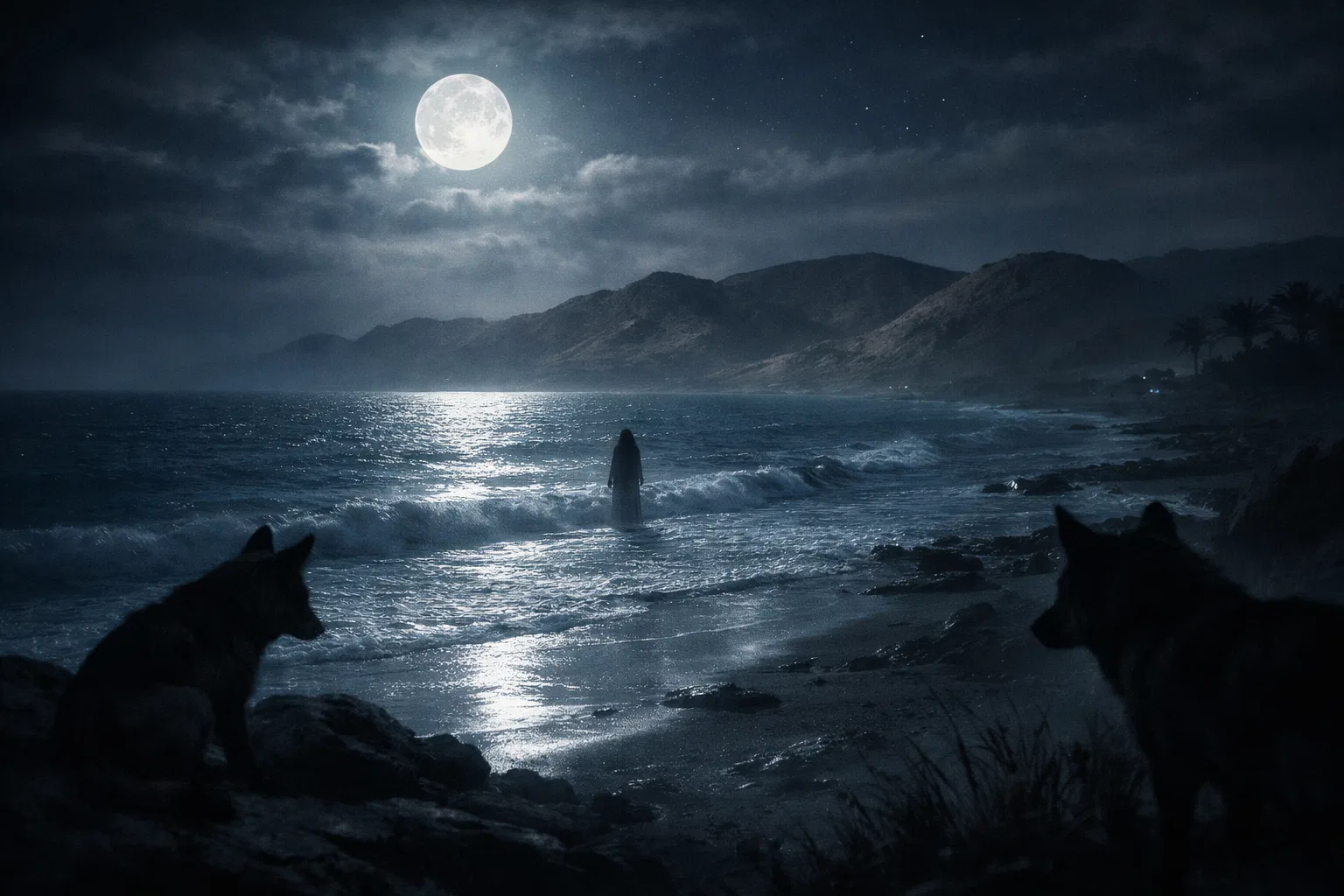
The Kiryat Yam mermaid story is the closest Israel comes to a classic modern cryptid episode. In August 2009, reports circulated that people had seen a mermaid-like creature near the shore of Kiryat Yam, a coastal town north of Haifa. The Jerusalem Post reported that the town council offered a $1 million reward for proof, while ABC News described evening crowds gathering on the beach hoping to spot or photograph the figure.[Jerusalem Post]jpost.comJerusalem Post'Mermaid sightings' reported in Kiryat YamJerusalem Post'Mermaid sightings' reported in Kiryat Yam
The reported creature was described in familiar mermaid terms: partly human, partly aquatic, appearing near sunset and vanishing into the water. Those details are important because they match a global folklore template rather than a clear biological description. The sightings depended on brief observation, distance, glare, wave movement and expectation. No body, high-quality image, biological sample or repeatable observation followed.
The case is useful precisely because it shows the ingredients of a modern cryptid flap:
- A vivid claim: a mermaid is instantly understandable.
- A public viewing site: people could go to the beach and look for themselves.
- A media hook: the reward made the story easy to report.
- Weak evidence: the excitement rested on testimony rather than verifiable proof.
A possible natural comparison is the Mediterranean monk seal, a rare marine mammal that has historically occurred along the Israeli coast. Delphis, an Israeli marine conservation organisation, notes that monk seal reports were once documented from places including Rosh HaNikra and Tantura, then largely ceased for decades before sporadic modern sightings returned.[Delphis]delphis.ngoMediterranean monk seal ResearchMediterranean monk seal Research Since 2010, more than 100 monk seal sightings have reportedly been recorded along Israel’s coastline, though the seals do not stay permanently.[Monk Seal Alliance]monksealalliance.orgpreparing the ground for the monk seal s return to the israeli coast 00565preparing the ground for the monk seal s return to the israeli coast 00565
That does not prove the Kiryat Yam witnesses saw a seal. It does show why the Israeli coast can produce odd marine encounters. A rare animal glimpsed briefly in low light can become, in memory and retelling, something more human-shaped and legendary.

Leviathan: the sea monster that became bigger than any sighting
Leviathan is the most famous monster associated with Israel’s textual world. It appears in the Hebrew Bible as a fearsome being of the deep, and later Jewish, Christian and literary traditions turned it into one of the great sea monsters of world culture. Modern cryptid writing sometimes treats Leviathan as if it were a candidate animal, but the stronger reading is mythic and symbolic.
Scholars differ over how literally to understand Leviathan. Some discussions ask whether it began from real animals such as crocodiles, whales or large marine creatures. Others stress its role as a chaos monster, part of a wider ancient Near Eastern pattern in which order is imagined through victory over the sea. A 2017 study framed the question directly as whether the biblical Leviathan is a real animal or a mythic marine monster, while Bible Odyssey places it in a broader mythological setting rather than a simple zoological category.[Czasopisma KUL]czasopisma.kul.plOpen source on kul.pl.
For ordinary readers, the key distinction is this: Leviathan is not an Israeli version of Nessie. There is no modern sighting trail around a specific Israeli lake or bay that establishes a continuing Leviathan claim. Its power comes from language, ritual imagination and the old fear of the sea. It is a cultural monster rather than a field cryptid.
That still makes it relevant to Israel’s mystery-beast tradition. The word “leviathan” later became a general term for something enormous, especially at sea. In that sense, ancient Israelite and Jewish monster language helped supply the vocabulary through which later cultures describe giant marine unknowns.
Behemoth, Ziz and the giant-animal imagination
Behemoth and Ziz are less familiar than Leviathan but just as revealing. Behemoth is associated with immense land strength; Ziz, in later Jewish lore, is a gigantic bird. Together with Leviathan, they form a three-part monster map: water, earth and sky.
The Jewish Encyclopedia’s account of Leviathan and Behemoth emphasises their primeval, unconquerable quality. They are not simply oversized animals; they are imagined as kings of their domains.[Jewish Encyclopedia]jewishencyclopedia.comJewish Encyclopedia LEVIATHAN AND BEHEMOTHJewish Encyclopedia LEVIATHAN AND BEHEMOTH The National Library of Israel presents the trio as Jewish monsters whose size and power had to be subordinated to God, preventing them from becoming rival divine forces.[הספרנים]blog.nli.org.ilהספרניםThe Three Jewish Monsters Charged With Saving the WorldהספרניםThe Three Jewish Monsters Charged With Saving the World
This is where Israel-linked folklore overlaps with cryptozoology but does not quite become it. A cryptid claim usually asks, “Could this creature exist?” The Behemoth-Leviathan-Ziz tradition asks a different question: “How do humans picture a world where some forces are too large to master?” The answer is monster imagery. Ancient readers did not need camera traps or lake sonar; they needed a way to speak about untameable creation.
Still, these figures influenced later monster thinking. Giant birds, huge land beasts and sea serpents recur across world folklore. Israel’s textual tradition gives one of the most influential versions of that pattern.
The re’em and the Israeli “unicorn” problem
One of the most interesting Israeli mystery-beast threads is not a sighting at all, but a translation puzzle. The re’em, an animal mentioned in the Hebrew Bible, was translated in some older traditions as a unicorn. Later readers then inherited a strange question: did the Bible describe a one-horned mythical beast?
The National Library of Israel explains that the re’em is commonly associated in modern Hebrew with the Arabian oryx, a white antelope with two long, straight horns that can look like one horn when seen from the side.[הספרנים]blog.nli.org.ilהספרניםUnicorns in the Holy Land?הספרניםUnicorns in the Holy Land? Biblical Archaeology Review similarly identifies re’em with the Arabian oryx and notes that the King James Version rendered it as “unicorn”, creating a long afterlife for the idea of a biblical unicorn.[The BAS Library]library.biblicalarchaeology.orgOpen source on biblicalarchaeology.org.
Other interpretations have connected the re’em with the aurochs, an extinct wild ox, because the biblical passages stress strength, wildness and untameability. Either way, the “unicorn” is best understood as a translation and interpretation story, not evidence for a hidden one-horned horse in Israel.
This is a good example of how cryptid traditions can grow from language. A word for a powerful wild animal passes through Greek, Latin and English translation traditions. A real or remembered animal becomes a legendary one. Later readers then ask whether the legend points back to something zoological. In Israel’s case, the answer is probably not a unicorn, but the trail leads to real desert fauna and extinct or reintroduced animals.
Crocodile Stream: when the monster really was real
Nahal Taninim, often translated as Crocodile Stream, is one of Israel’s best reminders that some “monster” place names begin with actual animals. The Israel Nature and Parks Authority says the stream was named for crocodiles because the reptiles lived in the nearby Kebara swamps until the beginning of the 20th century.[Israel Nature and Parks Authority]en.parks.org.ilOpen source on parks.org.il.
This changes the tone of the story. A crocodile in modern Israel sounds almost cryptid-like because wild crocodiles are no longer part of the country’s ordinary landscape. Historically, though, Nile crocodiles did occur in the region. The US Geological Survey’s Nile crocodile profile lists Israel within the species’ historical range, alongside other now-extirpated areas.[Nonindigenous Aquatic Species]nas.er.usgs.govNonindigenous Aquatic Species Nile Crocodile (Crocodylus niloticusNonindigenous Aquatic Species Nile Crocodile (Crocodylus niloticus
Nahal Taninim therefore offers a useful distinction between three kinds of “monster”:
- Folklore monster: Leviathan, a mythic sea beast.
- Translation monster: the re’em as “unicorn”.
- Former real animal: crocodiles in coastal wetlands, now remembered through a place name.
For cryptid readers, Crocodile Stream is especially valuable because it warns against assuming that every strange animal memory is fantasy. Sometimes the animal was real, but the habitat changed, the population vanished and later visitors find only a name that sounds legendary.

Desert predators and phantom-beast impressions
Israel’s deserts and open landscapes still hold animals capable of generating startling encounters. Striped hyenas, wolves, jackals, foxes and wild cats are real, mostly nocturnal, and often seen badly: crossing roads, feeding at carcasses, appearing in headlights or caught on trail cameras. These are exactly the conditions that produce “mystery animal” impressions elsewhere.
The striped hyena is especially important. A 2023 study based on Israel Nature and Parks Authority records found that the species underwent extreme population fluctuations in Israel, affected by poisoning campaigns during the British Mandate period and later in the 20th century.[PMC]pmc.ncbi.nlm.nih.govOpen source on nih.gov. Ynet described the striped hyena as Israel’s largest predator and highlighted the work of a Nature and Parks Authority inspector who has studied the animal for years.[ynetglobal]ynetnews.comynetglobal The mysterious life of Israel's endangered hyenasynetglobal The mysterious life of Israel's endangered hyenas
Hyenas look unfamiliar to many people: sloping back, heavy head, striped body, solitary night movement. A brief sighting can easily feel more monstrous than it is. Wolves add another layer. Reports from the Negev have even described unusual proximity between striped hyenas and wolves, with researchers suggesting that harsh desert conditions may encourage unexpected associations between species.[The Times of Israel]timesofisrael.comThe Times of Israel In Israel, hyenas and wolves team up to surviveThe Times of Israel In Israel, hyenas and wolves team up to survive
Leopards occupy a different place in the imagination. They are not cryptids in Israel’s past: they were real predators. But as they disappeared from the wild, they became almost ghost-like. A 2004 Haaretz report described research suggesting only eight leopards remained in Israel at that time, based on genetic analysis of droppings collected with help from Israel Nature and Parks Authority inspectors.[Haaretz]haaretz.comOpen source on haaretz.com. More recent scientific work states that the Arabian leopard became extinct in Israel in the early 2000s, after the Anatolian leopard had disappeared earlier.[Brill]brill.comarticle p171 3.xmlarticle p171 3.xml
This creates a “phantom cat” effect without needing to invent black panthers. In a landscape where leopards once lived, an unclear glimpse of a large cat or dog-like predator can carry the emotional weight of a vanished animal.
The Sea of Galilee: famous water, weak lake-monster evidence
The Sea of Galilee, or Lake Kinneret, seems at first like an obvious place for lake-monster stories. It is famous, old, culturally loaded and large enough to invite imagination. Yet there is little evidence for a sustained local lake-monster tradition comparable to Loch Ness, Lake Van or other named lake beasts.
What the lake does have is a real fish ecology and long fishing history. The Israel Nature and Parks Authority notes the ecological and commercial importance of Galilee tilapia, including the fish widely known as St Peter’s fish.[Israel Nature and Parks Authority]en.parks.org.ilIsrael Nature and Parks Authority Protecting the Galilee TilapiaIsrael Nature and Parks Authority Protecting the Galilee Tilapia Research on Israel’s freshwater fish fauna highlights the Sea of Galilee as a significant freshwater system for species identification and genetic study.[en-nnhc.huji.ac.il]en-nnhc.huji.ac.ilOpen source on huji.ac.il. A 2023 study revisiting freshwater fish species in Israel used DNA barcoding and stressed the importance of careful identification, including in the Sea of Galilee region.[PMC]pmc.ncbi.nlm.nih.govOpen source on nih.gov.
For mystery-animal purposes, the likely explanations for odd lake impressions are ordinary: large fish surfacing, birds, floating debris, wave shadows, low-angle light and expectation. The lake’s religious and cultural fame may make strange impressions feel meaningful, but there is no strong public evidence for an unknown large aquatic animal there.
This is an important negative finding. A good country cryptid page should not force a lake monster into every famous lake. In Israel, the Sea of Galilee is better treated as a place where folklore, scripture and ecology overlap, not as a proven monster-sighting hotspot.
The Mediterranean coast: seals, dolphins and mermaid afterlives
The Israeli Mediterranean coast is more productive for modern mystery-beast interpretation than the Sea of Galilee. It has beaches, evening crowds, marine mammals, rare visitors and a long tradition of sea imagery. That combination helps explain why the Kiryat Yam mermaid story travelled so well.
Mediterranean monk seals are central to this context. Delphis says seal reports along the Israeli coast were more common before the establishment of the State of Israel, with documented reports from the 1920s until the 1970s, followed by a long gap.[Delphis]delphis.ngoMediterranean monk seal ResearchMediterranean monk seal Research Modern sightings have resumed sporadically; in 2023, Israeli media reported the arrival of a monk seal known as Yulia on a central Israeli beach, watched by volunteers and the Nature and Parks Authority to prevent disturbance.[ynetglobal]ynetnews.comynetglobal A welcome guest: Why did this rare seal make a stopoverynetglobal A welcome guest: Why did this rare seal make a stopover
A monk seal does not look like a mermaid to a careful observer in daylight. But folklore rarely begins with careful observation in perfect conditions. A head and shoulders shape in the surf, an animal lifting itself near rocks, or a distant body seen at sunset can become ambiguous. Add local excitement and media attention, and ambiguity becomes a legend.
The coast also provides a natural route for imported stories. Mermaid lore is global, not uniquely Israeli. The Kiryat Yam case became Israeli because it attached itself to a specific town, beach and reward. That is often how modern cryptids localise: a travelling creature type finds a memorable address.
Hoax, misidentification or folklore?
Israel’s mystery-beast material is best read through four categories rather than one.
Folklore and religious imagination covers Leviathan, Behemoth and Ziz. These are not field reports in the modern sense. They are mythic beings used to express scale, danger, divine order and the limits of human control.
Translation and textual drift covers the re’em and “unicorn” tradition. The creature became mysterious partly because later languages turned a powerful wild animal into something more fabulous.
Former real animals include crocodiles at Nahal Taninim and leopards in desert regions. These cases show how real fauna can become legendary after disappearance. A creature does not need to be imaginary to become a monster in memory.
Modern media flaps include the Kiryat Yam mermaid. These depend on eyewitness claims, publicity and the absence of decisive evidence. They are often culturally revealing even when biologically weak.
The sceptical explanations are not dismissive; they are clarifying. Hyenas, wolves, jackals, seals, large fish, crocodile history and vanished leopards give Israel a real animal backdrop. The legends grow stronger, not weaker, when placed against that backdrop.
What readers should remember about Israel’s cryptids
Israel’s cryptid map is less about one hidden creature and more about a chain of transformations. Ancient sea fear becomes Leviathan. A powerful wild animal becomes a unicorn through translation. A crocodile population disappears but remains in a stream’s name. A rare seal or unclear coastal sighting becomes a mermaid story. A vanished leopard turns the desert into a place where big-cat memory lingers.
The strongest modern case is the Kiryat Yam mermaid, but it remains a media-driven claim without convincing proof. The strongest historical “monster” case is Nahal Taninim, where the frightening animal was real: crocodiles lived in nearby swamps until the early 20th century. The strongest cultural monsters are Leviathan, Behemoth and Ziz, whose importance lies not in zoological evidence but in how powerfully they shaped Jewish and wider monster imagination.
Israel’s strange-creature tradition is therefore best approached with curiosity and restraint. There is little reason to claim unknown animals are hiding in plain sight. There is every reason to see the country as a compact, unusually rich meeting place of ancient monster language, desert ecology, coastal ambiguity and stories that keep changing shape.
Amazon book picks
Further Reading
Books and field guides related to What Monsters Haunt Israel's Stories?. Use these as the next step if you want deeper reading beyond the article.
Tree of Souls
Strong source for Jewish monster lore including Leviathan and related beings.
The Book of Legendary Lands
Explores legendary geography and creatures connected to ancient traditions.
The Mythical Creatures Bible
Provides background on legendary beasts and monster archetypes.
A Field Guide to Demons, Fairies, Fallen Angels, and Other Su...
Places Israeli and Jewish supernatural beings within a wider creature tradition.
eBay marketplace picks
Marketplace Samples
Live-tested eBay searches with available results related to this page.
Endnotes
1.
Source: delphis.ngo
Title: Mediterranean monk seal Research
Link:https://www.delphis.ngo/en/seabeyond/seal
2.
Source: czasopisma.kul.pl
Link:https://czasopisma.kul.pl/index.php/vv/article/view/1836
3.
Source: pmc.ncbi.nlm.nih.gov
Link:https://pmc.ncbi.nlm.nih.gov/articles/PMC9998626/
4.
Source: haaretz.com
Link:https://www.haaretz.com/2004-01-20/ty-article/new-study-reveals-eight-leopards-remain-in-israel/0000017f-db2f-d3a5-af7f-fbaf69840000
5.
Source: brill.com
Title: article p171 3.xml
Link:https://brill.com/view/journals/ijee/71/4/article-p171_3.xml?language=en&srsltid=AfmBOopp8B42fCnak_TrTzWkS6b-TMZajfiZnT0zcMYCC3fkHjyPrjqn
6.
Source: en-nnhc.huji.ac.il
Link:https://en-nnhc.huji.ac.il/freshwater-fish-fauna-israel
7.
Source: pmc.ncbi.nlm.nih.gov
Link:https://pmc.ncbi.nlm.nih.gov/articles/PMC10731390/
8.
Source: dl0.creation.com
Link:https://dl0.creation.com/articles/p091/c09176/j27_3_56-57.pdf
9.
Source: haaretz.com
Link:https://www.haaretz.com/israel-news/2023-08-06/ty-article-static/.premium/israels-negev-desert-is-full-of-animals-but-youll-never-see-them/00000189-2a02-d145-a1e9-3b76d9710000
10.
Source: haaretz.com
Link:https://www.haaretz.com/2013-10-08/ty-article/.premium/hyenas-secret-lives-caught-on-tape/0000017f-df33-df9c-a17f-ff3b5ee50000
11.
Source: israel.travel
Title: Sea of Galilee/Kinnereth
Link:https://israel.travel/sea-of-galilee/
12.
Source: brill.com
Title: article p171 3.xml
Link:https://brill.com/view/journals/ijee/71/4/article-p171_3.xml?language=en&srsltid=AfmBOoraLtAPl6iTh6jR4nrgI45TdFMMbIkEakf-iztVrQXqEWO3yLoG
13.
Source: jpost.com
Title: Jerusalem Post’Mermaid sightings’ reported in Kiryat Yam
Link:https://www.jpost.com/israel/mermaid-sightings-reported-in-kiryat-yam/article-151518
14.
Source: abcnews.com
Link:https://abcnews.com/Travel/story?id=8310324&page=1
15.
Source: bibleodyssey.org
Link:https://www.bibleodyssey.org/dictionary/leviathan/
16.
Source: jewishencyclopedia.com
Title: Jewish Encyclopedia LEVIATHAN AND BEHEMOTH
Link:https://www.jewishencyclopedia.com/articles/9841-leviathan-and-behemoth
17.
Source: blog.nli.org.il
Title: הספרניםThe Three Jewish Monsters Charged With Saving the World
Link:https://blog.nli.org.il/en/three_jewish_monsters/
18.
Source: monksealalliance.org
Title: preparing the ground for the monk seal s return to the israeli coast 00565
Link:https://www.monksealalliance.org/en/projets/preparing-the-ground-for-the-monk-seal-s-return-to-the-israeli-coast-00565
19.
Source: blog.nli.org.il
Title: הספרניםUnicorns in the Holy Land?
Link:https://blog.nli.org.il/en/hoi_unicorns/
20.
Source: library.biblicalarchaeology.org
Link:https://library.biblicalarchaeology.org/article/the-biblical-oryx-a-new-name-for-an-ancient-animal/
21.
Source: en.parks.org.il
Link:https://en.parks.org.il/reserve-park/taninim-stream-nature-reserve/
22.
Source: nas.er.usgs.gov
Title: Nonindigenous Aquatic Species Nile Crocodile (Crocodylus niloticus)
Link:https://nas.er.usgs.gov/queries/FactSheet.aspx?speciesID=2273
23.
Source: ynetnews.com
Title: ynetglobal The mysterious life of Israel’s endangered hyenas
Link:https://www.ynetnews.com/environment/article/h1yd73myc
24.
Source: timesofisrael.com
Title: The Times of Israel In Israel, hyenas and wolves team up to survive
Link:https://www.timesofisrael.com/in-israel-hyenas-and-wolves-team-up-to-survive/
25.
Source: en.parks.org.il
Title: Israel Nature and Parks Authority Protecting the Galilee Tilapia
Link:https://en.parks.org.il/new/protecting-the-galilee-tilapia/
26.
Source: ynetnews.com
Title: ynetglobal A welcome guest: Why did this rare seal make a stopover
Link:https://www.ynetnews.com/environment/article/s11gwp04n
27.
Source: Wikipedia
Link:https://en.wikipedia.org/wiki/Ziz
28.
Source: Wikipedia
Link:https://en.wikipedia.org/wiki/Leviathan
29.
Source: Wikipedia
Title: Sea of Galilee
Link:https://en.wikipedia.org/wiki/Sea_of_Galilee
30.
Source: Wikipedia
Title: Nahal Taninim
Link:https://en.wikipedia.org/wiki/Nahal_Taninim
31.
Source: Wikipedia
Title: Nile crocodile
Link:https://en.wikipedia.org/wiki/Nile_crocodile
32.
Source: Wikipedia
Title: National Library of Israel
Link:https://en.wikipedia.org/wiki/National_Library_of_Israel
33.
Source: jpost.com
Title: article 758483
Link:https://www.jpost.com/environment-and-climate-change/article-758483
34.
Source: jpost.com
Title: article 847127
Link:https://www.jpost.com/israel-news/article-847127
35.
Source: jpost.com
Title: the mythical unicorn may have its origins in israel researchers find 611567
Link:https://www.jpost.com/israel-news/the-mythical-unicorn-may-have-its-origins-in-israel-researchers-find-611567
36.
Source: jpost.com
Link:https://www.jpost.com/business-and-innovation/health-and-science/marine-creatures-magic-trick-433089
37.
Source: jpost.com
Title: parshas terumah ecological consciousness and animal welfare 543198
Link:https://www.jpost.com/blogs/france-on-the-cusp-of-pograms/parshas-terumah-ecological-consciousness-and-animal-welfare-543198
38.
Source: jpost.com
Title: article 746854
Link:https://www.jpost.com/omg/article-746854
39.
Source: jpost.com
Title: Wildlife Articles and latest stories | The Jerusalem Post
Link:https://www.jpost.com/tags/wildlife?page=10
40.
Source: jpost.com
Title: article 831726
Link:https://www.jpost.com/science/science-around-the-world/article-831726
41.
Source: jpost.com
Title: article 749723
Link:https://www.jpost.com/omg/article-749723
42.
Source: jpost.com
Title: israels nature trails crocodile creeks and roman dams 668552
Link:https://www.jpost.com/israel-news/israels-nature-trails-crocodile-creeks-and-roman-dams-668552
43.
Source: timesofisrael.com
Title: idf spies rare predator in west bank
Link:https://www.timesofisrael.com/idf-spies-rare-predator-in-west-bank/
44.
Source: timesofisrael.com
Title: public asked to keep eye out for a seal after reliable sighting off haifa coast
Link:https://www.timesofisrael.com/liveblog_entry/public-asked-to-keep-eye-out-for-a-seal-after-reliable-sighting-off-haifa-coast/
45.
Source: timesofisrael.com
Title: largest hunt for loch ness monster in decades sets off
Link:https://www.timesofisrael.com/largest-hunt-for-loch-ness-monster-in-decades-sets-off/
46.
Source: blogs.timesofisrael.com
Title: rotten hogs
Link:https://blogs.timesofisrael.com/rotten-hogs/
47.
Source: blogs.timesofisrael.com
Title: fantastic jewish beasts and where to find them
Link:https://blogs.timesofisrael.com/fantastic-jewish-beasts-and-where-to-find-them/
48.
Source: timesofisrael.com
Title: the glorious nature reserve that rainfall forced israel to create
Link:https://www.timesofisrael.com/the-glorious-nature-reserve-that-rainfall-forced-israel-to-create/
49.
Source: cryptidz.fandom.com
Link:https://cryptidz.fandom.com/wiki/Leviathan
50.
Source: unisapressjournals.co.za
Link:https://unisapressjournals.co.za/index.php/JSEM/article/view/9108
51.
Source: gov.il
Link:https://www.gov.il/en/departments/ministry_of_environmental_protection
52.
Source: gov.il
Title: fishing enforcement
Link:https://www.gov.il/en/pages/fishing_enforcement
53.
Source: gov.il
Title: support fish
Link:https://www.gov.il/en/pages/support_fish
54.
Source: abcnews.com
Link:https://abcnews.com/Technology/legend-chupacabra-mystery-solved/story?id=13187448
55.
Source: ynetnews.com
Link:https://www.ynetnews.com/environment/article/r1oddqn4n
56.
Source: ynetnews.com
Link:https://www.ynetnews.com/environment/article/ry0s4oh4r
57.
Source: biblicalcyclopedia.com
Link:https://www.biblicalcyclopedia.com/U/unicorn.html
58.
Source: nli.org.il
Link:https://www.nli.org.il/en/a-topic/987007605990305171
59.
Source: itsgila.com
Link:https://www.itsgila.com/leopards.htm
60.
Source: en.parks.org.il
Link:https://en.parks.org.il/
61.
Source: en.parks.org.il
Title: parks.org.ilnew Archive
Link:https://en.parks.org.il/new/
Additional References
62.
Source: youtube.com
Title: Leviathan vs Behemoth: The Creatures That Terrified Ancient Israel
Link:https://www.youtube.com/watch?v=SnLQ2DOQL5s
Source snippet
Monsters and Mythical Creatures from Islamic, Jewish, and Christian Folklore...
63.
Source: fws.gov
Link:https://www.fws.gov/sites/default/files/documents/Ecological-Risk-Screening-Summary-Nile-Crocodile.pdf
64.
Source: youtube.com
Title: Leviathan: The Biblical Sea Monster That God Himself Feared
Link:https://www.youtube.com/watch?v=EtRuMzSWrik
Source snippet
Leviathan and the Bible's 3rd Creation Story...
65.
Source: youtube.com
Title: Leviathan and the Bible’s 3rd Creation Story
Link:https://www.youtube.com/watch?v=dxEAxe-_6dc
Source snippet
Leviathan vs Behemoth: The Creatures That Terrified Ancient Israel...
66.
Source: aol.com
Link:https://www.aol.com/spooky-mystery-animal-sighting-baffles-090000419.html
67.
Source: academia.edu
Link:https://www.academia.edu/143502979/Leviathan_in_Judaism_EBR_article_
68.
Source: researchgate.net
Link:https://www.researchgate.net/publication/308343544_Symbolism_and_Fantasy_of_the_Biblical_Leviathan_From_Monster_of_the_Abyss_to_Redeemer_of_the_Prophets
69.
Source: researchgate.net
Link:https://www.researchgate.net/publication/369117505_Population_trends_of_striped_hyena_Hyaena_hyaena_in_Israel_for_the_past_five_decades
70.
Source: researchgate.net
Link:https://www.researchgate.net/publication/397561432_The_curious_history_of_the_translation_of_the_Hebrew_word_niym_ta_tannim_dragons_jackals_or_crocodiles
71.
Source: herzogdemeuron.com
Link:https://www.herzogdemeuron.com/projects/426-national-library-of-israel/
Topic Tree
Follow this branch
Related pages 192
- Antigua Cryptids
- Maldives Monsters
- Malta Monsters
- Qatar Monsters
- Argentina Monsters
- +187 more in sidebar