Where Mali's River Monsters Meet Folklore
Mali does not have a modern, well-documented “monster flap” in the way some countries have lake-monster photographs, phantom-cat panics, or repeated press reports of unknown animals.
Page outline Jump by section
Why Mali’s “cryptids” are mostly river creatures
The most memorable Malian monster stories cluster around water because water is where danger, food and imagination meet. Hippos are large enough to feel prehistoric, crocodiles can vanish and reappear without warning, and the Niger and Senegal river systems have long supported fishing, farming, ferry travel and settlement. In that setting, an animal does not need to be biologically unknown to become cryptid-like. It only needs to be unusually coloured, unusually bold, unusually destructive, or woven into a story that treats it as more than an animal.
The hippopotamus is especially important. In Bambara, “mali” is listed as a translation for hippopotamus, which helps explain why hippo imagery and the country’s name often become intertwined in popular retellings, even though the etymology of the modern state name is more complicated than a simple one-word origin story.[Glosbe]glosbe.comhippopotamus in Bambarahippopotamus in Bambara - English-Bambara Dictionary | Glosbe… Real hippos also make the legends feel grounded. Conservation sources identify the common hippopotamus as a vulnerable species, with habitat loss, hunting pressure, pollution and water degradation among the threats facing hippos across their range; UNEP-GRID’s Mali biodiversity fiche also lists the hippopotamus among Mali’s vulnerable mammals.[iucn.org]iucn.orgSSC Hippo Specialist Group | IUCNIUCN SSC Hippo Specialist Group | IUCN…
That matters for interpretation. Mali’s hippo legends are not just random monster tales attached to a convenient animal. They come from a landscape where hippos, farms, river travel and human risk could genuinely overlap. A hippo that raids crops, blocks passage, survives spears, or becomes the friend of a child is a mythic exaggeration, but it is built from recognisable river life.
Mali Sadio: the beloved hippo of Bafoulabé
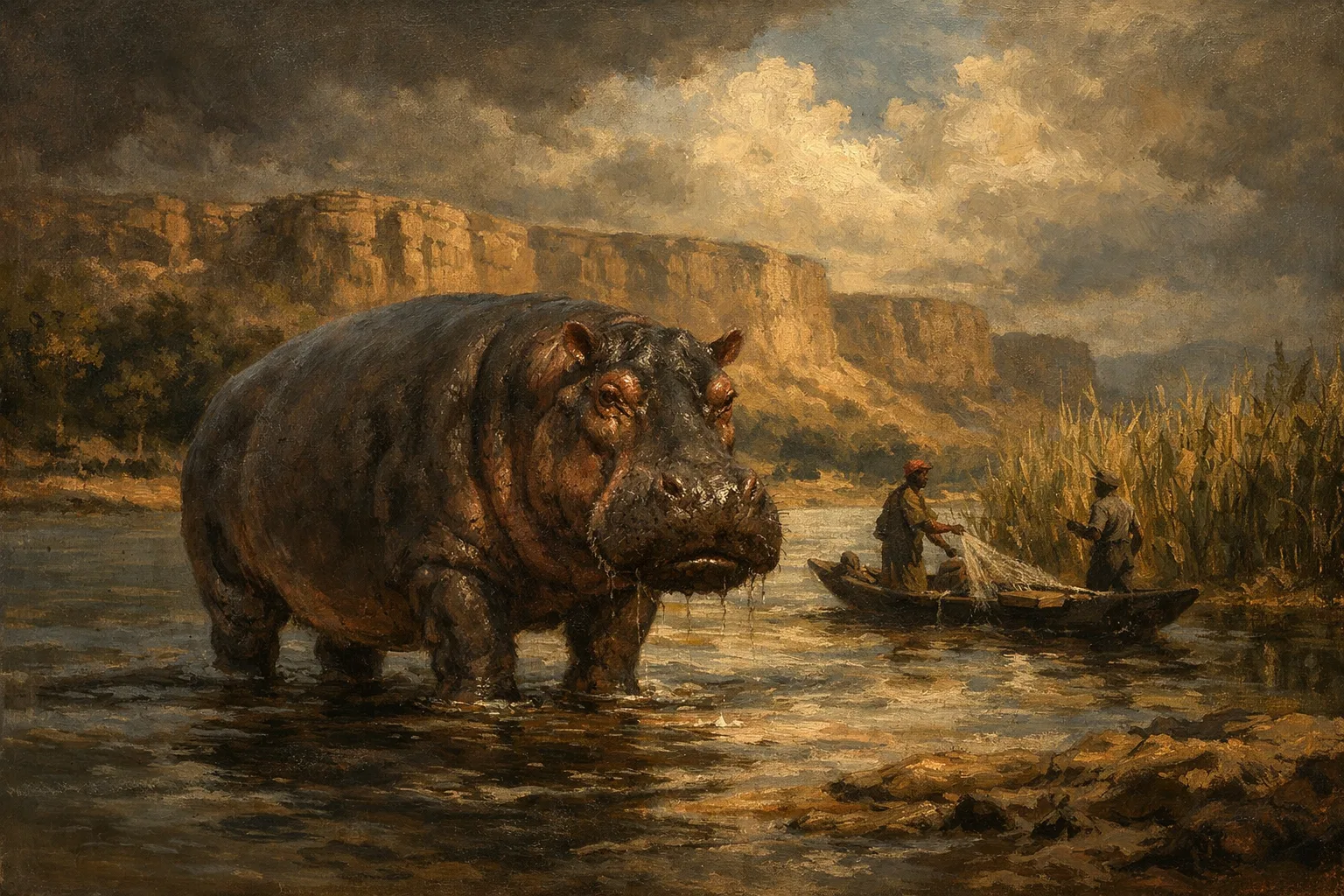
The best-known Malian mystery-animal legend is Mali Sadio, usually placed at Bafoulabé in western Mali. Bafoulabé sits at a highly story-friendly location: the confluence of the Bafing and Bakoy rivers, which form the Senegal River. The University of Florida’s African Networks Lab atlas notes that the town’s central traffic circle is adorned with a sculpture of Mali Sadio, described there as a hippopotamus hero.[African Networks Lab]anl.geog.ufl.eduAfrican Networks Lab AN ATLAS OF MALIAfrican Networks LabAN ATLAS OF MALI - West - African Networks Lab…
In common versions, Mali Sadio is not a savage monster but an extraordinary hippo linked to a girl named Sadio and remembered for a close relationship with local people. A 2024 Malian media account describes the legend as an oral story with several versions, centred on a young hippopotamus with white legs and a white facial marking, remembered through griots, storytellers, songs and festive performance. That same account gives one widely circulated death date tradition: 1893, when the hippo is said in some versions to have been killed by a stray bullet.[ASK WEB TV]askwebtv.comASK WEB TVThe fabulous story of Mali SadioASK WEB TV…
The “cryptid” interest here is not that Mali Sadio was an unknown species. The animal is plainly a hippopotamus. The strangeness lies in the details that made one hippo legendary: unusual colouring, social closeness to humans, contested versions of its death, and a long afterlife in song. The legend also travels beyond a single town. The 2024 report says the story is not limited to Bafoulabé but forms part of wider West African cultural memory, with versions in countries such as Senegal, Gambia, Guinea and Guinea-Bissau.[ASK WEB TV]askwebtv.comASK WEB TVThe fabulous story of Mali SadioASK WEB TV…
Mali Sadio therefore sits between folklore, local identity and animal memory. It is closer to a legendary animal biography than to a hidden-beast case. Readers looking for a “Malian Nessie” will not find lake-monster evidence here; they will find something subtler and, in many ways, more distinctive: a river animal turned into a civic emblem, a song subject and a moral tale about attachment, jealousy, violence and memory.
The monstrous hippo called Mali
A darker hippo story appears in the Fara Maka cycle, where Mali is not a beloved local animal but a monstrous, crop-eating hippopotamus. A modern folklore retelling describes Fara Maka as a hero who confronts a hippopotamus called Mali after it consumes crops; ordinary attacks fail, spears melt or fall away, hunting dogs are swallowed, and the creature can change shape into a crocodile, manatee or other form. The decisive figure is Nana Miriam, who uses a spell to paralyse the monster so it can finally be killed.[Brickthology]brickthology.comNana Miriam | BrickthologyNana Miriam | Brickthology…
This is much more like a classic monster tale. Mali is oversized, magically defended, destructive to food supplies, able to talk in some versions, and able to shift between water-associated animal forms. The creature’s shapeshifting is important because it gathers several real river fears into one impossible body: the bulk of a hippo, the stealth of a crocodile and the strangeness of a manatee-like aquatic mammal. The West African manatee is not imaginary; conservation material describes it as a vulnerable aquatic mammal of West African coastal and river systems, extending inland as far as Mali, Niger and Chad.[ワシントン条約情報と野生生物取引情報:トラフィック]trafficj.orgワシントン条約情報と野生生物取引情報:トラフィックCITES Co P16 Prop13 IUCN-TRAFFIC Analysis (PDF, 201KB)December 23, 2012 — Summary: The West African Manatee Trichechus senegalensis is a herbivorous aquat…
The story also gives a practical clue to why such a monster would matter. It eats crops “before they could be harvested” in one retelling, turning the beast into a threat to food security rather than merely a frightening animal.[Brickthology]brickthology.comNana Miriam | BrickthologyNana Miriam | Brickthology… That is a recurring pattern in animal folklore: the creature becomes memorable because it represents a real pressure point. A dangerous river animal is frightening; a dangerous river animal that destroys harvests becomes a social crisis.
As evidence, the Fara Maka and Mali material should be treated as folklore rather than eyewitness cryptozoology. The available web sources are retellings and summaries of oral tradition, not field reports or zoological records. Still, the tale is valuable because it shows how Malian and wider Songhay/Sorko river traditions can turn known animals into composite, supernatural opponents.
Dogon water beings and the problem with alien retellings
The Dogon people of Mali are often brought into “mystery creature” discussions because of the Nommo: ancestral water beings commonly described in popular summaries as amphibious or fish-like. EBSCO’s research starter describes the Nommo as ancestral spirits of the Dogon, with stories varying but often giving them fish-like attributes and a connection to the sky.[EBSCO]ebsco.comIn Dogon mythology, Nommo can refer to both the celestial…Read more… The Dogon landscape itself is internationally recognised: UNESCO describes the Cliff of Bandiagara as a living cultural landscape where Dogon social and cultural traditions remain significant, while also noting environmental and social pressures affecting the site.[UNESCO World Heritage Centre]whc.unesco.orgWorld Heritage Centre Cliff of Bandiagara (Land of the DogonsWorld Heritage Centre Cliff of Bandiagara (Land of the Dogons
For a cryptid page, the Nommo need careful handling. They are not “reported animals” in the normal sense. They belong to cosmology, ancestry, water symbolism and ritual imagination. Their relevance is that they show how aquatic and part-aquatic beings sit within Mali’s wider creature traditions. They are not evidence for hidden amphibious humanoids.
The biggest trap is the modern “Dogon Sirius mystery”, where the Nommo are pulled into ancient-astronaut claims. That material became popular through twentieth-century interpretations of Dogon astronomy, but it is heavily contested. A summary of the debate around Robert Temple’s The Sirius Mystery notes that later critics and anthropologists, including Walter van Beek, challenged the reliability of claims that the Dogon possessed ancient detailed knowledge of Sirius B before outside contact.[Wikipedia]WikipediaThe Sirius MysteryThe Sirius Mystery For a grounded Mali creature page, the responsible approach is to separate Dogon religious beings from later alien folklore. The Nommo are culturally important, but they should not be flattened into science-fiction visitors or treated as zoological claims.
Animal masks, carved creatures and enchanted lizards
Not every Malian mystery creature comes through a named legend. Some appear through art, ritual and symbolic animal forms. Bamana door locks, for example, are a useful reminder that animal imagery can carry protective, social and mythic meaning without being a “sighting” of a monster. Lynne Rienner’s page for Pascal James Imperato’s Legends, Sorcerers, and Enchanted Lizards: Door Locks of the Bamana of Mali notes that Bamana carved locks depict mythological and historical figures as well as crocodiles, lizards, tortoises, owls, bats, butterflies and humans.[Lynne Rienner Publishers]rienner.comOpen source on rienner.com.
This matters because a country-level cryptid history should not only ask, “Did someone see an unknown beast?” It should also ask, “Which animals were treated as powerful enough to guard thresholds, mark status, encode stories or warn against danger?” In that sense, Mali’s lizards, crocodiles, bats and owls belong to a symbolic bestiary. They may not produce newspaper-style monster hunts, but they help explain the imaginative environment from which monster stories grow.
UNESCO’s description of Bandiagara makes a related point for Dogon country: the relationship between people and environment is expressed through sacred rituals associated with animals including the pale fox, jackal and crocodile.[UNESCO World Heritage Centre]whc.unesco.orgWorld Heritage Centre Cliff of Bandiagara (Land of the DogonsWorld Heritage Centre Cliff of Bandiagara (Land of the Dogons A sceptical reader does not need to believe these animals are supernatural to see why they matter. They are part of a landscape in which animals act as signs, guardians, tricksters, ritual presences and moral figures.

What real animals could explain Mali’s mystery-beast stories?
The most plausible explanations for Mali’s creature traditions are not hoaxes or undiscovered species, but exaggeration, symbolism and encounters with impressive known animals. Mali’s biodiversity includes exactly the sort of animals that can become legendary when seen briefly, feared, hunted, sung about or remembered through oral tradition.
The strongest candidates are:
- Hippopotamus: the central animal in both Mali Sadio and the monstrous Mali tale. Hippos are large, semi-aquatic, crop-raiding or crop-adjacent in many African contexts, and capable of inspiring fear and respect. Their vulnerable conservation status also means modern populations should be discussed as real wildlife, not merely folklore props.[UNEP Grid]dicf.unepgrid.chUNEP Grid Biodiversity / Mali | Interactive Country FichesUNEP Grid Biodiversity / Mali | Interactive Country Fiches
- Crocodile: a natural candidate for shapeshifting river-monster elements, especially where a creature vanishes into water or becomes associated with danger at crossings. Bamana art and Dogon ritual references both include crocodile imagery.[UNESCO World Heritage Centre]whc.unesco.orgWorld Heritage Centre Cliff of Bandiagara (Land of the DogonsWorld Heritage Centre Cliff of Bandiagara (Land of the Dogons
- West African manatee: an elusive aquatic mammal that could feed “strange river animal” impressions. It is real, vulnerable and known from West African river systems extending inland to Mali.[ワシントン条約情報と野生生物取引情報:トラフィック]trafficj.orgワシントン条約情報と野生生物取引情報:トラフィックCITES Co P16 Prop13 IUCN-TRAFFIC Analysis (PDF, 201KB)December 23, 2012 — Summary: The West African Manatee Trichechus senegalensis is a herbivorous aquat…
- Hyena and big cats: these are less central to Mali’s named cryptid lore than hippos, but they belong to the wider zone of fearsome or morally charged animals. UNEP-GRID lists several vulnerable or threatened mammals for Mali, including cheetah, lion and other large species, while also noting wildlife decline driven by human activity and climate pressures.[UNEP Grid]dicf.unepgrid.chUNEP Grid Biodiversity / Mali | Interactive Country FichesUNEP Grid Biodiversity / Mali | Interactive Country Fiches
This does not “debunk” the legends in a dismissive way. Rather, it explains why they work. A monster hippo is convincing because hippos are already formidable. A shapeshifter that becomes a crocodile or manatee makes sense because rivers already contain animals that surface unpredictably. A legendary creature does not need to be fabricated from nothing; it can be a real animal seen through fear, humour, moral storytelling and sacred geography.
Are there modern cryptid reports from Mali?
The short answer is that strong, repeated, modern cryptid reporting from Mali is sparse in accessible sources. Searches for Mali-specific lake monsters, phantom cats, ape-men, sea-serpent-style creatures or newspaper monster flaps do not produce a robust modern case file comparable to better-known cryptid traditions elsewhere. The most substantial Mali material remains oral, musical, ethnographic or heritage-linked rather than journalistic.
That thinness is itself useful. It suggests that Mali’s mystery-animal page should not pretend there is a hidden archive of recent sightings waiting to be ranked by credibility. Instead, the evidence points to a different pattern:
- named legendary animals, especially hippos;
- river and crop-protection stories;
- aquatic spirits and Dogon cosmology;[facebook.com]facebook.comSource details in endnotes.
- symbolic animals in Bamana and Dogon cultural forms;
- real threatened wildlife that gives the legends ecological weight.
This also explains why Mali Sadio has a stronger public footprint than most supposed Malian cryptids. It has place attachment, a town sculpture, songs, griot performance and a memorable story shape. The University of Florida atlas records the sculpture at Bafoulabé’s traffic circle, while Malian media describes the legend’s ongoing performance life through storytellers, griots, women and children.[African Networks Lab]anl.geog.ufl.eduAfrican Networks Lab AN ATLAS OF MALIAfrican Networks LabAN ATLAS OF MALI - West - African Networks Lab…

How later accounts reshaped Mali’s cryptid traditions
Mali’s creature stories survive through retelling, and retelling changes them. Mali Sadio is a good example. In some versions, the hippo befriends a girl; in others, the emphasis falls on the hippo itself as an unusually marked animal; in some tellings the death is caused by jealousy, while in others a colonial figure or a stray bullet enters the story. The 2024 account explicitly notes that Mali Sadio is oral and has several versions.[ASK WEB TV]askwebtv.comASK WEB TVThe fabulous story of Mali SadioASK WEB TV…
The monstrous Mali tale also changes depending on whether it is treated as a heroic adventure, a crop-protection story, a Songhay/Sorko water narrative or a general African monster entry. Modern online retellings often compress the story into a neat sequence: crops eaten, spears fail, dogs fail, Nana Miriam’s magic succeeds.[Brickthology]brickthology.comNana Miriam | BrickthologyNana Miriam | Brickthology… That version is readable, but it is not the same thing as a stable eyewitness dossier. It is a folklore pattern, shaped for memory and performance.
The Dogon material has changed in a different way. Local religious and cosmological traditions became internationally reframed through anthropology, tourism and later ancient-astronaut writing. UNESCO now describes Dogon cultural traditions as both significant and vulnerable to socio-economic change, tourism, imported value systems and environmental pressures.[UNESCO World Heritage Centre]whc.unesco.orgWorld Heritage Centre Cliff of Bandiagara (Land of the DogonsWorld Heritage Centre Cliff of Bandiagara (Land of the Dogons In other words, Mali’s creature traditions are not frozen relics. They are living, contested and sometimes distorted by outside fascination.
What to remember about Mali’s mystery-animal tradition
Mali’s most important cryptid-adjacent creature is the hippopotamus: beloved as Mali Sadio, monstrous as the crop-eating Mali, and powerful enough to connect language, river life, civic memory and folklore. The strongest “sighting areas” are not modern hot spots but story landscapes: Bafoulabé, the Bafing-Bakoy confluence, the Niger and Senegal river systems, Dogon country and farming or fishing communities where animal danger and human livelihood meet.[ufl.edu]anl.geog.ufl.eduAfrican Networks Lab AN ATLAS OF MALIAfrican Networks LabAN ATLAS OF MALI - West - African Networks Lab…
The evidence does not support treating Mali’s legendary creatures as confirmed unknown animals. It supports a more interesting conclusion: Mali has a rich mystery-beast tradition in which real river animals become moral actors, civic symbols, ancestral beings, shapeshifters and ritual signs. The country’s “cryptids” are best understood as folklore with ecological roots — strange enough to linger, but grounded enough to tell us something real about rivers, wildlife, memory and the stories people build around powerful animals.
Amazon book picks
Further Reading
Books and field guides related to Where Mali's River Monsters Meet Folklore. Use these as the next step if you want deeper reading beyond the article.
African Myths of Origin
Places Malian creature traditions in broader African folklore.
Myths and Legends of Africa
Covers themes similar to river-monster and spirit traditions.
The Penguin Book of Modern African Folklore
Provides comparative African oral traditions.
eBay marketplace picks
Marketplace Samples
Live-tested eBay searches with available results related to this page.



Endnotes
1.
Source: askwebtv.com
Title: ASK WEB TVThe fabulous story of Mali Sadio
Link:https://askwebtv.com/societe/the-fabulous-story-of-mali-sadio/
Source snippet
ASK WEB TV...
2.
Source: glosbe.com
Title: hippopotamus in Bambara
Link:https://glosbe.com/en/bm/hippopotamus
Source snippet
hippopotamus in Bambara - English-Bambara Dictionary | Glosbe...
3.
Source: Wikipedia
Link:https://en.wikipedia.org/wiki/Mali
4.
Source: iucn.org
Title: SSC Hippo Specialist Group | IUCN
Link:https://iucn.org/our-union/commissions/group/iucn-ssc-hippo-specialist-group
Source snippet
IUCN SSC Hippo Specialist Group | IUCN...
5.
Source: brickthology.com
Title: Nana Miriam | Brickthology
Link:https://brickthology.com/2019/04/13/nana-miriam/
Source snippet
Nana Miriam | Brickthology...
6.
Source: ebsco.com
Link:https://www.ebsco.com/research-starters/religion-and-philosophy/nommo-ancestral-spirits
Source snippet
In Dogon mythology, Nommo can refer to both the celestial...Read more...
7.
Source: whc.unesco.org
Title: World Heritage Centre Cliff of Bandiagara (Land of the Dogons)
Link:https://whc.unesco.org/en/list/516/
8.
Source: Wikipedia
Title: The Sirius Mystery
Link:https://en.wikipedia.org/wiki/The_Sirius_Mystery
9.
Source: rienner.com
Link:https://www.rienner.com/title/Legends_Sorcerers_and_Enchanted_Lizards_Door_Locks_of_the_Bamana_of_Mali
10.
Source: Wikipedia
Title: West African mythology
Link:https://en.wikipedia.org/wiki/West_African_mythology
11.
Source: Wikipedia
Title: Mali Sadio
Link:https://en.wikipedia.org/wiki/Mali_Sadio
12.
Source: Wikipedia
Title: Mali Sadio
Link:https://fr.wikipedia.org/wiki/Mali_Sadio
13.
Source: Wikipedia
Title: Wildlife of Mali
Link:https://en.wikipedia.org/wiki/Wildlife_of_Mali
14.
Source: Wikipedia
Title: Bakoy River
Link:https://en.wikipedia.org/wiki/Bakoy_River
15.
Source: Wikipedia
Link:https://en.wikipedia.org/wiki/Bafoulab%C3%A9
16.
Source: Wikipedia
Link:https://en.wikipedia.org/wiki/Nommo
17.
Source: Wikipedia
Title: Bambara people
Link:https://en.wikipedia.org/wiki/Bambara_people
18.
Source: unesdoc.unesco.org
Link:https://unesdoc.unesco.org/ark%3A/48223/pf0000382780
19.
Source: unesco.org
Title: and aliph support rehabilitation built heritage cliff bandiagara
Link:https://www.unesco.org/en/articles/unesco-and-aliph-support-rehabilitation-built-heritage-cliff-bandiagara
20.
Source: unesco.org
Title: document 1162
Link:https://www.unesco.org/archives/multimedia/document-1162
21.
Source: brickthology.com
Link:https://brickthology.com/category/mali/
22.
Source: brickthology.com
Title: faran maka
Link:https://brickthology.com/2016/02/29/faran-maka/
23.
Source: brickthology.com
Link:https://brickthology.com/2017/01/09/mali/
24.
Source: brickthology.com
Link:https://brickthology.com/category/songhay/
25.
Source: brickthology.com
Link:https://brickthology.com/category/spear/
26.
Source: ebsco.com
Link:https://www.ebsco.com/research-starters/earth-and-atmospheric-sciences/inner-niger-delta-flooded-savanna
27.
Source: ebsco.com
Link:https://www.ebsco.com/research-starters/language-and-linguistics/dogon
28.
Source: rienner.com
Link:https://www.rienner.com/search?page=86
29.
Source: archive.org
Link:https://archive.org/download/voiceofafricabei02frob/voiceofafricabei02frob.pdf
30.
Source: portals.iucn.org
Link:https://portals.iucn.org/library/sites/library/files/documents/1998-012.pdf
31.
Source: portals.iucn.org
Link:https://portals.iucn.org/library/sites/library/files/documents/1992-008.pdf
32.
Source: ancestry.com
Link:https://www.ancestry.com/first-name-meaning/mali
33.
Source: youtube.com
Title: Djoliba Ensemble “Mali Sadio” on The Ed Sullivan Show
Link:https://www.youtube.com/watch?v=JT6JHu8isQk
Source snippet
Mali Sadio - Habib Koité...
34.
Source: youtube.com
Title: Mali Sadio
Link:https://www.youtube.com/watch?v=yKmUYvKShC8
Source snippet
, a story that challenges human oblivion...
35.
Source: anl.geog.ufl.edu
Title: African Networks Lab AN ATLAS OF MALI
Link:https://anl.geog.ufl.edu/mali-west/
Source snippet
African Networks LabAN ATLAS OF MALI - West - African Networks Lab...
36.
Source: dicf.unepgrid.ch
Title: UNEP Grid Biodiversity / Mali | Interactive Country Fiches
Link:https://dicf.unepgrid.ch/mali/biodiversity
37.
Source: trafficj.org
Title: ワシントン条約情報と野生生物取引情報:トラフィックCITES Co P16 Prop
Link:https://www.trafficj.org/cop16/pdf/CoP16_Prop13_Analysis.pdf
Source snippet
13 IUCN-TRAFFIC Analysis (PDF, 201KB)December 23, 2012 — Summary: The West African Manatee Trichechus senegalensis is a herbivorous aquat...
Published: December 23, 2012
38.
Source: cryptidz.fandom.com
Link:https://cryptidz.fandom.com/wiki/Mali
39.
Source: naturerules1.fandom.com
Link:https://naturerules1.fandom.com/wiki/Mali
40.
Source: aliens.fandom.com
Link:https://aliens.fandom.com/wiki/Nommo
41.
Source: afrika-junior.de
Link:https://www.afrika-junior.de/content/continent/mali.html
42.
Source: mythologica.fr
Title: Fara Maka
Link:https://mythologica.fr/afrique/faramaka.htm
43.
Source: gbif.org
Link:https://www.gbif.org/fr/species/176669120
44.
Source: ehrafworldcultures.yale.edu
Link:https://ehrafworldcultures.yale.edu/cultures/fa16/summary
45.
Source: 101lasttribes.com
Title: AFRIC A | 101 Last Tribes
Link:https://www.101lasttribes.com/tribes/bambara.html
46.
Source: fr.vikidia.org
Link:https://fr.vikidia.org/wiki/Bafoulab%C3%A9
Additional References
47.
Source: facebook.com
Link:https://www.facebook.com/groups/ancientnexus/posts/2759007687811383/
48.
Source: instagram.com
Link:https://www.instagram.com/reel/DWEekPxjDP7/?hl=en
49.
Source: researchgate.net
Link:https://www.researchgate.net/publication/350857049_THE_IUCN_RED_LIST_OF_THREATENED_SPECIES-_African_Manatee_Assessment_Errata_version
50.
Source: krugerpark.co.za
Link:https://www.krugerpark.co.za/krugerpark-times-2-1-animals-name-18978.html
51.
Source: abookofcreatures.com
Link:https://abookofcreatures.com/tag/african-folklore/
52.
Source: wmf.org
Link:https://www.wmf.org/projects/bandiagara-escarpment-cultural-landscape
53.
Source: africanworldheritagesites.org
Link:https://www.africanworldheritagesites.org/cultural-places/traditional-cultural-landscapes/bandiagara.html
54.
Source: worldheritageexplorer.org
Link:https://www.worldheritageexplorer.org/sites/cliff_of_bandiagara_land_of_the_dogons.html
55.
Source: iucnredlist.org
Link:https://www.iucnredlist.org/species/pdf/18567364/attachment
56.
Source: pinterest.com
Link:https://www.pinterest.com/pin/creatures-from-african-mythology-jengu–3448137206822851/
Topic Tree
Follow this branch
Related pages 192
- Antigua Cryptids
- Maldives Monsters
- Malta Monsters
- Qatar Monsters
- Argentina Monsters
- +187 more in sidebar