Where Guinea Bissau's Monsters Meet Real Wildlife
Guinea-Bissau is not a country with a famous, well-documented “national cryptid” in the way Scotland has the Loch Ness Monster or The Gambia has the Ninki Nanka.
Page outline Jump by section
Introduction
For cryptid-minded readers, that means Guinea-Bissau should be treated carefully. There are scattered online claims linking the country to West African dragon or giant-serpent traditions, but strong country-specific evidence is thin. What can be documented is richer than a forced monster entry: a living coastal world where sacred places, animal-shaped ritual art and rare wildlife make the boundary between folklore, ecology and “mystery beast” unusually porous.[Ecoturismo IBAP G. Bissau]ecoturismo.ibapgbissau.orgEcoturismo IBAP G. Bissau
Why Guinea-Bissau’s monster map starts in the Bijagós
The Bijagós Archipelago dominates any serious discussion of Guinea-Bissau’s anomalous-animal folklore because it supplies the setting that monster traditions usually need: tidal creeks, mangroves, sacred islands, dangerous reptiles, large aquatic mammals and local rules about places that should not be casually entered. UNESCO describes the archipelago as the only active deltaic archipelago on Africa’s Atlantic coast, with mangroves, mudflats and intertidal zones supporting turtles, sharks, rays, manatees, dolphins and huge numbers of migratory birds.[UNESCO World Heritage Centre]whc.unesco.orgOpen source on unesco.org.
This matters because many “cryptid” traditions begin not with a fabricated animal, but with a charged habitat. Swamps, river mouths and mangrove channels are hard to see through, dangerous to cross and full of animals that surface briefly before vanishing. In Guinea-Bissau, that setting is not hypothetical. The Bijagós are a real maze of islands and tidal flats, and UNESCO records the archipelago as one of the most important places in the world for sea-turtle nesting and one of Africa’s major areas for migratory birds on the East Atlantic Flyway.[UNESCO World Heritage Centre]whc.unesco.orgOpen source on unesco.org.
The cultural side is equally important. An ecotourism guide associated with Guinea-Bissau’s protected-area institutions explains that traditional Bijagó management protected strategic places and resources through spirits, religious ceremonies and customary rules; many sites have sacred status that gives them a high level of protection. That is exactly the sort of cultural ecology in which a dangerous creek, forest or island may be understood as more than “habitat”: it can become a place watched by powers, ancestors or animal-spirit figures.[Ecoturismo IBAP G. Bissau]ecoturismo.ibapgbissau.orgEcoturismo IBAP G. Bissau
The “saltwater hippo” is the closest thing to a natural wonder-beast
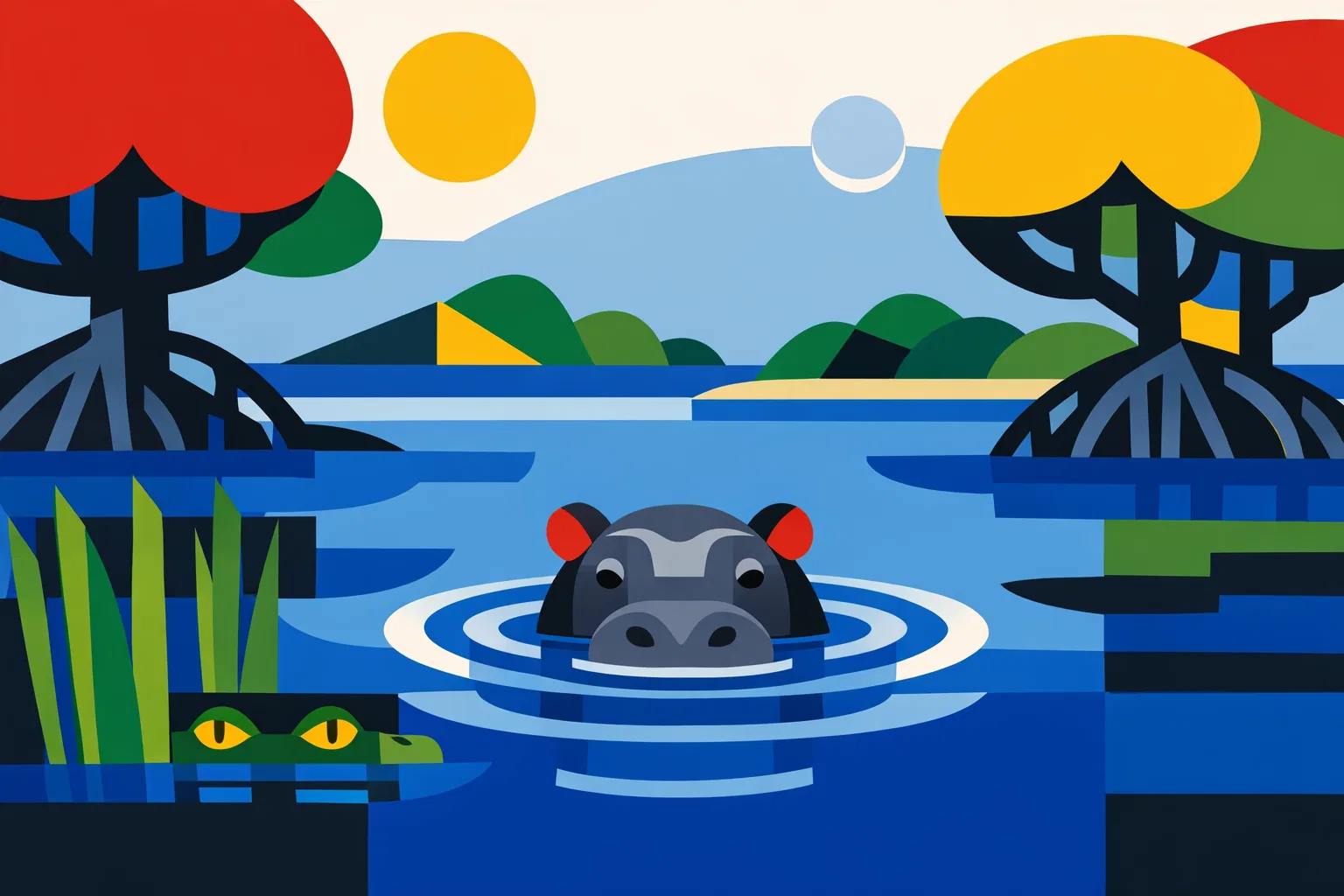
If Guinea-Bissau has a creature that sounds like a cryptid before the evidence catches up, it is the saltwater-going hippopotamus of Orango. Orango National Park, created in 2000 in the south-west of the Bijagós, is described by BioGuinea as a core area of the biosphere reserve and as a place where resident communities and biodiversity have developed an intimate relationship over centuries. The park is home to hippos that, unlike the familiar freshwater image of the animal, “love the ocean”.[Bio Guinea]bioguinea.orgthe orango national parkthe orango national park
That phrase alone explains why visitors often talk about Orango’s hippos in near-mythic terms. Hippos are already huge, dangerous and semi-aquatic; seeing them associated with lagoons, mangroves and sea water gives them the feel of a local marvel. Travel writing sometimes leans into this by calling them “marine” or “saltwater” hippos, but the safer interpretation is that these are common hippopotamuses using coastal and brackish environments, not a separate confirmed monster species. BioGuinea’s account places them alongside monkeys, African manatees, reptiles and endangered sea turtles, which helps keep the animal in its ecological context rather than turning it into fantasy.[Bio Guinea]bioguinea.orgthe orango national parkthe orango national park
For mystery-animal history, Orango’s hippos are a useful reminder: the most memorable “beast” in a country may be a real animal behaving in an unexpected place. A large animal moving through mangroves, surf or lagoons can easily generate stories among outsiders who do not know the local ecology. In Guinea-Bissau, the hippo does not need to be upgraded into an unknown species to be remarkable.

Crocodiles, caimans and the reptile problem
A second source of monster-like imagery is Guinea-Bissau’s reptile life. A 2025 scientific review on crocodiles reported evidence for three crocodile species in Guinea-Bissau, distributed on the mainland and in the Bijagós. That matters for folklore because crocodiles are classic misidentification candidates: in poor visibility, a large reptile’s back, tail, eyes or sudden splash can become a much stranger animal in memory and retelling.[PMC]pmc.ncbi.nlm.nih.govOpen source on nih.gov.
The protected-area guide also notes wet savannah and seasonal lakes in Orango where birds gather and where black caiman are present. Whether translated for visitors as caiman, crocodile or simply a dangerous water reptile, this is the sort of animal that anchors local cautionary stories. A reptile that waits in water, appears at night or occupies a forbidden pool does not have to be biologically unknown to become folklorically powerful.[Ecoturismo IBAP G. Bissau]ecoturismo.ibapgbissau.orgEcoturismo IBAP G. Bissau
This is why broad claims about “dragon-like” animals in Guinea-Bissau should be handled sceptically. A mangrove country with crocodiles, large snakes, monitor lizards, hippos and manatees already contains enough real shapes to explain many water-monster impressions. The unknown element may lie less in zoology than in how people interpret dangerous places and rare encounters.
Sacred forests and animal masks are not cryptids, but they matter
A common mistake in cryptid writing is to flatten every animal spirit, mask or ritual figure into a supposed eyewitness report. Guinea-Bissau’s Bijagó material shows why that is misleading. The protected-area guide identifies an “Iran” as a spirit in Bijagó cultural material, notes a hammerhead shark dance mask, and describes sacred forests that harbour spirits and serve as places for traditional ceremonies. These are religious and cultural forms, not evidence for unknown animals.[Ecoturismo IBAP G. Bissau]ecoturismo.ibapgbissau.orgEcoturismo IBAP G. Bissau
Still, they belong in a country-level mystery-beast page because they show which animals carry symbolic charge. A hammerhead shark mask is not a claim that a shark-headed monster walks the islands. It is evidence that marine animals can be ritually powerful, visually memorable and connected to identity, initiation or ceremony. In a coastal archipelago where sharks and rays are ecologically important, that link between animal form and spiritual meaning is highly relevant.[Ecoturismo IBAP G. Bissau]ecoturismo.ibapgbissau.orgEcoturismo IBAP G. Bissau
Sawfish are another strong example. The same guide records two sawfish species in the Bijagós as close to extinction, while broader accounts of sawfish cultural history note that in the Bissagos Islands, dancing dressed as sawfish and other sea creatures forms part of men’s coming-of-age ceremonies. Sawfish are real animals, but their saw-like rostra and rarity make them feel almost designed for legend.[Ecoturismo IBAP G. Bissau]ecoturismo.ibapgbissau.orgEcoturismo IBAP G. Bissau
The regional serpent shadow: Ninki Nanka and Guinea-Bissau
The West African creature most often pulled towards Guinea-Bissau in online cryptid lists is the Ninki Nanka, a dragon-like or giant-serpent figure best documented in Gambian and wider Mandinka contexts. Contemporary media coverage in 2006 described British investigators searching in The Gambia for a legendary reptile said by locals to be up to 30 feet long and to live in mangrove swamps. That case is useful for comparison, but it is not strong evidence for a Guinea-Bissau sighting tradition on its own.[The Independent]independent.co.ukOpen source on independent.co.uk.
Some modern web summaries extend Ninki Nanka-like or related serpent traditions towards Guinea and Guinea-Bissau, sometimes under variant names. The problem is that these claims are often recycled through low-quality compilations rather than grounded in local Guinea-Bissau testimony, archival newspapers or fieldwork. A fair country page should therefore say: Guinea-Bissau shares the regional ecology that makes such serpent lore plausible — mangroves, river mouths, crocodiles, large snakes and Mande cultural connections — but the best-known Ninki Nanka evidence remains centred elsewhere, especially The Gambia.[Wikipedia]WikipediaNinki NankaNinki Nanka
The comparison is still valuable. Ninki Nanka stories show how a West African water being can move between categories: spirit, warning, dragon, swamp monster, tourist trail and cryptozoological target. Guinea-Bissau has the right landscape for similar story mechanics, but the country-specific record is too thin to present a named Guinea-Bissau dragon as established folklore.
The Guinean bichir shows how “unknown animal” stories can change
One of the most interesting near-cryptid cases connected to Guinea-Bissau is not a monster at all, but a fish: the Guinean bichir, Polypterus ansorgii. A specialist aquarium account notes that the species was originally known from three specimens collected in 1910 from the River Corubal at Tchitoli, in what was then Portuguese Guinea, now Guinea-Bissau. For a long time, the scarcity of specimens left room for doubt about what the fish really was.[Aqualog.de]aqualog.deThe Guinean BichirThe Guinean Bichir
That story has a cryptozoological flavour because it involves rarity, old specimens, failed searches and later clarification. The same account explains that additional specimens from Nigeria and later a large individual from the Koliba, a tributary of the Corubal system, helped confirm that the species was real and could grow much larger than the original small type specimens suggested.[Aqualog.de]aqualog.deThe Guinean BichirThe Guinean Bichir
The bichir case is a useful corrective to monster thinking. Sometimes an “almost mythical” animal is not a lake beast or dragon, but a poorly known fish with a patchy museum record. It shows that Guinea-Bissau’s waterways can produce genuine zoological puzzles, but also that the route from mystery to knowledge is specimen-based, not legend-based.
What evidence is missing?
The main thing missing from Guinea-Bissau’s cryptid record is a repeatable, named, country-specific sighting tradition with dates, places and witnesses. There is no strong public trail of newspaper flaps about phantom cats, lake monsters, ape-men or sea serpents inside Guinea-Bissau comparable to better-known cryptid traditions elsewhere. The available evidence points instead to three overlapping bodies of material: Bijagó sacred ecology, unusual but real coastal wildlife, and regional West African serpent or water-spirit lore.[ibapgbissau.org]ecoturismo.ibapgbissau.orgEcoturismo IBAP G. BissauEcoturismo IBAP G. Bissau
That thinness should not be treated as failure. It may reflect language barriers, limited digitisation, the oral nature of many traditions, and the fact that local categories do not always match the English word “cryptid”. A spirit associated with a sacred forest, a dangerous crocodile pool or a ceremonial shark mask may be very important locally without ever becoming a “monster report” in the Western newspaper sense.
A good sceptical reading separates four categories:
- Documented wildlife: hippos, crocodiles, manatees, sharks, rays, sawfish, turtles and large fish.
- Sacred or ceremonial animal forms: masks, spirits, initiation imagery and protected places.
- Regional comparison material: especially Ninki Nanka-like water-serpent traditions from nearby West Africa.
- Weak cryptid claims: online list entries or recycled creature names that lack Guinea-Bissau-specific documentation.
Best explanations for Guinea-Bissau’s mystery-beast material
The most likely explanations are not mutually exclusive. First, real animals do a great deal of the work. Hippos in coastal waters, crocodiles in mangroves, manatees surfacing briefly, sawfish with saw-like snouts and sharks moving through tidal channels can all produce startling encounters. UNESCO’s biodiversity descriptions make clear that the archipelago contains exactly the sort of fauna that can appear strange to outsiders.[UNESCO World Heritage Centre]whc.unesco.orgOpen source on unesco.org.
Second, sacred geography shapes perception. The protected-area guide says strategic places and resources in the Bijagós have been protected through spirits, ceremonies and traditional rules, and that sacred status gives many sites a high level of protection. In such a setting, a frightening animal is not just an animal; it may be part of a moral landscape about who may enter, when, and with what permission.[Ecoturismo IBAP G. Bissau]ecoturismo.ibapgbissau.orgEcoturismo IBAP G. Bissau
Third, outside cryptid culture tends to rename local material. A water spirit becomes a “dragon”; a ceremonial animal image becomes a “monster”; a rare fish becomes a “living fossil”; a hippo in salt water becomes a “sea beast”. These translations can be fun, but they can also distort the original meaning. Guinea-Bissau is best read as a country where ecology and folklore are tightly linked, not as a place with one headline monster waiting to be found.
The takeaway for cryptid readers
Guinea-Bissau’s mystery-animal tradition is best understood as an ecological folklore page rather than a monster dossier. Its strongest anchors are the Bijagós Archipelago, Orango’s ocean-going hippos, crocodile and caiman habitats, endangered sawfish, shark and ray imagery, sacred forests, spirit-protected places and regional West African serpent lore. The evidence does not support presenting a confirmed Guinea-Bissau cryptid as an unknown animal.
That does not make the country less interesting. It makes it more grounded. Guinea-Bissau shows how real biodiversity can become legendary without leaving the world of real animals behind. In its mangroves and islands, the strange creature is often not a hidden dinosaur or escaped big cat, but a hippo in the surf, a crocodile in a sacred creek, a sawfish remembered in dance, or a spirit-haunted forest where the rules of nature and culture are deliberately woven together.
Amazon book picks
Further Reading
Books and field guides related to Where Guinea-Bissau's Monsters Meet Real Wildlife. Use these as the next step if you want deeper reading beyond the article.
The Last Giants
Connects African wildlife, conservation and the kind of animals that inspire legends.
The World of Lore: Monstrous Creatures
Examines legendary creatures and the cultural settings that create them.
Abominable Science!
Helps readers understand how monster stories emerge from real animals and folklore.
eBay marketplace picks
Marketplace Samples
Live-tested eBay searches with available results related to this page.
Endnotes
1.
Source: unesco.org
Link:https://www.unesco.org/en/articles/unesco-strengthens-its-support-guinea-bissau-protection-[bijagos-islands
2.
Source: whc.unesco.org
Link:https://whc.unesco.org/en/list/1431/
3.
Source: ecoturismo.ibapgbissau.org
Title: Ecoturismo IBAP G. Bissau
Link:https://ecoturismo.ibapgbissau.org/documentos/publicacoes/Guias/IBA-%20Guide%20ecotourisme%20EN%20LowDef.pdf
4.
Source: bioguinea.org
Title: the orango national park
Link:https://www.bioguinea.org/protected-areas-in-guinea-bissau/the-orango-national-park/
5.
Source: pmc.ncbi.nlm.nih.gov
Link:https://pmc.ncbi.nlm.nih.gov/articles/PMC12241385/
6.
Source: Wikipedia
Link:https://en.wikipedia.org/wiki/Sawfish
7.
Source: Wikipedia
Title: Ninki Nanka
Link:https://en.wikipedia.org/wiki/Ninki_Nanka
8.
Source: aqualog.de
Title: The Guinean Bichir
Link:https://www.aqualog.de/en/blog-en/the-guinean-bichir-a-myth-dispelled/
9.
Source: Wikipedia
Title: List of dragons in mythology and folklore
Link:https://en.wikipedia.org/wiki/List_of_dragons_in_mythology_and_folklore
10.
Source: Wikipedia
Title: West African mythology
Link:https://en.wikipedia.org/wiki/West_African_mythology
11.
Source: unesco.org
Link:https://www.unesco.org/en/mab/bolama-bijagos
12.
Source: unesdoc.unesco.org
Link:https://unesdoc.unesco.org/ark%3A/48223/pf0000011345
13.
Source: independent.co.uk
Link:https://www.independent.co.uk/news/science/the-monster-detectives-on-the-trail-of-the-ninkinanka-6095664.html
14.
Source: ceibabissau.com
Title: Saltwater Hippos
Link:https://ceibabissau.com/saltwater-hippos/
15.
Source: cryptidz.fandom.com
Title: Sea Serpents
Link:https://cryptidz.fandom.com/wiki/Sea_Serpents
16.
Source: cryptidarchives.fandom.com
Title: Ninki nanka
Link:https://cryptidarchives.fandom.com/wiki/Ninki_nanka
17.
Source: thecreaturecodex.tumblr.com
Title: ninki nanka
Link:https://thecreaturecodex.tumblr.com/post/697495654725009408/ninki-nanka
18.
Source: cc-tapis.com
Link:https://cc-tapis.com/collections/cryptid
19.
Source: beastsoflegend.com
Title: West Africa
Link:https://beastsoflegend.com/bestiary/africa/west/
20.
Source: prcmarine.org
Link:https://www.prcmarine.org/bijagos/article/10759
21.
Source: bijagos.com
Link:https://bijagos.com/
22.
Source: gbif.org
Link:https://www.gbif.org/species/165472299
Additional References
23.
Source: youtube.com
Link:https://www.youtube.com/watch?v=CX4n8wj72Is
Source snippet
Bissagos Islands, on the Mysterious Islands of West Africa...
24.
Source: youtube.com
Title: HIPPO ISLAND | Incredible Wildlife In Bissagos Islands | 4K
Link:https://www.youtube.com/watch?v=VPCBXoZI3k4
Source snippet
The Bissago People: Masters of Guinea-Bissau's Archipelago | SLICE | FULL DOCUMENTARY...
25.
Source: youtube.com
Title: Bissagos Islands, on the Mysterious Islands of West Africa
Link:https://www.youtube.com/watch?v=7XxFadC8aK8
Source snippet
Guinea-Bissau: The Wild Beauty of West Africa...
26.
Source: facebook.com
Link:https://www.facebook.com/groups/392368071290425/posts/1670246280169258/
27.
Source: abookofcreatures.com
Link:https://abookofcreatures.com/tag/african-folklore/
28.
Source: facebook.com
Link:https://www.facebook.com/100084193171166/posts/african-mythology-features-diverse-mythical-creaturescreatures-and-their-charact/752951587521274/
29.
Source: bbcearth.com
Link:https://www.bbcearth.com/news/behind-the-scenes-filming-animals-with-cameras-ii
30.
Source: responsibletravel.com
Link:https://www.responsibletravel.com/holidays/guinea-bissau/travel-guide/the-bijagos-archipelago
31.
Source: primevideo.com
Link:https://www.primevideo.com/detail/0SIOMUJMUPMKZX4CL23RFW0341
32.
Source: britishmuseum.org
Link:https://www.britishmuseum.org/collection/search?object=mask&page=12
Topic Tree
Follow this branch
Related pages 192
- Antigua Cryptids
- Maldives Monsters
- Malta Monsters
- Qatar Monsters
- Argentina Monsters
- +187 more in sidebar