Within Jordan Monsters
Is the Ghoul Jordan's Real Monster?
The ghoul is Jordan's strongest monster candidate, rooted in Arabic folklore about lonely places, deception and desert danger.
On this page
- The Arabic ghoul tradition
- Lonely places, graves and desert roads
- Why a folklore being fits the cryptid frame
Page outline Jump by section
Introduction
The ghoul is the closest thing Jordan has to a classic national monster. Unlike Bigfoot-style creatures that are presented as undiscovered animals, the ghoul comes from a much older Arabic tradition that blends folklore, wilderness travel, fear of isolation and real environmental dangers. In stories told across the Levant and Arabia, the ghoul lurks in deserts, abandoned places, graveyards and lonely roads, deceiving travellers before leading them to disaster. Jordan’s dramatic landscapes—especially its deserts, remote valleys, ruins and sparsely populated routes—provide exactly the sort of setting in which such legends thrive.

For readers interested in Jordan’s monster traditions, the ghoul matters because it occupies a space between folklore and cryptid culture. It is not treated as a biological species, yet it behaves like many legendary mystery creatures: it has a recognised habitat, recurring encounters, characteristic behaviour and a long history of witness stories. Its persistence says as much about life in harsh desert environments as it does about belief in monsters.[tandfonline.com]tandfonline.comTaylor & Francis OnlineThe Arabic Ghoul and its Western Transformation: Folkloreby AK Al-Rawi · 2009 · Cited by 43 — This paper discusses…
Is the Ghoul Jordan’s Real Monster?
If Jordan has a signature monster tradition, the ghoul is the strongest candidate.
The creature belongs to a wider Arabic folklore network rather than exclusively to Jordan, but Jordan’s geography makes it a natural home for ghoul stories. Vast desert expanses, isolated tracks, abandoned ruins and ancient burial sites create landscapes where travellers can become lost, disoriented or vulnerable. In traditional tales, these are exactly the places where a ghoul is expected to appear.[jstor.org]jstor.orgThe Arabic Ghoul and its Western Transformationby AK Al-Rawi · 2009 · Cited by 45 — periods, the character of the ghoul remained the…
Historically, the ghoul was not imagined as an undead corpse or cemetery zombie in the modern horror sense. Early Arabic traditions describe a shape-shifting being associated with deserts and wilderness. It could appear as a person, an animal, a stranger in distress or even a familiar face. Its defining characteristic was deception. The monster’s power came from leading people away from safety and into danger.[jstor.org]jstor.orgThe Arabic Ghoul and its Western Transformationby AK Al-Rawi · 2009 · Cited by 45 — periods, the character of the ghoul remained the…
That focus on deception is important. Jordan’s ghoul tradition reflects practical fears that were very real for travellers in desert country: losing one’s route, trusting the wrong guide, wandering after dark, or becoming stranded far from water and shelter.
The Arabic Ghoul Tradition
The ghoul has deep roots in Arabic culture. Folklore researcher Ahmed Al-Rawi traces references to the creature through Arabic sources dating back to at least the eighth century and argues that belief in ghouls was already widespread before Islam. The creature was regarded as a kind of devilish or jinn-like being inhabiting remote landscapes.[Taylor & Francis Online]tandfonline.comTaylor & Francis OnlineThe Arabic Ghoul and its Western Transformation: Folkloreby AK Al-Rawi · 2009 · Cited by 43 — This paper discusses…
Over centuries, certain features remained remarkably consistent:
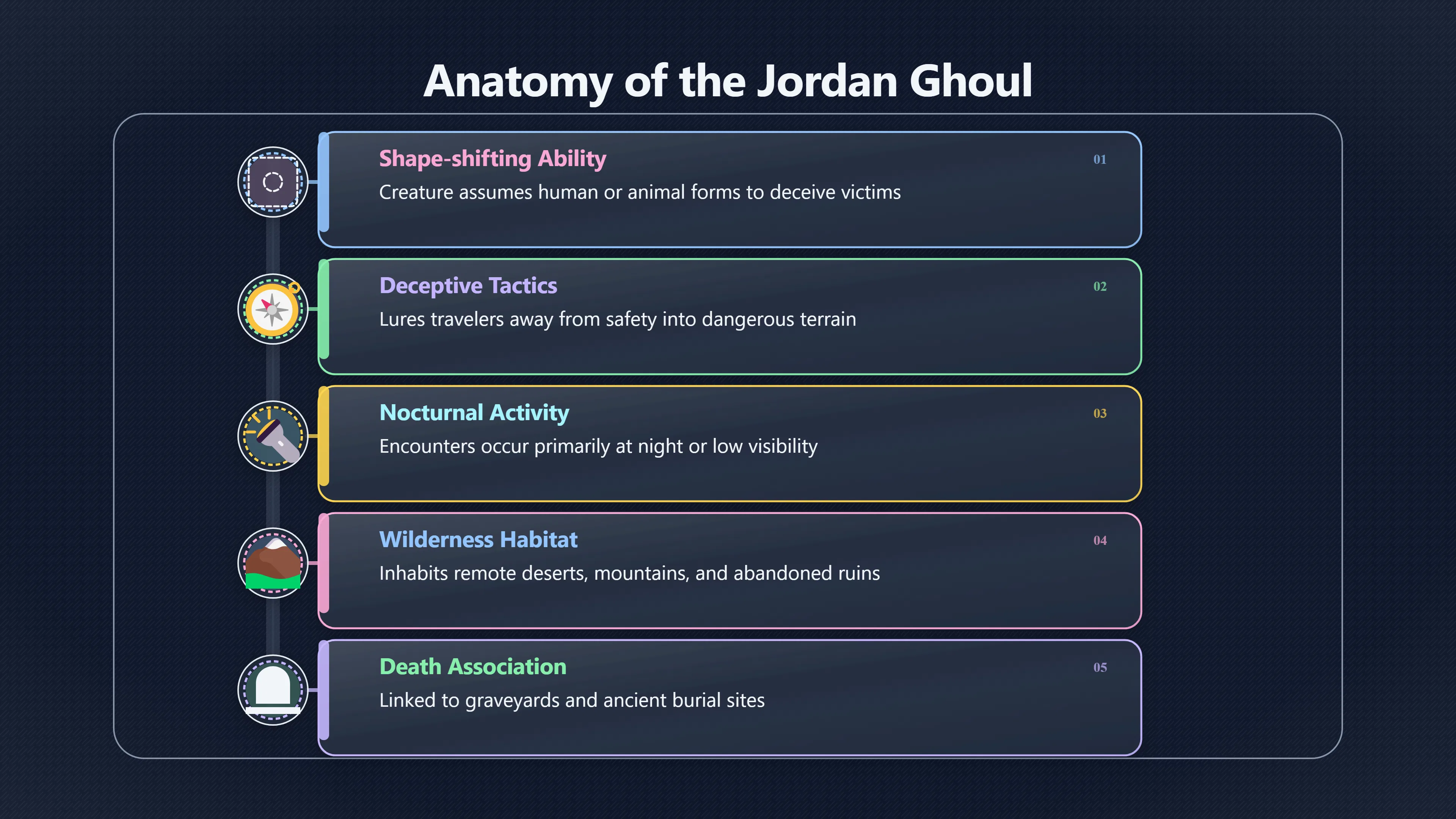
- The ghoul lived in deserts, mountains, valleys and other lonely places.
- It was a shape-shifter capable of changing appearance.
- It targeted isolated travellers.
- It was associated with death, graves and wilderness.
- Encounters often occurred at night or in poor visibility.[jstor.org]jstor.orgThe Arabic Ghoul and its Western Transformationby AK Al-Rawi · 2009 · Cited by 45 — periods, the character of the ghoul remained the…
Some traditions portray the creature as female, using beauty or familiarity to lure victims. Others describe it taking animal forms, especially creatures already viewed with suspicion. The precise details vary from region to region, but the core idea remains stable: the ghoul exploits human vulnerability in dangerous landscapes.[Wikipedia]WikipediaOpen source on wikipedia.org.
Jordan inherited this broader folklore tradition through the same cultural and historical currents that shaped much of the Arabic-speaking world. Rather than developing a unique monster species, the country became one of the landscapes in which the older ghoul narrative continued to make sense.
Lonely Places, Graves and Desert Roads
The strongest connection between Jordan and ghoul lore lies in terrain.
Traditional ghoul stories consistently place the creature in locations where people are physically exposed and socially isolated. Jordan contains many such environments: the eastern desert, remote wadis, ruined settlements, abandoned tracks and isolated burial grounds. Even today, some areas can feel strikingly empty once modern roads disappear.
In folklore, the ghoul often appears where human presence becomes uncertain. Graveyards feature prominently because they symbolise boundaries between the living and the dead. Deserts play a similar role. A traveller crossing an empty landscape may experience fatigue, darkness, unfamiliar sounds and distorted perception. Stories transform these dangers into a recognisable creature.[ebsco.com]ebsco.comGhoul (mythical creature) | Literature and WritingA ghoul is a mythical creature rooted in Arabic folklore, traditionally depicted a…
Many accounts across the broader Arabic tradition describe travellers seeing strange lights, hearing voices, encountering unexpected strangers or being lured from safe routes. Whether interpreted literally or symbolically, these motifs reflect the hazards of moving through remote territory before modern navigation and communication technologies existed.[Scribd]scribd.comThe Ghoul in Arabic Folklore | PDFghoul was believed to attract travelers by setting fire at night; alJhi elaborated by saying that…
The ghoul therefore functions as both a monster and a warning sign. It tells listeners that wilderness can deceive.
Why a Folklore Being Fits the Cryptid Frame
Strictly speaking, the ghoul is not a cryptid. Cryptids are usually presented as undiscovered animals, while the ghoul belongs to supernatural folklore.
Yet the ghoul occupies an interesting middle ground that explains why it often appears in discussions of monster traditions.
Like many famous cryptids, the ghoul has:
- A recognised habitat.
- Repeated encounter narratives.
- Consistent behavioural traits.
- Regional variations.
- Stories of eyewitness experiences.
- Explanations for why physical evidence is scarce.[tandfonline.com]tandfonline.comTaylor & Francis OnlineThe Arabic Ghoul and its Western Transformation: Folkloreby AK Al-Rawi · 2009 · Cited by 43 — This paper discusses…
Many legendary creatures around the world function similarly. They inhabit specific landscapes and become cultural explanations for unusual experiences. The ghoul fills that role in Jordan’s desert environment.
What separates it from a biological mystery animal is that traditional sources openly describe it as a supernatural entity. Historical storytellers generally were not trying to document an unknown species. They were describing a dangerous presence associated with wilderness, fear and deception.[Taylor & Francis Online]tandfonline.comTaylor & Francis OnlineThe Arabic Ghoul and its Western Transformation: Folkloreby AK Al-Rawi · 2009 · Cited by 43 — This paper discusses…

Could Real Animals Have Influenced the Legend?
One reason the ghoul remains fascinating is that parts of the tradition may have been reinforced by encounters with real wildlife.
Across the Middle East, hyenas, wolves, jackals and feral dogs have often been associated with graveyards, scavenging and nocturnal activity. A glimpse of a large animal at night can easily appear uncanny, especially when combined with existing folklore. Historical references even note occasions when hyenas were compared to ghouls by local observers.[Wikipedia]WikipediaOpen source on wikipedia.org.
Several ghoul characteristics overlap with traits that naturally alarm people:
- Nocturnal movement.
- Eyeshine in darkness.
- Scavenging behaviour.
- Strange vocalisations.
- Sudden appearances and disappearances.
A traveller who already knows ghoul stories may interpret an ambiguous encounter through that cultural lens. Over time, genuine wildlife observations and folklore can reinforce one another.
This does not mean the ghoul originated as a misunderstood animal. The folklore is much older and more complex than a simple case of mistaken identity. However, real animals likely helped keep the legend believable.
How Ghouls changed in retelling
One of the most interesting developments is that the Western image of the ghoul differs sharply from the older Arabic version.
Researchers note that European adaptations, especially through translations of stories from the Middle East, gradually shifted the creature’s image. In Western horror, ghouls became corpse-eating cemetery monsters. In the earlier Arabic tradition, they were more often wilderness predators, shape-shifters and deceivers associated with deserts and lonely places.[tandfonline.com]tandfonline.comTaylor & Francis OnlineThe Arabic Ghoul and its Western Transformation: Folkloreby AK Al-Rawi · 2009 · Cited by 43 — This paper discusses…
For Jordan, the older version is the more relevant one. The country’s ghoul tradition is tied less to grave-robbing horror and more to the dangers of remote landscapes. The creature belongs to roads, valleys, ruins and desert expanses where people can lose their bearings.
That distinction helps explain why the ghoul remains central to Jordan’s monster heritage. It is not merely a frightening creature. It is a cultural expression of what the desert represents: beauty, mystery, isolation and risk.
Why the Ghoul Endures in Jordan
The ghoul survives because it continues to embody fears that remain understandable even in a modern world.
Most people no longer cross Jordan’s deserts by camel caravan, yet the emotional power of the story remains. Remote places still create uncertainty. Darkness still distorts perception. Ruins and empty landscapes still invite imagination. The ghoul provides a memorable character through which those feelings can be expressed.
As a result, the creature occupies a unique position in Jordan’s monster tradition. It is neither a documented animal nor merely a forgotten folktale. Instead, it represents a long-running cultural conversation about how humans experience wilderness. In a country where desert landscapes remain central to both history and identity, that makes the ghoul Jordan’s most enduring and recognisable monster figure.[researchgate.net]researchgate.netResearchGate(PDF) The Mythical Ghoul in Arabic CultureThis study argues that Islam could not change the belief in supernatural beings suc…
Amazon book picks
Further Reading
Books and field guides related to Is the Ghoul Jordan's Real Monster?. Use these as the next step if you want deeper reading beyond the article.
The Arabian Nights
Features many of the supernatural narrative traditions connected to ghoul lore.
Legends of the Fire Spirits
Explores the belief world surrounding desert spirits and related beings.
![Cover for The Arabian Nights Entertainments [7 stories]](https://covers.openlibrary.org/b/id/1046897-M.jpg)
Encyclopedia of Things that Never Were
Includes legendary beings useful for comparing the ghoul to other monsters.
eBay marketplace picks
Marketplace Samples
Live-tested eBay searches with available results related to this page.

![Listing image for The Cute Monsters Doll Character Action Figure Collectible Toys [Random Colour]](/assets/images/marketplace-covers/29f5d3d446a0ddba82a6.jpg)

Endnotes
1.
Source: jstor.org
Link:https://www.jstor.org/stable/40646532
Source snippet
The Arabic Ghoul and its Western Transformationby AK Al-Rawi · 2009 · Cited by 45 — periods, the character of the ghoul remained the...
2.
Source: researchgate.net
Link:https://www.researchgate.net/publication/277816715_The_Mythical_Ghoul_in_Arabic_Culture
Source snippet
ResearchGate(PDF) The Mythical Ghoul in Arabic CultureThis study argues that Islam could not change the belief in supernatural beings suc...
3.
Source: ebsco.com
Link:https://www.ebsco.com/research-starters/literature-and-writing/ghoul-mythical-creature
Source snippet
Ghoul (mythical creature) | Literature and WritingA ghoul is a mythical creature rooted in Arabic folklore, traditionally depicted a...
4.
Source: researchgate.net
Title: 254289317 The Arabic Ghoul and its Western Transformation
Link:https://www.researchgate.net/publication/254289317_The_Arabic_Ghoul_and_its_Western_Transformation
Source snippet
(PDF) The Arabic Ghoul and its Western Transformation11 Nov 2009 — As a kind of devilish genie, the ghoul was part of beliefs held by Ara...
5.
Source: Wikipedia
Link:https://en.wikipedia.org/wiki/Ghoul
6.
Source: scribd.com
Link:https://www.scribd.com/document/299321543/The-Mythical-Ghoul-In-Arabic-Culture
Source snippet
The Ghoul in Arabic Folklore | PDFghoul was believed to attract travelers by setting fire at night; alJhi elaborated by saying that...
7.
Source: Wikipedia
Title: Ghouls in popular culture
Link:https://en.wikipedia.org/wiki/Ghouls_in_popular_culture
8.
Source: Wikipedia
Link:https://it.wikipedia.org/wiki/Ghul
Source snippet
Ghull'occupazione principale dei ghoul consiste nel battere le campagne, far abortire le donne incinte, succhiare il sangue dei giovan...
9.
Source: jstor.org
Link:https://www.jstor.org/stable/10.13169/arabstudquar.35.1.0004
Source snippet
Arabic culture and old Arabic fol tales and of Lord Shiva in the Hindu myth, this article...Read...
10.
Source: scribd.com
Link:https://www.scribd.com/document/823596142/Ghoul-Wikipedia
Source snippet
and consuming human flesh, often deceiving men by appearing...Read more...
11.
Source: tandfonline.com
Link:https://www.tandfonline.com/doi/abs/10.1080/00155870903219730
Source snippet
Taylor & Francis OnlineThe Arabic Ghoul and its Western Transformation: Folkloreby AK Al-Rawi · 2009 · Cited by 43 — This paper discusses...
12.
Source: mythus.fandom.com
Link:https://mythus.fandom.com/wiki/Ghoul
Source snippet
Myth and Folklore Wiki - FandomIn Arabian folklore, a ghul is a terrible, shape-shifting monster. It may appear in the form of a hyena or...
13.
Source: animated-character-database.fandom.com
Link:https://animated-character-database.fandom.com/wiki/Ghouls
Source snippet
Animated Character Database - FandomIn folklore, a ghoul (from Arabic: غول, ghūl) is a demon-like being or monstrous humanoid, often as...
Additional References
14.
Source: encyclopedia.com
Link:https://www.encyclopedia.com/philosophy-and-religion/other-religious-beliefs-and-general-terms/miscellaneous-religion/ghoul
Source snippet
GhoulAn evil spirit or revived corpse supposed to rob graves and feed on human corpses. It is similar to the vampire, but differs in that...
15.
Source: facebook.com
Link:https://www.facebook.com/NikkuVlogzFB/posts/haunted-arabian-desert-me-aagaye/471665432540121/
Source snippet
Haunted Arabian desert me aagayeIn Arabic folklore, the ghul is said to dwell in cemeteries and other uninhabited places. A male ghoul is...
16.
Source: medium.com
Link:https://medium.com/teatime-history/al-ghoul-devilish-arabian-monster-6876c0a5b442
17.
Source: kids.kiddle.co
Link:https://kids.kiddle.co/Ghoul
Source snippet
Facts for KidsA ghoul is a scary creature from ancient Arabian stories. These monsters often live in old burial grounds or lonely, empty...
18.
Source: youtube.com
Link:https://www.youtube.com/watch?v=OTCLK05XC7U&vl=en
19.
Source: facebook.com
Link:https://www.facebook.com/groups/392678574938393/posts/1677970939742477/
Source snippet
A ghoul appear as an emaciated, roughly humanoid creature with an almost-hairless mottled...Read more...
20.
Source: melow.in
Link:https://www.melow.in/public/assets/uploads/article/63.pdf
Source snippet
ndead monster that belonged to a diabolic class of djinn and was said to be the...Read more...
21.
Source: instagram.com
Title: It was instead a shapeshifter that lived in desert’s
Link:https://www.instagram.com/reel/DSSDEOBEQui/?hl=en
Source snippet
Did you know the word “ghoul” actually originated in folklore...In some traditions across the Arabian Peninsula, a ghoul was not the und...
22.
Source: facebook.com
Link:https://www.facebook.com/groups/1292154877594714/posts/2779598098850377/
Source snippet
aves and feeds on the flesh of the dead, or on young children.Read more...
23.
Source: pinterest.com
Link:https://www.pinterest.com/pin/a-ghoul-is-a-monster-or-evil-spirit-in-arabic-mythology-associated-with-graveyards-and-consuming-human–260434790936513739/
Source snippet
ated with graveyards and the consumption of human flesh.Read more...
Topic Tree