Cryptid Reports from Mozambique's Waters and Wilds
Mozambique is not one of the world’s best-documented “cryptid countries” in the modern, monster-hunting sense.
Page outline Jump by section
Why Mozambique’s monster lore is mostly water, snakes and misread wildlife
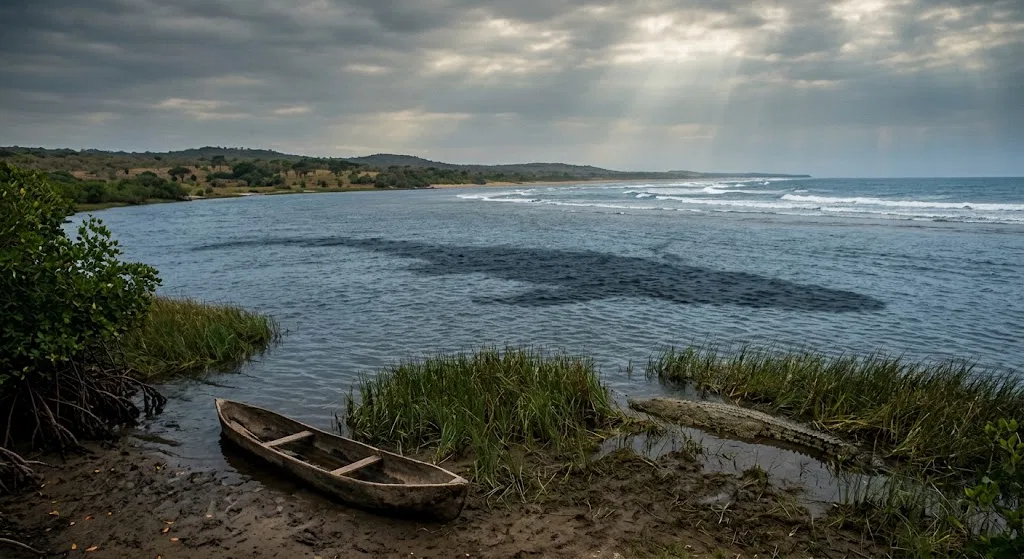
Mozambique’s legendary-creature map makes sense once the country’s geography is taken seriously. Much of the memorable material comes from water: Lake Niassa in the north-west, the Zambezi and its tributaries, the old Delagoa Bay region around modern Maputo Bay, and the long Indian Ocean coast. Water is where ordinary danger, food, travel, fertility and sudden death meet. A crocodile in a river, a hippo in a channel, a whale offshore or a dugong in a seagrass bed already has enough force to become a story before any supernatural detail is added. Modern wildlife sources still describe hippos and crocodiles as strongly tied to Mozambique’s lakes, perennial rivers and pans, while Bazaruto is known for whales, dolphins, turtles, sharks and dugongs.[gorongosa.org]gorongosa.orgAerial wildlife count of the Gorongosa National Park,Lake Urema and the perennial rivers and pans (Fig. 21 & 22). Fig. 4: Spatial distribution of…Read more…
That matters because Mozambique’s mystery beasts are rarely “one animal seen once”. They are usually traditions attached to places where people already knew animals could harm, feed or transform human life. A giant lake creature may preserve a memory of dangerous water crossings. A snake with rooster-like features may exaggerate a real venomous snake and a mysterious bird call. A “mermaid” association may grow around dugongs, as has happened in many coastal cultures where sirenians were interpreted through human-shaped myth. None of this makes the stories duller. It makes them more readable: the legend sits on top of a real ecological stage.[reptarium.cz]reptile-database.reptarium.czReptile DatabaseDendroaspis polylepis GÜNTHER, 1864 - The Reptile Databaseby E Common Names — antinori: Somalia, Ethiopia, NE Uganda, N K…
The crowing crested cobra: Mozambique’s most cryptid-like snake story
The clearest Mozambique-linked mystery-animal claim is the “crowing crested cobra”, a regional legend of a large venomous snake said to carry a crest or wattles and to make sounds like a rooster. In Mozambique-linked versions, the lower Zambezi is important. David Livingstone’s posthumously published material includes the Shupanga name “Bubu” for a dangerous snake described by Susi as about twelve feet long, dark, bluish underneath, and marked on the head like a cock’s wattles. Later summaries connect this account with the broader crowing-crested-cobra tradition, while also noting that Livingstone himself suspected a mamba explanation.[goodreads.com]goodreads.comOpen source on goodreads.com.
The story has the right ingredients for a classic cryptid: a named local creature, a frightening behaviour pattern, a specific area, an old traveller account and a proposed zoological identity. It also has the right ingredients for scepticism. The black mamba is native to Mozambique and is a large, fast, highly venomous snake; the Reptile Database lists the black mamba with a Mozambique-linked type locality on the Zambezi River. That does not explain every detail of the Bubu story, but it makes the “huge deadly snake” part much less mysterious than the crest and crowing.[Reptile Database]reptile-database.reptarium.czReptile DatabaseDendroaspis polylepis GÜNTHER, 1864 - The Reptile Databaseby E Common Names — antinori: Somalia, Ethiopia, NE Uganda, N K…
The sound is the key problem. Snakes can hiss, rasp and produce warning noises, but a convincing rooster-like call is a different matter. Later discussions of the crowing crested cobra point to birds, especially rails and flufftails, as likely sources of eerie calls heard from cover at dawn, dusk or night. The buff-spotted flufftail, for example, is a secretive bird whose calls are often heard from thick vegetation near streams, exactly the kind of setting where a frightened listener might connect an unseen sound with a snake already feared in local story.[A Book of Creatures]abookofcreatures.comA Book of Creatures Mozambique | A Book of CreaturesA Book of Creatures Mozambique | A Book of Creatures
The best reading is therefore layered. The Bubu is not strong evidence for an unknown crested cobra species, but it is excellent evidence for how a real animal fear can become a named monster. Mambas, cobras, bird calls, traveller retellings and local warning lore all seem to have been folded into one memorable snake. For a Mozambique cryptid page, this is the nearest thing to a “case file”: not proof of a new reptile, but a durable example of folklore interacting with dangerous wildlife.[jstor.org]jstor.orgOpen source on jstor.org.
Chipfalamfula: the river creature whose belly is a world
The most striking folkloric monster attached to Mozambique is Chipfalamfula, usually glossed as a “river-shutter”. It appears in Ronga tale material from the Delagoa Bay region, collected in the late nineteenth century by Henri-Alexandre Junod in Les chants et les contes des Ba-Ronga. Later retellings describe Chipfalamfula as an enormous aquatic being, sometimes whale-like, sometimes more like a colossal catfish, with power over water itself.[archive.org]archive.orgOpen source on archive.org.
The best-known story is not a simple sighting report. It is a wonder tale about Chichinguane, a girl betrayed by jealous sisters and rescued by the great water being. Inside Chipfalamfula, she finds a world of abundance, safety and community. When she returns, her transformation is marked by fish-like or silvery features, and the creature’s power later helps part or close the water. Read literally, Chipfalamfula is a monster big enough to swallow a human and contain a country. Read as folklore, it is about danger at the water’s edge, coming of age, family betrayal, rebirth and the river as both threat and refuge.[A Book of Creatures]abookofcreatures.comA Book of Creatures Mozambique | A Book of CreaturesA Book of Creatures Mozambique | A Book of Creatures
This is where “cryptid” becomes a limited word. Chipfalamfula is not best treated as a misplaced animal report. It belongs closer to water-spirit and giant-fish folklore than to eyewitness zoology. Yet it is still highly relevant to Mozambique’s monster tradition because it gives the country a native aquatic giant that is not simply imported from Loch Ness-style lake-monster culture. It is a local story shaped by rivers, floods, hunger, kinship and the imaginative scale of water.[A Book of Creatures]abookofcreatures.comOpen source on abookofcreatures.com.
A plausible natural background is not hard to imagine, but it should not be overplayed. The Zambezi and southern coastal systems support large fish, crocodiles and hippos; whales are present offshore; floods can dramatically change a landscape. Those realities help explain why a water-being story feels natural in Mozambique. They do not reduce Chipfalamfula to a misidentified species. The tale’s most important features are not anatomical but social and symbolic: the creature controls water, shelters the abandoned and punishes danger.[cambridge.org]cambridge.orgThose that are within a protected area often inhabit a river that forms the area's…Read more…
Namungumi and Lake Niassa: where lake monster, ritual image and border geography overlap
Lake Niassa, also known internationally as Lake Malawi or Lake Nyasa, gives Mozambique a share in one of Africa’s great lake-monster settings. The lake is bordered by Malawi, Mozambique and Tanzania, so monster traditions and rumour trails do not sit neatly inside one modern national boundary. Mozambique’s part of the lake was declared a reserve and Ramsar site in 2011, protecting one of the world’s largest and most biodiverse freshwater lakes.[WWF Centroamérica]wwfca.orgWWF CentroaméricaMozambique's Lake Niassa declared reserve and Ramsar…10 Jun 2011 — Lake Niassa has been officially declared a reserve…
One tradition linked to the wider Lake Malawi/Nyasa cultural world is the Namungumi or Nalumgumi, usually translated as “whale” and associated with Yao initiation contexts in Malawi, Mozambique and Tanzania. Modern creature catalogues describe it as a four-limbed, tusked lake being represented in initiation imagery, while related names such as Liporo and Napolo point toward a wider cluster of dangerous or flood-linked water beings. The most cautious wording is important here: this is ritual and folkloric material, not a confirmed animal report.[A Book of Creatures]abookofcreatures.comA Book of Creatures Mozambique | A Book of CreaturesA Book of Creatures Mozambique | A Book of Creatures
Lake Nyasa also appears in cryptozoological catalogues under reports of a lake monster sometimes called Dzimwé, with a 1905 newspaper story claiming that missionaries had heard of a “sea serpent” attacking a government boat. That is a weak but interesting source trail: it shows how quickly a local or mission-station rumour could be converted into international newspaper monster language. It does not give enough detail to identify a creature, and it may have been shaped by the early twentieth-century appetite for lake and sea serpent stories.[Cryptid Archives]cryptidarchives.fandom.comCryptid Archives Lake Nyasa monsterCryptid Archives Lake Nyasa monster
The ecological context points towards ordinary but formidable candidates. Lake and river margins in Mozambique can involve crocodiles and hippos; Mozambique’s hippo population has been surveyed in major river and lake-shore systems, and crocodiles are a conspicuous part of wetland wildlife in places such as Gorongosa’s Lake Urema. A frightened boat crew, a distant animal in rough water, floating debris or a crocodile encounter could all become “monster” material in retelling.[cambridge.org]cambridge.orgThose that are within a protected area often inhabit a river that forms the area's…Read more…
Sea serpents, dugongs and the Mozambique Channel
Mozambique’s coast adds a different kind of monster tradition: not a single named national beast, but a long history of sea-serpent interpretation around the western Indian Ocean and African waters. A 2021 study of historical “sea serpent” reports from circum-African waters argues that many supposed monsters may have been real marine animals affected by entanglement, debris or unusual viewing conditions, rather than unknown giant reptiles. Its corpus includes Mozambique Channel material, which is exactly the kind of maritime zone where distance, swell, animal movement and sailors’ expectations could produce strange reports.[Anthropocenes]anthropocenes.netOpen source on anthropocenes.net.
The Mozambique Channel is also full of animals that look uncanny even when correctly identified. FishBase lists the harlequin snake eel as ranging as far south as Delagoa Bay, Mozambique, and notes that it is often confused with a banded sea snake. A modern Bazaruto science note likewise explains how a harlequin snake eel can be mistaken for a snake unless details such as the snout, eyes and tail are checked. Small misidentifications like that do not create a giant sea serpent by themselves, but they show the general problem: the sea is full of animal shapes that read wrongly at first glance.[FishBase]fishbase.seOpen source on fishbase.se.
Dugongs are more important for the “mermaid” side of the story. Bazaruto Archipelago National Park is repeatedly described by conservation organisations as holding the last-known viable dugong population in the Western Indian Ocean. Dugongs are sirenians, the marine mammal group historically associated with mermaid and siren legends in many parts of the world. Recent travel writing from Bazaruto still uses that mythic association, while conservation sources focus on the animal’s vulnerability and the need to protect seagrass habitat.[African Parks]africanparks.orgOpen source on africanparks.org.
This makes Mozambique a good example of how a “monster” can become a conservation ambassador. A dugong is not a cryptid; it is a real, threatened mammal. But its elusiveness, human-like mythology and coastal charisma let it occupy some of the emotional space that mermaids occupy in folklore. In a public-facing cryptid guide, that distinction is useful: Bazaruto’s mystery is not whether dugongs exist, but how a rare animal can become wrapped in myth while also needing practical protection from nets, habitat loss and fishing pressure.[dugongseagrass.org]dugongseagrass.orgDugong & Seagrass Hub MozambiqueDugong & Seagrass Hub Mozambique
What evidence is actually on the table?
The evidence for Mozambique’s mystery creatures falls into four very different categories, and mixing them up is where bad monster writing begins.
Folklore and ritual tradition are the strongest category. Chipfalamfula and Namungumi belong here. They are culturally meaningful water beings preserved in tales, initiation imagery and later folklore collections. Their value is not that they prove hidden animals, but that they show how communities imagined water, danger, abundance and transformation.[archive.org]archive.orgOpen source on archive.org.
Colonial-era testimony and traveller reporting applies most clearly to the Bubu or crowing-crested-cobra material. Livingstone’s circle recorded a named local snake story, and Shircore later discussed crowing crested cobra claims in African Affairs. These accounts are historically interesting, but they are filtered through translation, colonial collecting habits and second-hand natural history.[goodreads.com]goodreads.comOpen source on goodreads.com.
Cryptozoological cataloguing is useful but weaker. Entries on Lake Nyasa monsters or crowing snakes gather references and make cross-country comparisons, but they often depend on older newspapers, traveller books or specialist monster literature rather than new field evidence. They are helpful signposts, not final proof.[Cryptid Archives]cryptidarchives.fandom.comCryptid Archives Lake Nyasa monsterCryptid Archives Lake Nyasa monster
Mainstream zoology and conservation evidence explains much of the background. Mozambique has real crocodiles, hippos, mambas, eels, dugongs, whales and other animals capable of inspiring fear or wonder. It also has under-surveyed regions: recent herpetological work has described northern Mozambique as poorly known in terms of biodiversity, especially amphibians and reptiles. That leaves room for scientific discovery, but not automatically for giant monsters.[herpconbio.org]herpconbio.orgOpen source on herpconbio.org.
The most likely explanations, creature by creature
For the crowing crested cobra, the most likely explanation is a blend of real venomous snakes and misattributed sound. The black mamba and other dangerous snakes provide the fearsome body of the story; secretive birds such as flufftails provide a plausible source for mysterious calls; loose skin, injury, prey remains or visual exaggeration could help explain crest-like details. The Bubu remains a memorable tradition, but the case for a new crested, rooster-calling snake is weak.[reptarium.cz]reptile-database.reptarium.czReptile DatabaseDendroaspis polylepis GÜNTHER, 1864 - The Reptile Databaseby E Common Names — antinori: Somalia, Ethiopia, NE Uganda, N K…
For Chipfalamfula, the explanation is primarily folkloric rather than zoological. Large fish, crocodiles, floods and whales may sit behind the imagery, but the story’s structure is closer to a mythic river helper and punisher than to a natural-history observation. Treating it as a literal cryptid would flatten what makes it interesting.[A Book of Creatures]abookofcreatures.comOpen source on abookofcreatures.com.
For Lake Niassa monsters, the most likely explanations are mixed: crocodiles, hippos, waves, floating vegetation, large fish, second-hand missionary rumour and imported “sea serpent” phrasing. The lake’s immense scale and biodiversity make it an ideal setting for stories, but available evidence does not establish an unknown large animal.[wwfca.org]wwfca.orgWWF CentroaméricaMozambique's Lake Niassa declared reserve and Ramsar…10 Jun 2011 — Lake Niassa has been officially declared a reserve…
For Mozambique Channel sea serpents, the best explanations include known marine animals seen poorly, entangled animals, snake eels, whales, whale sharks, floating debris and sailors’ storytelling conventions. The 2021 sea-serpent study is especially useful because it shifts the question away from “monster or hoax?” towards “what real environmental event might have looked monstrous at sea?”[anthropocenes.net]anthropocenes.netOpen source on anthropocenes.net.
For mermaid-like coastal legends, dugongs are the obvious real animal, but they should not be treated as “explaining away” all mermaid traditions everywhere. In Mozambique, the strong point is narrower: Bazaruto protects a rare dugong population, and dugongs are widely associated with mermaid lore because of their mammalian bodies, surfacing behaviour and elusive coastal presence.[African Parks]africanparks.orgOpen source on africanparks.org.
Why Mozambique still matters in African cryptid history
Mozambique’s monster tradition is quieter than the famous Congo dinosaur stories, the Nandi bear of Kenya or South Africa’s better-known sea-serpent newspaper trails. That quietness is part of its value. It shows how country-level cryptid history does not always revolve around one headline beast. Sometimes it is a patchwork: a Zambezi snake, a Delagoa Bay river-being, a shared Lake Nyasa rumour, a coastal “mermaid” animal and a set of real ecological dangers that make strange stories plausible.[fandom.com]cryptidz.fandom.comCryptid Wiki Nandi BearCryptid Wiki Nandi Bear
It also warns against forcing every local creature into a cryptozoology template. Chipfalamfula is not Mozambique’s Loch Ness Monster. The Bubu is not simply an undiscovered cobra. Dugongs are not cryptids at all. Each case asks to be read differently: folklore as folklore, witness claim as witness claim, conservation fact as conservation fact, and cryptozoological speculation as speculation. That approach keeps the stories alive without pretending the evidence is stronger than it is.[ebsco.com]ebsco.comOpen source on ebsco.com.
For readers building a wider “cryptids by country” map, Mozambique is best understood as a water-and-snake country. Its strongest themes are dangerous rivers, living lakes, uncertain sounds in vegetation, enormous imagined fish, and the blurred line between rare marine animals and old sea myths. The monsters are not confirmed animals hiding just beyond science. They are stranger than that: stories rooted in places where real animals, real danger and real cultural memory already make the world feel larger than it looks.
Amazon book picks
Further Reading
Books and field guides related to What Lurks in Mozambique's Waters and Wilds?. Use these as the next step if you want deeper reading beyond the article.
Field Guide to Lake Monsters, Sea Serpents, and Other Mystery...
Covers aquatic mystery-creature traditions that match Mozambique's water-focused monster lore.
Abominable Science!
Helps readers interpret monster traditions through evidence, folklore and misidentification.
The Mythology Book
Places regional monster traditions within global mythology patterns.
African Myths of Origin
Provides cultural context for Mozambican creature traditions and oral storytelling.
eBay marketplace picks
Marketplace Samples
Live-tested eBay searches with available results related to this page.
Endnotes
1.
Source: gorongosa.org
Title: Aerial wildlife count of the Gorongosa National Park,
Link:https://gorongosa.org/wp-content/uploads/2024/11/GorongosaAerialWildlifeCount-October-2024.pdf
Source snippet
Lake Urema and the perennial rivers and pans (Fig. 21 & 22). Fig. 4: Spatial distribution of...Read more...
2.
Source: cambridge.org
Link:https://www.cambridge.org/core/journals/oryx/article/current-status-and-distribution-of-the-vulnerable-common-hippopotamus-hippopotamus-amphibius-in-mozambique/F26DCB487C208BAD0ED46CC49CC889D8
Source snippet
Those that are within a protected area often inhabit a river that forms the area's...Read more...
3.
Source: xeno-canto.org
Link:https://xeno-canto.org/species/Sarothrura-elegans
Source snippet
Buff-spotted Flufftail · Sarothrura elegans · (Smith, A, 1839)Flufftail heard calling from a very thick clump of bushes near a...
4.
Source: goodreads.com
Link:https://www.goodreads.com/quotes/8328521-susi-to-whom-this-snake-is-known-in-the-shupanga
5.
Source: jstor.org
Link:https://www.jstor.org/stable/718495
6.
Source: gbif.org
Title: Mozambique Herpetological Collection
Link:https://www.gbif.org/dataset/3c66c8f5-a981-46ea-8b0f-6ae44f799220
7.
Source: archive.org
Link:https://archive.org/details/leschantsetlesco00juno
8.
Source: books.google.com
Title: Bantu Myths and Other Tales
Link:https://books.google.com/books/about/Bantu_Myths_and_Other_Tales.html?id=XPwUAAAAIAAJ
9.
Source: ebsco.com
Link:https://www.ebsco.com/research-starters/language-and-linguistics/bantu-mythology
10.
Source: gorongosa.org
Title: GorongosaAerialWildlifeCount October 2022
Link:https://gorongosa.org/wp-content/uploads/2023/10/GorongosaAerialWildlifeCount-October-2022.pdf
Published: October 2022
11.
Source: gorongosa.org
Link:https://gorongosa.org/wp-content/uploads/2023/10/GorongosaAerialWildlifeCount2020.pdf
12.
Source: anthropocenes.net
Link:https://www.anthropocenes.net/article/id/931/
13.
Source: anthropocenes.net
Link:https://www.anthropocenes.net/article/931/galley/4830/view/
14.
Source: fishbase.se
Link:https://fishbase.se/summary/8053
15.
Source: reptile-database.org
Link:https://www.reptile-database.org/
16.
Source: gorongosa.org
Link:https://gorongosa.org/wp-content/uploads/2020/08/gorongosaaerialwildlifecount2018_report_december2018.pdf
17.
Source: gorongosa.org
Link:https://gorongosa.org/wp-content/uploads/2020/08/gorongosaaerialwildlifecount2016_report14november2016.pdf
18.
Source: gorongosa.org
Link:https://gorongosa.org/wp-content/uploads/2021/06/WaterbirdCountGorongosa2021.June7-compressed.pdf
19.
Source: books.google.com
Title: Missionary Travels and Researches in Sou
Link:https://books.google.com/books/about/Missionary_Travels_and_Researches_in_Sou.html?id=yFIa0QEACAAJ
20.
Source: books.google.com
Title: Les chants et les contes des Ba Ronga de
Link:https://books.google.com/books/about/Les_chants_et_les_contes_des_Ba_Ronga_de.html?id=_qXfAAAAMAAJ
21.
Source: goodreads.com
Link:https://www.goodreads.com/author/quotes/211925.David_Livingstone?page=2
22.
Source: resolve.cambridge.org
Title: prologue the pathetic death of bwana ingeleshi
Link:https://resolve.cambridge.org/core/services/aop-cambridge-core/content/view/A3AD88745767064C18BE2B3CC8DED43A/9781108182591pro_pxv-xxxviii_CBO.pdf/prologue_the_pathetic_death_of_bwana_ingeleshi.pdf
23.
Source: jstor.org
Link:https://www.jstor.org/stable/1156211
24.
Source: abookofcreatures.com
Title: A Book of Creatures Mozambique | A Book of Creatures
Link:https://abookofcreatures.com/category/mozambique/
25.
Source: wwfca.org
Link:https://www.wwfca.org/en/?200582%2FMozambiques-Lake-Niassa-declared-reserve-and-Ramsar-site=
Source snippet
WWF CentroaméricaMozambique's Lake Niassa declared reserve and Ramsar...10 Jun 2011 — Lake Niassa has been officially declared a reserve...
26.
Source: africanparks.org
Link:https://www.africanparks.org/the-parks/bazaruto
Source snippet
African ParksBazaruto Archipelago National ParkDeclared a protected area in 1971, the Bazaruto Archipelago National Park is one of the mo...
27.
Source: reptile-database.reptarium.cz
Link:https://reptile-database.reptarium.cz/Dendroaspis/polylepis
Source snippet
Reptile DatabaseDendroaspis polylepis GÜNTHER, 1864 - The Reptile Databaseby E Common Names — antinori: Somalia, Ethiopia, NE Uganda, N K...
28.
Source: abookofcreatures.com
Title: crowing crested cobra
Link:https://abookofcreatures.com/2021/06/25/crowing-crested-cobra/
29.
Source: Wikipedia
Title: Black mamba
Link:https://en.wikipedia.org/wiki/Black_mamba
30.
Source: abookofcreatures.com
Link:https://abookofcreatures.com/2017/02/20/chipfalamfula/
31.
Source: worldcetaceanalliance.org
Title: welcoming the whales in mozambique
Link:https://worldcetaceanalliance.org/2019/08/22/welcoming-the-whales-in-mozambique/
32.
Source: cryptidarchives.fandom.com
Title: Cryptid Archives Lake Nyasa monster
Link:https://cryptidarchives.fandom.com/wiki/Lake_Nyasa_monster
33.
Source: abookofcreatures.com
Link:https://abookofcreatures.com/2021/04/30/namungumi/
34.
Source: abookofcreatures.com
Link:https://abookofcreatures.com/category/malawi/
35.
Source: bcssmz.org
Title: harlequin snake eel
Link:https://bcssmz.org/harlequin-snake-eel/
36.
Source: africanparks.org
Link:https://www.africanparks.org/newsroom/press-release/first-marine-reserve
37.
Source: africanparks.org
Link:https://www.africanparks.org/what-49-dugongs-are-teaching-us
38.
Source: dugongseagrass.org
Title: Dugong & Seagrass Hub Mozambique
Link:https://www.dugongseagrass.org/where-we-work/mozambique/
39.
Source: africanparks.org
Link:https://www.africanparks.org/first-africa-tracking-bazarutos-dugongs
40.
Source: africanparks.org
Link:https://www.africanparks.org/life-below-water
41.
Source: cryptidarchives.fandom.com
Title: Cryptid Archives Crowing crested cobra
Link:https://cryptidarchives.fandom.com/wiki/Crowing_crested_cobra
42.
Source: herpconbio.org
Link:https://www.herpconbio.org/Volume_17/Issue_2/Farooq_etal_2022.pdf
43.
Source: cryptidz.fandom.com
Title: Cryptid Wiki Nandi Bear
Link:https://cryptidz.fandom.com/wiki/Nandi_Bear
44.
Source: africanparks.org
Title: biodiversity conservation
Link:https://www.africanparks.org/the-parks/bazaruto/biodiversity-conservation
45.
Source: africanparks.org
Link:https://www.africanparks.org/the-parks/bazaruto/visit-bazaruto
46.
Source: africanparks.org
Link:https://www.africanparks.org/bazaruto
47.
Source: africanparks.org
Title: bazaruto archipelago national park mozambique celebrates 50th year anniversary
Link:https://www.africanparks.org/bazaruto-archipelago-national-park-mozambique-celebrates-50th-year-anniversary
48.
Source: africanparks.org
Link:https://www.africanparks.org/lorena-mantos-building-successful-conservation-future-bazaruto
49.
Source: Wikipedia
Link:https://en.wikipedia.org/wiki/Mozambique
50.
Source: Wikipedia
Title: Nandi bear
Link:https://en.wikipedia.org/wiki/Nandi_bear
51.
Source: Wikipedia
Title: David Livingstone
Link:https://en.wikipedia.org/wiki/David_Livingstone
52.
Source: Wikipedia
Title: Lake Malawi
Link:https://en.wikipedia.org/wiki/Lake_Malawi
53.
Source: Wikipedia
Title: Bazaruto Archipelago National Park
Link:https://en.wikipedia.org/wiki/Bazaruto_Archipelago_National_Park
54.
Source: abookofcreatures.com
Link:https://abookofcreatures.com/tag/african-folklore/
55.
Source: abookofcreatures.com
Link:https://abookofcreatures.com/category/zimbabwe/
56.
Source: abookofcreatures.com
Title: lake monsters
Link:https://abookofcreatures.com/category/lake-monsters/
57.
Source: abookofcreatures.com
Link:https://abookofcreatures.com/tag/reptiles/
58.
Source: abookofcreatures.com
Title: river shutters
Link:https://abookofcreatures.com/tag/river-shutters/
59.
Source: abookofcreatures.com
Link:https://abookofcreatures.com/tag/whales/
60.
Source: abookofcreatures.com
Link:https://abookofcreatures.com/category/pond-and-river/page/7/
61.
Source: abookofcreatures.com
Link:https://abookofcreatures.com/category/noisemakers/
62.
Source: abookofcreatures.com
Link:https://abookofcreatures.com/category/sub-saharan-africa/
63.
Source: abookofcreatures.com
Link:https://abookofcreatures.com/category/snakes/
64.
Source: abookofcreatures.com
Link:https://abookofcreatures.com/category/tanzania/
65.
Source: cryptidarchives.fandom.com
Title: List of sea serpent sightings in the Pacific Ocean (1848–1891)
Link:https://cryptidarchives.fandom.com/wiki/List_of_sea_serpent_sightings_in_the_Pacific_Ocean_%281848%E2%80%931891%29
66.
Source: cryptidarchives.fandom.com
Link:https://cryptidarchives.fandom.com/wiki/Mngwa
67.
Source: cryptidz.fandom.com
Link:https://cryptidz.fandom.com/wiki/Pamba
68.
Source: mythus.fandom.com
Link:https://mythus.fandom.com/wiki/Werehyena
69.
Source: cryptidz.fandom.com
Title: Crowing Crested Cobra
Link:https://cryptidz.fandom.com/wiki/Crowing_Crested_Cobra
70.
Source: cryptidarchives.fandom.com
Title: Category:Lake monsters of Africa
Link:https://cryptidarchives.fandom.com/wiki/Category%3ALake_monsters_of_Africa
71.
Source: academia.edu
Link:https://www.academia.edu/44478797/Introduction_and_Les_chants_des_Ba_Ronga_by_Henri_Alexandre_Junod_Translated_by_Joseph_Talleda
72.
Source: facebook.com
Title: African Parks Did you know Bazaruto Archipelago National Park
Link:https://www.facebook.com/AfricanParks/posts/-bazaruto-archipelago-national-park-mozambique-is-home-to-the-last-known-viable-/1308878008096436/
73.
Source: facebook.com
Title: Bazaruto Archipelago National Park
Link:https://www.facebook.com/bazarutopark/
74.
Source: worldatlas.com
Title: mozambique channel
Link:https://www.worldatlas.com/seas/mozambique-channel.html
75.
Source: reptile-database.reptarium.cz
Title: cz Lycodonomorphus mlanjensis
Link:https://reptile-database.reptarium.cz/Lycodonomorphus/mlanjensis
76.
Source: reptile-database.reptarium.cz
Title: cz Dendroaspis angusticeps | The Reptile Database
Link:https://reptile-database.reptarium.cz/Dendroaspis/angusticeps
77.
Source: reptile-database.reptarium.cz
Title: cz Search results
Link:https://reptile-database.reptarium.cz/advanced_search?genus=Dendroaspis&submit=Search
78.
Source: africageographic.com
Title: bazaruto archipelago national park
Link:https://africageographic.com/stories/bazaruto-archipelago-national-park/
79.
Source: bibleportal.com
Title: David Livingstone
Link:https://bibleportal.com/zh-Hans/bible-quote/susi-to-whom-this-snake-is-known-in-the-shupanga-tongue-as-bubu-describes-it-as-about-twelve-feet-long
80.
Source: static-prod.lib.princeton.edu
Link:https://static-prod.lib.princeton.edu/visual_materials/maps/websites/africa/livingstone/livingstone.html
81.
Source: tbsbibles.org
Title: David Livingstone
Link:https://www.tbsbibles.org/page/DavidLivingstone?srsltid=AfmBOopJOhZY2n6XRG3AmMUE97cGBWSgjkmyTIuBUPb3SgJ89tUoUo4x
82.
Source: mythicalcreaturesandbeasts.com
Title: Nandi Bear
Link:https://mythicalcreaturesandbeasts.com/nandi-bear/
83.
Source: shazam.com
Title: Black Mamba
Link:https://www.shazam.com/song/1440028217/black-mamba
84.
Source: dugongconservation.org
Link:https://www.dugongconservation.org/where-we-work/mozambique/
85.
Source: krugerpark.co.za
Title: Black Mamba
Link:https://www.krugerpark.co.za/africa_black_mamba.html
Additional References
86.
Source: history.co.uk
Link:https://www.history.co.uk/articles/strange-sea-serpent-sightings-from-history
87.
Source: lacerta.de
Link:https://www.lacerta.de/AF/Bibliografie/BIB_5010.pdf
88.
Source: victoriafalls-guide.net
Link:https://www.victoriafalls-guide.net/african-folklore.html
89.
Source: alantours.co.za
Link:https://alantours.co.za/about-cat/african-myths-and-legends/
90.
Source: brill.com
Link:https://brill.com/downloadpdf/display/title/3130.pdf?srsltid=AfmBOoqBiljh0pr8BfnuzMnpG9o2Nq31I2rpqrgqCZoMi8fhubqMik
91.
Source: facebook.com
Link:https://www.facebook.com/groups/Zamsnakes/posts/1876836745860623/
92.
Source: rockncritters.co.uk
Link:https://www.rockncritters.co.uk/marine-fish/banded-snake-eel/rnc-01401
93.
Source: wildlifeworldwide.com
Link:https://www.wildlifeworldwide.com/locations/bazaruto-archipelago
94.
Source: facebook.com
Link:https://www.facebook.com/groups/mozambique4all/posts/2105628099571615/
95.
Source: facebook.com
Link:https://www.facebook.com/nickevanskzn/videos/big-mozambique-spitting-cobra-giving-us-one-last-warning-using-intimidation-as-a/1452192352857782/
Topic Tree
Follow this branch
Related pages 192
- Antigua Cryptids
- Maldives Monsters
- Malta Monsters
- Qatar Monsters
- Argentina Monsters
- +187 more in sidebar