Within Kenya Cryptids
Did Kenya Have Spotted Mountain Lions?
The marozi story asks whether unusual highland lions were a lost form, a misread sighting or a legend strengthened by rare skins.
On this page
- Aberdare and Mount Kenya sightings
- The 1931 spotted lion skins
- Ordinary lions, markings and mountain mist
Page outline Jump by section
Introduction
Few Kenyan mystery-animal stories sit so close to the boundary between zoology and legend as the marozi, the so-called “spotted lion” of the Aberdare highlands and Mount Kenya region. Unlike many cryptid tales, the marozi was not described as a giant monster or supernatural beast. Witnesses claimed it looked very much like a lion, but one with unusually prominent spots, a small body size and, in some reports, a sparse mane. The puzzle became famous because several sightings came from experienced hunters and game officials, and because two unusual skins collected in 1931 appeared to show spotted adult lions. Yet nearly a century later, no scientist accepts the marozi as a confirmed species. The debate remains a fascinating case study in how unusual wildlife, difficult mountain terrain and fragmentary evidence can create a lasting mystery.[Wikipedia]WikipediaOpen source on wikipedia.org.
Aberdare and Mount Kenya sightings
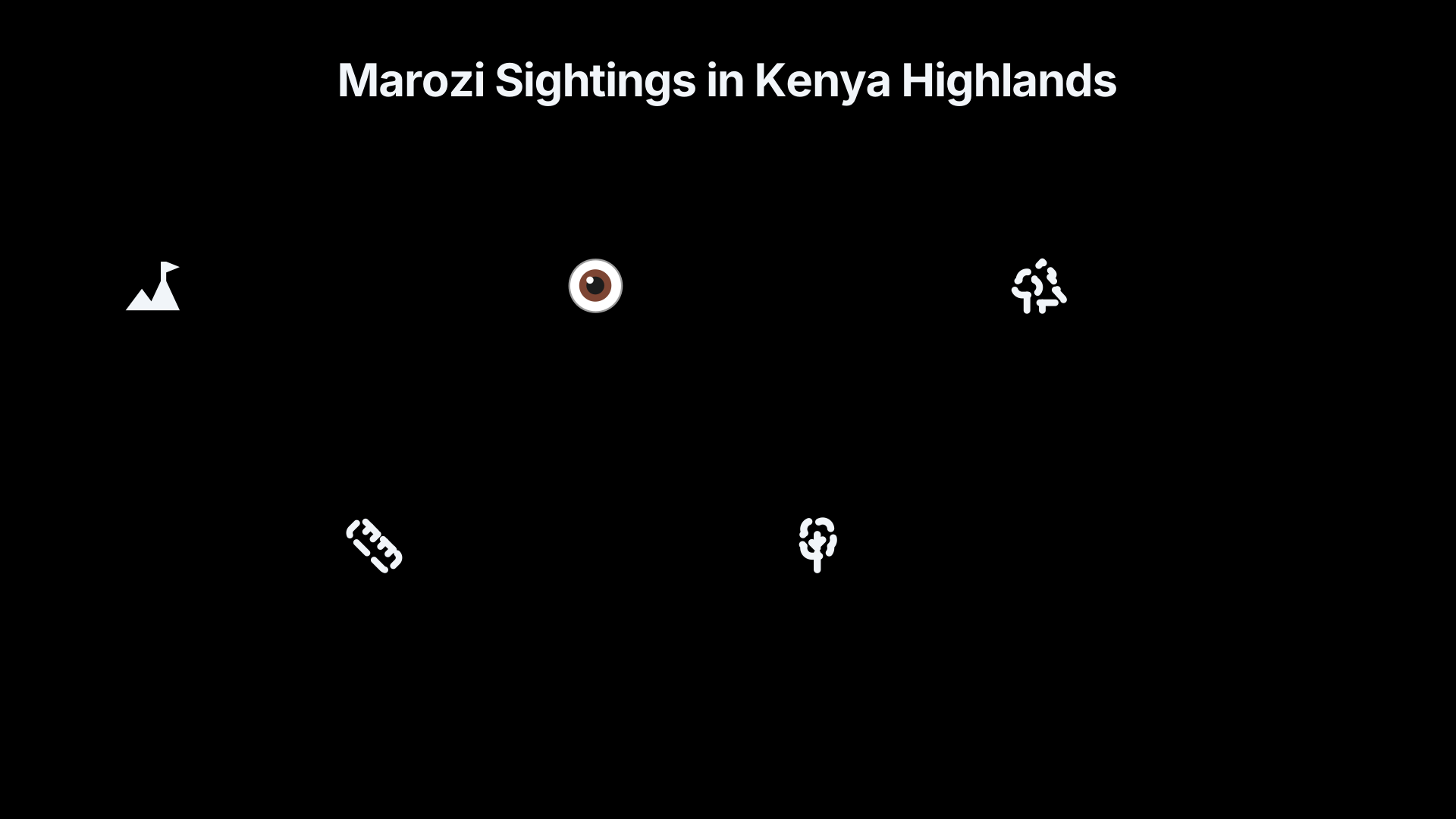
The marozi story is closely tied to Kenya’s central highlands rather than the open savannah landscapes most people associate with lions. Reports clustered around the Aberdare Range, the Kinangop Plateau and the slopes of Mount Kenya, often at elevations of around 10,000 feet (3,000 metres) or more. This alone attracted attention, since lions are generally associated with lower-altitude grasslands rather than cool, misty mountain environments.[Wikipedia]WikipediaOpen source on wikipedia.org.
One of the earliest often-cited reports came from Colonel Richard Meinertzhagen in 1903, who claimed to have seen dark lions bearing unusual markings in Kenya’s mountains. Later reports followed from hunters, settlers and game officials who described lion-like cats carrying leopard-style spotting. These accounts were never numerous, but they appeared often enough to create the impression that something unusual might inhabit the highlands.[Wikipedia]WikipediaOpen source on wikipedia.org.
Particularly influential were reports from experienced observers. Game Warden Captain R. E. Dent reportedly observed several spotted lions in the Aberdare region, while another witness, G. Hamilton-Snowball, reported seeing a pair on the Kinangop Plateau at roughly 11,500 feet. Such accounts helped distinguish the marozi from ordinary folklore because they came from people familiar with East African wildlife.[Wikipedia]WikipediaOpen source on wikipedia.org.
At the same time, the mountain setting encouraged mystery. The Aberdares are heavily forested, frequently shrouded in cloud and mist, and far less open than lion country on the plains. Animals could be glimpsed only briefly, leaving plenty of room for uncertainty and exaggeration. The landscape itself became part of the legend.[Wikipedia]WikipediaOpen source on wikipedia.org.
The 1931 spotted-lion skins
The strongest piece of evidence for the marozi arrived in 1931 when a farmer named Michael Trent shot two unusual cats in the Aberdare Mountains: a male and a female. According to reports, both animals displayed conspicuous spots across their bodies, despite appearing to be mature rather than juvenile lions. The male also possessed only a limited mane, adding to the impression that these were not typical lions.[Wikipedia]WikipediaOpen source on wikipedia.org.
The skins attracted immediate interest from Nairobi’s Game Department because adult lions normally lose most of the visible spotting they carry as cubs. The pelts seemed unusual enough that they were preserved and examined. Unfortunately, the bodies themselves were not retained intact. Little skeletal material survived, and the absence of complete skulls and skeletons would haunt the marozi debate for decades. Without those remains, zoologists could not confidently determine whether the animals represented a distinct population, an unusual colour form or simply atypical lions.[Wikipedia]WikipediaOpen source on wikipedia.org.
The skins became the centrepiece of all later discussion. Supporters of the marozi theory argued that they showed animals whose spotting was too extensive to be dismissed as ordinary juvenile markings. Critics replied that skins alone could not establish a new species or subspecies, especially when the crucial anatomical evidence had been lost.[messybeast.com]messybeast.comThey were smaller for one thing, and they were spotted all over. No, they did not belong to…Read more…
Why explorers went looking for the marozi
The spotted skins inspired British adventurer Kenneth Gandar-Dower, who became the most famous champion of the marozi story. In the mid-1930s he organised expeditions into the Aberdares and Mount Kenya region in search of living examples. His efforts popularised the mystery internationally and later formed the basis of his 1937 book The Spotted Lion.[Wikipedia]WikipediaKenneth Gandar DowerKenneth Gandar Dower
Gandar-Dower never captured or photographed a marozi. However, he believed he found supporting evidence. During his searches he recorded reports from local guides and residents who insisted that spotted mountain lions were distinct from both ordinary lions and leopards. He also reported finding tracks at high elevations that he considered consistent with an unknown lion population.[Wikipedia]WikipediaKenneth Gandar DowerKenneth Gandar Dower
For believers, the combination of local testimony, unusual tracks and the Trent skins suggested that a small highland lion population might once have existed. For sceptics, none of this crossed the line into proof. Tracks are difficult to interpret, eyewitnesses can disagree, and no living specimen ever emerged despite repeated searches.[Wikipedia]WikipediaOpen source on wikipedia.org.
Ordinary lions, markings and mountain mist
The most widely accepted explanation today is that the marozi was not a separate species at all but a collection of unusual lion sightings. Young lions naturally possess spots and rosettes. These markings usually fade with age, but they do not disappear at exactly the same rate in every animal. Some lions retain visible spotting well into adolescence and even adulthood. Several zoologists argued that the famous Aberdare skins fell within this range of variation.[Wikipedia]WikipediaOpen source on wikipedia.org.
The Trent animals also appear to have been relatively small. Rather than indicating a separate species, this may suggest that they were subadult lions that had not fully matured. Their lingering spots and reduced mane growth would fit that interpretation. Later commentators noted that lions only a few years old can show markings remarkably similar to those seen on the marozi skins.[Wikipedia]WikipediaOpen source on wikipedia.org.
Other explanations have been proposed over the years. Some writers suggested an isolated mountain population of lions adapted to cooler conditions. Others speculated about unusual genetics, while a few entertained the possibility of lion-leopard ancestry, although there is no evidence that such hybrids existed in the wild Aberdares. None of these alternatives gained broad scientific support.[Wikipedia]WikipediaOpen source on wikipedia.org.
The setting itself may have encouraged misinterpretation. A partially spotted lion glimpsed through mountain mist, forest shadows or poor light could easily appear stranger than it really was. In a region where lions were already uncommon and sightings brief, an unusual individual might quickly become the foundation of a local legend.[Wikipedia]WikipediaOpen source on wikipedia.org.

Why the marozi still matters
The marozi occupies an unusual place in Kenya’s mystery-animal tradition because the debate centres on real evidence rather than purely anecdotal stories. There were actual skins, identifiable witnesses and documented searches. Yet there was never enough evidence to convince mainstream zoology that a distinct mountain lion form existed.[Wikipedia]WikipediaOpen source on wikipedia.org.
As a result, the marozi survives as one of East Africa’s most intriguing unresolved wildlife stories. It is neither a straightforward cryptid nor a confirmed animal. Instead, it represents a genuine historical puzzle: whether the Aberdare highlands once hosted a distinctive population of spotted lions, or whether a handful of unusual individuals were transformed by circumstance, rarity and human imagination into one of Kenya’s enduring animal mysteries.[Wikipedia]WikipediaOpen source on wikipedia.org.
Amazon book picks
Further Reading
Books and field guides related to Did Kenya Have Spotted Mountain Lions?. Use these as the next step if you want deeper reading beyond the article.
The Man Eaters of Tsavo
Provides historical context for unusual lion narratives in Kenya.
The Kingdon Field Guide to African Mammals
Explains lion variation and identification.
Mammals of Africa
Useful for evaluating whether the marozi could be a distinct animal.
eBay marketplace picks
Marketplace Samples
Live-tested eBay searches with available results related to this page.
Endnotes
1.
Source: Wikipedia
Link:https://en.wikipedia.org/wiki/Marozi
2.
Source: messybeast.com
Link:https://messybeast.com/genetics/lions-spotted-2.htm
Source snippet
They were smaller for one thing, and they were spotted all over. No, they did not belong to...Read more...
3.
Source: Wikipedia
Link:https://it.wikipedia.org/wiki/Marozi
4.
Source: Wikipedia
Link:https://de.wikipedia.org/wiki/Marozi
5.
Source: Wikipedia
Title: Kenneth Gandar Dower
Link:https://en.wikipedia.org/wiki/Kenneth_Gandar_Dower
6.
Source: youtube.com
Title: The Marozi (Panthera leo maculatus) The spotted Lion
Link:https://www.youtube.com/watch?v=oywNPe5KHHc
Source snippet
The Marozi...
7.
Source: youtube.com
Title: The Marozi
Link:https://www.youtube.com/watch?v=iUKhz_wUWWU
8.
Source: youtube.com
Title: The Marozi
Link:https://www.youtube.com/watch?v=RpZTMMBWuJk
Source snippet
Are the Spotted Lions in Kenya's Aberdare Montane forests hybrids or a rare lion variant?...
9.
Source: library.eshikshya.org
Link:https://library.eshikshya.org/kiwix/content/wikipedia_en_all_maxi_2023-05/A/Marozi
Source snippet
years later, explorer Kenneth Gandar-Dower headed an expedition into the region in an attempt to capture or kill more specimens. He retur...
10.
Source: itsmth.fandom.com
Link:https://itsmth.fandom.com/wiki/Marozi
Source snippet
It's Something Wiki | FandomHe preserved the skins but not the skulls or skeletons. In 1935, Kenneth Gandar Dower headed an expedition...
Additional References
11.
Source: bionity.com
Link:https://www.bionity.com/en/encyclopedia/Marozi.html
Source snippet
MaroziThe unusual spotted markings on what seemed to be smallish adult lions prompted interest from the Nairobi Game Department; they wer...
12.
Source: duncanjdsmith.com
Link:https://www.duncanjdsmith.com/wp-content/uploads/2021/02/Old-Africa_Spotted-Lions.pdf
Source snippet
Pursuit of the Spotted LionThe spotted lion pelt in London's Natural History Museum, claimed by Gandar-Dower to be that of a Marozi. Page...
13.
Source: reddit.com
Title: the marozi or spotted lion is an alleged species
Link:https://www.reddit.com/r/Cryptozoology/comments/13e1152/the_marozi_or_spotted_lion_is_an_alleged_species/
Source snippet
The marozi or "spotted lion" is an alleged species...The species was reported from Eastern Africa, where in 1931 a man named Michael Tre...
14.
Source: facebook.com
Link:https://www.facebook.com/groups/1002571683091379/posts/9652578404757287/
Source snippet
gions of Kenya, which has intrigued researchers and wildlife enthusiasts...
15.
Source: strangeanimalspodcast.blubrry.net
Link:https://strangeanimalspodcast.blubrry.net/2024/02/12/episode-367-the-marozi/
Source snippet
367: The Marozi - Strange Animals Podcast12 Feb 2024 — In 1931 a farmer shot two small spotted lions in the mountains...
16.
Source: youtube.com
Link:https://www.youtube.com/watch?v=4FwbLpXtpoI
Source snippet
Marozi spotted lion Kenya cryptid The Marozi: Mutant Lion, Leopon, or an undiscovered species?...
17.
Source: pinebarrensinstitute.com
Title: cryptid profile marozi
Link:https://pinebarrensinstitute.com/cryptids/2018/8/18/cryptid-profile-marozi
Source snippet
Cryptid Profile: Marozi18 Aug 2018 — The first recorded encounter of a spotted lion took place in 1931. Kenneth Gandar-Dower took place i...
18.
Source: archive.org
Link:https://archive.org/details/dli.ministry.23073
Source snippet
Internet ArchiveThe spotted lion: Dower,Kenneth Gandar7 Mar 2021 — The spotted lion by Dower,Kenneth Gandar Publication date 1937 Topics...
19.
Source: youtube.com
Title: The Marozi: Mutant Lion, Leopon, or an undiscovered species?
Link:https://www.youtube.com/watch?v=yFje4KNUnr4
Source snippet
The Marozi (Panthera leo maculatus) The spotted Lion...
20.
Source: amazon.de
Link:https://www.amazon.de/-/en/Spotted-reprint-Kenneth-Gandar-Dower/dp/1616460717?tag=searcht-20
Source snippet
Kenneth Gandar Dower was killed in 1944 when the ship he was traveling on was torpedoed by a Japanese submarine, leaving...
Topic Tree