Strange Creatures of Nepal's High Himalaya
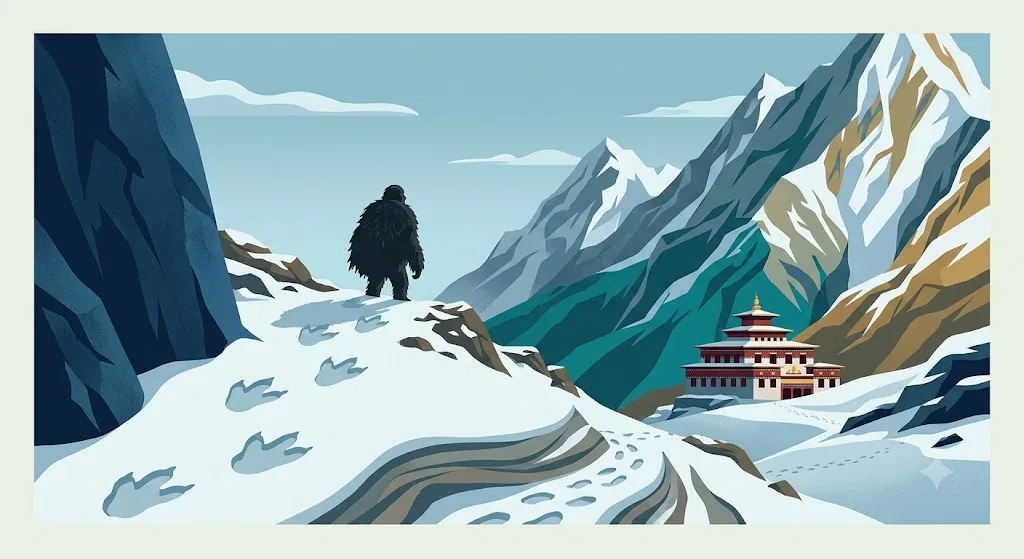
Nepal’s mystery-animal tradition is dominated by one figure: the Yeti, the shaggy, human-like being said to haunt the high Himalaya. It is not a confirmed animal.
Page outline Jump by section
Introduction
That does not make the legend uninteresting. Quite the opposite: Nepal is one of the best places in the world to see how a local mountain being becomes a global cryptid. Yeti tales link monastery relics, Everest expeditions, newspaper excitement, government permit rules, scientific testing, and the modern travel industry. Around it sit smaller but important traditions: forest shamans, serpent guardians of lakes and ponds, and stories that blur the line between folklore, spiritual landscape, and mystery-beast report.
Why Nepal became Yeti country
The Yeti is usually described in English-language popular culture as a large, hairy, ape-like or human-like creature of the Himalaya. In Nepal’s case, the legend became especially attached to the Everest region, the Khumbu, high passes, monasteries, and expedition routes used by foreign climbers in the twentieth century. The creature’s international fame grew because mountaineers, journalists, and later cryptozoologists carried local mountain stories into newspapers and books at exactly the moment Everest was becoming a global symbol of adventure.[Wikipedia]WikipediaOpen source on wikipedia.org.
The phrase “Abominable Snowman” is itself part of the story. It became popular after the 1921 British Everest reconnaissance era, when reports of large tracks in snow were filtered through expedition accounts and journalism. The famous English phrase appears to have grown from a confused or embellished rendering of a Himalayan term for a “snow man” or “man-bear” type being, rather than from a neat local name meaning “abominable”.[Wikipedia]WikipediaOpen source on wikipedia.org.
That matters because many readers first meet the Yeti as a monster of snowfields. In Nepal, the older picture is less tidy. The Yeti is not only a beast leaving footprints near glaciers; it is also a figure embedded in mountain belief, warnings about wilderness, stories of hidden valleys, and the practical knowledge of people who live alongside bears, langurs, yak, serow, snow, rock, and forests. The global cryptid version simplified a more layered Himalayan tradition into a single chaseable creature.
Where the reports cluster
Nepal’s Yeti geography is not evenly spread across the country. The strongest association is with the Himalayan north and north-east: Everest, Khumbu, Pangboche, Khumjung, high passes, and valleys used by climbers and trekking expeditions. These places offered three ingredients that made the legend travel: local stories, dramatic snowbound terrain, and foreign observers primed to turn tracks or relics into evidence.[AAC Publications]publications.americanalpineclub.orgAAC PublicationsHimalaya, Nepal, Slick-Johnson Nepal Snowman ExpeditionBetween the Chhoyang and the Iswa Kholas at about 12,000 feet they…
The Barun Valley is another important name in the evidence debate. In the 1980s, researchers and naturalists investigated Yeti-like footprints and local reports there, but the work increasingly pointed towards bear explanations, especially how overlapping bear tracks can look strangely human-like in snow or mud.[Wikipedia]WikipediaOpen source on wikipedia.org.
Pangboche and Khumjung matter for a different reason: relics. Monasteries in the Everest region became famous for objects described as Yeti hands, scalps, or skull-like remains. These were not just tourist curiosities; in local settings they could be treated as sacred or ritual objects. Their later handling by foreign collectors and investigators also raises an uncomfortable issue often missing from older cryptid writing: “evidence” was sometimes taken, smuggled, damaged, or removed from the communities that kept it.[Wikipedia]WikipediaPangboche HandPangboche Hand
What evidence has actually been offered?
The Nepal Yeti file rests on four main kinds of claimed evidence: sightings, tracks, relics, and biological samples. None has produced mainstream scientific confirmation of an unknown Himalayan ape or hominin.
Sightings are usually brief, distant, and shaped by extreme conditions. A dark figure moving on a slope, a shape glimpsed at altitude, or an animal seen at the edge of visibility can become memorable without becoming reliable proof. Early Western accounts often came from mountaineering contexts, where fatigue, distance, weather, and expectation all mattered.[Wikipedia]WikipediaOpen source on wikipedia.org.
Footprints are the most famous form of Yeti evidence. Snow is a poor recording surface: it melts, refreezes, enlarges, collapses, and distorts edges. A normal animal track can become long, wide, or toe-like after thawing. Overlapping front and hind paw prints can also create a false impression of one large, almost human foot. This is why many sceptical explanations focus not on witnesses lying, but on tracks changing after the animal has gone.[Wikipedia]WikipediaOpen source on wikipedia.org.
Relics such as the Pangboche hand and Khumjung scalp have generated some of the most dramatic stories. The Pangboche hand was promoted as a possible Yeti relic, but later testing of a finger associated with it found human DNA. The object’s history also includes alleged theft and smuggling, including the famous story that actor James Stewart helped carry material out of the region.[Wikipedia]WikipediaPangboche HandPangboche Hand
Hair, bone, tooth, skin and faecal samples have been more scientifically useful, but not in the way believers hoped. A 2017 Proceedings of the Royal Society B study analysed alleged Yeti specimens from the Himalaya and Tibetan Plateau and found that the supposed Yeti material came from Asian black bears, Himalayan brown bears, Tibetan brown bears, and one dog. The researchers argued that the biological roots of the Yeti legend are likely local bears rather than an unknown creature.[royalsocietypublishing.org]royalsocietypublishing.orgHimalayan 'yeti' DNA: polar bear or DNA degradation?Read moreRoyal Society PublishingEvolutionary history of enigmatic bears in the Tibetan Plateau…by T Lan · 2017 · Cited by 66 — Proceedings of…
The bear explanation is stronger than it sounds
Saying “it was probably a bear” can sound like a lazy debunk, but in Nepal it is a serious ecological explanation. Bears live in the kinds of landscapes where many Yeti stories arise, and their behaviour can be surprisingly misleading. A bear can stand upright briefly, leave large tracks, move through snow and scrub, raid livestock or food stores, and appear larger or stranger when glimpsed in poor visibility.
Nepal has both Asiatic black bear and brown bear contexts relevant to Yeti interpretation. A conservation report from the Manaslu Conservation Area found Himalayan black bears associated with forest habitats, while brown bear signs were recorded above the tree line in high pastures near the Tibetan border. That split is useful: it mirrors the way Yeti lore can move between forest edge, pasture, and high mountain space.[ntnc.org.np]ntnc.org.npDISTRIBUTIO N AND ABUNDANCE OF HIMALAYANDISTRIBUTIO N AND ABUNDANCE OF HIMALAYAN
The track problem is especially important. Research associated with the Barun Valley suggested that young Asiatic black bears spending time in trees can develop track patterns that, when overprinted in snow, look oddly hominid. A hind paw landing over or near a front paw can create a long print with a thumb-like mark; on a slope, the effect can become even more persuasive.[Wikipedia]WikipediaOpen source on wikipedia.org.
This does not mean every Yeti story is “just a bear” in a crude sense. Some are spiritual narratives, some are cautionary folklore, some are expedition misunderstandings, and some may be invented or embellished. But for physical evidence — tracks, hair, bone and faeces — bears remain the explanation with the best support.
The Yeti relics of Pangboche and Khumjung
Pangboche is central to the relic side of Nepal’s Yeti history. The monastery was associated with a mummified hand said by supporters to belong to a Yeti. Western interest grew during Tom Slick’s late-1950s expeditions, when investigators sought physical proof of the creature. Later accounts describe bone fragments being removed after monks refused to allow the relic to be taken for study; the story then folds into smuggling, celebrity involvement, scientific claims, and eventual DNA testing.[Wikipedia]WikipediaPangboche HandPangboche Hand
The most important modern result is simple: a finger linked to the Pangboche hand tested as human. That does not answer every question about the original object, especially because the relic’s history is tangled by alleged substitution and theft, but it removes the strongest version of the claim that this was clean biological evidence for an unknown creature.[Wikipedia]WikipediaPangboche HandPangboche Hand
Khumjung is famous for a different relic, often described in travel accounts as a Yeti scalp. It has become a pilgrimage-like stop for some trekkers interested in the legend. Earlier investigations associated such scalp-like objects with known animals rather than an unknown primate; one common explanation is that a hide or scalp from a Himalayan animal was shaped, preserved, or interpreted as something stranger.[The Nepal Journal]thenepaljournal.comThe Nepal Journal Why the Yeti Legend Lives On in NepalThe Nepal Journal Why the Yeti Legend Lives On in Nepal
These relics are valuable even when they fail as cryptid evidence. They show how a creature can be local, sacred, theatrical, economic, and scientific all at once. A monastery object can be a ritual item to one audience, a tourist attraction to another, and a testable specimen to a third. The trouble begins when the last audience treats the object as ownerless evidence.
The 1950s: when Yeti hunting became official business
The 1950s were the Yeti’s great publicity decade. Everest expeditions, newspaper stories, and wealthy private searches turned Himalayan folklore into an international mystery. Tom Slick’s Nepal expeditions are part of that moment, as is the 1954 Daily Mail “Snowman” expedition, which helped popularise the idea that physical proof might be waiting in monasteries, tracks, or hair samples.[AAC Publications]publications.americanalpineclub.orgAAC PublicationsHimalaya, Nepal, Slick-Johnson Nepal Snowman ExpeditionBetween the Chhoyang and the Iswa Kholas at about 12,000 feet they…
The strangest official document in the story is the 1959 Yeti memo. The U.S. Embassy in Kathmandu relayed Nepal’s rules for expeditions searching for the creature: searchers needed a permit, the Yeti was not to be killed except in self-defence, and photographs or captured evidence had to be turned over to Nepalese authorities.[National Archives Museum]visit.archives.govOpen source on archives.gov.
This did not mean the U.S. government had proved the Yeti existed. It meant the Yeti had become a real administrative problem: foreign expeditions were entering Nepal, publicity was valuable, sovereignty mattered, and the government wanted rules around any claimed discovery. In cryptid history, that is almost as interesting as a footprint. The creature was unconfirmed, but the social machinery around it was very real.
Forest shamans and the smaller wild beings of Nepal
Nepal’s mystery-beast landscape is not only about a giant snow creature. One of the most intriguing related figures is the forest shaman, a small, hairy, partly human wilderness being in Nepalese shamanic tradition. Academic discussion of the figure connects it to shamanic initiation: a being of the forest may abduct, test, teach, or transform a future healer.[atpweb.org]atpweb.orgTH E "CALLING," THE YETI, AND THE BAN JHAKRITH E "CALLING," THE YETI, AND THE BAN JHAKRI
This tradition is important because it complicates the usual Western “ape-man” framing. Some Himalayan beings are not simply animals hiding from science. They may be teachers, spirits, tricksters, guardians, or initiators. A story about a hairy forest figure taking a child into a cave does not work like a zoological sighting report; it belongs to a ritual and spiritual vocabulary.
That does not place it outside a cryptid-by-country project. It shows one of the main traps in reading Nepal’s monster lore: not every hairy being is a failed wildlife report. Some are part of how communities talk about danger, knowledge, illness, vocation, and the power of the forest.
Serpent guardians, lakes and water monsters
Nepal does not have a Loch Ness-style lake monster tradition with the same international profile as the Yeti. Its stronger water-creature folklore centres on serpent beings associated with lakes, ponds, rain, and sacred water. Kathmandu Valley’s old lake traditions, Taudaha Lake, Nagdaha, and serpent shrines show how water beings can function as guardians rather than “monsters” in the modern cryptid sense.[Wikipedia]WikipediaOpen source on wikipedia.org.
Taudaha Lake is a good example. Local legend links it to the draining of the ancient Kathmandu lake and to displaced serpent beings. The lake’s name is commonly explained through words connected with snake and lake, and folklore says a serpent king was given an underwater palace there and promised to protect local people if the water’s peace was not disturbed.[Wikipedia]WikipediaTaudaha LakeTaudaha Lake
For readers looking for “Nepal lake monsters”, this is the useful distinction: Nepal’s lake lore is less about a hidden biological animal with a long neck and more about sacred serpent guardians of water. In a cryptid framework, these traditions belong near lake-monster material, but they should not be forced into the same evidence category as modern eyewitness claims about unknown animals.
Tourism turned the Yeti into a national brand
By the twenty-first century, Nepal’s Yeti was not only a legend or cryptozoological problem; it was a brand. The creature has appeared in trekking culture, souvenirs, airline naming, public art, and tourism campaigns. The most visible recent example was the Visit Nepal 2020 campaign, which used the Yeti as a mascot and commissioned large decorated Yeti sculptures.[Nepali Times]nepalitimes.comNepali Times Sorting through history for the YetiNepali Times Sorting through history for the Yeti
That campaign also showed how contested the creature remains. Some residents criticised the sculptures for not matching local expectations of what a Yeti should look like; others objected to the use of religious and cultural imagery on public mascot figures. Reports from early 2020 describe religious symbols being removed from some sculptures after criticism.[nepalitimes.com]nepalitimes.comNepali Times Love it or hate it, it's abominableNepali Times Love it or hate it, it's abominable
The episode is revealing. A cryptid can become too famous for its own folklore. Once the Yeti is turned into a national mascot, everyone has a stake in its appearance: artists, tourism officials, local residents, religious communities, trekkers, sceptics, and monster fans. The argument was not only “is the Yeti real?” but “who gets to decide what the Yeti means?”

What sceptics, believers and folklorists each get right
The Nepal Yeti survives because different groups are often talking about different things.
Sceptics are strongest on physical evidence. DNA testing, track mechanics, known wildlife, and the messy history of relics all point away from a confirmed unknown ape. Alleged Yeti specimens tested in the 2017 genetic study were not mysterious primate remains; they were bear and dog material.[Royal Society Publishing]royalsocietypublishing.orgHimalayan 'yeti' DNA: polar bear or DNA degradation?Read moreRoyal Society PublishingEvolutionary history of enigmatic bears in the Tibetan Plateau…by T Lan · 2017 · Cited by 66 — Proceedings of…
Believers are right that the legend cannot be dismissed as a single modern hoax. The Yeti did not appear from nowhere in a tabloid office. It drew on older Himalayan ideas about wild beings, dangerous mountain spaces, and encounters beyond ordinary settlement. Even the “Abominable Snowman” label, however distorted, grew from expedition-era contact with local interpretations of tracks.[Wikipedia]WikipediaOpen source on wikipedia.org.
Folklorists and historians are best placed to explain why the story changes. In local settings, the creature can be a warning, spirit, relic, or mountain presence. In expedition writing, it becomes a quarry. In newspapers, it becomes a sensation. In science, it becomes samples and controls. In tourism, it becomes a mascot. The same being moves through several systems of meaning without staying the same.
The most likely explanation
The most likely explanation for Nepal’s Yeti tradition is not one neat answer. It is a stack of explanations that accumulated over time.
At the physical level, many tracks, hairs, bones, and sightings are best explained by bears, other known wildlife, distorted snow prints, distance, and expectation. At the cultural level, Nepal’s Yeti belongs to a wider Himalayan world of wild beings, forest powers, sacred relics, and mountain danger. At the media level, twentieth-century expedition culture turned a regional tradition into the “Abominable Snowman”, a global cryptid with a life of its own.
That layered answer is less dramatic than discovering a hidden ape, but it is more faithful to the evidence. Nepal’s Yeti is not confirmed as an animal. It is confirmed as something else: one of the world’s most successful mystery-creature traditions, rooted in real mountains, real wildlife, real local belief, and a century of storytelling that still has not melted away.
Amazon book picks
Further Reading
Books and field guides related to What Really Haunts Nepal's High Himalaya?. Use these as the next step if you want deeper reading beyond the article.
The Snow Leopard
Captures the atmosphere and culture of the high Himalaya where Yeti stories thrive.
The Mammoth Book of Unexplained Phenomena
Includes discussion of famous mystery-creature traditions such as the Yeti.
eBay marketplace picks
Marketplace Samples
Live-tested eBay searches with available results related to this page.



Endnotes
1.
Source: Wikipedia
Link:https://en.wikipedia.org/wiki/Yeti
2.
Source: Wikipedia
Title: Pangboche Hand
Link:https://en.wikipedia.org/wiki/Pangboche_Hand
3.
Source: ntnc.org.np
Title: DISTRIBUTIO N AND ABUNDANCE OF HIMALAYAN
Link:https://www.ntnc.org.np/sites/default/files/doc_publication/2018-11/Final%20Progress%20Report_Himalayan%20black%20bear%20and%20brown%20bear_NTNC-Taronga_Nepal.pdf
4.
Source: visit.archives.gov
Link:https://visit.archives.gov/whats-on/explore-exhibits/want-hunt-yeti
5.
Source: prologue.blogs.archives.gov
Title: Pieces of History On Exhibit: The “Yeti Memo”
Link:https://prologue.blogs.archives.gov/2017/09/28/on-exhibit-the-yeti-memo/
6.
Source: atpweb.org
Title: TH E “CALLING,” THE YETI, AND THE BAN JHAKRI (“
Link:https://www.atpweb.org/jtparchive/trps-29-97-01-047.pdf
7.
Source: Wikipedia
Link:https://en.wikipedia.org/wiki/Nagdaha
8.
Source: Wikipedia
Title: Taudaha Lake
Link:https://en.wikipedia.org/wiki/Taudaha_Lake
9.
Source: Wikipedia
Link:https://en.wikipedia.org/wiki/Swayambhunath
10.
Source: Wikipedia
Title: Visit Nepal 2020
Link:https://en.wikipedia.org/wiki/Visit_Nepal_2020
11.
Source: Wikipedia
Title: Category:Nepalese legendary creatures
Link:https://en.wikipedia.org/wiki/Category%3ANepalese_legendary_creatures
12.
Source: Wikipedia
Title: Banjhakri and Banjhakrini
Link:https://en.wikipedia.org/wiki/Banjhakri_and_Banjhakrini
13.
Source: Wikipedia
Title: Asian black bear
Link:https://en.wikipedia.org/wiki/Asian_black_bear
14.
Source: Wikipedia
Title: Monster of Lake Tota
Link:https://en.wikipedia.org/wiki/Monster_of_Lake_Tota
15.
Source: Wikipedia
Title: List of lake monsters
Link:https://en.wikipedia.org/wiki/List_of_lake_monsters
16.
Source: Wikipedia
Title: Lake monster
Link:https://en.wikipedia.org/wiki/Lake_monster
17.
Source: archives.gov
Title: nr18 02
Link:https://www.archives.gov/press/press-releases/2018/nr18-02
18.
Source: time.com
Title: us government hunt yeti
Link:https://time.com/4090520/us-government-hunt-yeti/
19.
Source: youtube.com
Title: The Mystery of the Yeti: Legends of the Himalayas | Simple History
Link:https://www.youtube.com/watch?v=AVmdl-KHjPA
Source snippet
Yeti - The Mythical Creature | The Tales of Nepal...
20.
Source: youtube.com
Link:https://www.youtube.com/watch?v=uCDa526bqdU
Source snippet
The DNA Results Are Finally In...
21.
Source: royalsocietypublishing.org
Title: Himalayan ‘yeti’ DNA: polar bear or DNA degradation?Read more
Link:https://royalsocietypublishing.org/rspb/article/284/1868/20171804/78775/Evolutionary-history-of-enigmatic-bears-in-the
Source snippet
Royal Society PublishingEvolutionary history of enigmatic bears in the Tibetan Plateau...by T Lan · 2017 · Cited by 66 — Proceedings of...
22.
Source: royalsociety.org
Title: mysteries of the yeti
Link:https://royalsociety.org/blog/2017/11/mysteries-of-the-yeti/
Source snippet
Royal SocietyMysteries of the yeti29 Nov 2017 — Our results refute that finding and strongly suggest that the biological basis of the yet...
23.
Source: publications.americanalpineclub.org
Link:https://publications.americanalpineclub.org/articles/12195932400/Himalaya-Nepal-Slick-Johnson-Nepal-Snowman-Expedition
Source snippet
AAC PublicationsHimalaya, Nepal, Slick-Johnson Nepal Snowman ExpeditionBetween the Chhoyang and the Iswa Kholas at about 12,000 feet they...
24.
Source: thenepaljournal.com
Title: The Nepal Journal Why the Yeti Legend Lives On in Nepal
Link:https://thenepaljournal.com/why-the-yeti-legend-lives-on-in-nepal/
25.
Source: nepalitimes.com
Title: Nepali Times Sorting through history for the Yeti
Link:https://nepalitimes.com/sorting-through-history-for-the-yeti
26.
Source: nepalitimes.com
Title: Nepali Times Love it or hate it, it’s abominable
Link:https://nepalitimes.com/love-it-or-hate-it-it-s-abominable
27.
Source: thehimalayantimes.com
Title: religious images removed from mascot
Link:https://thehimalayantimes.com/kathmandu/religious-images-removed-from-mascot
28.
Source: facebook.com
Link:https://www.facebook.com/groups/2077090212683898/posts/2473305599729022/
29.
Source: royalsocietypublishing.org
Link:https://royalsocietypublishing.org/rspb/article/282/1800/20141712/77504/Himalayan-yeti-DNA-polar-bear-or-DNA-degradation-A
30.
Source: cryptidz.fandom.com
Link:https://cryptidz.fandom.com/wiki/Nepal
31.
Source: cryptidz.fandom.com
Title: Lake Monsters
Link:https://cryptidz.fandom.com/wiki/Lake_Monsters
32.
Source: noobs-guide-to-necromancy.fandom.com
Link:https://noobs-guide-to-necromancy.fandom.com/wiki/Nepal
33.
Source: sciencefocus.com
Link:https://www.sciencefocus.com/nature/monsters
34.
Source: thehimalayantimes.com
Title: nepal names yeti as national symbol
Link:https://thehimalayantimes.com/nepal/nepal-names-yeti-as-national-symbol
35.
Source: himalaya-nepal.com
Title: Legend of the Yeti Nepal
Link:https://himalaya-nepal.com/travel-in-Nepal/Legend-of-the-Yeti-Nepal.htm
36.
Source: hillforts.co.uk
Title: abominable snowman
Link:https://www.hillforts.co.uk/abominable-snowman
37.
Source: vajraadventure.com
Link:https://www.vajraadventure.com/blog/yeti
38.
Source: abandonedspaces.com
Title: yeti scalp
Link:https://www.abandonedspaces.com/public/yeti-scalp.html
39.
Source: wolverhampton.gov.uk
Title: discover former mps links everest and abominable snowman
Link:https://www.wolverhampton.gov.uk/news/discover-former-mps-links-everest-and-abominable-snowman
40.
Source: thehistoryblog.com
Link:https://www.thehistoryblog.com/archives/14196
41.
Source: abookofcreatures.com
Title: lake monsters
Link:https://abookofcreatures.com/tag/lake-monsters/
42.
Source: nepalitimes.com
Link:https://nepalitimes.com/tag/yeti
43.
Source: historicmysteries.com
Link:https://www.historicmysteries.com/myths-legends/yeti/25179/
44.
Source: lairofmythics.com
Title: lake monsters
Link:https://lairofmythics.com/blogs/cryptid-case-files/lake-monsters?srsltid=AfmBOoqDY0VEnVooqIk79sLO-2OzkSJOxx6z-eNIiKOKHbCTar5355Rq
45.
Source: worldheritageoutlook.iucn.org
Link:https://worldheritageoutlook.iucn.org/node/1180/pdf?year=2025
Additional References
46.
Source: medicine.buffalo.edu
Title: Jacobs School of Medicine Abominable Snowman?
Link:https://medicine.buffalo.edu/oiace/news.host.html/content/shared/university/news/news-center-releases/2017/11/037.detail.html
Source snippet
Nope. Study ties DNA samples from...28 Nov 2017 — The research, published Nov. 29 in Proceedings of the Royal Society B, analyzed nine “...
47.
Source: everest1921.com
Link:https://www.everest1921.com/printing-the-legend.html
Source snippet
Mount Everest: the Reconnaissance, 1921The Abominable Snowman is born - Mount Everest, 1921The report of 31 October 1921 contained the f...
Published: October 1921
48.
Source: docsteach.org
Title: despatch kathmandu yeti
Link:https://docsteach.org/document/despatch-kathmandu-yeti/
Source snippet
Foreign Service Despatch 75 from the American Embassy...In 1959, the U.S. State Department received a curious memo from the new...
49.
Source: usgs.gov
Link:https://www.usgs.gov/publications/current-status-brown-bears-manasalu-conservation-area-nepal
50.
Source: youtube.com
Link:https://www.youtube.com/watch?v=KfBdcUpL2bA
Source snippet
Yeti Evidence Finally Tested | Expedition Unknown: Hunt for the Yeti E4 | Discovery Channel India...
51.
Source: researchgate.net
Link:https://www.researchgate.net/publication/322519965_Imagining_the_Wild_Man_Yeti_Sightings_in_Folktales_and_Newspapers_of_the_Darjeeling_and_Kalimpong_Hills
52.
Source: academia.edu
Link:https://www.academia.edu/143171833/The_Yeti_Spirit_of_Himalayan_Forest_Shamans
53.
Source: researchgate.net
Link:https://www.researchgate.net/publication/321361263_Evolutionary_history_of_enigmatic_bears_in_the_Tibetan_Plateau-Himalaya_region_and_the_identity_of_the_yeti
54.
Source: iucnredlist.org
Link:https://www.iucnredlist.org/species/pdf/121229971/attachment
55.
Source: researchgate.net
Link:https://www.researchgate.net/publication/281575326_Conservation_Strategy_for_Brown_Bear_and_Its_Habitat_in_Nepal
Topic Tree
Follow this branch
Related pages 192
- Antigua Cryptids
- Maldives Monsters
- Malta Monsters
- Qatar Monsters
- Argentina Monsters
- +187 more in sidebar