Within Tunisia Monsters
Could Lions Still Be Hiding in Tunisia?
Memories of extinct local lions may help explain later big-cat sightings, but fleeting reports cannot prove that a hidden population survived.
On this page
- When lions disappeared from Tunisia
- Why extinct predators linger in local memory
- Misidentification, last survivors and modern big cat claims
Page outline Jump by section
Introduction
Could lions still be hiding in Tunisia? The short answer is almost certainly no. Yet the question refuses to disappear. Tunisia is one of the few countries where stories of mysterious big cats are rooted in a genuine historical reality: lions really did live there. Unlike many phantom-cat legends elsewhere in the world, Tunisian rumours of large feline shadows moving through forests or mountains emerge against the backdrop of a predator that once roamed the country before vanishing in the late nineteenth century.[PMC]pmc.ncbi.nlm.nih.govPMCExamining the Extinction of the Barbary Lion and Itsby SA Black · 2013 · Cited by 66 — Until the 18th century, Barbary lions ranged from the Atlas Mountains to the Mediterranean [7]. Ext…

That unusual history helps explain why occasional reports of oversized cats attract attention. Memories of the Barbary lion, local folklore, fragments of hunting history and sightings of unfamiliar animals can combine into stories that sound less implausible than they might elsewhere. The challenge is separating cultural memory from biological evidence.
When lions disappeared from Tunisia
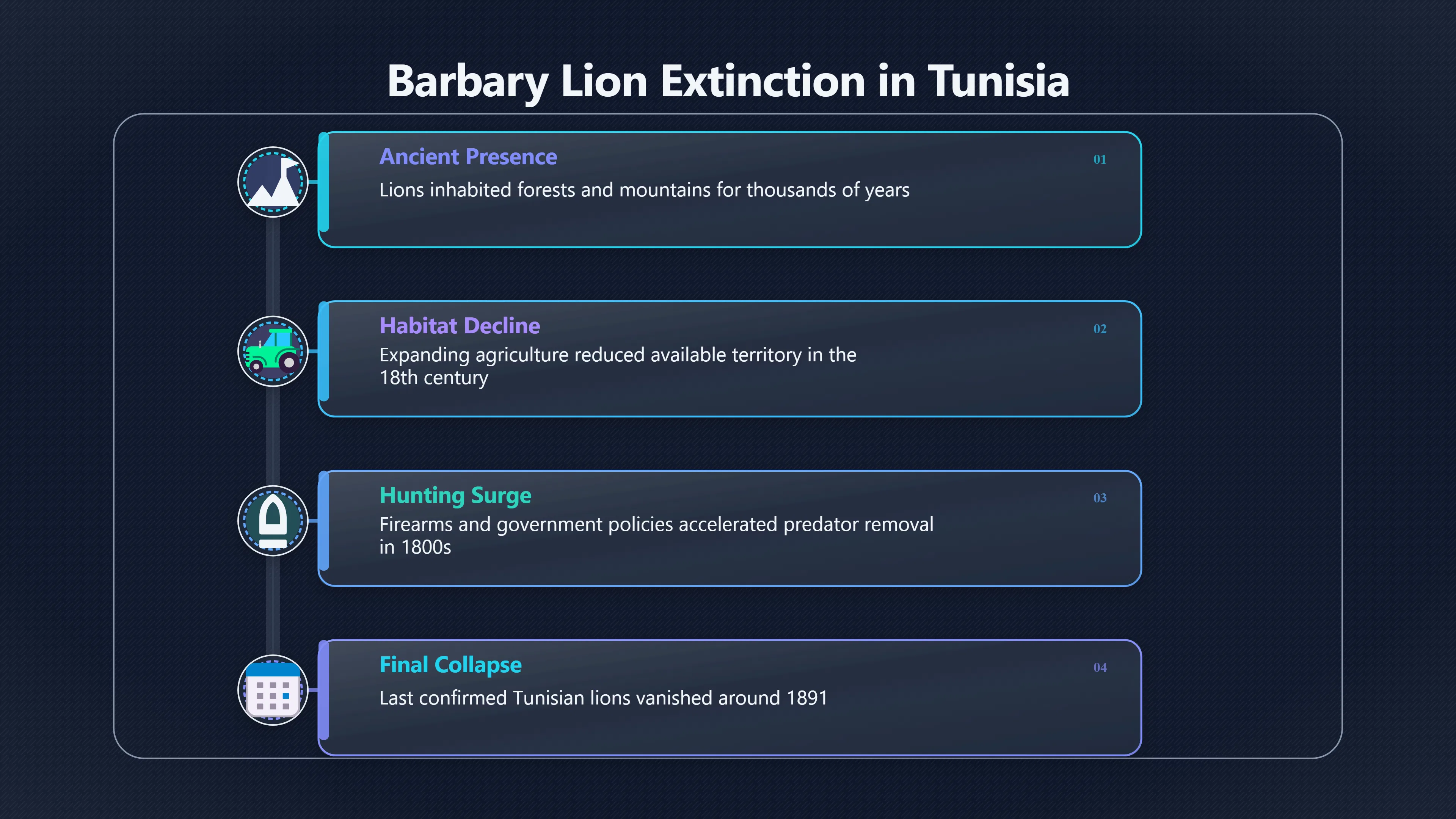
For thousands of years lions inhabited North Africa, including what is now Tunisia. Historical records, archaeological evidence and later hunting accounts show that lions occupied forests, scrubland and mountain regions across the Maghreb.[PMC]pmc.ncbi.nlm.nih.govPMCExamining the Extinction of the Barbary Lion and Itsby SA Black · 2013 · Cited by 66 — Until the 18th century, Barbary lions ranged from the Atlas Mountains to the Mediterranean [7]. Ext…
Their decline accelerated during the eighteenth and nineteenth centuries. Expanding agriculture reduced habitat, firearms made hunting more effective, and governments sometimes encouraged the killing of large predators. By the late nineteenth century, lion populations in Tunisia had collapsed. Several historical reviews place the last confirmed Tunisian lions around 1891, making Tunisia one of the first North African countries to lose the species completely.[zobodat.at]zobodat.atZeitschrift Saeugetierkundein European museumswas killed in 1893 near Batna. Thus we can consider the Barbary Lion as having been exterminated in Tunisia in…
This date matters because it creates a clear dividing line between history and legend. Unlike Algeria and Morocco, where scattered reports continued into the twentieth century, Tunisia’s documented lion population appears to have disappeared earlier.[PMC]pmc.ncbi.nlm.nih.govPMCExamining the Extinction of the Barbary Lion and Itsby SA Black · 2013 · Cited by 66 — Until the 18th century, Barbary lions ranged from the Atlas Mountains to the Mediterranean [7]. Ext…
The extinction was recent enough, however, that stories could be passed down through families. Grandparents and great-grandparents in some rural communities lived only a few generations removed from a time when lions were remembered as real animals rather than mythical creatures.[Reddit]reddit.comIt went extinct in the wild because of the "France civilization " but they still live in the Zoos.Read more…
Why extinct predators linger in local memory
Large predators leave an unusually strong mark on cultural memory. People build stories around animals that threaten livestock, inspire fear or symbolise wilderness. Even after the animals disappear, the stories often survive.
Tunisia’s lost lions occupy a similar place in memory to wolves in Britain or bears in parts of Europe. They represent a vanished landscape that feels both historical and mysterious. In areas near old forests and mountain ranges, tales of large cats can therefore sound like echoes of something once real rather than entirely invented.[PMC]pmc.ncbi.nlm.nih.govPMCExamining the Extinction of the Barbary Lion and Itsby SA Black · 2013 · Cited by 66 — Until the 18th century, Barbary lions ranged from the Atlas Mountains to the Mediterranean [7]. Ext…
There is also a psychological effect at work. When people know a species once existed locally, the idea that a few survivors might have escaped notice seems more plausible. Throughout the twentieth century, many regions that formerly held lions produced rumours that isolated animals had survived in remote valleys or mountains long after official extinction dates.
In Tunisia, these stories rarely developed into a sustained national legend. Instead, they tended to appear as occasional rumours about strange nocturnal animals, unusually large cats or reports of predator-like behaviour in remote areas.
Why phantom-cat reports keep appearing
Around the world, phantom-cat reports typically involve witnesses glimpsing a large feline briefly, often at dawn, dusk or night. Tunisia’s examples are usually modest compared with famous British black-panther stories or American mountain-lion rumours, but the underlying mechanisms are similar.[Wikipedia]WikipediaPhantom catPhantom cat
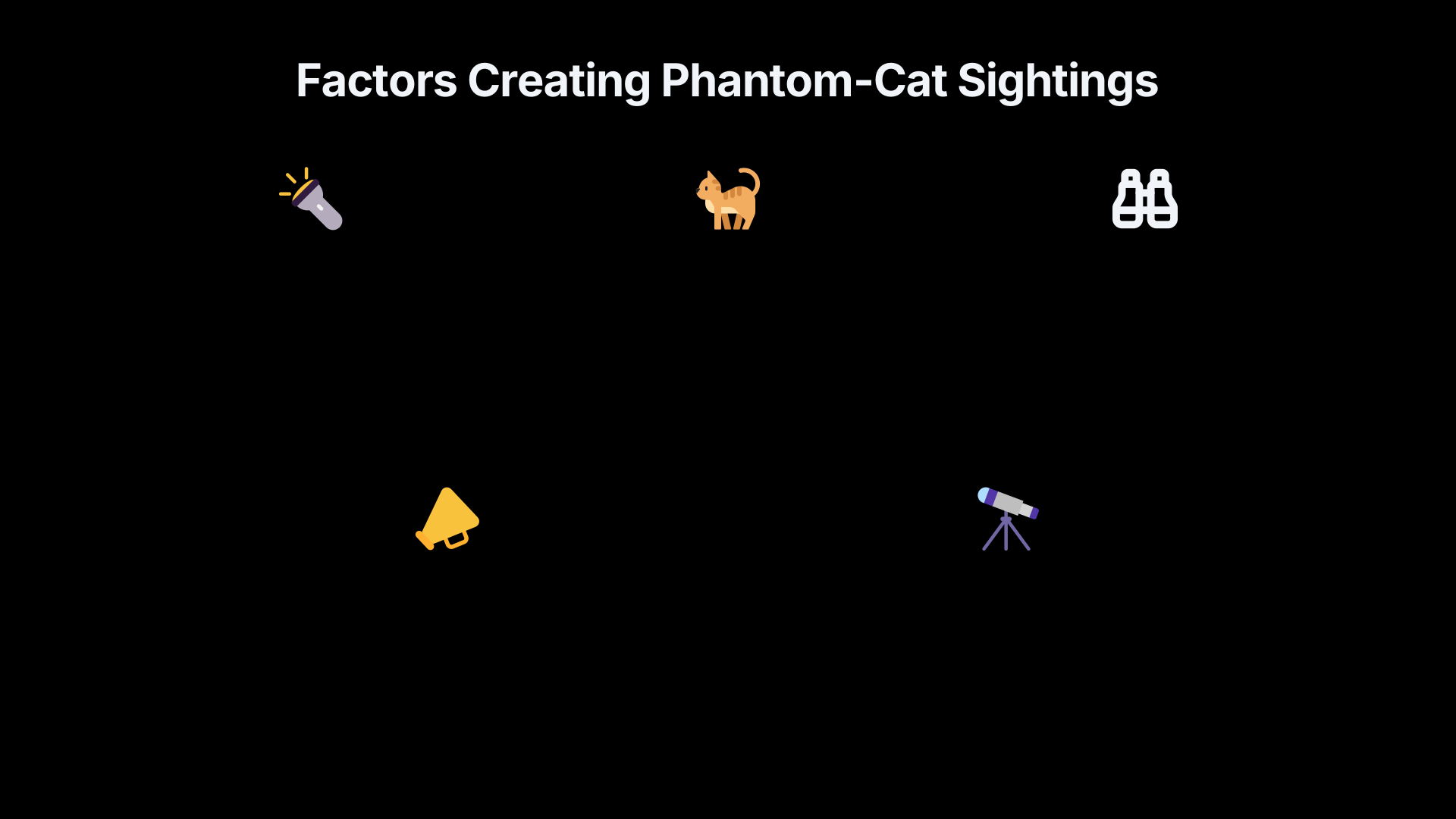
Several factors can create convincing sightings:
Distance and poor light. A medium-sized animal viewed briefly can appear much larger than it really is.
Expectation. Someone aware that lions once lived in Tunisia may be more likely to interpret an unusual animal as a surviving big cat.
Fragmentary observations. Most reports involve only a few seconds of viewing time, making reliable identification difficult.
Story reinforcement. Once a rumour begins circulating in a community, later observations may be interpreted through the same lens.
Unlike countries with ongoing clusters of alleged big-cat encounters, Tunisia has not produced a consistent body of evidence such as repeated photographs, tracks verified by specialists, carcasses or genetic samples. The reports remain anecdotal rather than investigative.
Misidentification, last survivors and modern big-cat claims
The most important question is whether any modern reports could represent genuine surviving lions. The evidence strongly argues against that possibility.
A breeding population of lions requires a substantial number of animals, territory, prey and genetic diversity. No such population has been documented in Tunisia despite decades of wildlife surveys and conservation work. Protected areas such as the forests of the north are monitored far more closely today than in the nineteenth century.[Wikipedia]WikipediaList of World Heritage Sites in TunisiaList of World Heritage Sites in Tunisia
Claims of lone survivors face similar problems. A lion living unnoticed for generations would need either a hidden population to reproduce or repeated undiscovered animals appearing from nowhere. Neither scenario has supporting evidence.
More plausible explanations include:
- Large feral or stray dogs seen under poor conditions.
- Domestic cats viewed at misleading distances.
- Wildcats appearing larger than expected.
- Exaggerated retellings of ordinary wildlife encounters.
- Rare escapees from captivity, a common explanation in many phantom-cat cases worldwide.[Wikipedia]WikipediaPhantom catPhantom cat
The distinction between a surviving lion and a modern phantom cat is crucial. A surviving lion would represent an extraordinary zoological discovery requiring physical evidence. A phantom-cat report only requires a witness sincerely believing they saw something unusual.
The attraction of the “last lion” story
Many mystery-animal traditions revolve around the idea that extinction was not quite complete. The appeal is obvious. A hidden survivor offers a hopeful ending to a story of environmental loss.
North Africa generated numerous twentieth-century rumours of lingering Barbary lions after their recognised disappearance. Some reports from neighbouring countries were recorded decades after official extinction dates, helping to keep the possibility alive in public imagination. Researchers reviewing historical records have found evidence that small remnant populations may have survived longer in parts of Algeria and Morocco than once believed, although Tunisia’s documented extinction appears earlier.[wikipedia.org]WikipediaBarbary lionApril 19, 2026 — Today, it is locally extinct in this region. Fossils of the Barbary lion dating to between 100,000 and 110,000 years wer…
That wider regional history feeds Tunisian speculation. If lions survived unexpectedly elsewhere in the Maghreb for a few extra decades, some people naturally wonder whether Tunisia might also have harboured hidden survivors. The available evidence, however, points the other way. Historical records suggest Tunisia lost its lions before the prolonged twentieth-century survival stories emerged farther west.[Zobodat]zobodat.atZeitschrift Saeugetierkundein European museumswas killed in 1893 near Batna. Thus we can consider the Barbary Lion as having been exterminated in Tunisia in…
What the phantom-lion legend reveals
Tunisia’s phantom-cat stories are interesting precisely because they begin with a real animal rather than a wholly mythical creature. The country once possessed lions, and the disappearance of those predators left a cultural footprint that still shapes how unusual wildlife sightings are interpreted.
From a cryptid perspective, the legend is less about discovering a hidden population and more about understanding how extinction echoes through memory. A fleeting glimpse of a large animal, a tale handed down through generations, or a rumour from a remote hillside gains extra power because people know lions truly belonged to the Tunisian landscape.
The result is a distinctly Tunisian mystery: not a monster emerging from folklore alone, but a phantom built from the memory of a predator that genuinely vanished. The evidence does not support surviving lions, yet the story endures because the lost king of North Africa was once real.[nih.gov]pmc.ncbi.nlm.nih.govPMCExamining the Extinction of the Barbary Lion and Itsby SA Black · 2013 · Cited by 66 — Until the 18th century, Barbary lions ranged from the Atlas Mountains to the Mediterranean [7]. Ext…

Amazon book picks
Further Reading
Books and field guides related to Could Lions Still Be Hiding in Tunisia?. Use these as the next step if you want deeper reading beyond the article.
The Histories
Provides essential background on North Africa, antiquity and legendary accounts.
eBay marketplace picks
Marketplace Samples
Live-tested eBay searches with available results related to this page.


Endnotes
1.
Source: pmc.ncbi.nlm.nih.gov
Title: PMCExamining the Extinction of the Barbary Lion and Its
Link:https://pmc.ncbi.nlm.nih.gov/articles/PMC3616087/
Source snippet
by SA Black · 2013 · Cited by 66 — Until the 18th century, Barbary lions ranged from the Atlas Mountains to the Mediterranean [7]. Ext...
2.
Source: zobodat.at
Title: Zeitschrift Saeugetierkunde 35 0034 0045
Link:https://www.zobodat.at/pdf/Zeitschrift-Saeugetierkunde_35_0034-0045.pdf
Source snippet
in European museumswas killed in 1893 near Batna. Thus we can consider the Barbary Lion as having been exterminated in Tunisia in...
3.
Source: Wikipedia
Title: List of African species extinct in the Holocene
Link:https://en.wikipedia.org/wiki/List_of_African_species_extinct_in_the_Holocene
4.
Source: tunza.eco-generation.org
Title: Tunza Eco-Generation Barbary lion
Link:https://tunza.eco-generation.org/ambassadorReportView.jsp?viewID=12489
Source snippet
Barbary lion - Ambassador report - Our Actions18 Jun 2015 — In the 1970s, Barbary lions were assumed to have been ext...
5.
Source: reddit.com
Link:https://www.reddit.com/r/Tunisia/comments/18fyhxb/atlas_lion_extinct_around_1920_yes_we_did_have/
Source snippet
It went extinct in the wild because of the "France civilization " but they still live in the Zoos.Read more...
6.
Source: Wikipedia
Title: List of World Heritage Sites in Tunisia
Link:https://en.wikipedia.org/wiki/List_of_World_Heritage_Sites_in_Tunisia
7.
Source: Wikipedia
Title: Phantom cat
Link:https://en.wikipedia.org/wiki/Phantom_cat
8.
Source: Wikipedia
Title: Barbary lion
Link:https://en.wikipedia.org/wiki/Barbary_lion
Source snippet
April 19, 2026 — Today, it is locally extinct in this region. Fossils of the Barbary lion dating to between 100,000 and 110,000 years wer...
Published: April 19, 2026
9.
Source: reddit.com
Title: the last photo of a barbary lion taken in 1924
Link:https://www.reddit.com/r/Tunisia/comments/1ewub0h/the_last_photo_of_a_barbary_lion_taken_in_1924/
10.
Source: Wikipedia
Link:https://en.wikipedia.org/wiki/Lion
11.
Source: youtube.com
Title: Barbary Lions | Largest Lions in the World?
Link:https://www.youtube.com/watch?v=EnZ_g5oBlsU
Source snippet
6 Most Powerful Extinct Lion Species...
Additional References
12.
Source: youtube.com
Link:https://www.youtube.com/watch?v=Lv6KPCrCINg
Source snippet
Barbary lion extinction history The Extinction of the Barbary Lions #barbarylion #lions #barbary #history #facts Legends Unfold...
13.
Source: blogs.kent.ac.uk
Title: Kent Blogs When did the Barbary lion fall extinct in the wild?
Link:https://blogs.kent.ac.uk/barbarylion/2014/08/01/when-did-the-barbary-lion-become-extinct-in-the-wild/
Source snippet
Blogs at KentAug 1, 2014 — An authentic sighting? The Barbary lion was known to range Morocco, Algeria, Tunisia and Libya. Any other popu...
14.
Source: youtube.com
Title: Mysterious Big Cat Cryptids
Link:https://www.youtube.com/watch?v=4UnMAIxav7A
Source snippet
Big Cats Caught on Camera in the British Countryside? | UK Panther Sightings Investigated...
15.
Source: facebook.com
Link:https://www.facebook.com/someamazingfacts/posts/the-mighty-atlas-lion-a-lost-king-of-north-africathe-atlas-lion-also-called-the-/1373633534793754/
16.
Source: nationalgeographic.com
Link:https://www.nationalgeographic.com/animals/mammals/facts/african-lion
17.
Source: bigcatrescue.org
Link:https://bigcatrescue.org/conservation-news/barbary-lions
18.
Source: detroitlions.com
Link:https://www.detroitlions.com/team/players-roster/
19.
Source: facebook.com
Link:https://www.facebook.com/Channel4News/posts/divers-have-recorded-what-they-believe-is-the-first-underwater-footage-of-a-grea/976214425041670/
20.
Source: facebook.com
Link:https://www.facebook.com/LibyatheVision/posts/libyan-wildlife-photographer-mohammed-almuntasir-captured-a-brief-video-of-a-san/1545842874223504/
21.
Source: researchgate.net
Link:https://www.researchgate.net/figure/Lion-sightings-in-the-eastern-Maghreb-of-Algeria-and-Tunisia-1851-1860-Ksour-Mountains_fig9_236022631
Topic Tree