Within Bhutan Beasts
Are Migoi Sightings Really Bear Encounters?
Footprints, casts and sightings keep the legend alive, but bears and distorted tracks remain the strongest natural explanations.
On this page
- What counts as evidence in Bhutan's Migoi story
- Why snow tracks can mislead witnesses
- How bears fit the wider yeti pattern
Page outline Jump by section
Introduction
The strongest evidence claims for Bhutan’s Migoi tradition have usually involved footprints, brief sightings, hair samples, and stories passed down through remote Himalayan communities. Yet when those claims are examined closely, bears emerge again and again as the most convincing natural explanation. This does not make the Migoi story uninteresting. In many ways, the tension between strange evidence and ordinary wildlife is exactly what keeps the legend alive.

Across the Himalayas, including the eastern Bhutan landscapes associated with the Migoi, witnesses have reported large tracks in snow, distant upright figures, and mysterious animals glimpsed in poor weather. Cryptozoologists have often treated such reports as possible evidence for an unknown creature. Sceptics, wildlife researchers, and mountaineers have repeatedly pointed instead to bears, distorted footprints, and the challenges of identifying animals in harsh mountain environments. Modern DNA studies have strengthened the bear explanation considerably, even as the folklore continues to flourish.[Science]science.orgSo much for the abominable snowmanStudy finds that '…28 Nov 2017 — DNA analyses of nine samples purported to be from the "abominable snowman" reveal that eight actually…
What Counts as Evidence in Bhutan’s Migoi Story?
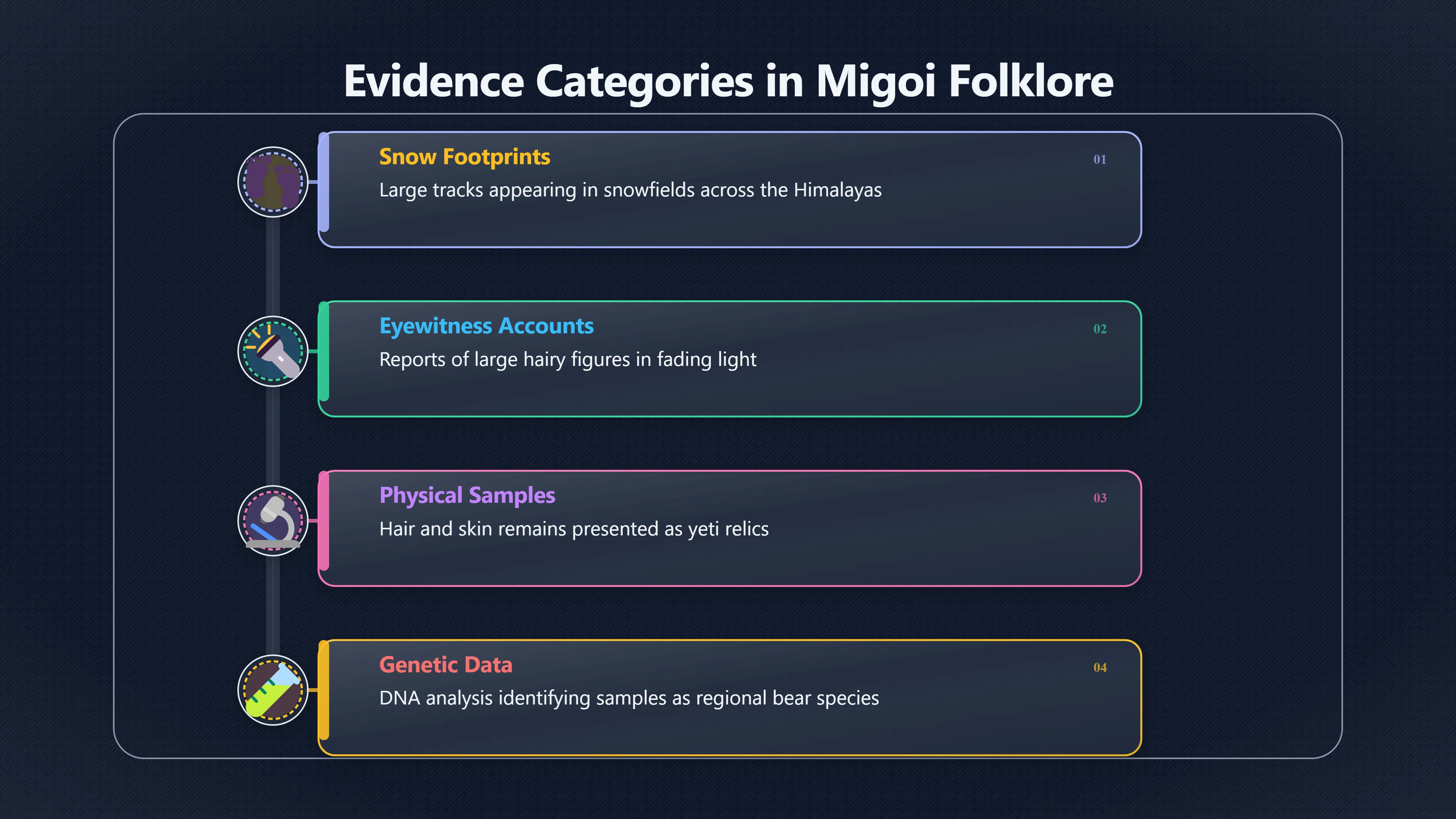
Unlike a recognised animal species, the Migoi has never been supported by a confirmed body, skeleton, living specimen, or verified genetic sample. Most evidence falls into a handful of recurring categories.
Footprints are by far the most famous. Large tracks appearing in snowfields have been reported across the Himalayan region for more than a century. In Bhutan, stories of unusual tracks help reinforce the belief that something unknown still moves through remote valleys and mountain passes.[Wikipedia]WikipediaOpen source on wikipedia.org.
Eyewitness reports form the second major category. These often describe a large, hairy, human-like figure seen at a distance, in fading light, during storms, or across difficult terrain. Such accounts can be sincere while still being vulnerable to misidentification.
Physical samples have occasionally been presented as Migoi or yeti evidence. Hair, skin, bones, and other remains have attracted attention because they seem more testable than stories. However, modern genetic analysis has repeatedly traced supposed yeti material back to known animals rather than an unknown species.[science.org]science.orgSo much for the abominable snowmanStudy finds that '…28 Nov 2017 — DNA analyses of nine samples purported to be from the "abominable snowman" reveal that eight actually…
The important point is that Migoi evidence is largely indirect. It depends on traces, impressions, and interpretations rather than on a clearly documented animal.
Why Snow Tracks Can Mislead Witnesses
Footprints may look like the strongest evidence at first glance, but snow is surprisingly good at creating illusions.
A fresh bear track can change dramatically after exposure to sunlight, wind, melting, and refreezing. As edges soften and expand, individual paw prints may merge together. What began as a series of ordinary tracks can appear larger, more human-like, and more mysterious than it really was.
This effect has been discussed for decades in relation to famous Himalayan yeti footprints. Researchers examining classic footprint photographs have argued that many can be explained by bear tracks altered by weather conditions. Later analysis of well-known footprint cases found additional clues consistent with bear movement, including associated marks interpreted as claw impressions.[Wikipedia]WikipediaOpen source on wikipedia.org.
Mountain terrain also creates perspective problems. Tracks viewed from a distance can seem enormous. Snow depth varies across a slope, making stride lengths appear unusual. In strong winds, parts of a track may disappear while others remain, producing shapes that look unlike any normal animal footprint.
For a witness already familiar with local Migoi stories, an ambiguous track may naturally be interpreted through the lens of the legend. That does not mean the observer is dishonest; it means the evidence itself is often difficult to read with confidence.
How Bears Fit the Wider Yeti Pattern
The bear explanation is not simply a modern attempt to dismiss folklore. It emerged because bears repeatedly match important details found in reports.
Several Himalayan bear species inhabit regions associated with yeti traditions, including the Himalayan brown bear and the Asiatic black bear. These animals can occasionally stand or walk short distances on their hind legs, creating a strikingly human-like silhouette. At a distance, especially in poor visibility, a large upright bear can appear surprisingly similar to descriptions of a wild hairy humanoid.[Wikipedia]WikipediaOpen source on wikipedia.org.
The connection between bears and yeti traditions is also reflected in language. Some Himalayan terms historically associated with yeti-like beings have been interpreted as referring to bear-like creatures or “man-bears,” showing that local traditions did not always draw a sharp distinction between mysterious wild beings and known wildlife.[Wikipedia]WikipediaOpen source on wikipedia.org.
Bhutan’s eastern highlands contain suitable habitat for bears as well as the kind of rugged terrain where sightings are difficult to verify. When a witness reports a large dark figure crossing a distant slope, bears offer a plausible explanation that requires no unknown species.
What DNA Evidence Has Revealed
The most significant challenge to Migoi-as-an-undiscovered-animal theories has come from genetics.
For years, various hair samples and supposed yeti relics circulated through museums, private collections, and monasteries across the Himalayan region. Some were promoted as possible evidence of an unknown primate. When researchers obtained DNA from these materials and compared it with known species, the results pointed overwhelmingly toward bears.[Royal Society Publishing]royalsocietypublishing.orgRoyal Society PublishingEvolutionary history of enigmatic bears in the Tibetan Plateau…by T Lan · 2017 · Cited by 65 — Phylogenetic an…
A widely cited 2017 study analysed multiple specimens attributed to the yeti. The researchers found that the samples belonged to Himalayan brown bears, Tibetan brown bears, Asiatic black bears, or other known animals rather than an unknown creature. Eight of nine purported yeti samples matched bear species, while another proved to be from a dog.[royalsocietypublishing.org]royalsocietypublishing.orgRoyal Society PublishingEvolutionary history of enigmatic bears in the Tibetan Plateau…by T Lan · 2017 · Cited by 65 — Phylogenetic an…
These findings do not disprove every Migoi sighting. A witness can still report seeing something unusual. What the studies do show is that some of the most celebrated pieces of physical evidence fail to support the existence of an unknown Himalayan ape-like animal.

Why the Migoi Legend Survives
The bear explanation answers many questions, but not all of them. Legends survive because they serve cultural purposes that go beyond zoology.
In Bhutan, the Migoi is connected to remote landscapes, local identity, and a sense that parts of the mountains remain mysterious. Even if a particular footprint was probably made by a bear, the story attached to it may still hold meaning for the community that preserves it.
There is also a psychological factor. A fleeting encounter in fog, snow, or dense forest can feel extraordinary. Once such an experience is retold, it becomes part of a larger tradition. New reports are then interpreted alongside older stories, reinforcing the legend across generations.
This helps explain why the Migoi remains culturally important even as scientific evidence increasingly favours known wildlife. The legend thrives not because every claim is convincing, but because the Himalayan environment continues to produce exactly the kinds of ambiguous experiences that inspire mystery.
So Are Migoi Sightings Really Bear Encounters?
The cautious answer is that many probably are.
When researchers compare reported evidence with known animals, bears consistently provide the best fit for large footprints, distant upright figures, and many physical samples. Weather-distorted tracks offer a strong explanation for some of the most famous footprint cases, while DNA testing has repeatedly identified supposed yeti remains as belonging to regional bear species.[royalsocietypublishing.org]royalsocietypublishing.orgRoyal Society PublishingEvolutionary history of enigmatic bears in the Tibetan Plateau…by T Lan · 2017 · Cited by 65 — Phylogenetic an…
That does not mean every Migoi story can be reconstructed with certainty. Most sightings are too brief, too old, or too poorly documented for definitive conclusions. What can be said is that the strongest available evidence currently supports a pattern familiar across the Himalayas: unusual observations interpreted through a powerful local legend, with bears providing the most convincing natural explanation for many of the reports.[wikipedia.org]WikipediaOpen source on wikipedia.org.
Amazon book picks
Further Reading
Books and field guides related to Are Migoi Sightings Really Bear Encounters?. Use these as the next step if you want deeper reading beyond the article.
Abominable Science!
Explains how misidentification and evidence problems shape Yeti claims.
Field Guide To Bigfoot, Yeti, & Other Mystery Primates Worldwide
Covers Yeti traditions and competing explanations.
eBay marketplace picks
Marketplace Samples
Live-tested eBay searches with available results related to this page.



Endnotes
1.
Source: science.org
Title: So much for the abominable snowman
Link:https://www.science.org/content/article/so-much-abominable-snowman-study-finds-yeti-dna-belongs-bears
Source snippet
Study finds that '...28 Nov 2017 — DNA analyses of nine samples purported to be from the "abominable snowman" reveal that eight actually...
2.
Source: royalsocietypublishing.org
Link:https://royalsocietypublishing.org/rspb/article/284/1868/20171804/78775/Evolutionary-history-of-enigmatic-bears-in-the
Source snippet
Royal Society PublishingEvolutionary history of enigmatic bears in the Tibetan Plateau...by T Lan · 2017 · Cited by 65 — Phylogenetic an...
3.
Source: Wikipedia
Link:https://en.wikipedia.org/wiki/Yeti
4.
Source: royalsociety.org
Title: Mysteries of the yeti | Royal Society
Link:https://royalsociety.org/blog/2017/11/mysteries-of-the-yeti/
Source snippet
November 29, 2017 — Our results refute that finding and strongly suggest that the biological basis of the yeti legend is local brown and...
Published: November 29, 2017
Additional References
5.
Source: wired.com
Link:https://www.wired.com/story/yeti-bear-legend-dna-analysis-myth
Source snippet
Un estudio genético de nueve muestras, que incluían patas, cueros cabelludos, huesos y excrementos cuidadosamente preservados en monaster...
6.
Source: eurekalert.org
Link:https://www.eurekalert.org/news-releases/844761
Source snippet
study ties DNA samples from purported Yetis to Asian bearsNovember 28, 2017 — The research, which will be published in Proceedings of the...
Published: November 28, 2017
7.
Source: nationalgeographic.com
Link:https://www.nationalgeographic.com/science/article/yeti-legends-real-animals-dna-bears-himalaya-science
Source snippet
Yeti Legends Are Based on These Real Animals, DNA ShowsNovember 29, 2017 — “This study clearly confirms that the Yeti samples tested are...
Published: November 29, 2017
8.
Source: downtoearth.org.in
Link:https://www.downtoearth.org.in/wildlife-biodiversity/the-yeti-quest-59535
9.
Source: dailybhutan.com
Title: there is a yeti preserve in bhutan that is bigger than the size of singapore
Link:https://www.dailybhutan.com/article/there-is-a-yeti-preserve-in-bhutan-that-is-bigger-than-the-size-of-singapore
Source snippet
There is a yeti preserve in Bhutan that is bigger than the...21 Oct 2021 — the Brokpa people of Bhutan believe that the yetis have backw...
10.
Source: uncdf.org
Title: the footprint of climate change disrupts lives in the land of the yeti
Link:https://www.uncdf.org/article/8256/the-footprint-of-climate-change-disrupts-lives-in-the-land-of-the-yeti
Source snippet
The footprint of climate change disrupts lives in the land...12 Jun 2023 — In the far eastern region of Bhutan lies [Sakteng]({{ 'sakteng/' | relative_url }}), a small tow...
11.
Source: atlasobscura.com
Title: DN A Says ‘Yeti’ Evidence Comes From Bears, But Will Believers Be
Link:https://www.atlasobscura.com/articles/yeti-dna-study-footprints-himalayas-genetic-asiatic-bears
Source snippet
DNA Says 'Yeti' Evidence Comes From Bears, But Will Believers Be...November 30, 2017 — “Our findings strongly suggest that the biologica...
Published: November 30, 2017
12.
Source: theguardian.com
Title: dna sampling exposes nine yeti specimens as eight bears and a dog
Link:https://www.theguardian.com/science/2017/nov/29/dna-sampling-exposes-nine-yeti-specimens-as-eight-bears-and-a-dog
Source snippet
DNA sampling exposes nine 'yeti specimens' as eight...29 Nov 2017 — “Of those nine samples, eight of them matched local bears that are f...
13.
Source: voanews.com
Title: Abominable News: Purported Yeti Evidence Came from Bears, Dog
Link:https://www.voanews.com/a/purported-yeti-evidence-from-bears-dog/4141349.html
Source snippet
November 28, 2017 — The researchers sequenced mitochondrial DNA — genetic material in structures within cells that was passed down from m...
Published: November 28, 2017
14.
Source: hcn.org
Link:https://www.hcn.org/issues/issue-302/a-most-unusual-sanctuary-where-the-yeti-roams-free/
Source snippet
A most unusual sanctuary, where the Yeti roams free25 Jul 2005 — The Bhutanese have created a 253-square-mile wildlife sanctuary for the...
Topic Tree