Within Montenegro Monsters
What Screams and Stalks Montenegro After Dark?
Montenegro's caves and forests are linked to dog-headed ogres and screaming night beings shaped by darkness, strange sounds and dangerous terrain.
On this page
- The dog headed psoglav of caves and burial places
- The drekavac and the power of unexplained cries
- Animals, echoes and fear in remote landscapes
Page outline Jump by section
Introduction
Montenegro’s strangest night creatures are not usually described by what they look like. They are recognised first by what people hear. Across the mountains, forests, caves and graveyards of the South Slavic world, stories persist about screaming beings in the dark, dog-headed cave monsters and uncanny sounds that seem to come from nowhere. In Montenegro, these traditions are part of a wider folklore landscape that includes the psoglav, a terrifying dog-headed creature associated with caves and burial places, and the drekavac, a night-haunting “screamer” whose cries were once taken as warnings of death, illness or misfortune.[Wikipedia]WikipediaOpen source on wikipedia.org.
Unlike lake-monster legends, these stories are rooted less in sightings and more in the experience of moving through dangerous terrain after dark. Deep karst caves, isolated villages, echoing valleys and the cries of nocturnal animals all helped create a folklore in which the unseen could feel more frightening than the visible. The result is a tradition that sits somewhere between monster lore, cautionary tale and an attempt to explain unsettling sounds in the night.[Wikipedia]WikipediaOpen source on wikipedia.org.
The dog-headed psoglav of caves and burial places
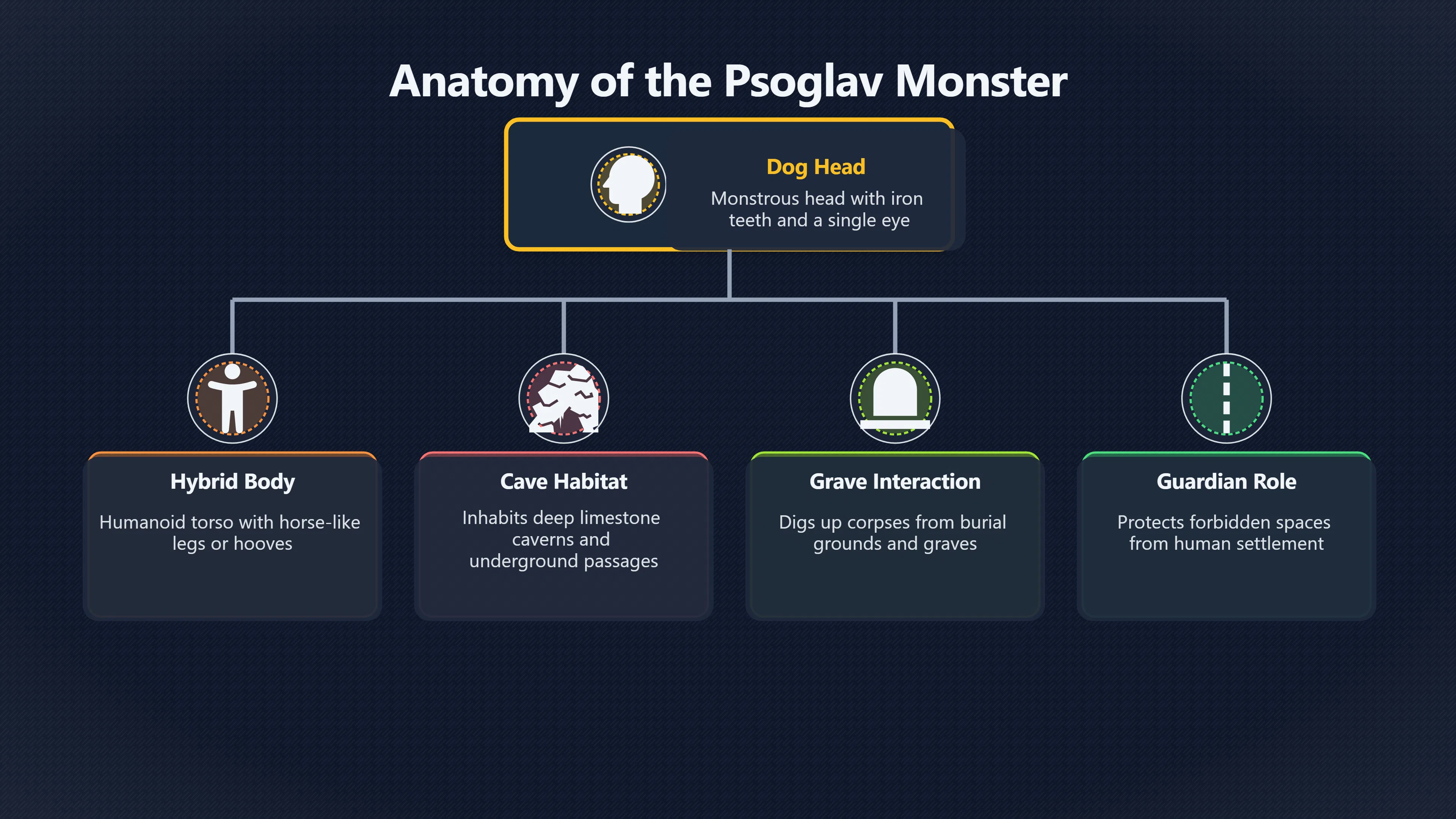
Among the most disturbing creatures linked to Montenegro and neighbouring South Slavic regions is the psoglav, literally a “dog-head”. Folklore describes it as a monstrous being with a dog’s head, iron teeth, a single eye and an almost human body. Some traditions add horse-like legs or hooves, making it a hybrid creature that is neither fully animal nor fully human.[Wikipedia]WikipediaOpen source on wikipedia.org.
The psoglav was said to inhabit caves, dark underground places and lands beyond ordinary human settlement. Stories describe it feeding on people and even digging up corpses from graves. These gruesome details connect it with burial grounds, the underworld and fears surrounding death rather than with any specific animal mystery.[Wikipedia]WikipediaOpen source on wikipedia.org.
For Montenegro, the cave connection is especially important. Much of the country is formed from rugged limestone landscapes riddled with sinkholes, caverns and underground passages. Before modern lighting and mapping, caves represented genuine danger. A cave entrance could conceal sudden drops, wild animals, unstable rock or complete darkness. Folklore often transformed these hazards into monsters, giving communities a memorable reason to avoid certain places after nightfall. The psoglav functioned as a guardian of forbidden spaces, turning geological danger into a vivid story.[Wikipedia]WikipediaOpen source on wikipedia.org.
The creature also belongs to a much older tradition of dog-headed beings found across Europe and beyond. Medieval travellers, religious texts and folklore collections frequently placed dog-headed races at the edges of the known world. In the Balkans, the psoglav became a localised version of that broader idea: a monstrous inhabitant of caves and wilderness beyond the safety of the village.[sic-journal.org]sic-journal.orgby adding that they lived in caves in the mountains of India, that they had large teeth and breathed…
The drekavac and the power of unexplained cries
If the psoglav was feared because of where it lived, the drekavac was feared because of what it sounded like.
The name is usually translated as “the screamer” or “the screecher”. Throughout South Slavic folklore, including traditions recorded in Montenegro, the drekavac is associated with terrifying cries heard after dark. The sound often mattered more than the creature’s appearance. In many stories nobody saw it clearly; they only heard a shriek that echoed across fields, forests or graveyards.[Wikipedia]Wikipediahas been variously described:.Read more…
Descriptions vary dramatically from place to place. Some traditions portray the drekavac as the restless spirit of an unbaptised child. Others describe it as an undead figure emerging from a grave, a strange canine creature walking on two legs, or a shapeshifting animal-like being. The inconsistency is revealing. Unlike legends based on a supposedly observed animal, the drekavac was built around a shared experience—the unsettling sound—while the creature itself changed according to local beliefs.[Wikipedia]Wikipediahas been variously described:.Read more…
In many accounts, hearing the scream was considered an omen. It might foretell illness, death, crop failure or trouble for livestock. The cry itself became the monster. People did not need to see glowing eyes in the forest if the sound alone was enough to convince them that something unnatural was nearby.[Katie Marie Robinson-Sherlock]katiemariewriter.comKatie Marie Robinson-SherlockThe Chilling Legend of the Drekavac9 Oct 2024 — In Slavic folklore, encountering this creature or hearing it…
This emphasis on sound helps explain why the drekavac spread so widely across the Balkans. Different communities could hear different animals, interpret them through local beliefs and arrive at remarkably similar stories about a night creature whose presence was announced by a scream.[Wikipedia]Wikipediahas been variously described:.Read more…

Why screams carry so far in Montenegro’s landscape
Montenegro’s geography is almost designed to amplify mysterious sounds. Steep valleys, rocky canyons and mountain slopes create complex echoes. A cry from a distant animal can bounce between cliffs and emerge from an unexpected direction, making it difficult to locate its source.
Many of the country’s nocturnal animals produce calls that can sound surprisingly human. Foxes emit piercing screams. Owls create eerie shrieks and whistles. Wild cats, martens and other mammals can produce vocalisations that are startling when heard in darkness. Even ordinary livestock can sound unfamiliar when their calls are distorted by distance and terrain.
Before electric lighting became widespread, rural communities experienced these sounds in conditions of near-total darkness. A scream heard from a cemetery, cave entrance or forest edge could easily acquire a supernatural explanation. The drekavac legend provided a framework for understanding those experiences. Rather than being random noises, the sounds became messages from a known creature with a recognised place in folklore.[Wikipedia]Wikipediahas been variously described:.Read more…
The same mechanism appears in many mountain cultures. When the source of a sound cannot be identified, the imagination often supplies one. In Montenegro, that imagined source frequently took the form of a drekavac.
From folklore monster to modern mystery creature
Although the drekavac originated in folklore, it occasionally crossed into modern mystery-animal culture. During the late twentieth and early twenty-first centuries, reports from parts of the former Yugoslavia described strange livestock attacks, unusual carcasses and unexplained nocturnal cries that some locals linked to the creature. These stories rarely produced convincing physical evidence, but they demonstrate how an old legend can adapt to modern expectations.[Wikipedia]WikipediaOpen source on wikipedia.org.
Instead of an undead spirit, the drekavac sometimes became an unknown animal. Reports described odd-looking canine creatures, fox-like bodies or unidentified predators. Yet these claims generally remained anecdotal, and no recognised zoological discovery emerged from them. Sceptical explanations usually pointed towards known wildlife, scavengers, disease, decomposition or simple misidentification.[Cryptid Wiki]cryptidz.fandom.comCryptid Wiki Drekavac | Cryptid WikiCryptid Wiki Drekavac | Cryptid Wiki
The psoglav underwent a similar transformation in popular culture. Once a cave-dwelling demon, it increasingly appears in fantasy art, folklore collections and monster catalogues. Modern audiences often treat it as a cryptid-like creature even though its origins are clearly mythological rather than zoological.[Wikipedia]WikipediaOpen source on wikipedia.org.

Animals, echoes and fear in remote landscapes
The most revealing thing about Montenegro’s night creatures is not whether they existed, but why people believed in them.
The psoglav embodies the dangers of caves, wilderness and burial places. The drekavac embodies the fear of unexplained sounds in darkness. Both legends emerged from environments where people regularly encountered situations that felt threatening but could not be easily explained.[Wikipedia]WikipediaOpen source on wikipedia.org.
Viewed this way, these creatures are not failed zoology. They are cultural maps of fear. The psoglav warns against entering dangerous underground places. The drekavac gives a name and personality to frightening nocturnal cries. Together they reveal how people interpreted remote landscapes long before torches, roads and scientific explanations made those environments feel familiar.
That is why the legends remain memorable. A lake monster may be seen once and forgotten. A scream echoing through a dark valley, or a cave entrance disappearing into blackness, is an experience many people can still imagine. In Montenegro’s folklore, those experiences became monsters that stalked the night long after the sound itself had faded.[Wikipedia]WikipediaOpen source on wikipedia.org.
Amazon book picks
Further Reading
Books and field guides related to What Screams and Stalks Montenegro After Dark?. Use these as the next step if you want deeper reading beyond the article.
The Element Encyclopedia of Magical Creatures
Contains many creature types comparable to Balkan night beings.
The Lore of the Land
Helps explain how sounds, places and fears become monster stories.
eBay marketplace picks
Marketplace Samples
Live-tested eBay searches with available results related to this page.
Endnotes
1.
Source: Wikipedia
Link:https://en.wikipedia.org/wiki/Psoglav
2.
Source: Wikipedia
Link:https://en.wikipedia.org/wiki/Drekavac
Source snippet
has been variously described:.Read more...
3.
Source: Wikipedia
Link:https://fr.wikipedia.org/wiki/Psoglav
4.
Source: sic-journal.org
Link:https://www.sic-journal.org/Article/Index/657
Source snippet
by adding that they lived in caves in the mountains of India, that they had large teeth and breathed...
5.
Source: Wikipedia
Link:https://fr.wikipedia.org/wiki/Drekavac
6.
Source: Wikipedia
Link:https://it.wikipedia.org/wiki/Drekavac
7.
Source: Wikipedia
Link:https://de.wikipedia.org/wiki/Drekavac
8.
Source: youtube.com
Title: Psoglav – The One-Eyed Werewolf of Slavic Folklore
Link:https://www.youtube.com/watch?v=aHqe0J69nJo
Source snippet
DREKAVAC - The Screamer Who Brings Death...
9.
Source: youtube.com
Link:https://www.youtube.com/watch?v=-rrPlQCZZN0
Source snippet
Slavic Mythology Horror: Creatures You Don't Want to Meet...
10.
Source: katiemariewriter.com
Link:https://katiemariewriter.com/2024/10/09/the-chilling-legend-of-the-drekavac/
Source snippet
Katie Marie Robinson-SherlockThe Chilling Legend of the Drekavac9 Oct 2024 — In Slavic folklore, encountering this creature or hearing it...
11.
Source: cryptidz.fandom.com
Title: Cryptid Wiki Drekavac | Cryptid Wiki
Link:https://cryptidz.fandom.com/wiki/Drekavac
12.
Source: mythus.fandom.com
Title: List of Slavic creatures
Link:https://mythus.fandom.com/wiki/List_of_Slavic_creatures
13.
Source: worldanvil.com
Link:https://www.worldanvil.com/w/mriyar-felixora/a/drekavac—workinprogress-article
Additional References
14.
Source: vampirestears.it
Title: the drekavac reality or myth
Link:https://www.vampirestears.it/en/2021/06/24/the-drekavac-reality-or-myth/
Source snippet
Vampire's TearsThe drekavac: reality or myth?24 Jun 2021 — Translated from the Serbian “the screamer“, the drekavac is a mythological cre...
15.
Source: crazyalchemist.com
Title: drekavac tometino polje
Link:https://www.crazyalchemist.com/myths-folklore/drekavac-tometino-polje/
Source snippet
When it takes animal form — the dog-like creature, the long-limbed thing — its presence...Read more...
16.
Source: youtube.com
Title: Slavic Mythology Horror: Creatures You Don’t Want to Meet
Link:https://www.youtube.com/watch?v=DtMitxK7I3g
Source snippet
9 Notorious Creatures from Slavic Folklore - Slavic Mythology...
17.
Source: reddit.com
Link:https://www.reddit.com/r/AgeofMythology/comments/qa5hbf/drekavac_from_south_slavic_mythology/
18.
Source: reddit.com
Link:https://www.reddit.com/r/FolkloreAndMythology/comments/qa5gy2/drekavac_from_south_slavic_mythology/
19.
Source: facebook.com
Link:https://www.facebook.com/SlavicSpirituality/posts/drekavac-literally-the-screamer-or-the-screecher-also-called-drekalo-krekavac-zd/976828711131768/
20.
Source: facebook.com
Link:https://www.facebook.com/anna.lewild/videos/meet-psoglav-the-iron-toothed-dog-headed-beast-of-balkan-folklore-one-of-the-cre/620126067801311/
21.
Source: facebook.com
Link:https://www.facebook.com/groups/1114208771968434/posts/1529289807126993/
22.
Source: facebook.com
Link:https://www.facebook.com/SlavPaganism/posts/psoglav-serbian-%D0%BF%D1%81%D0%BE%D0%B3%D0%BB%D0%B0%D0%B2-literally-doghead-is-a-demonic-mythical-creature-from-ba/1248737413958949/
23.
Source: youtube.com
Link:https://www.youtube.com/watch?v=QmO9LNy1yeM
Topic Tree