What Lurks Beneath Uganda's Legendary Waters?
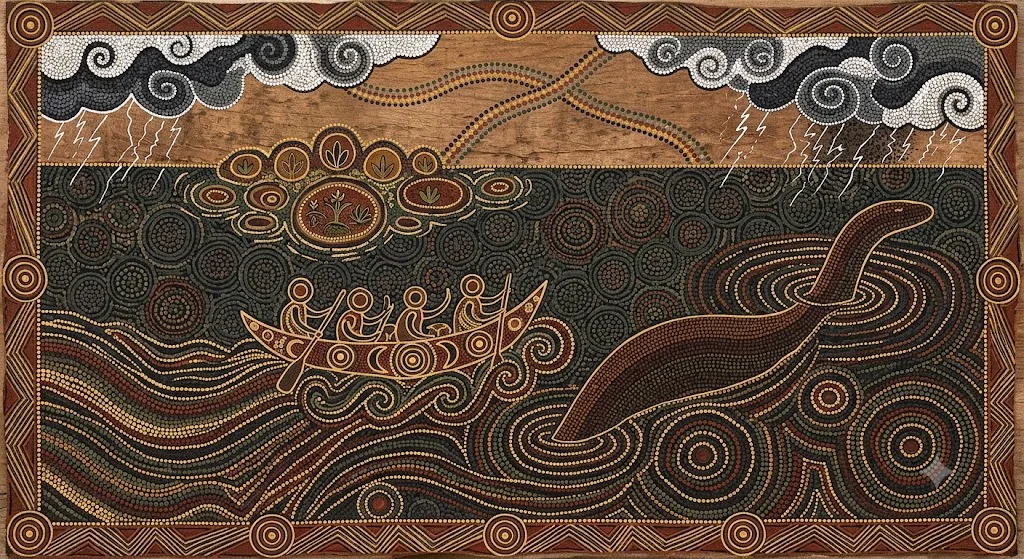
Uganda’s clearest mystery-animal tradition centres on the Lukwata, a dangerous being associated with Lake Victoria and, in later retellings, other western Ugandan waters. Early twentieth-century writers described it variously as a giant serpent, an enormous fish, a smooth-backed monster or an unidentified creature capable of striking fishing canoes.
Page outline Jump by section
Introduction
The Lukwata is therefore best understood not as a scientifically established animal but as a meeting point between lakeside folklore, spiritual ideas about dangerous water, genuine encounters with large reptiles and fish, and colonial-era enthusiasm for “unknown beasts”. A few supposedly zoological incidents gave the story a cryptozoological afterlife, but their descriptions conflict and usually reached print second-hand. Uganda has other mysterious-water traditions and lies close to the better-known Nandi bear territory of western Kenya, but no comparably strong Ugandan cryptid catalogue emerges from reliable sources. The country’s monster history is distinctive precisely because one powerful lake tradition carries most of the weight.
What was the Lukwata supposed to be?
Descriptions of the Lukwata refuse to settle into a single animal. In some accounts it is serpent-like; in others it has a blunt or fish-shaped head, a dark smooth body or a bulky form capable of disturbing a boat. Stories gathered around Lake Victoria also connected it with attacks on fishing canoes and with the treacherous power of the lake itself. This variation matters. A creature with no stable anatomy may represent a category of feared water beings rather than one biological species repeatedly described by eyewitnesses.
The earliest widely cited printed discussion appeared in 1913, when colonial administrator Charles William Hobley wrote that communities on both the Ugandan and Kenyan sides of Lake Victoria told stories of a monster called the Lukwata by the Baganda. He recorded reports from Luo fishermen that it appeared and attacked canoes. Hobley initially suspected large pythons, although he later wondered whether the stories referred to something else. His article did not produce a body or a first-hand, repeatable scientific observation; it documented reports circulating around the lake.[Internet Archive]archive.orgInternet Archive Full text of "The Journal of the East Africa and UgandaUganda and Kavirondo sides of the lake have stories of a lake monster which the Baganda call the Lukwata. The Ja-Luo fishermen describe h…
Later scholarship placed the creature within a wider cultural landscape of Lake Victoria. Anthropologist Michael Kenny’s study of the lake’s powers treated the Lukwata alongside beliefs about spiritual authority, danger and the extraordinary forces associated with the water. That approach cautions against stripping the monster out of its original setting and treating every tradition as if it were an unsuccessful zoological field report.[JSTOR]jstor.orgKenny Anthropos 72. Kenny Anthropos 72. the waters of the Victoria Nyanza are inhabited by a monster (known to the Baganda as lukwata). s…
The name has also been used loosely in later cryptozoological writing. Accounts from different places and periods have been combined under one label despite describing animals with incompatible bodies. The result is a composite monster: part serpent, part fish, part turtle and part spirit of dangerous water.
How the story entered the written record
The Lukwata became internationally legible as a “lake monster” during the colonial period, when European officials and travellers were actively collecting stories about animals that seemed unfamiliar to them. This process preserved valuable testimony, but it also changed its meaning. Oral accounts connected to fishing, ritual or local ideas about the lake were reformatted as clues in a hunt for undiscovered fauna.
One often-repeated incident concerns British official Clement Hill, who was said to have encountered a large creature while travelling on Lake Victoria around 1900. Hill apparently left no published first-hand account. Later writers supplied differing versions: one described a large fish-like head that nearly upset a launch; another turned the event into a more elaborate sighting. The discrepancies make it impossible to reconstruct exactly what Hill saw, or even how much detail originated with him rather than with later narrators.[Cryptid Archives]cryptidarchives.fandom.comCryptid Archives Lukwata | Encyclopaedia of CryptozoologyCryptid ArchivesLukwata | Encyclopaedia of Cryptozoology - FandomThe most famous lukwata sighting was allegedly made by English diplomat…
This is a recurring weakness in classic cryptid cases. A brief or ambiguous incident is repeated by several authors, each adding interpretation. Multiple printed versions can then look like multiple witnesses even though they derive from one poorly documented event. In the Hill case, the absence of a direct statement from the supposed observer is more important than the number of later retellings.
Hobley’s 1913 discussion is firmer evidence for the existence of the tradition, because it explicitly records that lakeside communities were telling Lukwata stories. It is not firm evidence for the existence of an unknown animal. The distinction is crucial: the document establishes that the monster was remembered and discussed, not that its zoological identity was demonstrated.[Internet Archive]archive.orgInternet Archive Full text of "The Journal of the East Africa and UgandaUganda and Kavirondo sides of the lake have stories of a lake monster which the Baganda call the Lukwata. The Ja-Luo fishermen describe h…
By 1937, the Lukwata had entered the broader literature of “African mystery beasts”. Such writing helped detach it from the detailed cultural life of Lake Victoria and align it with a global gallery of sea serpents, surviving prehistoric animals and hidden monsters. Modern cryptid summaries continue to repeat these early accounts, often relying on the same small group of colonial sources rather than on new Ugandan sighting records.[offbeat.fandom.com]offbeat.fandom.comOffbeat Folklore Wiki - Fandom↑ Hobley, CW. "On Some Unidentified Beasts", The East Africa Natural History Society (1913). Pg 50-52.Read…

Where do the reports cluster?
The creature’s strongest association is with Lake Victoria, especially its northern and north-western shores in Uganda and the neighbouring waters historically used by Baganda, Basoga and Luo fishing communities. Because Lake Victoria is shared by Uganda, Kenya and Tanzania, the tradition cannot be confined neatly within modern national borders. Uganda nevertheless occupies a central place because the name and several early accounts were recorded through Baganda traditions and colonial administration in the Uganda Protectorate.[Internet Archive]archive.orgInternet Archive Full text of "The Journal of the East Africa and UgandaUganda and Kavirondo sides of the lake have stories of a lake monster which the Baganda call the Lukwata. The Ja-Luo fishermen describe h…
Lake Victoria is large enough to encourage monster stories without requiring an unknown giant animal. It covers roughly 68,800 square kilometres and stretches across three countries. Although enormous in area, it is relatively shallow for a lake of its size, with complex bays, islands, wetlands and heavily used fishing grounds. Its fisheries include large catfish, lungfish and introduced Nile perch, while poor visibility in many inshore waters makes accurate size and distance judgements difficult.[nilebasin.org]nilebasin.orgOpen source on nilebasin.org.
Storms add another source of danger and confusion. Lake Victoria is known for powerful nocturnal convection and rapidly developing thunderstorms. For people travelling in low canoes, sudden waves, floating vegetation, submerged objects or the movement of a large animal could become part of a frightening and memorable encounter. None of those possibilities explains every tradition, but they show why stories of a force that overturns or seizes boats could remain persuasive around the lake.[White Rose Research Online]eprints.whiterose.ac.ukOpen source on whiterose.ac.uk.
Later Lukwata literature sometimes shifts west towards the Semliki River and Lake Albert region. A frequently repeated account says that administrator Hesketh Bell shot a small creature there that a local boy identified as a Lukwata. It was described as having a snake-like head, a short neck and tail, flipper-like limbs and a soft, rubbery covering. The obvious zoological comparison is a softshell turtle, not the enormous canoe-attacking serpent of Lake Victoria. The episode therefore supports the possibility that the name was applied to more than one unfamiliar or striking aquatic animal.[A Book of Creatures]abookofcreatures.comOpen source on abookofcreatures.com.
What evidence actually exists?
The surviving case rests almost entirely on testimony and literary transmission. Its main components are:
- reports collected from fishing communities around Lake Victoria;[Wikipedia]WikipediaLake VictoriaLake Victoria
- several inconsistent second-hand versions of Clement Hill’s alleged encounter;
- the Semliki-area animal attributed to Hesketh Bell;
- later cryptozoological compilations repeating those earlier texts.
There is no securely documented Lukwata carcass in a museum, no preserved skin that has been genetically or anatomically examined, and no accepted photograph or film. Nor does the available literature reveal a sustained modern “flap” in which independent Ugandan witnesses repeatedly described the same unknown species within a short period.
Even the physical descriptions work against a single-animal theory. A long serpent with a rounded head, a bulky fish-like creature and a small flippered animal with a soft back do not form a coherent zoological profile. They become one creature only when the flexible name “Lukwata” is treated as a formal species label.
This does not make the accounts worthless. Witness stories can preserve information about real animal encounters, local environmental risks and the cultural meanings attached to particular places. But anecdotal evidence becomes much weaker when descriptions conflict, accounts are recorded long after the event and no physical trace can be checked independently.
The most plausible animal explanations
Several known animals could have contributed to Lukwata reports. No single explanation is required, because the tradition may combine different encounters.
African rock pythons are the most obvious source for serpent-like sightings. They are among Africa’s largest snakes, are strongly associated with rivers, swamps and lakes, and swim capably. A python seen partly submerged can appear longer than the visible section, while waves or poor light can obscure its markings. Hobley himself considered large pythons before deciding that the stories might involve something else. Their existence explains why a giant-snake interpretation is plausible, though not why every account should be accepted literally.[archive.org]archive.orgInternet Archive Full text of "The Journal of the East Africa and UgandaUganda and Kavirondo sides of the lake have stories of a lake monster which the Baganda call the Lukwata. The Ja-Luo fishermen describe h…
Softshell turtles fit the smaller Semliki-style creature far better. Their flattened bodies, elongated heads, flexible shells and powerful swimming limbs can appear bizarre to someone expecting a conventional hard-shelled turtle. Later commentators have accordingly interpreted Bell’s animal as a large African softshell turtle. That identification would also explain why this supposed “Lukwata” looked unlike the serpentine Lake Victoria monster.[Cryptid Archives]cryptidarchives.fandom.comCryptid Archives Lukwata | Encyclopaedia of CryptozoologyCryptid ArchivesLukwata | Encyclopaedia of Cryptozoology - FandomThe most famous lukwata sighting was allegedly made by English diplomat…
Large fish provide another strong possibility. Lake Victoria supports substantial fish species, including catfish, lungfish and Nile perch. A large fish surfacing beside a small canoe may expose only its head, back or tail, preventing a witness from seeing its complete shape. Turbid water further encourages overestimation and anatomical guesswork.[sciencedirect.com]sciencedirect.comOpen source on sciencedirect.com.
Crocodiles, hippopotamuses and floating debris could account for some reports of impacts, wakes or overturned boats, although they do not match every Lukwata description. The point is not that one ordinary animal has been proved to be “the real monster”. It is that Uganda’s lakes and wetlands already contain enough large, dangerous and visually ambiguous objects to generate extraordinary encounters without requiring an undiscovered megafaunal species.
The most economical interpretation is therefore a layered one: known animals supplied some sightings; dangerous water and boating accidents supplied others; and an established cultural figure gave those experiences a memorable name.

Folklore or cryptid?
Calling the Lukwata a cryptid can be useful for modern readers because it places the creature among famous lake-monster claims. It can also mislead. “Cryptid” implies that a particular animal species has been reported but not scientifically confirmed. The older Lukwata material does not consistently describe such a species. It includes a feared being, a force associated with water, stories of canoe attacks and several incompatible animal forms.
The folklore interpretation better preserves this complexity. In societies dependent on lake travel and fishing, narratives about dangerous beings can express practical realities: deep water, sudden storms, drowning, unpredictable animals and the need to respect places beyond human control. Research on animal folktales more broadly has shown that stories often encode observations about real species and ecological relationships while also performing moral and social functions.[arXiv]arxiv.orgOpen source on arxiv.org.
Colonial writing tended to separate “belief” from “zoology” and then ask whether the local story concealed an animal waiting to be classified. That question produced the mystery-beast version of the Lukwata, but it was not necessarily the only question being answered by the original tradition. For lakeside storytellers, the being could be real in a cultural, spiritual and environmental sense without needing to behave like a specimen in a field guide.
A careful modern account should therefore avoid two extremes. It should not declare the Lukwata a surviving prehistoric animal, but neither should it dismiss the tradition as mere foolishness. The legend is evidence of how communities understood and narrated a powerful lake, even where it is not evidence of an unknown species.
Uganda’s other mystery-beast traditions
Uganda does not have a well-documented national roster comparable with countries whose cryptid cultures have been repeatedly commercialised through books, museums and monster tourism. Most online lists recycle the Lukwata or import creatures whose strongest associations lie elsewhere.
The Nandi bear, for example, is sometimes given an East African range extending into Uganda. Its core tradition and most famous reports, however, belong to western Kenya. Descriptions usually portray a heavily built, shaggy carnivore with high shoulders and a sloping back. Suggested explanations have included spotted hyenas, honey badgers, unusually described primates and folklore amplified by colonial hunters. Mainstream zoology has produced no evidence for an unknown bear-like species, and the Ugandan connection remains secondary rather than central.[Wikipedia]WikipediaNandi bearNandi bear
Uganda also has lakes with reputations for swallowing people or demanding victims. Lake Nkugute in the country’s south-west is associated in local reporting with stories of dangerous water and unexplained drownings. These are mystery-place traditions rather than clear accounts of a named monster, but they belong to the same broad pattern: hazardous lakes become personalities, agents or beings in community memory.[Wikipedia]WikipediaLake NkuguteLake Nkugute
Such stories should not automatically be merged. A lake said to swallow swimmers, a spiritual water power and a reported animal are related cultural forms, not interchangeable evidence for one hidden species. Keeping them separate helps distinguish folklore, environmental warning and eyewitness claim.
Why Uganda never developed a Loch Ness-style industry
The Lukwata has not become a major pillar of Ugandan tourism. Uganda’s international nature image is dominated by confirmed wildlife: mountain gorillas, chimpanzees, lions, elephants, shoebills and the varied fauna of its national parks and wetlands. Lake and river tourism focuses largely on scenery, fishing, birdwatching, rafting and wildlife observation rather than organised monster hunting.[Wikipedia]WikipediaTourism in UgandaTourism in Uganda
There are practical reasons for this. The Lukwata lacks a celebrated modern photograph, a concentrated series of recent sightings or a single lakeside town that has adopted the monster as a commercial emblem. Lake Victoria is also an immense working landscape shared among three countries, not an isolated body of water whose entire identity can easily be attached to one creature.
Its modern afterlife is therefore strongest in cryptozoology websites, monster encyclopaedias and general collections of world folklore. These sources have kept the name alive, but they often compress cultural tradition and conflicting colonial reports into a standard lake-monster biography. The result resembles Loch Ness more than the older Lake Victoria belief system from which it was drawn.
That may eventually change as cultural tourism and local storytelling gain greater prominence. Yet any responsible presentation should give Ugandan and lakeside interpretations priority rather than marketing the creature simply as “Africa’s Nessie”.
What would stronger evidence look like?
A serious zoological case would require evidence that separates an unknown animal from familiar wildlife and inherited storytelling. Useful material would include multiple independent sightings with consistent anatomical details; photographs or video with secure dates and locations; sonar or environmental DNA results collected under controlled conditions; or physical remains examined by qualified zoologists.
Historical progress would also require better archival work. Researchers would need to trace the earliest versions of each colonial account, identify who actually witnessed what, and compare those texts with oral histories from communities around the Ugandan shore. That could clarify whether “Lukwata” once named a particular form of being, a general class of dangerous water creature or several different animals.
Until such evidence appears, the most defensible conclusion is straightforward. Uganda’s Lukwata is a genuine and historically documented legend, but an unverified animal. Its enduring interest comes less from the likelihood of a giant undiscovered lake species than from the way dangerous water, real wildlife, spiritual meaning and colonial monster-hunting were folded into a single memorable name.

The lasting mystery
The Lukwata survives because its uncertainty is built into the story. It can be pictured as a serpent beneath a canoe, a huge fish breaking the surface, a strange turtle carried from a river, or the lake’s own dangerous power given a body. Each version answers a different fear.
Scientifically, known reptiles, fish, storms and mistaken size estimates offer stronger explanations than a hidden population of giant monsters. Historically, however, the story cannot be reduced to one misidentified python. It represents a wider relationship between people and inland waters on which travel, food and survival depended.
That makes the Lukwata Uganda’s most important mystery creature even without proof of an unknown species. It is not simply a failed zoological discovery. It is a lake legend repeatedly reinterpreted: first within local traditions, then by colonial naturalists, and later by global cryptozoology. The creature’s body remains unstable, but its place in Uganda’s monster history is secure.
Amazon book picks
Further Reading
Books and field guides related to What Lurks Beneath Uganda's Legendary Waters?. Use these as the next step if you want deeper reading beyond the article.
Field Guide to Lake Monsters, Sea Serpents, and Other Mystery...
Strong match for Uganda's legendary lake-creature traditions.
The United States of Cryptids
Provides useful comparisons for how monster traditions develop.
Cryptozoology A to Z
Includes global mystery-animal traditions and investigative context.
eBay marketplace picks
Marketplace Samples
Live-tested eBay searches with available results related to this page.



Endnotes
1.
Source: archive.org
Title: Internet Archive Full text of “The Journal of the East Africa and Uganda
Link:https://archive.org/stream/journalof345819121914east/journalof345819121914east_djvu.txt
Source snippet
Uganda and Kavirondo sides of the lake have stories of a lake monster which the Baganda call the Lukwata. The Ja-Luo fishermen describe h...
2.
Source: jstor.org
Link:https://www.jstor.org/stable/40459181
Source snippet
Kenny Anthropos 72. Kenny Anthropos 72. the waters of the Victoria Nyanza are inhabited by a monster (known to the Baganda as lukwata). s...
3.
Source: cryptidarchives.fandom.com
Title: Cryptid Archives Lukwata | Encyclopaedia of Cryptozoology
Link:https://cryptidarchives.fandom.com/wiki/Lukwata
Source snippet
Cryptid ArchivesLukwata | Encyclopaedia of Cryptozoology - FandomThe most famous lukwata sighting was allegedly made by English diplomat...
4.
Source: offbeat.fandom.com
Link:https://offbeat.fandom.com/wiki/Lukwata
Source snippet
Offbeat Folklore Wiki - Fandom↑ Hobley, CW. "On Some Unidentified Beasts", The East Africa Natural History Society (1913). Pg 50-52.Read...
5.
Source: sciencedirect.com
Link:https://www.sciencedirect.com/science/article/pii/S0380133023001648
6.
Source: Wikipedia
Title: Central African rock python
Link:https://en.wikipedia.org/wiki/Central_African_rock_python
7.
Source: Wikipedia
Title: Lake Victoria
Link:https://en.wikipedia.org/wiki/Lake_Victoria
8.
Source: arxiv.org
Link:https://arxiv.org/abs/1907.03969
9.
Source: Wikipedia
Title: Nandi bear
Link:https://en.wikipedia.org/wiki/Nandi_bear
10.
Source: cryptidarchives.fandom.com
Title: Cryptid Archives Nandi bear
Link:https://cryptidarchives.fandom.com/wiki/Nandi_bear
11.
Source: Wikipedia
Title: Lake Nkugute
Link:https://en.wikipedia.org/wiki/Lake_Nkugute
12.
Source: Wikipedia
Title: Tourism in Uganda
Link:https://en.wikipedia.org/wiki/Tourism_in_Uganda
13.
Source: Wikipedia
Link:https://en.wikipedia.org/wiki/Lukwata
14.
Source: Wikipedia
Title: List of cryptids
Link:https://en.wikipedia.org/wiki/List_of_cryptids
15.
Source: cryptidz.fandom.com
Title: Nandi Bear
Link:https://cryptidz.fandom.com/wiki/Nandi_Bear
16.
Source: archive.org
Link:https://archive.org/stream/Cryptozoology_201608/Cryptozoology_djvu.txt
17.
Source: abookofcreatures.com
Link:https://abookofcreatures.com/2019/07/29/lukwata/
Source snippet
A Book of CreaturesLukwata29 Jul 2019 — Hobley, C. W. (1913) On Some Unidentified Beasts. The Journal of the East Africa and Uganda Natur...
18.
Source: nilebasin.org
Link:https://nilebasin.org/sites/default/files/2023-09/23%2520eflow%2520Ken%25202003.pdf
19.
Source: eprints.whiterose.ac.uk
Link:https://eprints.whiterose.ac.uk/id/eprint/148027/8/mwr-d-19-0069.1.pdf
20.
Source: abookofcreatures.com
Link:https://abookofcreatures.com/category/uganda/
21.
Source: abookofcreatures.com
Link:https://abookofcreatures.com/category/lake-monsters/page/2/
22.
Source: abookofcreatures.com
Link:https://abookofcreatures.com/author/abookofcreatures/page/15/
23.
Source: abookofcreatures.com
Link:https://abookofcreatures.com/category/kenya/
24.
Source: youtube.com
Link:https://www.youtube.com/watch?v=sKDKSnpJku8&vl=en
25.
Source: deezer.com
Link:https://www.deezer.com/cs/episode/839303442
26.
Source: deezer.com
Link:https://www.deezer.com/tr/episode/361787452
Additional References
27.
Source: cryptozoologicalreferencelibrary.wordpress.com
Title: Cryptozoological Reference Library By C
Link:https://cryptozoologicalreferencelibrary.wordpress.com/wp-content/uploads/2019/10/hobley-1913.pdf
Source snippet
W. HOBLEY.by ONSU BEASTS · Cited by 7 — Eldoret, actually saw what he believes to be the beast, and his. Page 2. ON SOME UNIDENTIFIED BEA...
28.
Source: researchgate.net
Link:https://www.researchgate.net/publication/230069015_The_Environment_of_Lake_Victoria_East_Africa_Current_Status_and_Historical_Changes
29.
Source: primeugandasafaris.com
Link:https://www.primeugandasafaris.com/african-rock-python-reptiles-uganda-uganda-safari-news/
30.
Source: facebook.com
Link:https://www.facebook.com/100072393361136/posts/python-species-in-east-africaeast-africa-is-home-to-several-species-of-pythons-i/730348259388280/
31.
Source: chipangali.com
Link:https://www.chipangali.com/african-rock-python/
32.
Source: arcadiasafaris.com
Link:https://www.arcadiasafaris.com/african-rock-python-reptiles-in-uganda/
33.
Source: facebook.com
Link:https://www.facebook.com/ivancartersafrica/posts/african-rock-python-majestic-and-impressive-inhabitant-of-a-healthy-ecosystem/1430839631840597/
34.
Source: instagram.com
Link:https://www.instagram.com/reel/DG8qGDBNv8_/
35.
Source: cdn.cseindia.org
Link:https://cdn.cseindia.org/attachments/0.54040900_1634104819_lake-victoria-basin-the-state-of-environment.pdf
36.
Source: instagram.com
Link:https://www.instagram.com/reel/DaEloo9BDn2/
Topic Tree
Follow this branch
Related pages 192
- Antigua Cryptids
- Maldives Monsters
- Malta Monsters
- Qatar Monsters
- Argentina Monsters
- +187 more in sidebar