Creature Lore of Saint Lucia's Stories
Saint Lucia has no well-documented equivalent of the Loch Ness Monster, Bigfoot or a national “phantom cat” supported by long runs of dated newspaper reports. Its mystery-creature tradition is richer in another direction: shape-shifting night beings, dangerous roadside women, summoned little spirits and guardians of forest and water.
Page outline Jump by section
Introduction
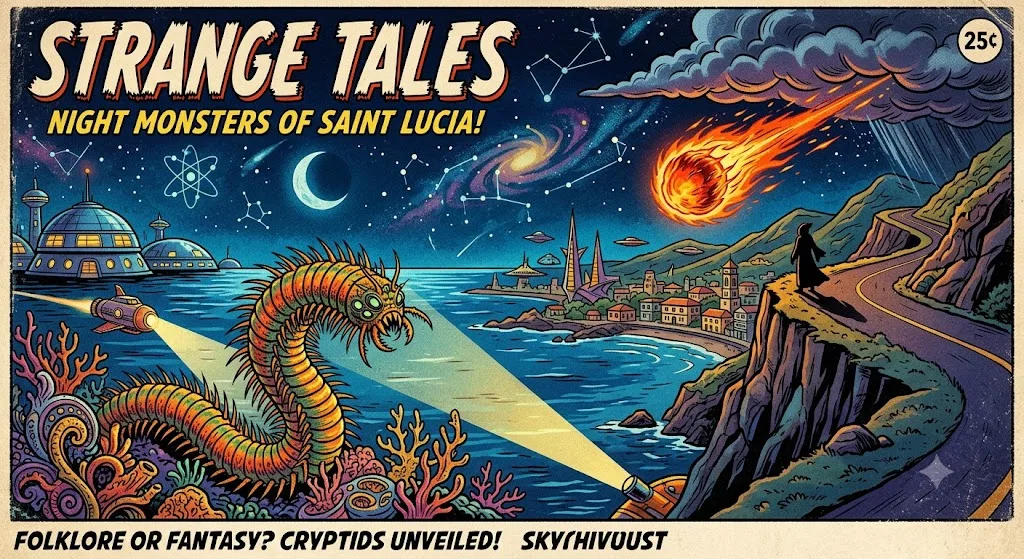
The striking exception is the “St Lucia Thing”, a huge, nocturnal reef worm reported by divers near Anse Chastanet. Unlike most monster stories, it was photographed and linked to a real group of marine animals, although some details about its exact identity and maximum size remained uncertain. Together, the Thing and the island’s traditional beings show why Saint Lucia rewards careful distinctions between folklore, eyewitness report, unusual wildlife and claims of an unknown animal.[underwaterjournal.com]underwaterjournal.comUnderwater Journal Close Encounter with the St. Lucia ThingUnderwater JournalClose Encounter with the St. Lucia Thing - Underwater Journal…
What counts as a Saint Lucian cryptid?
Using “cryptid” broadly, Saint Lucia offers two very different kinds of mystery creature.[govt.lc]govt.lcSaint LuciaWeb Portal of the Government of Saint Lucia…
The first consists of beings such as the soucouyant, Ladjablès and Ti Bolom. These are supernatural figures embedded in oral storytelling, morality tales and community memory. They are not normally presented through specimens, tracks or repeatable biological observations. A Saint Lucian government account of the 2019 play A Little Folktale, for example, explicitly identifies La Diablesse, the soucouyant and Ti Bolom as folklore characters remembered from stories told by grandparents.[Saint Lucia - Access Government]govt.lcSaint LuciaWeb Portal of the Government of Saint Lucia…
The second category is an anomalous animal report: someone sees a creature that appears too large, unfamiliar or behaviourally strange to fit ordinary expectations. The St Lucia Thing belongs here. It began as a divers’ mystery surrounding an exceptionally long reef-dwelling worm, then moved towards a conventional zoological explanation after photographs were obtained.[Underwater Journal]underwaterjournal.comUnderwater Journal Close Encounter with the St. Lucia ThingUnderwater JournalClose Encounter with the St. Lucia Thing - Underwater Journal…
That distinction matters. Calling every supernatural figure a hidden animal strips away much of its cultural meaning, while dismissing every strange sighting as fantasy can obscure genuinely unusual wildlife. Saint Lucia’s story is strongest when the categories remain separate.
The St Lucia Thing: a monster that became an animal
The island’s clearest cryptozoological case developed around the reefs near Anse Chastanet, on the south-west coast close to Soufrière. According to underwater photographer Walt Stearns, dive staff and a local marine biologist had heard reports during the late 1980s and early 1990s of a worm-like animal said to reach about ten feet in length and the thickness of a human arm. Witnesses described it as nocturnal, hidden in reef crevices and extraordinarily quick to withdraw when struck by a dive light. Evidence at that stage reportedly consisted of testimony and one poor-quality photograph.[Underwater Journal]underwaterjournal.comUnderwater Journal Close Encounter with the St. Lucia ThingUnderwater JournalClose Encounter with the St. Lucia Thing - Underwater Journal…
Stearns searched for the creature during night dives in 1994. He reported finding a specimen moving among coral at depths between roughly 40 and 80 feet. His photographed animal was about four feet long and wrist-thick: smaller than the most dramatic stories, but still an impressive segmented marine worm. Its dark reddish-brown body, repeated segments, side appendages and gill structures placed it among polychaete annelids, commonly called bristle worms.[Underwater Journal]underwaterjournal.comUnderwater Journal Close Encounter with the St. Lucia ThingUnderwater JournalClose Encounter with the St. Lucia Thing - Underwater Journal…
This is where the case changes character. The photographs did not confirm a ten- or fifteen-foot sea monster. They demonstrated that an unusually large, elusive reef animal lay behind at least some of the reports. The published account tentatively associated it with the eunicid worm Eunice roussaei. That is a recognised species in the World Register of Marine Species, not an imaginary label invented for the story.[Underwater Journal]underwaterjournal.comUnderwater Journal Close Encounter with the St. Lucia ThingUnderwater JournalClose Encounter with the St. Lucia Thing - Underwater Journal…
The identification should still be phrased cautiously. Stearns noted that no suitable specimen or tissue sample had been collected from the Saint Lucian animal, and that its exact identification therefore remained tentative. Modern taxonomic work confirms that Eunice roussaei is a distinct giant bristle worm, but a photograph alone cannot establish that every large worm reported off Saint Lucia belonged to that species.[underwaterjournal.com]underwaterjournal.comUnderwater Journal Close Encounter with the St. Lucia ThingUnderwater JournalClose Encounter with the St. Lucia Thing - Underwater Journal…
The sensible conclusion is therefore modest but interesting: the St Lucia Thing was probably not an undiscovered vertebrate or classical sea serpent. It was a real, exceptionally large marine worm whose darkness-loving behaviour, rapid retreat and partial emergence from a reef hole made its true length difficult to judge. The largest estimates remain unverified.
Why the Thing looked monstrous
Several features made the Anse Chastanet reports unusually fertile ground for monster-making.
Only part of the animal was visible. Long eunicid worms spend much of their bodies inside rock, rubble or reef crevices. A diver seeing several feet outside a hole cannot easily know how much remains concealed.
It appeared at night. Darkness removes familiar scale cues and narrows a diver’s view to the beam of a torch. An animal that recoils immediately may be seen only for seconds.
It moved like a serpent. A long, segmented worm travelling in an undulating motion can resemble a thin snake or eel, especially when its legs and gills are not clearly visible.
There was already a local story. Once dive staff had a name for “the Thing”, later encounters were likely to be interpreted through that shared expectation. This does not mean witnesses invented what they saw; it means the story helped determine which features were remembered and repeated.
The case is therefore a useful model of how a cryptid report can contain a real zoological core without validating its most spectacular measurements. It is also more evidentially substantial than the typical sea-monster anecdote because a witness deliberately searched for the animal, photographed it and sought specialist identification.[Underwater Journal]underwaterjournal.comUnderwater Journal Close Encounter with the St. Lucia ThingUnderwater JournalClose Encounter with the St. Lucia Thing - Underwater Journal…
The soucouyant: fire in the night
The soucouyant is one of Saint Lucia’s best-known supernatural beings. In commonly told versions, an apparently ordinary person sheds their human skin at night and travels as a ball of fire, entering houses to drink blood. Some retellings describe the soucouyant specifically as an old woman, while contemporary Saint Lucian accounts stress that the figure may be imagined as any age or gender.[JournoPortfolio]media.journoportfolio.comJourno PortfolioJourno Portfolio
This variation is a sign of oral tradition rather than a flaw that can be corrected by finding one “true” description. Folklore changes between families, districts, generations and neighbouring Caribbean islands. The core image—secret human identity, nocturnal transformation and fiery movement—remains recognisable even as details shift.
From a cryptozoological standpoint, a reported fireball is not persuasive evidence for a flying blood-feeding creature. Distant lamps, meteors, burning debris, electrical effects, insects passing close to a light source and ordinary errors of distance can all produce strange night observations. Yet reducing the soucouyant to a misidentified light also misses the point. The being functions as a story about concealed danger: someone familiar by day may become threatening after dark, and a seemingly harmless person may possess hidden power.
The soucouyant remains culturally active rather than merely historical. Saint Lucia’s government highlighted it among the figures used by young writers in A Little Folktale, a production designed partly to bridge the gap between older family storytelling and younger audiences.[Saint Lucia - Access Government]govt.lcSaint LuciaWeb Portal of the Government of Saint Lucia…
Ladjablès: the danger beside the road
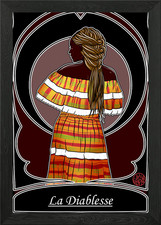
Ladjablès, also widely rendered as La Diablesse, appears as an alluring woman whose beauty conceals something inhuman. Saint Lucian retellings commonly give her a corpse-like or otherwise terrible hidden face and one leg ending in a cow’s hoof, covered by a long dress in nineteenth-century Creole style. She lures men away from roads into forest, ravines or ditches, with unfaithful men often singled out as likely victims.[JournoPortfolio]media.journoportfolio.comJourno PortfolioJourno Portfolio
The figure works especially well in an island landscape of steep slopes, narrow roads, deep vegetation and sudden drops. A man travelling alone at night, perhaps tired or intoxicated, could become lost or fall; the story gives such danger a memorable face and a moral structure. The fatal hazard is not just terrain but temptation, secrecy and the decision to follow a stranger.
That does not make Ladjablès a literal hoofed hominid hiding in the rainforest. No physical evidence, stable anatomical description or mapped sequence of modern sightings supports that reading. She is better understood as a supernatural roadside figure shared across parts of the Caribbean but shaped by Saint Lucian language, dress, geography and social concerns.
Her continued appearance in school projects, theatre and popular cultural writing shows how folklore survives by adaptation. The monster is no longer confined to a tale told on a dark veranda; she can become a stage character, illustration or horror figure while retaining the recognisable hoof beneath the skirt.[Saint Lucia - Access Government]govt.lcSaint LuciaWeb Portal of the Government of Saint Lucia…
Ti Bolom: the island’s most distinct little being
Ti Bolom occupies a particularly important place because researchers describe it as widely known across generations in Saint Lucia. The figure is generally portrayed as a child-sized being summoned or created to carry out its master’s bidding, often in connection with the devil or forbidden power. Unlike an animal reported in one habitat, Ti Bolom belongs to stories about human ambition, control, wealth and the consequences of commanding supernatural labour.[University of Bristol]bristol.ac.ukUniversity of Bristol2023/2024: project: Telling and Retelling | Brigstow Institute1 Jan 2024 — The research team will document, archive…
A University of Bristol project launched in partnership with Saint Lucian participants set out to document, archive and analyse Ti Bolom stories rather than impose a single fixed version. Its researchers noted that accounts refer to particular villages and landmarks, vary among tellers and show influences associated with European Catholicism, West African traditions and the wider Caribbean.[jeangoldinginstitute.blogs.bristol.ac.uk]jeangoldinginstitute.blogs.bristol.ac.uktelling tales building a folk map of st luciatelling tales building a folk map of st lucia
This work highlights an important problem in monster research. A folklore figure cannot be studied adequately by compiling a list of alleged powers and treating it like a species profile. Who tells the story, where it is set and why particular details matter are part of the evidence. A Ti Bolom story attached to a known road, estate or village may express local history even when no one expects zoologists to trap a specimen there.
Ti Bolom also illustrates how colonial records can distort living traditions. Written archives often preserve what officials, missionaries or outsiders thought worth recording, while oral accounts preserve change, disagreement and performance. Treating several versions as valuable in their own right is more faithful to the tradition than declaring one internet summary definitive.
Forest and river guardians
Saint Lucian folklore also includes beings associated with particular environments. Papa Bwa is commonly described as a protector of forests and wild animals, while Mama Glo is linked with rivers and may be represented as partly woman and partly snake. One recent Saint Lucian guide presents the pair as forest and river guardians shaped by the island’s mixed cultural inheritance.[JournoPortfolio]media.journoportfolio.comJourno PortfolioJourno Portfolio
These figures overlap with traditions found elsewhere in the Caribbean, so it would be misleading to claim that every detail originated uniquely in Saint Lucia. Their local importance lies in how they are attached to Saint Lucian woods, waterways and ideas about proper behaviour towards nature.
They can also be read without choosing between literal belief and total dismissal. A guardian story may discourage reckless hunting, warn children away from dangerous water or give moral force to limits on taking animals. That ecological reading does not prove that conservation was the tale’s original or only purpose, but it helps explain why such beings remain meaningful in landscapes where forests and rivers sustain both wildlife and communities.
Real wildlife behind strange encounters
Saint Lucia is unusually rich in endemic species—animals found nowhere else—which makes encounters with unfamiliar wildlife entirely plausible. The government’s Wildlife Unit records five endemic bird species, thirteen endemic bird subspecies and seven endemic reptiles. Conservation organisations also emphasise that a high proportion of the island’s terrestrial reptiles are unique to Saint Lucia.[moaslu.govt.lc]moaslu.govt.lcWildlife ManagementWildlife Management
That diversity can feed mystery-animal stories in several ways. A snake glimpsed briefly may look larger than it is. Bats can create abrupt winged silhouettes at dusk. Iguanas, boas and large lizards may startle visitors unfamiliar with Caribbean fauna. At sea, eels, rays, chains of floating debris and partially surfaced marine animals can produce serpentine impressions.
The island also contains animals so rare that even genuine sightings may seem improbable. The Saint Lucia racer, for example, survives only in a severely restricted offshore habitat and is regarded as one of the world’s rarest snakes. Its existence is supported by specimens, field surveys and conservation programmes—the kinds of evidence absent from folklore beings.[Convention on Biological Diversity]cbd.intlc nr 05 enlc nr 05 en
This creates a useful test. Rarity alone does not make an animal a cryptid. A rare species becomes scientifically established through diagnostic features, preserved material, reproducible observations and expert comparison. A monster report normally begins with testimony and remains uncertain unless stronger evidence follows.
Where reports and stories cluster
Saint Lucia’s creature traditions tend to cluster by the kind of landscape each story requires rather than around one national monster hotspot.
The Anse Chastanet and Soufrière reef area is central to the St Lucia Thing. The reported animal was associated with dark reef crevices and night diving, not inland lakes or rivers.[Underwater Journal]underwaterjournal.comUnderwater Journal Close Encounter with the St. Lucia ThingUnderwater JournalClose Encounter with the St. Lucia Thing - Underwater Journal…
Forests, ravines and isolated roads provide the natural stage for Ladjablès and other dangerous night figures. Their narratives depend on separation from the safety of home and village.
Rivers and wooded interiors suit guardian beings such as Mama Glo and Papa Bwa, whose identities are bound to water and wild animals.
Named villages and landmarks across the island recur in Ti Bolom storytelling. Recent research found that tellers often anchor the being in specific local places, suggesting a distributed folk geography rather than one famous lair.[jeangoldinginstitute.blogs.bristol.ac.uk]jeangoldinginstitute.blogs.bristol.ac.uktelling tales building a folk map of st luciatelling tales building a folk map of st lucia
This place-based pattern is more revealing than drawing a speculative sighting map. Folklore chooses settings that reinforce its message: the road for temptation, the forest for disorientation, the river for hidden depth and the reef for creatures that emerge only in darkness.

What evidence actually exists?
The evidence is uneven and should not be bundled together.
For the St Lucia Thing, there are first-person observations, photographs and a plausible identification as a giant eunicid worm. What remains weak are the most extreme length claims and the precise species assignment without a collected Saint Lucian specimen.[Underwater Journal]underwaterjournal.comUnderwater Journal Close Encounter with the St. Lucia ThingUnderwater JournalClose Encounter with the St. Lucia Thing - Underwater Journal…
For Ti Bolom, the soucouyant and Ladjablès, the evidence is evidence of tradition: testimony that stories are widely known, published cultural accounts, theatre productions and active research into oral versions. This demonstrates that the beings matter in Saint Lucian culture. It does not demonstrate that they exist as biological organisms.[govt.lc]govt.lcSaint LuciaWeb Portal of the Government of Saint Lucia…
There is little strong, accessible evidence for a separate Saint Lucian tradition of giant apes, phantom big cats, persistent lake monsters or flying cryptids in the modern zoological sense. Repeating unsourced online lists would create a false impression of a large case archive. The better-supported picture is narrower: a rich supernatural bestiary and one memorable marine-animal mystery.
How the legends have changed
Saint Lucia’s creature stories were once transmitted principally through face-to-face storytelling. A young writer involved in A Little Folktale recalled hearing such stories from her grandmother and worrying that fewer people were passing them on. The play transformed that concern into a production performed at the Caribbean Festival of Arts in 2019.[Saint Lucia - Access Government]govt.lcSaint LuciaWeb Portal of the Government of Saint Lucia…
Academic and community projects are producing another change. Instead of flattening Ti Bolom into a fixed dictionary entry, researchers have begun recording multiple tellers, locations and versions. The resulting “folk map” approach treats variation as information and connects stories to the geography in which they are told.[University of Bristol]bristol.ac.ukUniversity of Bristol2023/2024: project: Telling and Retelling | Brigstow Institute1 Jan 2024 — The research team will document, archive…
Literature and theatre have long helped carry Saint Lucian folk material beyond the island. Nobel laureate Derek Walcott grew up where Afro-Caribbean customs remained influential outside the more Europeanised culture of Castries, and his dramatic work repeatedly drew on Caribbean folklore and Saint Lucian landscape.[NobelPrize.org]nobelprize.orgOpen source on nobelprize.org.
Tourism changes the framing again. Visitors often encounter Saint Lucia first as a landscape of rainforest, reefs and the Pitons. A label such as “Saint Lucia’s Loch Ness Monster” makes the reef worm instantly marketable, but it also imports a foreign model that can overshadow the more distinctive local tradition. The Thing is interesting precisely because it is not Nessie: it is a case in which divers’ monster talk converged with the study of a real invertebrate.
The most credible reading
Saint Lucia’s mystery-creature history does not point to a hidden population of giant land animals. Its strongest zoological case points instead to the capacity of real marine life to exceed ordinary expectations. A four-foot nocturnal bristle worm emerging from coral is strange enough without extending it to fifteen feet.
The island’s better-known beings belong to folklore, where credibility means something different. The soucouyant, Ladjablès, Ti Bolom and environmental guardians are credible as enduring cultural traditions because people continue to tell, perform, reinterpret and research their stories. They reveal anxieties about night travel, temptation, concealed identity, dangerous power and human behaviour towards the natural world.
The clearest summary is therefore a three-part one: Saint Lucia has a well-established supernatural folklore, a thin public record of conventional cryptid “flaps”, and one unusually satisfying marine mystery in which the monster was probably an extraordinary animal all along.
Amazon book picks
Further Reading
Books and field guides related to What Creatures Haunt Saint Lucia's Stories?. Use these as the next step if you want deeper reading beyond the article.
Abominable Science!
Fits the page's distinction between folklore and biological mystery creatures.
eBay marketplace picks
Marketplace Samples
Live-tested eBay searches with available results related to this page.

Endnotes
1.
Source: govt.lc
Title: Saint Lucia
Link:https://www.govt.lc/news/final-rehearsals-for-cast-of-a-little-folktale
Source snippet
Web Portal of the Government of Saint Lucia...
2.
Source: bristol.ac.uk
Link:https://www.bristol.ac.uk/brigstow/research/projects/20232024/telling-and-re-telling-tales.html
Source snippet
University of Bristol2023/2024: project: Telling and Retelling | Brigstow Institute1 Jan 2024 — The research team will document, archive...
3.
Source: marinespecies.org
Link:https://www.marinespecies.org/aphia.php?id=327785&p=taxdetails
Source snippet
Eunice roussaei Quatrefages, 186626 Mar 2008 — Eunice roussaei Quatrefages, 1866 · Biota · Animalia (Kingdom) · Annelida (Phylum) · Polyc...
4.
Source: marinespecies.org
Title: Wo RM S
Link:https://www.marinespecies.org/aphia.php?id=479976&p=sourcedetails
Source snippet
WoRMS - World Register of Marine Species7 Feb 2024 — Here we show that the species occurring in the Adriatic Sea is Eunice roussaei and h...
5.
Source: media.journoportfolio.com
Title: Journo Portfolio
Link:https://media.journoportfolio.com/users/355480/uploads/1f99af0e-4a7f-44aa-a66e-29e777ebf843.pdf
6.
Source: bristol.ac.uk
Title: telling and re telling tales
Link:https://www.bristol.ac.uk/brigstow/research/projects/20222023/telling-and-re-telling-tales.html
7.
Source: jeangoldinginstitute.blogs.bristol.ac.uk
Title: telling tales building a folk map of st lucia
Link:https://jeangoldinginstitute.blogs.bristol.ac.uk/2025/10/07/telling-tales-building-a-folk-map-of-st-lucia/
8.
Source: bristol.ac.uk
Title: seedcorn 202324
Link:https://www.bristol.ac.uk/brigstow/news/2023/seedcorn-202324.html
9.
Source: moaslu.govt.lc
Title: Wildlife Management
Link:https://moaslu.govt.lc/wildlife-management/
10.
Source: nobelprize.org
Link:https://www.nobelprize.org/prizes/literature/1992/walcott/article/
11.
Source: marinespecies.org
Title: World Register of Marine Species
Link:https://www.marinespecies.org/aphia.php?id=327786&p=taxdetails
12.
Source: marinespecies.org
Title: Wo RM S
Link:https://www.marinespecies.org/aphia.php?id=129278&p=browser
13.
Source: marinespecies.org
Link:https://marinespecies.org/aphia.php?id=130062&p=taxdetails
14.
Source: marinespecies.org
Title: World Register of Marine Species
Link:https://www.marinespecies.org/rest/AfricaIDByName/aphia.php?id=327786&p=taxdetails
15.
Source: marinespecies.org
Title: World Register of Marine Species
Link:https://www.marinespecies.org/aphia.php?id=129278&p=taxdetails
16.
Source: marinespecies.org
Link:https://www.marinespecies.org/aphia.php?id=50104&p=sourcedetails
17.
Source: marinespecies.org
Link:https://www.marinespecies.org/aphia.php?id=50071&p=sourcedetails
18.
Source: marinespecies.org
Title: Wo RM S
Link:https://marinespecies.org/aphia.php?id=50873&p=sourcedetails
19.
Source: education.govt.lc
Title: final rehearsals for cast of a little folktale
Link:https://education.govt.lc/news/final-rehearsals-for-cast-of-a-little-folktale
20.
Source: bristol.ac.uk
Title: Dr Leighan Renaud
Link:https://www.bristol.ac.uk/people/person/Leighan-Renaud-91a99938-a38e-422e-9018-a051f09aeb15/
21.
Source: jeangoldinginstitute.blogs.bristol.ac.uk
Title: bristol.ac.uk Tag: Seedcorn funding
Link:https://jeangoldinginstitute.blogs.bristol.ac.uk/tag/seedcorn-funding/
22.
Source: jeangoldinginstitute.blogs.bristol.ac.uk
Title: bristol.ac.ukdata science – Page 2
Link:https://jeangoldinginstitute.blogs.bristol.ac.uk/tag/data-science/page/2/
23.
Source: jeangoldinginstitute.blogs.bristol.ac.uk
Title: bristol.ac.uk JG I support
Link:https://jeangoldinginstitute.blogs.bristol.ac.uk/tag/jgi-support/
24.
Source: jeangoldinginstitute.blogs.bristol.ac.uk
Title: bristol.ac.uk Archive – Page 2
Link:https://jeangoldinginstitute.blogs.bristol.ac.uk/archive/page/2/
25.
Source: underwaterjournal.com
Title: Underwater Journal Close Encounter with the St. Lucia Thing
Link:https://www.underwaterjournal.com/close-encounter-with-the-st-lucia-thing/
Source snippet
Underwater JournalClose Encounter with the St. Lucia Thing - Underwater Journal...
26.
Source: cbd.int
Title: lc nr 05 en
Link:https://www.cbd.int/doc/world/lc/lc-nr-05-en.pdf
27.
Source: Wikipedia
Link:https://en.wikipedia.org/wiki/Soucouyant
28.
Source: tilife.org
Title: Sea Serpent
Link:https://tilife.org/BackIssues/Archive/tabid/393/articleType/ArticleView/articleId/2254/Sea-Serpent.html
29.
Source: zookeys.pensoft.net
Link:https://zookeys.pensoft.net/article/86448/list/9/
30.
Source: caribbeanreads.com
Link:https://www.caribbeanreads.com/soucouyant/
Additional References
31.
Source: researchgate.net
Link:https://www.researchgate.net/publication/231973812_Identity_of_Eunice_roussaei_Eunicidae_Polychaeta_Annelida_from_the_Adriatic_and_Mediterranean_Seas
Source snippet
aphroditois (Fauvel, 1932), but E. roussaei was shown to be a distinct species by comparing the...Read more...
32.
Source: findyello.com
Link:https://www.findyello.com/tip/grenada/from-soucouyants-to-douens-lets-explore-our-rich-caribbean-folklore-4/
Source snippet
From Soucouyants to Douens: Let's Explore our Rich...Apr 12, 2021 — Of folkloric creatures, La Diablesse was one of the scaries...
33.
Source: youtube.com
Title: Most TERRIFYING Mythological Creatures From The Caribbean!
Link:https://www.youtube.com/watch?v=BDSldGP5rCI
Source snippet
La Diablesse of St Lucia La Diablesse of St Lucia | Caribbean Folklore | Episode 1 Tales of the Carribean Islands...
34.
Source: youtube.com
Title: A TERRIFYING Caribbean FOLKTALE: “La Diablesse” (The Devil Woman)
Link:https://www.youtube.com/watch?v=v16ZMLg_HV4
Source snippet
Ti Jean and His Brothers by Derek Walcott...
35.
Source: researchgate.net
Link:https://www.researchgate.net/publication/261133149_Biodiversity_Assessment_of_Saint_Lucia%27s_Forests_With_Management_Recommendations
36.
Source: history.co.uk
Link:https://www.history.co.uk/articles/strange-sea-serpent-sightings-from-history
37.
Source: reddit.com
Link:https://www.reddit.com/r/Cryptozoology/comments/1iexzqo/a_drawing_of_jon_downeys_serpent_seen_in_north/
38.
Source: englishjournals.com
Link:https://www.englishjournals.com/assets/archives/2020/vol6issue4/6-4-14-748.pdf
39.
Source: lntreasures.com
Link:https://lntreasures.com/sl.html
40.
Source: reddit.com
Link:https://www.reddit.com/r/AskTheCaribbean/comments/udeh7l/are_there_any_caribbean_folklore_or_mythical/
Topic Tree
Follow this branch
Related pages 192
- Antigua Cryptids
- Maldives Monsters
- Malta Monsters
- Qatar Monsters
- Argentina Monsters
- +187 more in sidebar