Cryptids of Azerbaijan's Wild Places
Azerbaijan is not a classic “lake monster country” in the Loch Ness sense. Its creature lore is better understood as a meeting point between Caucasus mountain wild-man traditions, Oghuz Turkic epic monsters, forest spirits, desert ogres, giant birds, and real wildlife that can still make a night encounter feel uncanny.
Page outline Jump by section
Introduction
The useful way to read Azerbaijan’s monster tradition is to separate folklore from eyewitness claim. Tepegöz, the div and the desert ogre belong mainly to story and myth. The Woodman and Almasty sit closer to cryptid territory because writers have treated them as reported creatures of forests and mountains. Leopards, bears, wolves, lynx, seals and sturgeon supply the ecological background: Azerbaijan really does have large, elusive animals, but that does not turn every legend into a hidden species.[Azerbaijan Travel]azerbaijan.travelTravel Shahdag’s wild thrills and placid pauses | Azerbaijan.TravelTravel Shahdag’s wild thrills and placid pauses | Azerbaijan.Travel
What creatures are most strongly associated with Azerbaijan?
Azerbaijan’s creature traditions are varied, but a few figures matter most for a country-level cryptid and monster page.
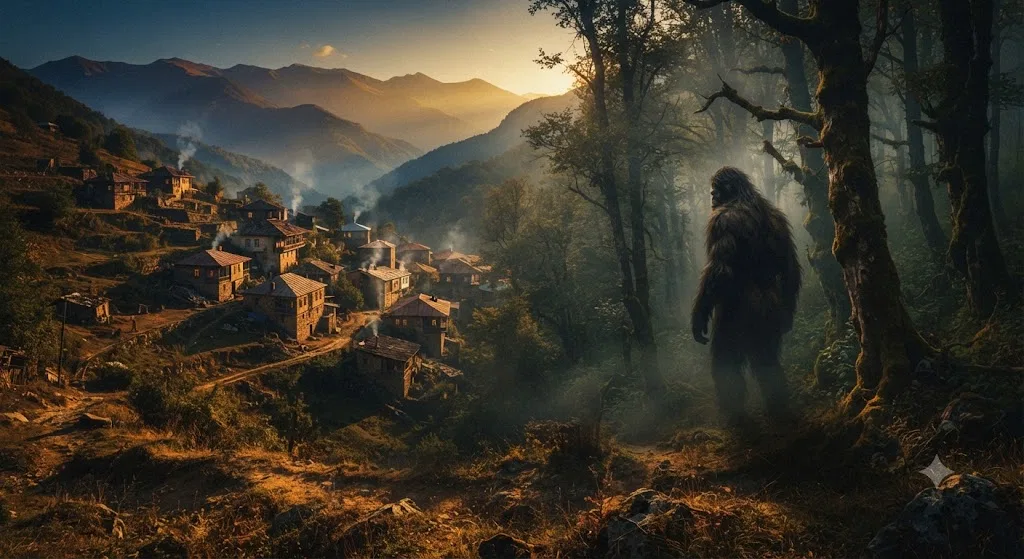
The Woodman or Tree Man is the closest fit for a local Bigfoot-style figure. JAMnews describes it as a hair-covered being of mountainous forests, monkey-like in outline, smelly, wilful and inclined to wander into gardens or take discarded clothes. The article explicitly presents it as a local forest creature rather than a modern imported monster, while also noting that some people compare it with Bigfoot-style legends.[Jamnews in English]jam-news.netJamnews in English The magical creatures of Azerbaijani mythologyJamnews in English The magical creatures of Azerbaijani mythology
The Almasty is the broader Caucasian wild-man tradition. In a paper attributed to Marie-Jeanne Koffmann, the Almasty is presented as a creature reported across the Caucasus, with case files divided by region and 60 first-hand witness interrogations listed for Azerbaijan. That is important for cryptid history, but it should be treated cautiously: Koffmann wrote from a cryptozoological position, and her work is testimony-based rather than proof of an undiscovered hominin.[Idaho State University]isu.eduOpen source on isu.edu.
Tepegöz is Azerbaijan’s best-known epic monster. It belongs to the Dede Korkut cycle, an Oghuz Turkic epic tradition recognised by UNESCO as shared heritage of Azerbaijan, Kazakhstan and Turkey. In popular retellings, Tepegöz is a one-eyed giant who forces people into a cave and eats them, a close cousin in mood to the cyclops stories of the wider ancient world.[UNESCO Intangible Cultural Heritage]ich.unesco.orgOpen source on unesco.org.
The div and Qulyabani occupy the ogre-and-demon end of the spectrum. The div is described in Azerbaijani popular mythology as a tall magical being, often giant-like and dangerous. Qulyabani is portrayed as a dark-haired, backwards-footed creature of steppes and cemeteries, less an animal claim than a warning figure for travellers and lonely places.[Jamnews in English]jam-news.netJamnews in English The magical creatures of Azerbaijani mythologyJamnews in English The magical creatures of Azerbaijani mythology
The forest-man tradition: cryptid claim or old mountain folklore?
The Woodman is the most reader-friendly entry point because it sounds almost modern: a hairy, human-like creature in mountain forests, glimpsed at the edge of orchards and settlements. Yet the older shape of the story is not “ape hiding from scientists” so much as “forest being living beside human communities”. The creature’s stink, clothes-stealing and garden visits make it feel like a household-border legend: it belongs where forest, village and cultivated land meet.[Jamnews in English]jam-news.netJamnews in English The magical creatures of Azerbaijani mythologyJamnews in English The magical creatures of Azerbaijani mythology
Koffmann’s Almasty material gives the tradition a more cryptozoological tone. Her paper describes the reported creature as ranging through forests, cliffs, marshes, caves, Caspian dunes and mountain zones, while arguing that forest belts between steppe and high rocky chains were its preferred refuge. The same text says Koffmann’s data came from 265 interrogations of alleged first-hand witnesses, including 60 from Azerbaijan.[Idaho State University]isu.eduOpen source on isu.edu.
That sounds impressive, but it is not the same as biological evidence. The reports are valuable as folklore and witness tradition: they show that wild-man stories were collected in an Azerbaijan-linked Caucasus context. They do not provide a body, DNA, clear photographs, verified tracks or a specimen. A sceptical reading would treat the Almasty as a blend of mountain folklore, misidentification, rumour, unusual human encounters, bears seen briefly, and the strong storytelling power of borderlands where people, livestock and wilderness overlap.
Tepegöz: Azerbaijan’s one-eyed giant and the epic monster tradition
Tepegöz matters because it shows that Azerbaijan’s monster culture is not only about sightings. It is also literary, epic and moral. The Dede Korkut tradition is built around heroic legends, folk tales and music, and UNESCO describes it as an element transmitted through oral expression, performing arts and cultural codes.[UNESCO Intangible Cultural Heritage]ich.unesco.orgOpen source on unesco.org.
In popular Azerbaijani mythology summaries, Tepegöz is the monster who forces victims into a cave and eats them. The trick for defeating him is not brute strength but cunning: the hero must avoid being scented, use a sheep-skin motif, and strike the creature’s single eye. That makes Tepegöz a classic monster of thresholds: the cave, the herd, the hero’s test, and the triumph of intelligence over appetite.[Jamnews in English]jam-news.netJamnews in English The magical creatures of Azerbaijani mythologyJamnews in English The magical creatures of Azerbaijani mythology
For a cryptid page, Tepegöz should not be mistaken for a reported animal. Its importance lies in continuity. When later audiences hear of hairy wild men, giants, or man-eating beings in the Caucasus, Tepegöz helps explain why the region already had a strong vocabulary for monstrous humanoids before modern cryptozoology arrived.

Why Azerbaijan has fewer famous lake-monster stories than readers might expect
Azerbaijan has dramatic water settings: the Caspian coast, mountain lakes and reservoirs. Yet fresh searches do not show a robust, nationally famous lake monster tradition comparable to Loch Ness, Lake Van or Ogopogo. Lake Göygöl, for example, is famous for landscape and origin rather than a well-documented monster flap; it formed after an earthquake-triggered collapse blocked a river, giving it a striking natural history without needing a serpent legend.[Wikipedia]WikipediaGöygöl (lakeGöygöl (lake
The Caspian Sea is the obvious place to look for sea-serpent stories, but the best-known “Caspian Sea Monster” is a technological one. The nickname refers to an enormous Soviet ekranoplan, a ground-effect craft that flew just above the water. Caspian Post describes the craft as roughly 90 metres long in its early form, developed in the mid-1960s, and photographed by US spy satellites near Kaspiysk in 1967.[Caspian Post]caspianpost.comCaspian Post Does the Caspian Sea Monster Really Exist?Caspian Post Does the Caspian Sea Monster Really Exist?
That nickname can confuse cryptid research. A search for Azerbaijan and the Caspian “monster” often leads to aircraft history, not folklore. Real Caspian animals are still relevant, however. Sturgeon once reached enormous size, and the Caspian seal is distinctive enough to feed strange-animal impressions, especially at distance or in poor light. But modern environmental reporting frames these animals as threatened wildlife, not monsters: Azerbaijani officials have warned that falling Caspian levels threaten sturgeon habitat and seal breeding sites.[Reuters]reuters.comAzerbaijan sounds the alarm over shallowing of Caspian Sea | ReutersAzerbaijan sounds the alarm over shallowing of Caspian Sea | Reuters
Real animals behind strange reports
Azerbaijan’s wildlife gives plenty of room for misidentification. Shahdag National Park is publicly promoted for mammals including roe deer, wild boar, brown bear, jackal and forest cat, with protected species such as lynx and golden eagle also highlighted. A sudden bear encounter, a jackal call, a wildcat crossing a track, or a large raptor seen against mountain light can all become bigger in retelling.[Azerbaijan Travel]azerbaijan.travelTravel Shahdag’s wild thrills and placid pauses | Azerbaijan.TravelTravel Shahdag’s wild thrills and placid pauses | Azerbaijan.Travel
The leopard is especially important. It is real, rare, elusive and culturally powerful. Reports from Azerbaijan describe camera-trap photographs of leopards in Hirkan National Park, while conservation writing on the wider Caucasus repeatedly treats the leopard as one of the region’s most charismatic and threatened animals.[AzerNews]azernews.azAzer News Leopard caught on camera traps in Hirkan National ParkAzer News Leopard caught on camera traps in Hirkan National Park
This matters for phantom-cat stories. In some countries, “black panther” or “mystery big cat” reports depend on escaped exotic pets. Azerbaijan does not need that explanation for every big-cat impression, because leopards genuinely occur in the region, though very rarely. The careful distinction is this: a leopard can explain some large-cat rumours, but a vague “huge dark animal” seen at dusk is still not proof of any particular creature.

The changing story around Azerbaijan’s cryptid traditions
The older layer of Azerbaijan’s monster tradition is mythic and moral. Tepegöz tests heroes. Divs and desert ogres warn against danger, appetite and disorder. Forest beings mark the boundary between cultivated life and the mountain world. These creatures belong to oral tradition, epic storytelling and local cautionary tales.
The newer layer is cryptozoological. Once the Caucasian Almasty became part of Soviet and international wild-man debates, older forest-person traditions could be reinterpreted as possible evidence for a relict hominin. Koffmann’s work is a clear example of this shift: villagers’ testimony and mountain folklore are organised into behavioural categories such as diet, daily activity, habitat and movement.[Idaho State University]isu.eduOpen source on isu.edu.
The most recent layer is ecological and touristic. Azerbaijan now presents its mountain parks, rare cats, forests and Caspian coast through conservation and travel language. The monster mood has not vanished, but it has moved: the strange creature in the forest may now be discussed beside camera traps, endangered leopards, national parks and habitat loss rather than only beside fireside stories.[Azerbaijan Travel]azerbaijan.travelTravel Shahdag’s wild thrills and placid pauses | Azerbaijan.TravelTravel Shahdag’s wild thrills and placid pauses | Azerbaijan.Travel
What is the most plausible reading?
The best-supported conclusion is that Azerbaijan has a rich monster and mystery-beast tradition, but not a confirmed hidden animal. The strongest folklore figures are well attested as stories: Tepegöz in epic tradition, the div and Qulyabani in popular mythology, and the Woodman as a forest spirit or hairy mountain being. The strongest cryptid-style claim is the Azerbaijan-linked Almasty material, especially Koffmann’s reported witness archive, but that remains testimony rather than zoological proof.[unesco.org]ich.unesco.orgOpen source on unesco.org.
A fair sceptical explanation does not have to flatten the stories. Azerbaijan’s terrain includes mountains, forests, steppe edges and the Caspian coast; its fauna includes bears, lynx, jackals, wildcats, leopards, seals and huge fish. That is exactly the kind of landscape where a brief sighting can become a legend and a legend can shape what later witnesses think they saw.[Azerbaijan Travel]azerbaijan.travelTravel Shahdag’s wild thrills and placid pauses | Azerbaijan.TravelTravel Shahdag’s wild thrills and placid pauses | Azerbaijan.Travel
So the answer to “what is Azerbaijan’s cryptid?” is not one creature but a cluster: the forest man in the mountains, the Almasty of the wider Caucasus, the epic giant Tepegöz, and the real animals that keep the country’s wild places feeling just strange enough for such stories to survive.
Amazon book picks
Further Reading
Books and field guides related to What Monsters Haunt Azerbaijan's Wild Places?. Use these as the next step if you want deeper reading beyond the article.
Bigfoot!
Helps readers compare Woodman and Almasty traditions with global wild-man reports.
Mysterious Creatures
Places Caucasian wild-man traditions within wider cryptozoological literature.

The book of Dede Korkut
Primary source for Tepegoz and key Oghuz monster traditions linked to Azerbaijan.
Encyclopedia of Things that Never Were
Provides broad context for Azerbaijan's giants, spirits and monster lore.
eBay marketplace picks
Marketplace Samples
Live-tested eBay searches with available results related to this page.


Endnotes
1.
Source: azerbaijan.travel
Title: Travel Shahdag’s wild thrills and placid pauses | Azerbaijan.Travel
Link:https://azerbaijan.travel/shahdags-wild-thrills-and-placid-pauses
2.
Source: reuters.com
Title: Azerbaijan sounds the alarm over shallowing of Caspian Sea | Reuters
Link:https://www.reuters.com/sustainability/climate-energy/azerbaijan-sounds-alarm-over-shallowing-caspian-sea-2025-08-21/
3.
Source: ich.unesco.org
Link:https://ich.unesco.org/en/RL/heritage-of-dede-qorqud-korkyt-ata-dede-korkut-epic-culture-folk-tales-and-music-01399
4.
Source: Wikipedia
Title: Göygöl (lake)
Link:https://en.wikipedia.org/wiki/G%C3%B6yg%C3%B6l_%28lake%29
5.
Source: azernews.az
Title: Azer News Leopard caught on camera traps in Hirkan National Park
Link:https://www.azernews.az/nation/144001.html
6.
Source: Wikipedia
Title: Div (mythology)
Link:https://en.wikipedia.org/wiki/Div_%28mythology%29
7.
Source: Wikipedia
Title: Caspian Sea Monster
Link:https://en.wikipedia.org/wiki/Caspian_Sea_Monster
8.
Source: Wikipedia
Title: Azerbaijani folklore
Link:https://en.wikipedia.org/wiki/Azerbaijani_folklore
9.
Source: Wikipedia
Link:https://en.wikipedia.org/wiki/Tepeg%C3%B6z
10.
Source: Wikipedia
Link:https://en.wikipedia.org/wiki/Simurgh
11.
Source: Wikipedia
Link:https://en.wikipedia.org/wiki/Yeti
12.
Source: Wikipedia
Title: Book of Dede Korkut
Link:https://en.wikipedia.org/wiki/Book_of_Dede_Korkut
13.
Source: Wikipedia
Title: Wildlife of Azerbaijan
Link:https://en.wikipedia.org/wiki/Wildlife_of_Azerbaijan
14.
Source: Wikipedia
Title: Shahdag National Park
Link:https://en.wikipedia.org/wiki/Shahdag_National_Park
15.
Source: Wikipedia
Link:https://en.wikipedia.org/wiki/Ogopogo
16.
Source: Wikipedia
Title: Lake Van Monster
Link:https://en.wikipedia.org/wiki/Lake_Van_Monster
17.
Source: Wikipedia
Title: Almas (folklore)
Link:https://en.wikipedia.org/wiki/Almas_%28folklore%29
18.
Source: ich.unesco.org
Link:https://ich.unesco.org/en/decisions/13.COM/10.B.3
19.
Source: ich.unesco.org
Link:https://ich.unesco.org/en/video/44838
20.
Source: ich.unesco.org
Title: photo pop up 00973
Link:https://ich.unesco.org/en/photo-pop-up-00973?photoID=11931
21.
Source: unesco.org
Title: document 4759
Link:https://www.unesco.org/archives/multimedia/document-4759
22.
Source: unesco.az
Link:https://unesco.az/index.php/en/articles/news/319
23.
Source: azerbaijan.az
Link:https://azerbaijan.az/en/related-information/166
24.
Source: azerbaijan.az
Link:https://azerbaijan.az/en/related-information/34
25.
Source: azerbaijan.az
Link:https://azerbaijan.az/en/related-information/163
26.
Source: azernews.az
Link:https://www.azernews.az/nation/218058.html
27.
Source: jam-news.net
Title: Jamnews in English The magical creatures of Azerbaijani mythology
Link:https://jam-news.net/azerbaijani-demons/
28.
Source: isu.edu
Link:https://www.isu.edu/media/libraries/rhi/research-papers/Koffmann_2.pdf
29.
Source: caspianpost.com
Title: Caspian Post Does the Caspian Sea Monster Really Exist?
Link:https://caspianpost.com/stories/does-the-caspian-sea-monster-really-exist
30.
Source: isu.edu
Title: The almasty
Link:https://www.isu.edu/media/libraries/rhi/research-papers/Koffmann_1.pdf
31.
Source: caspianpost.com
Link:https://caspianpost.com/stories/the-mysterious-leopards-of-the-caspian-region
32.
Source: essentialhistoryandmythology.wordpress.com
Link:https://essentialhistoryandmythology.wordpress.com/2025/04/17/divs/
33.
Source: azerbaijans.com
Title: National Parks
Link:https://www.azerbaijans.com/content_459_en.html
Additional References
34.
Source: youtube.com
Title: Reading Eyewitness Reports of the Almasty: Russia’s Yeti
Link:http://www.youtube.com/watch?v=CHiHmVIugBc
Source snippet
Azerbaijan folklore creatures Tepegöz [Tepegoz]({{ 'tepegoz/' | relative_url }}): The One-Eyed Monster | Azerbaijani Mythology 🇦🇿 | Chapter XI Carlito Gio: Mythical Creatu...
35.
Source: youtube.com
Title: Tepegoz: The One-Eyed Monster | Azerbaijani Mythology | Chapter XI
Link:http://www.youtube.com/watch?v=Cn51mSlRP-U
Source snippet
The Legend of Isgander and the One-Eyed Giant: Təpəgöz - One Eyed Monster...
36.
Source: reddit.com
Link:https://www.reddit.com/r/interestingasfuck/comments/5ehblm/the_caspian_sea_monster_this_one_of_a_kind/
37.
Source: instagram.com
Link:https://www.instagram.com/reel/DQ4A64mCJp6/
38.
Source: academia.edu
Link:https://www.academia.edu/23719777/Recovery_of_the_leopard_in_Azerbaijan
39.
Source: academia.edu
Link:https://www.academia.edu/107265065/Simurgh_in_Azerbaijani_folklore
40.
Source: researchgate.net
Link:https://www.researchgate.net/publication/362845940_The_Caspian_Sea_and_Its_Values_in_Azerbaijan
41.
Source: researchgate.net
Link:https://www.researchgate.net/publication/322519965_Imagining_the_Wild_Man_Yeti_Sightings_in_Folktales_and_Newspapers_of_the_Darjeeling_and_Kalimpong_Hills
42.
Source: sacred-texts.com
Link:https://sacred-texts.com/lcr/abs/abs17.htm
43.
Source: facebook.com
Link:https://www.facebook.com/RMSOBigfoot/posts/adyghe-yeti-encounter-in-the-foothills-of-north-caucasus-mountainsyeti-wildman/1432082008538566/
Topic Tree
Follow this branch
Related pages 192
- Antigua Cryptids
- Maldives Monsters
- Malta Monsters
- Qatar Monsters
- Argentina Monsters
- +187 more in sidebar