Within Latvian Monsters
Who Were Latvia's Dog Headed Forest Beings?
Suņpurnis and related dog-headed beings turn Latvia's forests into a border zone between human society and animal danger.
On this page
- Suņpurnis in Baltic folklore mapping
- Forest outsiders and monstrous races
- Why this is folklore, not a sighting flap
Page outline Jump by section
Introduction
Among Latvia’s stranger folklore figures, few are as unsettling as the dog-headed beings often known as “Dogsnouts”. These creatures were not hidden animals supposedly glimpsed in modern forests. They belonged to an older world of legend in which the deep woods marked the edge of human society and the beginning of something unknown. Stories described them as human-shaped but marked by animal features, especially canine heads or snouts, living beyond ordinary settlements and sometimes forming entire communities of their own.[Wikipedia]WikipediaLatvian mythologyLatvian mythology

For readers interested in Latvian mystery-creature traditions, the important point is that these beings occupy a different category from lake-monster reports or alleged modern cryptid sightings. They represent a folklore tradition about dangerous outsiders, wilderness and the fear of crossing cultural boundaries. Their significance lies less in claims of encounters and more in what they reveal about how people imagined the forests beyond the village edge.[Wikipedia]WikipediaLatvian mythologyLatvian mythology
Who Were Latvia’s Dog-Headed Forest Beings?
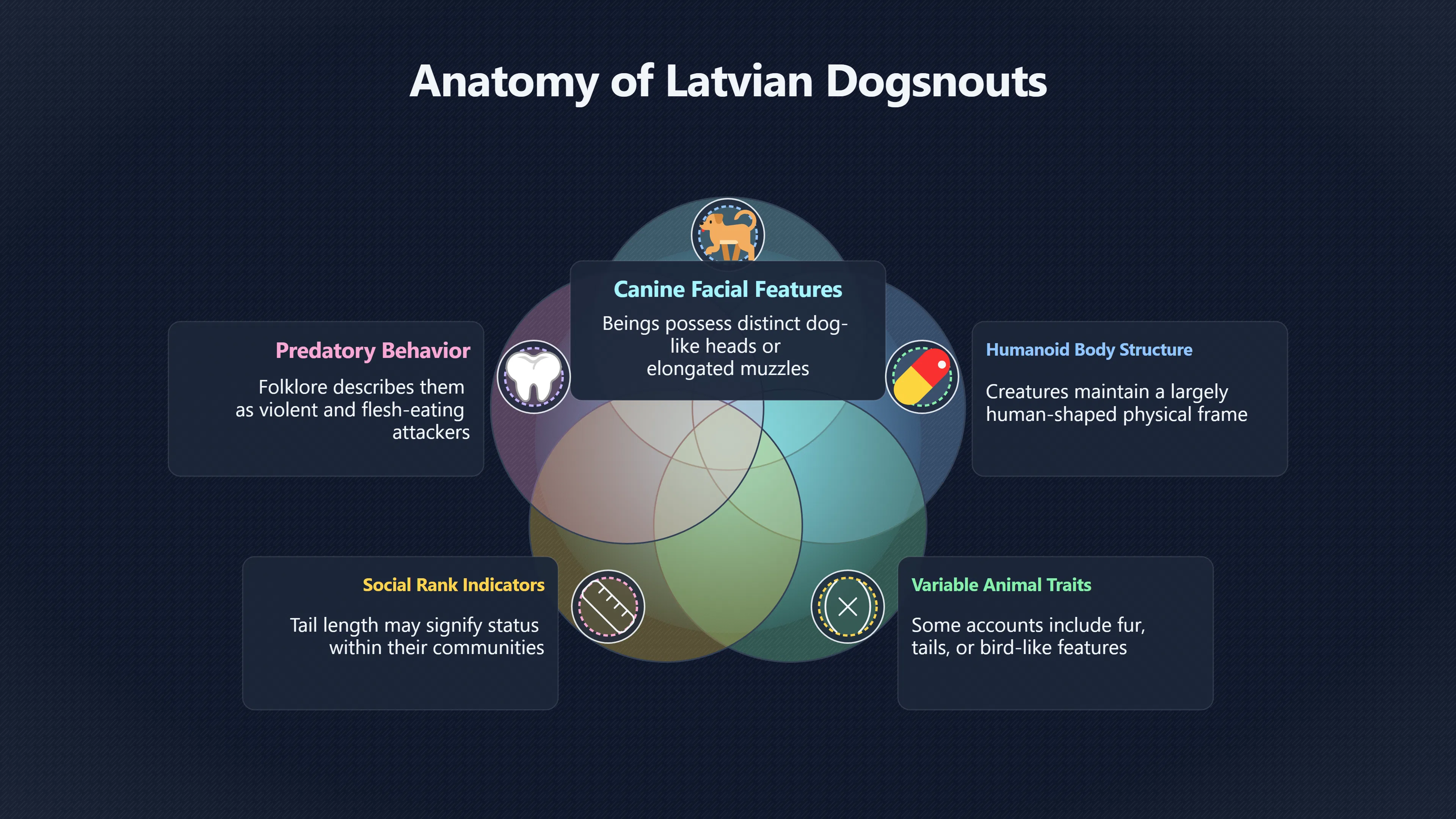
Latvian folklore preserves traditions of dog-headed creatures known as Dogsnouts. Descriptions vary from tale to tale, but the core image is remarkably consistent: a being with a largely human body and a dog-like head or muzzle. Some traditions added fur, tails, unusual eyes or even bird-like features, but the defining characteristic remained the blending of human and animal.[Wikipedia]WikipediaLatvian mythologyLatvian mythology
Unlike a lone monster lurking in a swamp, Dogsnouts were often imagined as a people. Folklore described them as living in organised groups, possessing leaders and even kings. Some accounts claimed that social rank could be recognised through physical traits such as tail length. This turns them from simple monsters into a legendary race occupying territory beyond normal human control.[Wikipedia]WikipediaLatvian mythologyLatvian mythology
Stories frequently portrayed them as violent and predatory. They could attack travellers, capture humans or consume victims. Such details place them firmly within the tradition of dangerous forest beings rather than benevolent nature spirits. Yet their behaviour also mirrors how many cultures imagined unknown peoples living beyond familiar frontiers.[Wikipedia]WikipediaLatvian mythologyLatvian mythology
Suņpurnis in Baltic Folklore Mapping
Latvia’s dog-headed beings did not emerge in isolation. They belong to a much wider family of legends stretching across Europe, the Middle East and Asia. Scholars generally connect such stories to the ancient and medieval tradition of dog-headed peoples known as cynocephali, a term used for legendary human-like races with canine heads. Medieval maps and travel accounts often placed these beings on the edges of the known world.[wikipedia.org]WikipediaOpen source on wikipedia.org.
What makes the Latvian tradition distinctive is its relocation of these beings into the Baltic forest landscape. Instead of inhabiting distant continents or mythical islands alone, they became creatures associated with woodland margins and sparsely settled regions. The forests of Latvia, which cover a large proportion of the country, provided an ideal setting for tales about dangerous beings existing just beyond the reach of ordinary communities.[Wikipedia]WikipediaLatvian mythologyLatvian mythology
This localisation is a common pattern in folklore. A broad international motif is adapted to local geography until it feels native to the landscape. In Latvia, the immense forest belt became the natural home for creatures already associated with remoteness and otherness.[Wikipedia]WikipediaOpen source on wikipedia.org.
Forest Outsiders and Monstrous Races
The most revealing aspect of Dogsnout stories is not their appearance but their social role.
Across many European traditions, monstrous races occupied symbolic borderlands. They represented people who were imagined as existing outside the moral, religious or cultural order of the community. Dog-headed beings were among the most widespread examples. Medieval writers debated whether such creatures were human, animal or something in between.[wordpress.com]tenthmedieval.wordpress.comA Corner of Tenth-Century Europe The dogheads explained?A Corner of Tenth-Century Europe18 Nov 2023 — A race of men who had heads like dogs, the so-called Cynocephali. Unlike a lot of the so…
In Latvian folklore, the forest serves a similar function. Villages and farms represented the ordered world. The deep woods represented uncertainty. Placing dog-headed peoples there transformed the forest into a zone where familiar rules no longer applied.
Several themes repeatedly appear:
- The wilderness as a frontier: The creatures live beyond settled land.
- Human-animal ambiguity: Their mixed appearance blurs distinctions between civilisation and nature.
- Fear of strangers: They embody anxieties about unknown groups living outside the community.
- Predation and captivity: Tales often emphasise the danger faced by travellers who wander too far from safety.[wikipedia.org]WikipediaLatvian mythologyLatvian mythology
Seen this way, Dogsnouts are less like a mystery beast and more like a folklore expression of what lay beyond the village boundary.
Why Dog-Heads Became Linked to Danger
The dog’s role in folklore helps explain the creature’s power. Dogs occupy an unusual symbolic position. They are close companions of humans yet remain connected to hunting, guarding and the wild. A creature with a dog’s head and a human body therefore feels familiar and threatening at the same time.
Latvian traditions often pushed this tension further by portraying Dogsnouts as blood-drinking or flesh-eating attackers. Such details exaggerated their animal side while retaining enough human qualities to make them disturbing. A wolf is simply a predator. A dog-headed person raises deeper questions about identity, behaviour and belonging.[Wikipedia]WikipediaLatvian mythologyLatvian mythology
This combination appears repeatedly in wider European dog-head traditions. The creature’s appearance creates a visual shorthand for beings that stand between categories and therefore outside ordinary society.[wikipedia.org]WikipediaOpen source on wikipedia.org.

Why This Is Folklore, Not a Sighting Flap
Unlike famous cryptid stories, there is no significant modern Latvian “Dogsnout flap” involving clusters of eyewitness reports, searches, photographs or investigations.
The evidence for these beings comes from folklore collections, traditional narratives and studies of Latvian mythology rather than from contemporary claims of encounters. References describe them as legendary inhabitants of forests and distant regions, not as unidentified animals under active investigation.[Wikipedia]WikipediaLatvian mythologyLatvian mythology
That distinction matters. A cryptid case usually begins with reports of an unknown creature that witnesses believe might be physically real. Dogsnout traditions begin with storytelling. Their value lies in cultural history rather than zoological mystery.
This does not make the stories unimportant. In many ways they are more revealing than a modern monster rumour. They show how Latvians imagined the relationship between settlement and wilderness, civilisation and danger, the familiar and the foreign. The forests at the country’s edge became populated not by hidden animals but by symbolic beings whose canine faces marked them as inhabitants of a world just beyond human order.[Wikipedia]WikipediaLatvian mythologyLatvian mythology
Amazon book picks
Further Reading
Books and field guides related to Who Were Latvia's Dog-Headed Forest Beings?. Use these as the next step if you want deeper reading beyond the article.
The Element Encyclopedia of Magical Creatures
Covers legendary races and folkloric monsters.
Monsters: An Investigator's Guide to Magical Beings
Includes many humanoid monster traditions.
eBay marketplace picks
Marketplace Samples
Live-tested eBay searches with available results related to this page.
Endnotes
1.
Source: Wikipedia
Title: Latvian mythology
Link:https://en.wikipedia.org/wiki/Latvian_mythology
2.
Source: capitalriga.eu
Title: GHOST S DON’T REALLY CARE ABOUT US
Link:https://www.capitalriga.eu/2018/10/ghosts-dont-really-care-about-us.html
Source snippet
The origins and...28 Oct 2018 — Latvian Halloween, myths, creatures and deities in Latvian folklore... An evil creature usually portray...
3.
Source: Wikipedia
Link:https://en.wikipedia.org/wiki/Cynocephaly
4.
Source: Wikipedia
Title: Baltic mythology
Link:https://en.wikipedia.org/wiki/Baltic_mythology
5.
Source: realfantasticbeasts.com
Link:https://realfantasticbeasts.com/cynocephali.html
Source snippet
The Monstrous Races in Medieval Art and Thought. Syracuse: Syracuse University Press, 1981. Friedrich, Jennie. "Saint Christopher's Canin...
6.
Source: Wikipedia
Link:https://en.wikipedia.org/wiki/Psoglav
Source snippet
PsoglavPsoglav (Serbian Cyrillic: Псоглав, literally "doghead") is a demonic mythical creature in Balkan mythology; belief about it e...
7.
Source: tenthmedieval.wordpress.com
Title: A Corner of Tenth-Century Europe The dogheads explained?
Link:https://tenthmedieval.wordpress.com/2023/11/18/the-dogheads-explained/
Source snippet
A Corner of Tenth-Century Europe18 Nov 2023 — A race of men who had heads like dogs, the so-called Cynocephali. Unlike a lot of the so...
8.
Source: danakrehnblog.wordpress.com
Link:https://danakrehnblog.wordpress.com/2021/05/23/cynocephali-the-dog-headed-race-a-brief-introduction/
Source snippet
The Dog-Headed Race: A Brief Introductionby DK Rehn — The earliest sources of monstrous races, including the dog-headed cynocephali, de...
9.
Source: intothewonder.wordpress.com
Title: dogmen and cynocephali
Link:https://intothewonder.wordpress.com/2016/04/29/dogmen-and-cynocephali/
Source snippet
and Cynocephali - Into the Wonder - WordPress.com29 Apr 2016 — Cynocephalus simply means “dog-head.” It is a term applied to a number of...
Additional References
10.
Source: sic-journal.org
Link:https://www.sic-journal.org/Article/Index/657
Source snippet
Dog-headed Creatures as the Other The Role of Monsters...by L Šešo · Cited by 5 — The existence of dog-headed creatures and other monstr...
11.
Source: reddit.com
Link:https://www.reddit.com/r/latvia/comments/uqizwm/what_are_some_mythical_creatures_or_beings_that/
Source snippet
Mythical creatures in Latvian folkloreLietuvēns is the spirit of a dead child that lingers for about 70 years. They like to torture anima...
12.
Source: mythlok.com
Link:https://mythlok.com/sumpurnis/
Source snippet
Sumpurnis: The Baltic WerewolfExplore the fascinating world of Baltic mythology with our in-depth article on Sumpurnis, a mythical creat...
13.
Source: facebook.com
Title: the cynocephali were supposed to be a mythdog headed figuresrobed watchersan isl
Link:https://www.facebook.com/ProfessorShadow68/posts/the-cynocephali-were-supposed-to-be-a-mythdog-headed-figuresrobed-watchersan-isl/122271202352143356/
Source snippet
Professor Shadow29 Jun 2026 — The Cynocephali were supposed to be a myth. Dog-headed figures. Robed watchers. An island lost somewhere be...
14.
Source: facebook.com
Link:https://www.facebook.com/groups/1114208771968434/posts/1529289807126993/
Source snippet
l creature in Balkan mythology, described as having a human body...Read more...
15.
Source: reddit.com
Link:https://www.reddit.com/r/BalticStates/comments/15r2loh/what_are_your_fav_mythical_baltic_creatures_you/
Source snippet
hih plot is inspired in scp archives, but instead anomalies are "the fay" who...
16.
Source: deepbaltic.com
Link:https://deepbaltic.com/2021/12/07/mapping-folklore-mythical-creatures-of-the-baltics-and-beyond/
Source snippet
Mapping Folklore: Mythical Creatures of the Baltics and...7 Dec 2021 — So if we accept the Kaunas Beast, then it will become a new mythi...
17.
Source: instagram.com
Title: My piece for Monsters Without Borders: Sumpurnis
Link:https://www.instagram.com/p/DBzR8xsxnu_/
Source snippet
Out of...My piece for Monsters Without Borders: Sumpurnis. Out of Latvia, the Sumpurnis... creature with the head of a dog or bird. Un...
18.
Source: facebook.com
Link:https://www.facebook.com/TheDoctorregenerated/posts/the-dog-people-cynocephali-depicted-the-world-over-including-famously-saint-chri/959548083337583/
Source snippet
of humanoids with the heads of dogs, appearing in ancient and...Read more...
19.
Source: markedhistory.com
Title: Marked History Sumpurnis
Link:https://markedhistory.com/sumpurnis/
Source snippet
Sumpurnis - - MarkedHistory1 Mar 2026 — In Latvian tradition, the Sumpurnis is a fearsome being that lives deep within the forests. It is...
Topic Tree