Within Lithuanian Beasts
Why Werewolves Haunted Lithuanian Villages
Lithuanian werewolf stories are the country's strongest cryptid-like archive, mixing wolf fear with rumours about real neighbours.
On this page
- What the folklore archives preserve
- Wolves, livestock and rural fear
- Suspicion, memory and sceptical explanations
Page outline Jump by section
Introduction
Among Lithuania’s many legendary creatures, werewolves stand out because they sit halfway between monster story and village gossip. The country’s folklore archives preserve hundreds of narratives about people who supposedly became wolves, attacked livestock, roamed forests at night or concealed a dangerous second identity behind an ordinary human face. Unlike modern cryptid stories that focus on unknown animals, Lithuanian werewolf traditions often focused on known people. The question was not “What creature is in the woods?” but “Which neighbour might secretly be one?” This combination of wolf fear, social suspicion and oral storytelling created one of the richest werewolf traditions in the Baltic region.[Academia]academia.eduWerewolves in Lithuanian Folklore Sources of the End…Lithuanian werewolf legends span from the sixteenth to the twentieth cent…
The stories matter because they reveal how rural communities explained livestock losses, strange behaviour, misfortune and social tensions. They also show how folklore preserved memories of real wolves while transforming them into narratives about hidden identities, accusations and fear.[Academia]academia.eduWerewolves in Lithuanian Folklore Sources of the End…Lithuanian werewolf legends span from the sixteenth to the twentieth cent…
What the Folklore Archives Preserve
Lithuania possesses an unusually large body of werewolf material. Research based on the Lithuanian Folklore Archives identifies more than 350 werewolf narratives collected mainly during the nineteenth and twentieth centuries. Most are classified as belief legends rather than fairy tales, meaning that storytellers often presented them as something that had happened to real people or within living memory.[Academia]academia.eduWerewolves in Lithuanian Folklore Sources of the End…Lithuanian werewolf legends span from the sixteenth to the twentieth cent…
These accounts vary widely, but several recurring themes appear:
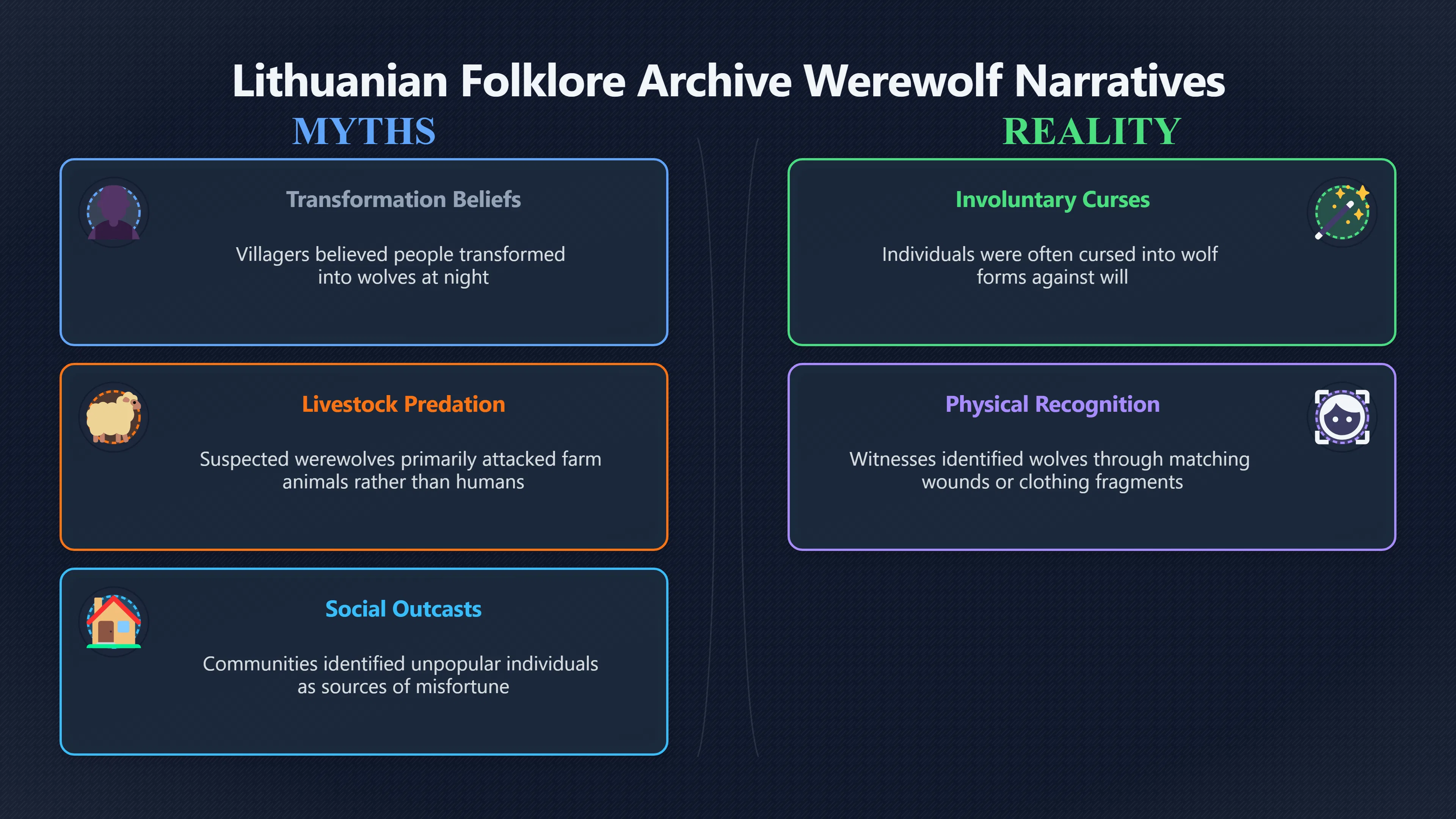
- A villager is believed to transform into a wolf at night.
- A person is cursed into wolf form against their will.
- A suspected werewolf attacks livestock rather than people.
- Someone recognises a wolf as a neighbour through a wound, clothing fragment or distinctive behaviour.
- A community identifies an unpopular or suspicious individual as the source of unexplained misfortune.[Academia]academia.eduWerewolves in Lithuanian Folklore Sources of the End…Lithuanian werewolf legends span from the sixteenth to the twentieth cent…
The sheer number of recorded narratives suggests that werewolf belief was not an isolated curiosity. It formed part of a wider folk understanding of how humans, animals and supernatural forces might overlap. Researchers note that the stories changed over time, reflecting both older Baltic traditions and later Christian ideas about sin, witchcraft and curses.[Academia]academia.eduWerewolves in Lithuanian Folklore Sources of the End…Lithuanian werewolf legends span from the sixteenth to the twentieth cent…
Why the Stories Were Treated as Believable
Many legends were told as local history rather than fantasy. Storytellers frequently named villages, forests or individuals. The effect was to bring the supernatural close to home. Instead of a distant monster, the werewolf became someone who might live down the road or work in the next field.[Academia]academia.eduWerewolves in Lithuanian Folklore Sources of the End…Lithuanian werewolf legends span from the sixteenth to the twentieth cent…
This feature helps explain why werewolf stories survived so strongly in rural areas. They were woven into community memory and social relationships. A tale about a wolf in the forest could be forgotten; a tale about a neighbour who became a wolf could be repeated for generations.[Academia]academia.eduWerewolves in Lithuanian Folklore Sources of the End…Lithuanian werewolf legends span from the sixteenth to the twentieth cent…
Wolves, Livestock and Rural Fear
Behind the supernatural stories stood a very real animal. Wolves were historically common across Lithuania and represented a genuine threat to livestock. For farming communities dependent on sheep, cattle and horses, wolf attacks could cause serious economic damage.[Medieval History]medievalhistory.infowerewolves in medieval europeIn the wild, Eurasian wolves are pack hunters, typically preying on animals such as deer, moose…Read more…
Werewolf legends often blurred the boundary between actual wolf predation and human wrongdoing. When animals disappeared or were found mauled, folklore offered an explanation that combined both fears. A wolf attack could become evidence that a person had transformed, or that a neighbour possessed dangerous magical powers.[Academia]academia.eduWerewolves in Lithuanian Folklore Sources of the End…Lithuanian werewolf legends span from the sixteenth to the twentieth cent…
This blending of animal threat and social threat is one reason Lithuanian werewolf traditions resemble cryptid lore. The stories begin with something observable—a dead animal, tracks in snow, howling at night—and then move into speculation about a hidden creature. The difference is that the hidden creature was usually believed to be human as well as animal.[Academia]academia.eduWerewolves in Lithuanian Folklore Sources of the End…Lithuanian werewolf legends span from the sixteenth to the twentieth cent…

The Wolf as a Boundary Figure
In Baltic and wider eastern European traditions, wolves occupied a symbolic position between civilisation and wilderness. They lived beyond village boundaries yet regularly crossed them. They were feared predators but also admired for strength, endurance and independence.[Wikipedia]WikipediaWerewolf in Slavic mythologyWerewolf in Slavic mythology
The werewolf inherited this ambiguity. Some stories portray transformed people as dangerous attackers. Others depict them as victims of curses who suffer in animal form and long to return to ordinary life. In these accounts, the werewolf becomes less a monster than a tragic figure trapped between two worlds.[Wikipedia]WikipediaWerewolf in Slavic mythologyWerewolf in Slavic mythology
How Suspicion Fell on Real People
One of the most revealing aspects of Lithuanian werewolf folklore is its connection to social suspicion. The stories often emerged in environments where everyone knew everyone else and unusual behaviour was difficult to ignore.
Individuals who lived on the margins of village society could become targets of rumour. A solitary person, an eccentric healer, someone involved in disputes, or a neighbour already regarded with distrust might become linked to werewolf accusations. The stories therefore functioned as a way of expressing social anxieties.[Academia]academia.eduWerewolves in Lithuanian Folklore Sources of the End…Lithuanian werewolf legends span from the sixteenth to the twentieth cent…
A common motif involved recognition. A wolf is injured during a nighttime encounter. The following day, a villager appears with a matching wound. The coincidence is treated as proof that the person and the wolf are one and the same. Similar recognition stories appear throughout northern and eastern Europe, but they are especially prominent in Lithuanian archival material.[Academia]academia.eduWerewolves in Lithuanian Folklore Sources of the End…Lithuanian werewolf legends span from the sixteenth to the twentieth cent…
These narratives reveal a community logic that transformed circumstantial evidence into certainty. Once suspicion existed, ordinary events could be reinterpreted as confirmation.
Why So Many Stories Survived
The survival of hundreds of Lithuanian werewolf narratives owes much to systematic folklore collecting. The Lithuanian Folklore Archives preserve material gathered over more than two centuries, creating one of the most important repositories of traditional belief in the country.[Tautosakos Archyvas]tautosakos-rankrastynas.ltTautosakos ArchyvasLithuanian Folklore Archive's DatabaseIt contains collections of the Lithuanian Science Society (working in 1907–1940…
By the time many stories were recorded, belief in literal human-to-wolf transformation was already weakening. Yet collectors found that older villagers still remembered tales told by parents and grandparents. This allowed researchers to document not only the legends themselves but also traces of how people once understood them.[Academia]academia.eduWerewolves in Lithuanian Folklore Sources of the End…Lithuanian werewolf legends span from the sixteenth to the twentieth cent…
The result is a rare record of how a supernatural belief operated in everyday life. Rather than surviving only in medieval texts, Lithuanian werewolves remained embedded in local storytelling well into the modern era.[Academia]academia.eduWerewolves in Lithuanian Folklore Sources of the End…Lithuanian werewolf legends span from the sixteenth to the twentieth cent…
Suspicion, Memory and Sceptical Explanations
From a modern perspective, there is no evidence that Lithuanian werewolf stories describe an unknown animal species or genuine human transformation. Scholars generally interpret them as folklore shaped by environmental realities, social tensions and cultural beliefs.[Academia]academia.eduWerewolves in Lithuanian Folklore Sources of the End…Lithuanian werewolf legends span from the sixteenth to the twentieth cent…
Several factors help explain the persistence of the legends:
Real wolf encounters. Wolves were familiar and feared animals whose presence provided a natural foundation for transformation stories.[Medieval History]medievalhistory.infowerewolves in medieval europeIn the wild, Eurasian wolves are pack hunters, typically preying on animals such as deer, moose…Read more…
Livestock losses. When valuable animals disappeared, supernatural explanations could seem more satisfying than uncertainty.[Academia]academia.eduWerewolves in Lithuanian Folklore Sources of the End…Lithuanian werewolf legends span from the sixteenth to the twentieth cent…
Village conflict. Rumours about werewolves often reflected existing tensions between neighbours, families or social outsiders.[Academia]academia.eduWerewolves in Lithuanian Folklore Sources of the End…Lithuanian werewolf legends span from the sixteenth to the twentieth cent…
Memory and storytelling. Dramatic tales were easier to remember and pass on than mundane explanations. Over time, stories accumulated local details that made them appear increasingly credible.[Academia]academia.eduWerewolves in Lithuanian Folklore Sources of the End…Lithuanian werewolf legends span from the sixteenth to the twentieth cent…
For readers interested in Lithuania’s monster traditions, werewolves are significant not because they provide evidence for a hidden creature roaming the countryside, but because they preserve a remarkable record of how communities interpreted fear. The archives reveal a world in which wolves, rumours and human relationships constantly overlapped. In that sense, Lithuanian werewolf legends are less about beasts in the forest than about the uneasy possibility that the real danger might already be part of the village.[Academia]academia.eduWerewolves in Lithuanian Folklore Sources of the End…Lithuanian werewolf legends span from the sixteenth to the twentieth cent…
Amazon book picks
Further Reading
Books and field guides related to Why Werewolves Haunted Lithuanian Villages. Use these as the next step if you want deeper reading beyond the article.
The World of Lore: Monstrous Creatures
Discusses legendary monsters and transformations.
The Book of Imaginary Beings
Provides comparative context for shapeshifters and legendary creatures.
eBay marketplace picks
Marketplace Samples
Live-tested eBay searches with available results related to this page.



Endnotes
1.
Source: academia.edu
Link:https://www.academia.edu/113746951/Werewolves_in_Lithuanian_Folklore_Sources_of_the_End_of_the_Nineteenth_and_Twentieth_Centuries
Source snippet
Werewolves in Lithuanian Folklore Sources of the End...Lithuanian werewolf legends span from the sixteenth to the twentieth cent...
2.
Source: Wikipedia
Title: Werewolf in Slavic mythology
Link:https://en.wikipedia.org/wiki/Werewolf_in_Slavic_mythology
3.
Source: Wikipedia
Title: Thiess of Kaltenbrun
Link:https://en.wikipedia.org/wiki/Thiess_of_Kaltenbrun
Source snippet
Thiess of KaltenbrunThiess of Kaltenbrunn (Kniedini), also spelled Thies, and commonly referred to as the Livonian werewolf, was a Liv...
4.
Source: Wikipedia
Title: Lithuanian mythology
Link:https://en.wikipedia.org/wiki/Lithuanian_mythology
Source snippet
Lithuanian mythologySacred groves. edit. Sacred groves were considered holy, not in themselves, but as homes of the gods. Jerome of Pr...
5.
Source: Wikipedia
Link:https://en.wikipedia.org/wiki/Werewolf
Source snippet
WerewolfBelief in werewolves developed in parallel with the belief in witches during the late Middle Ages and the early modern period...
6.
Source: tautosakos-rankrastynas.lt
Link:https://www.tautosakos-rankrastynas.lt/en/
Source snippet
Tautosakos ArchyvasLithuanian Folklore Archive's DatabaseIt contains collections of the Lithuanian Science Society (working in 1907–1940...
7.
Source: medievalhistory.info
Title: werewolves in medieval europe
Link:https://medievalhistory.info/werewolves-in-medieval-europe/
Source snippet
In the wild, Eurasian wolves are pack hunters, typically preying on animals such as deer, moose...Read more...
8.
Source: traditionarchives.org
Link:https://www.traditionarchives.org/archives/lithuania
Source snippet
The Lithuanian Folklore Archives of the ILLF preserve collections of manuscripts, photographs, and negatives as well as sound and video r...
9.
Source: villains.fandom.com
Title: In order not to be, you must feed like real wolves, attack animals.Read more
Link:https://villains.fandom.com/wiki/Werewolves_%28folklore%29
Source snippet
(folklore) - Villains Wiki - FandomDo not mix with true wolves, often stay close to living places, even settle in livestock...
Additional References
10.
Source: lnkc.lt
Link:https://www.lnkc.lt/eknygos/eka/mythology/relmyth.html
11.
Source: reddit.com
Link:https://www.reddit.com/r/BalticStates/comments/1jses24/origins_of_werewolves_and_other_mythology/
Source snippet
Origins of werewolves and other mythology.: r/BalticStatesA certain Baltic tribe (maybe the Samogitians or the Prussians) practiced ritu...
12.
Source: publicera.kb.se
Link:https://publicera.kb.se/arv/article/download/48457/50728/160828
Source snippet
Flight to Šatrija HillThis study analyses 99 folk legends concerning the witches' sabbath from the Lithuanian Folklore Archives. The folk...
13.
Source: sites.pitt.edu
Link:https://sites.pitt.edu/~dash/werewolf.html
Source snippet
University of PittsburghWerewolf Legends from GermanyWerewolf legends are well known. According to them, many people possessed the power...
14.
Source: facebook.com
Link:https://www.facebook.com/groups/trenchcrusade/posts/607487185579800/
Source snippet
I am sharing my newest version of the goofy homebrew lore I made (with art drawn by me), of the Werewolfs of Samogitia (the...Read more...
15.
Source: researchgate.net
Title: 26851448 The Sacred Groves of the Balts Lost History and Modern Research
Link:https://www.researchgate.net/publication/26851448_The_Sacred_Groves_of_the_Balts_Lost_History_and_Modern_Research
Source snippet
(PDF) The Sacred Groves of the Balts: Lost History and...14 Jun 2026 — The article deals with the sacred groves of the Balts in Lithuani...
16.
Source: researchgate.net
Title: 331646417 Some Notes on the Possible Origins of Livonian Werewolves
Link:https://www.researchgate.net/publication/331646417_Some_Notes_on_the_Possible_Origins_of_Livonian_Werewolves
Source snippet
Some Notes on the Possible Origins of Livonian Werewolves11 Mar 2019 — Bruiningk's publication “Der Werwolf in Livland” in 1924 attracted...
17.
Source: archyvas.llti.lt
Title: folklore collections of the lithuanian science society
Link:https://archyvas.llti.lt/en/folklore_collections_of_the_lithuanian_science_society/?id=171
Source snippet
2013, The Collections of the Lithuanian Science Society...Lithuanian Folklore Archives have comprising 1,269 folklore compilations (over...
18.
Source: deepbaltic.com
Link:https://deepbaltic.com/2021/12/07/mapping-folklore-mythical-creatures-of-the-baltics-and-beyond/
Source snippet
Mapping Folklore: Mythical Creatures of the Baltics and...7 Dec 2021 — We see the figure of a devil on the modern Lithuanian-Belarusian...
19.
Source: scispace.com
Link:https://scispace.com/pdf/the-werewolf-as-a-religious-and-ethnic-other-in-a-45188es2zq.pdf
Source snippet
Abstract: The paper focuses on a particular legend about a wrestling match between a human and a dead werewolf, which I recorded during m...
Topic Tree