Within Togo Mysteries
Could the Lost Togo Mouse Still Survive?
Known from only two specimens collected in 1890, the Togo mouse remains one of West Africa's most intriguing unresolved zoological mysteries.
On this page
- What the original specimens reveal
- Why later searches failed
- How scientists could look for it today
Page outline Jump by section
Introduction
The Togo mouse is one of the strangest wildlife mysteries associated with Togo, not because it is a legendary monster, but because it is a real animal that may have vanished almost as soon as science discovered it. Known formally as Leimacomys buettneri, the species is represented by only two specimens collected in 1890 near Bismarckburg (modern-day Yegué) in central Togo. More than a century later, no confirmed sighting, capture or photograph has been added to the record.[Wikipedia]WikipediaTogo mouseFebruary 9, 2026 — The Togo mouse (Leimacomys buettneri), also known as Büttner's African forest mouse or the groove-toothed forest mouse…

That unusual situation places the Togo mouse in a grey area between zoology and the kind of mystery-animal stories often discussed in cryptozoology. Unlike a traditional cryptid, the animal is unquestionably real because museum specimens exist. The mystery is whether it still survives somewhere in the forests and hills along the Togo–Ghana border, or whether it disappeared before scientists ever had the chance to understand it.[Small Mammals Specialist Group]small-mammals.orgEfforts are underway to search for this species, and may rely on indigenous knowledge as…Read more…
Could the Lost Togo Mouse Still Survive?
For many readers, the obvious question is simple: how can an animal be known to science yet effectively vanish?
The answer lies in the circumstances of its discovery. The Togo mouse was described in 1893 from two specimens collected during the German colonial period. Those specimens remain the only confirmed examples ever obtained. The species is so unusual that it was placed in its own genus, Leimacomys, and is often treated as representing a distinctive evolutionary line among African rodents.[Wikipedia]WikipediaTogo mouseFebruary 9, 2026 — The Togo mouse (Leimacomys buettneri), also known as Büttner's African forest mouse or the groove-toothed forest mouse…
Because no verified specimen has been collected since the nineteenth century, researchers cannot confidently estimate its population, distribution, behaviour or even whether it still exists. Conservation databases therefore classify it as Data Deficient rather than formally extinct. In other words, scientists lack enough information to make a definitive judgement.[GBIF]gbif.orgLeimacomys buettneri Matschie, 1893Status and Conservation. Classified as Data Deficient on The IUCN Red List. No specimen of Buttner…
The species has attracted attention from organisations focused on “lost species” — animals that have disappeared from scientific observation for decades. Re:wild currently lists the Togo mouse among its global lost-species priorities.[Re:wild]rewild.orglost small mammalsRe:wildLost Small MammalsTogo Mouse. Scientific Name: Leimacomys buettneri. Last Seen: 1890 in Togo/Ghana Years Lost: 134. Red List Statu…
What the Original Specimens Reveal
The two museum specimens are precious because they are almost all researchers have.
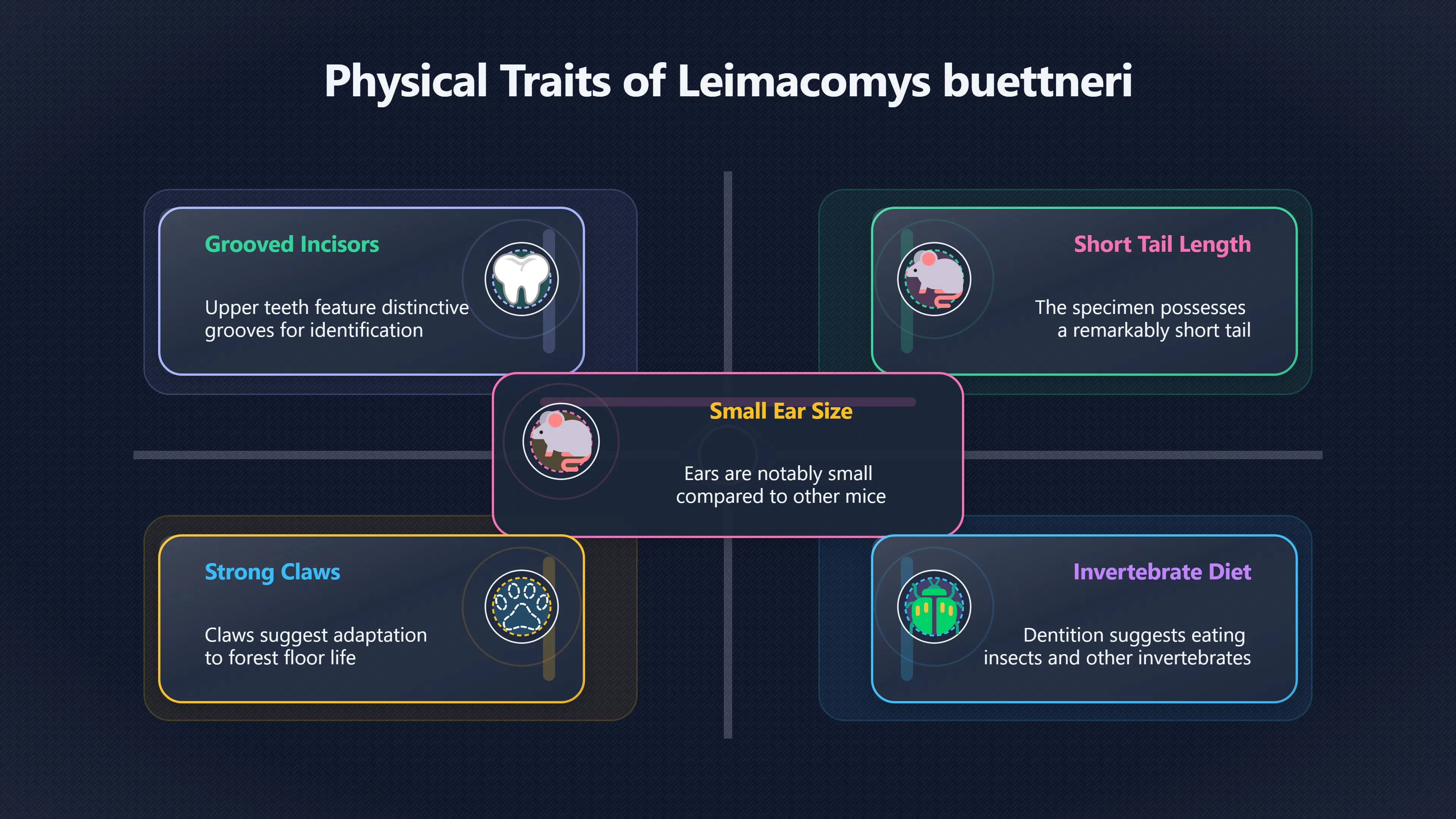
Descriptions of the preserved animals show a small forest-dwelling rodent with several unusual features. Its upper incisors carried distinctive grooves, giving rise to the name “groove-toothed forest mouse”. The tail was remarkably short, the ears small, and the claws relatively strong. These characteristics suggest an animal adapted to life on or beneath the forest floor rather than one that spent much time climbing.[Wikipedia]WikipediaLeimacomys buettneriLeimacomys buettneri
Scientists have also noted that the dentition appears better suited to eating insects and other invertebrates than to the seed-heavy diet associated with many mice. If correct, that would make the Togo mouse ecologically unusual among African rodents.[Animalia]animalia.bioTogo mouseTogo mouse - Facts, Diet, Habitat & Pictures on Animalia.bioA unique muroid rodent known from only two specimens taken from near…
The original specimens are preserved in museum collections and remain the primary source of information about the species. Modern taxonomic databases still recognise Leimacomys buettneri as a valid species, even though virtually nothing is known about its ecology in the wild.[Mammal Diversity Database]mammaldiversity.orgLiving. Found in the wild. Listed… Other common names. Büttner Forest Mouse · Büttner Togo Mouse · Groove-toothed Forest Mouse · Togo…
A further complication is geography. The collection locality lies close to the present-day border between Togo and Ghana, meaning the species may never have been restricted to Togo alone. Researchers have long suspected that any surviving population would probably occupy forest habitats extending across both countries.[Wikipedia]WikipediaLeimacomys buettneriLeimacomys buettneri

Why Later Searches Failed
The absence of modern records sounds dramatic, but it does not necessarily prove extinction.
One possibility is that the Togo mouse was always naturally rare. If a species occupies a small range, occurs at low density and is active mainly underground or at night, it can be surprisingly easy to miss during conventional surveys.[University of Vermont]uvm.eduProg RepProg Rep
Another problem is that the original collection site changed substantially over time. Forest habitats in parts of West Africa have experienced extensive alteration through agriculture, logging and human settlement. If the mouse depended on specialised forest conditions, suitable habitat may have shrunk considerably since the nineteenth century.[Small Mammals Specialist Group]small-mammals.orgEfforts are underway to search for this species, and may rely on indigenous knowledge as…Read more…
Field expeditions have attempted to relocate the species. Researchers working in and around the Kyabobo region and adjacent forest areas specifically searched for Leimacomys buettneri, yet failed to capture a confirmed specimen. A notable report from mammalogist Jan Decher described both a 1994 Oxford University expedition and later surveys that searched unsuccessfully for the animal.[University of Vermont]uvm.eduProg RepProg Rep
However, failure to find a species is not the same as proving it absent. Small mammals can be notoriously difficult to detect, especially if researchers do not know the precise habitat preferences or trapping methods required. This uncertainty explains why the species remains one of Africa’s most intriguing unresolved zoological puzzles.[Small Mammals Specialist Group]small-mammals.orgthe search for lost species continuesthe search for lost species continues
A Mystery Animal, But Not a Cryptid
The Togo mouse occupies an unusual place in discussions of mystery animals.[animalia.bio]animalia.bioTogo mouseTogo mouse - Facts, Diet, Habitat & Pictures on Animalia.bioA unique muroid rodent known from only two specimens taken from near…
Most famous cryptids are reported through eyewitness accounts, folklore or disputed evidence. The Togo mouse is different because it already has physical proof behind it. The mystery concerns survival rather than existence. Museum specimens confirm that the animal lived, but modern science cannot yet determine whether it persists in the wild.[Wikipedia]WikipediaTogo mouseFebruary 9, 2026 — The Togo mouse (Leimacomys buettneri), also known as Büttner's African forest mouse or the groove-toothed forest mouse…
This distinction makes it closer to other “lost species” than to creatures such as lake monsters or unknown apes. The central question is not “Did it ever exist?” but “Has anyone managed to find it again?”[Re:wild]rewild.orglost small mammalsRe:wildLost Small MammalsTogo Mouse. Scientific Name: Leimacomys buettneri. Last Seen: 1890 in Togo/Ghana Years Lost: 134. Red List Statu…
That status has given the species a modest afterlife in conservation circles. Lost-species campaigns often highlight animals like the Togo mouse because rediscoveries occasionally occur after decades or even centuries without records. Several mammals, birds and amphibians once feared extinct have eventually been found again, encouraging continued searches.[Re:wild]rewild.orglost small mammalsRe:wildLost Small MammalsTogo Mouse. Scientific Name: Leimacomys buettneri. Last Seen: 1890 in Togo/Ghana Years Lost: 134. Red List Statu…

How Scientists Could Look for It Today
Modern wildlife surveys have tools unavailable to nineteenth-century collectors.
One promising approach is environmental DNA, often called eDNA. Animals shed traces of genetic material into soil, water and leaf litter. By analysing samples from likely habitats, researchers may be able to detect evidence of elusive species without capturing them directly. If genetic material from the Togo mouse could be extracted from museum specimens, scientists would have a reference for comparison. The potential value of museum material for modern biological research has become increasingly clear in recent years.[Mammal Diversity Database]mammaldiversity.orgLiving. Found in the wild. Listed… Other common names. Büttner Forest Mouse · Büttner Togo Mouse · Groove-toothed Forest Mouse · Togo…
Improved trapping methods could also help. Conservation groups involved in lost-species projects note that previous surveys may not have fully targeted the ecological niche occupied by the animal. Intensive ground-level trapping in remaining forest patches could reveal species that conventional surveys miss.[Small Mammals Specialist Group]small-mammals.orgthe search for lost species continuesthe search for lost species continues
Local ecological knowledge may prove equally important. Researchers associated with recent search efforts have reported that people living near the Kyabobo region recognise a small mammal referred to locally as “Yefuli”, raising the possibility that the species survives under a familiar local identity even though it has not been scientifically documented. Such reports remain unconfirmed, but they offer leads worth investigating.[Small Mammals Specialist Group]small-mammals.orgthe search for lost species continuesthe search for lost species continues
For now, the Togo mouse remains suspended between discovery and disappearance: a scientifically recognised animal represented by two nineteenth-century specimens and a century-long silence. In a country where famous monster legends are relatively scarce, that unresolved question may be the most compelling wildlife mystery of all.[Wikipedia]WikipediaTogo mouseFebruary 9, 2026 — The Togo mouse (Leimacomys buettneri), also known as Büttner's African forest mouse or the groove-toothed forest mouse…
eBay marketplace picks
Marketplace Samples
Live-tested eBay searches with available results related to this page.



Endnotes
1.
Source: Wikipedia
Title: Togo mouse
Link:https://en.wikipedia.org/wiki/Togo_mouse
Source snippet
February 9, 2026 — The Togo mouse (Leimacomys buettneri), also known as Büttner's African forest mouse or the groove-toothed forest mouse...
Published: February 9, 2026
2.
Source: small-mammals.org
Link:https://small-mammals.org/portfolio/buttners-african-forest-mouse/
Source snippet
Efforts are underway to search for this species, and may rely on indigenous knowledge as...Read more...
3.
Source: gbif.org
Link:https://www.gbif.org/species/2438372
Source snippet
Leimacomys buettneri Matschie, 1893Status and Conservation. Classified as Data Deficient on The IUCN Red List. No specimen of Buttner...
4.
Source: Wikipedia
Title: Leimacomys buettneri
Link:https://it.wikipedia.org/wiki/Leimacomys_buettneri
5.
Source: animalia.bio
Title: Togo mouse
Link:https://animalia.bio/togo-mouse
Source snippet
Togo mouse - Facts, Diet, Habitat & Pictures on Animalia.bioA unique muroid rodent known from only two specimens taken from near...
6.
Source: Wikipedia
Title: Leimacomys buettneri
Link:https://pt.wikipedia.org/wiki/Leimacomys_buettneri
7.
Source: small-mammals.org
Title: the search for lost species continues
Link:https://small-mammals.org/2022/02/16/the-search-for-lost-species-continues/
8.
Source: animalia.bio
Title: Togo mouse
Link:https://animalia.bio/togo-mouse/1000
9.
Source: Wikipedia
Title: Timeline of extinctions in the 19th century
Link:https://en.wikipedia.org/wiki/Timeline_of_extinctions_in_the_19th_century
10.
Source: youtube.com
Title: The Search for the MOST WANTED LOST SPECIES
Link:https://www.youtube.com/watch?v=lmyILf1gJBw
Source snippet
Re:wild's Search for Lost Species — 2024...
11.
Source: youtube.com
Link:https://www.youtube.com/watch?v=yizEWMuj9hY
Source snippet
The Search for Lost Species Intro by Daniel Craig...
12.
Source: mammaldiversity.org
Link:https://www.mammaldiversity.org/taxon/1003005/
Source snippet
Living. Found in the wild. Listed... Other common names. Büttner Forest Mouse · Büttner Togo Mouse · Groove-toothed Forest Mouse · Togo...
13.
Source: rewild.org
Title: lost small mammals
Link:https://www.rewild.org/lost-species/lost-small-mammals
Source snippet
Re:wildLost Small MammalsTogo Mouse. Scientific Name: Leimacomys buettneri. Last Seen: 1890 in Togo/Ghana Years Lost: 134. Red List Statu...
14.
Source: uvm.edu
Title: Prog Rep
Link:https://www.uvm.edu/~jdecher/ProgRep.html
15.
Source: library.eshikshya.org
Title: Togo Mouse
Link:https://library.eshikshya.org/kiwix/content/wikipedia_en_all_maxi_2023-05/A/Togo_Mouse
Additional References
16.
Source: arxiv.org
Link:https://arxiv.org/abs/2505.24827
17.
Source: worldrainforests.com
Link:https://worldrainforests.com/biodiversity/en/togo/DD.html
Source snippet
of Data Deficient species in TogoList of Data Deficient species in Togo; Leimacomys buettneri, Togo Mouse, 11387, DD; Arthroleptis brev...
18.
Source: researchgate.net
Link:https://www.researchgate.net/publication/350857049_THE_IUCN_RED_LIST_OF_THREATENED_SPECIES-_African_Manatee_Assessment_Errata_version
19.
Source: iucnredlist.org
Link:https://www.iucnredlist.org/resources/grid
20.
Source: iucn.org
Link:https://iucn.org/
21.
Source: inaturalist.org
Link:https://www.inaturalist.org/taxa/735169-Leimacomyinae
22.
Source: iucnredlist.org
Title: IUC N Red List of Threatened Species DD
Link:https://www.iucnredlist.org/ja/search
23.
Source: iucnredlist.org
Title: IUC N Red List of Threatened Species DD
Link:https://www.iucnredlist.org/ja/search/map
24.
Source: iucnredlist.org
Title: IUC N Red List of Threatened Species DD
Link:https://www.iucnredlist.org/ja/search/map?populationTrend=0&searchType=species
25.
Source: iucnredlist.org
Title: IUC N Red List of Threatened Species DD
Link:https://www.iucnredlist.org/ja/search/map?searchType=species&taxonomies=101624
Topic Tree