Cryptids of Central African Republic
Central African Republic has no confirmed “monster animal” in the scientific sense, but it has a surprisingly rich place in Central African mystery-beast lore.
Page outline Jump by section
Introduction
That matters because Central African Republic is ecologically well suited to mystery-animal stories. It sits between Congo Basin rainforest, wooded savanna, wetlands and major river systems, with real leopards, lions, crocodiles, hippos, forest elephants, gorillas and rare smaller mammals in the same broad landscape. UNESCO describes the Sangha Trinational forest complex, shared by Central African Republic, Cameroon and the Republic of Congo, as a major north-western Congo Basin conservation area, while WCS describes the country’s north-eastern protected complex as an 11.5-million-hectare network tied to the Chari basin and Lake Chad watershed.[UNESCO World Heritage Centre]whc.unesco.orgOpen source on unesco.org.
Why Central African Republic attracts river-monster stories
Central African Republic is landlocked, so its creature traditions are not sea-serpent stories. They are river, swamp, forest and savanna-edge stories. That geography shapes the folklore. The southern part of the country is tied to the Congo drainage through rivers such as the Ubangi and Sangha; the north and north-east are linked to the Chari basin and to protected savanna-wetland systems around Bamingui-Bangoran and Manovo-Gounda St Floris.[UNESCO World Heritage Centre]whc.unesco.orgOpen source on unesco.org.
The country’s real wildlife also gives the legends believable raw material. Crocodiles and hippos are plausible sources for frightening river encounters, especially where a person sees only a head, back, tail, wake or sudden attack. Leopards, lions and African golden cats give local people a real vocabulary of dangerous cats, while forest elephants and gorillas help explain why outsiders have often imagined the region as a place where very large animals might still be poorly documented. The Dzanga-Sangha protected area, for example, is described by its managers as one of the last refuges for forest elephants and western lowland gorillas, and the UNESCO-listed Sangha Trinational landscape protects contiguous rainforest across three countries.[Dzanga-Sangha]dzanga-sangha.orgOpen source on dzanga-sangha.org.
The important caution is that “remote” does not mean “empty of knowledge”. Forest peoples, hunters, fishers and park staff often know local animals intimately. The mystery usually appears when oral descriptions are translated into European languages, detached from their local setting, and then reclassified by outsiders as cryptids, prehistoric survivors or “unknown species”.
The water leopard: Central African Republic’s strongest cryptid tradition
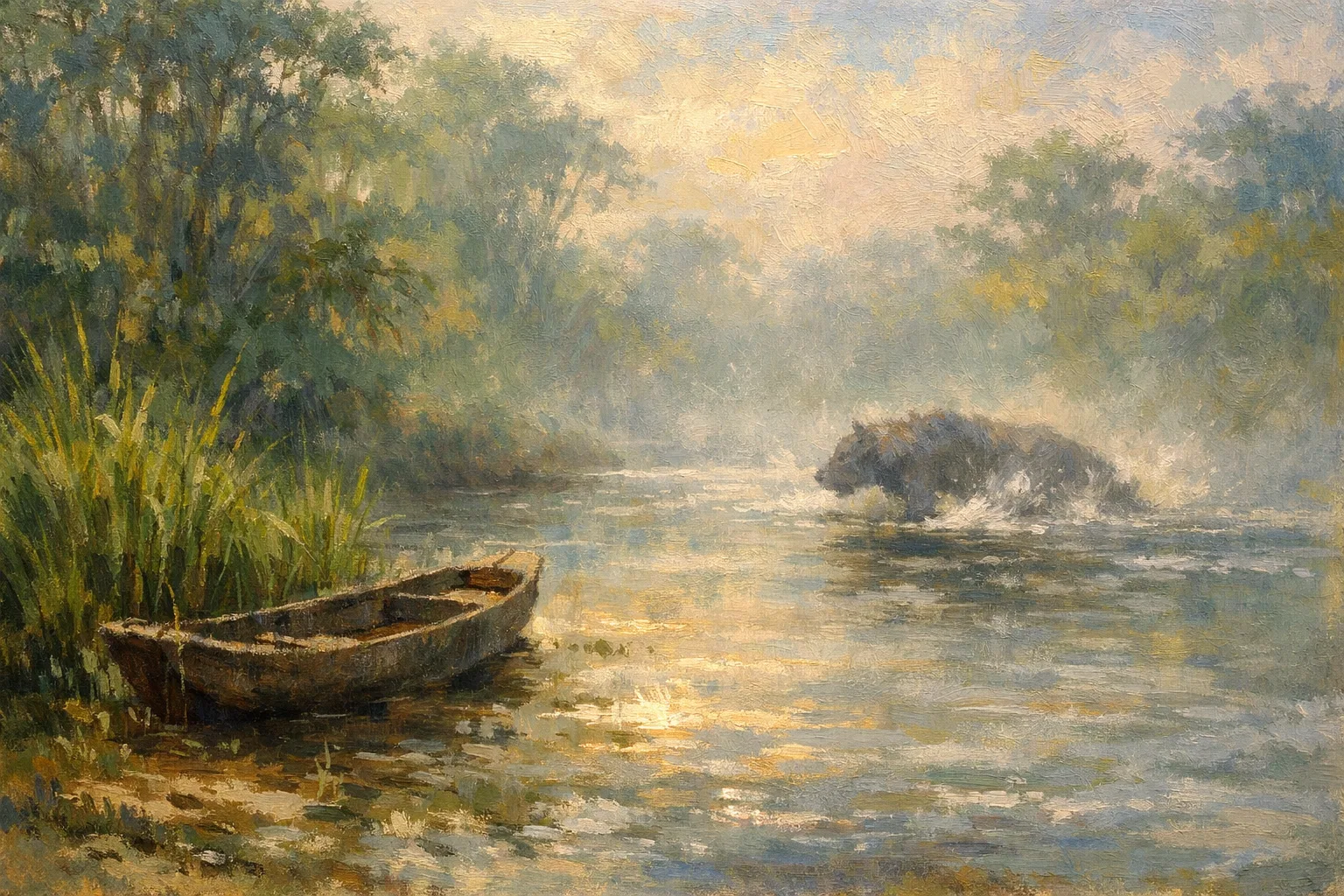
The creature most closely associated with Central African Republic in cryptozoological writing is the mourou-ngou, usually glossed as a “water leopard”. Reports place it especially around rivers such as the Bamingui, Bangoran, Gribingui, Koukourou, Kotto, Mbari and Ouaka, with related water-lion names extending into Chad and other parts of Central Africa. It is normally described as a semi-aquatic catlike animal, larger than an ordinary leopard, with large fangs, a hairy tail and a habit of attacking people, hippos or large animals near water.[Cryptid Archives]cryptidarchives.fandom.comCryptid Archives Mourou-ngouCryptid Archives Mourou-ngou
The most repeated Central African Republic story concerns an alleged 1911 attack at the confluence of the Bamingui and Koukourou rivers. In later retellings, an old man named Moussa reportedly told colonial game official Lucien Blancou that a boat carrying French tirailleurs was overturned and that one soldier was seized by a striped, panther-like animal. The account is dramatic, but it is not the same as a modern zoological record: it is a remembered story, passed through an interviewer, later through cryptozoological writers, and then through secondary summaries.[Cryptid Archives]cryptidarchives.fandom.comCryptid Archives Mourou-ngouCryptid Archives Mourou-ngou
The water-leopard tradition becomes more interesting when treated as folklore with possible zoological triggers. A crocodile can overturn or attack a person in water, but it does not look like a striped cat. A leopard can attack people, but it is not an aquatic river monster. The African golden cat is native to Central African Republic, but it is much smaller than the reported mourou-ngou and would not match the large-fanged, boat-threatening animal of the stories. The giant otter shrew is also a real semi-aquatic Central African mammal, found in the region from Nigeria and Gabon eastwards through Central African Republic, but it is far too small to explain a “water leopard” except as a reminder that unusual river mammals do exist.[IUCN CatSG]catsg.orgIUCN Cat SGLiving SpeciesIUCN Cat SGLiving Species
A sensible reading is that the mourou-ngou is probably a compound tradition. Some reports may preserve memories of crocodile attacks, leopard encounters, distorted night sightings, unfamiliar skins or tracks, and the general danger of river crossings. Later cryptozoology then sharpened that mixed material into a single “species”.
Long-necked river beasts and the mokele-mbembe connection
Central African Republic is sometimes pulled into the mokele-mbembe story, the wider Congo Basin legend of a large, long-necked water creature often reimagined in Western cryptozoology as a surviving sauropod dinosaur. The strongest geographical associations of mokele-mbembe lie outside Central African Republic, especially around the Republic of the Congo and Cameroon, but the Ubangi and Sangha river systems connect the country to the broader legend. The University of Chicago Magazine notes that mokele-mbembe has been reported across several Central African countries, including Central African Republic, while modern summaries often trace the classic tradition to the Congo Basin’s rivers and swamps.[The University of Chicago Magazine]mag.uchicago.eduOpen source on uchicago.edu.
The Central African Republic angle is usually indirect. Cryptozoological summaries mention long-necked or horned river beasts from the south-west or from river systems that cross borders, including forms sometimes grouped with mokele-mbembe or emela-ntouka traditions. These claims are best understood as part of a regional pattern rather than a clean country-specific case. The Congo Basin does not obey modern national borders, and animal stories can travel with trade, hunting, river movement, colonial administration and later books.[Cryptid Archives]cryptidarchives.fandom.comCryptid Archives BadiguiCryptid Archives Badigui
The evidence problem is severe. Despite repeated expeditions, interviews and popular claims, no bones, clear photographs, verified tissue, reliable trackway or living animal has confirmed mokele-mbembe. EBSCO’s research summary states plainly that no hard evidence has emerged despite expeditions in the Congo Basin, and the University of Chicago account of Roy Mackal’s search highlights the dependence on interviews and the difficulty of treating such testimony as proof.[EBSCO]ebsco.comOpen source on ebsco.com.
The most plausible explanations are cultural and zoological rather than prehistoric. Hippos, elephants, crocodiles, large snakes, rhinos remembered from older ranges, floating logs, wakes, fear of dangerous river places and imported dinosaur imagery have all been suggested as contributors. For Central African Republic specifically, the legend’s value is less “there may be a dinosaur here” and more “the country sits inside the river-and-rainforest zone where Central African water-beast traditions were collected, translated and amplified”.
Fanged cats in the north: the Ennedi tiger problem
Another recurring mystery-beast theme linked to Central African Republic is the “fanged cat” or “mountain tiger” tradition, sometimes folded into the wider Ennedi tiger legend of Chad. In Central African Republic versions, names such as gassingrâm or vassoko appear in accounts from northern or north-eastern hill country, especially around Ouanda Djallé and the Massif des Bongos. These creatures are usually described as larger than a lion, reddish or striped, nocturnal, powerfully fanged, and associated with caves or rocky uplands.[Cryptid Archives]cryptidarchives.fandom.comCryptid Archives GassingrâmCryptid Archives Gassingrâm
This is where the cryptozoological imagination often leaps to sabre-toothed cats. That leap is not justified by evidence. Sabre-toothed cats are extinct; no confirmed modern specimen, skull, skin, DNA sample or camera-trap image supports their survival in Central African Republic. What exists is a body of reported descriptions, often filtered through colonial-era naturalists and later cryptozoology.
More ordinary explanations are stronger. Lions and leopards both occur in the wider region, and a fleeting night sighting of a large predator can easily become exaggerated, especially if the witness is already afraid. A mane, a damaged tail, unusual coat colour, a carrying posture, reflected eyeshine or a carcass dragged into rocks could all alter the memory of an encounter. The country’s real conservation context also complicates interpretation: northern wildlife has been heavily affected by conflict, poaching and habitat pressure, so older reports may refer to animals that were more common in the past than they are now. UNEP-GRID notes significant reductions in flagship species in Central African Republic, including elephant, giraffe, ostrich, lion and hippo.[UNEP Grid]dicf.unepgrid.chOpen source on unepgrid.ch.
The fanged-cat stories remain culturally striking because they sit between known predator lore and prehistoric fantasy. They are strongest as local dangerous-animal traditions, weakest as literal claims of surviving sabre-tooths.
Ape-like and forest-person stories: why they are easy to overread
Central African Republic’s south-western forests are home to real great apes, especially western lowland gorillas and chimpanzees in and around the Dzanga-Sangha landscape. That alone makes ape-like mystery stories tempting for outsiders: a night encounter, a distant bipedal posture, a vocalisation or a glimpse of a large primate can quickly be reworked into “forest people” or “African Bigfoot” language. Dzanga-Sangha is explicitly promoted for western lowland gorillas and forest elephants, and the Sangha Trinational World Heritage site is recognised for its biodiversity and intact forest processes.[Dzanga-Sangha]dzanga-sangha.orgOpen source on dzanga-sangha.org.
The trap is to mistake real primate richness for evidence of unknown hominids. Modern conservation science uses camera traps, acoustic monitoring, field surveys and ranger patrols across Central African forests. These tools do not make discovery impossible, but they raise the bar: a large breeding population of unknown ape-like animals would be expected to leave repeatable physical evidence. Recent work on African tropical-forest camera-trap systems shows how quickly monitoring technology is improving, with models being expanded to classify more animal groups, riverbank scenes and human-edge environments.[arXiv]arxiv.orgOpen source on arxiv.org.
For a Central African Republic cryptid page, ape-like material should therefore be handled carefully. The country has real apes, rich forest knowledge and strong oral traditions, but it does not have a well-documented, country-specific “Bigfoot” case comparable to better-known claims from the Democratic Republic of the Congo or Cameroon. Where ape-like rumours appear, misidentified gorillas, chimpanzees, hearsay, hunting stories and cross-border borrowing are more likely than an undiscovered human relative.
What the evidence actually looks like
The evidence for Central African Republic’s mystery beasts is mostly testimonial. It consists of oral reports, remembered incidents, local names, colonial-era notes, cryptozoological catalogues and later retellings. That does not make the stories worthless. It does mean they should not be presented as if they were confirmed zoology.
The strongest points in favour of taking the traditions seriously are modest but real:
- The geography fits the stories. Rivers, wetlands, gallery forests, savanna edges and remote protected areas create places where dangerous animal encounters are plausible.
- The witness vocabulary is locally grounded. Names such as water leopard, water lion or water elephant show that people were comparing reported creatures with known animals, not always describing imported monsters.
- Some source traditions are old enough to pre-date internet folklore. The water-leopard and fanged-cat reports were circulating in colonial-era and mid-20th-century cryptozoological literature, not only modern forums.[ShukerNature]karlshuker.blogspot.comjungle walruses perplexing petroglyphjungle walruses perplexing petroglyph
The weaknesses are stronger:
- There is no verified specimen. No skull, skin, DNA, clear photograph or captured animal confirms a mourou-ngou, long-necked river beast or modern sabre-toothed cat.
- Many accounts are second-hand or later summaries. A remembered 1911 river attack or an old report from a village chief may be culturally valuable, but it is not controlled evidence.
- Known animals explain much of the setting. Crocodiles, hippos, leopards, lions, African golden cats, giant otter shrews and forest elephants create a rich field of possible misidentifications or story triggers.[IUCN CatSG]catsg.orgIUCN Cat SGLiving SpeciesIUCN Cat SGLiving Species
- Later cryptozoology often over-standardises messy folklore. Local stories that may once have described different hazards can become merged into a neat “unknown species” profile.
The result is not a debunked hoax in the simple sense. It is a set of traditions with weak physical evidence but strong environmental and cultural roots.

How Central African Repu’s cryptid traditions changed in retelling
The likely pattern is a three-stage transformation. First came local animal knowledge: fishers, hunters and travellers naming dangerous river presences, strange predators, unusual tracks or remembered attacks in terms that made sense locally. A “water leopard” was not necessarily a claim about taxonomy; it was a way to describe a feared animal of the river.
Second came colonial collection. Officials, hunters and naturalists recorded snippets of these accounts, often through translation and with uneven attention to local context. Once a story entered European natural-history or adventure writing, it could be compared with extinct animals, unknown cats or prehistoric reptiles.
Third came modern cryptozoology and internet culture. The mourou-ngou, gassingrâm and mokele-mbembe became catalogue entries, sometimes treated as if each name referred to a discrete hidden species. This made the stories easier to search and share, but also flatter. A living river tradition became a monster profile.
Central African Republic’s modern tourism and conservation imagery has mostly gone in a different direction. Dzanga-Sangha is known for forest elephants, gorilla tracking and rainforest conservation rather than monster hunting. That contrast is useful: the country’s real wildlife is already extraordinary, and the cryptid stories work best when read beside that reality rather than as a replacement for it.[World Wildlife Fund]worldwildlife.orghow conservation in dzanga sangha supports peoplehow conservation in dzanga sangha supports people
Best explanations by creature type
For readers trying to sort the claims, the simplest approach is to separate the traditions by habitat and likely trigger.
Water leopard or water lion reports are best read as river-danger folklore shaped by crocodile attacks, leopard fear, night sightings, unusual tracks, otter-like animals, fishers’ stories and the genuine risk of crossing remote waterways. The mourou-ngou is the most distinctive Central African Republic case, but not a verified animal.
Long-necked river beasts belong to the wider Congo Basin mokele-mbembe complex. Central African Republic is relevant because of its Ubangi and Sangha links, but the country is not the core location of the legend. The dinosaur interpretation has no hard evidence and depends heavily on interviews, retellings and popular imagery.[EBSCO]ebsco.comOpen source on ebsco.com.
Fanged mountain cats probably combine real lion and leopard encounters with fear of large predators, poor night visibility, regional Chad-CAR folklore and later sabre-tooth speculation. The reports are colourful, but the prehistoric-survivor reading is unsupported.
Ape-like forest claims are easy to inflate because the country really does have gorillas and chimpanzees. Without physical evidence, they are better treated as misidentification, cross-border borrowing or general forest folklore rather than proof of an unknown hominid.
What would change the assessment?
The standard for confirming a new large animal is not a better story; it is repeatable evidence. For Central African Republic’s cryptids, the most persuasive evidence would be a clearly documented specimen, DNA from hair or tissue collected under controlled conditions, a sequence of verifiable camera-trap images, or multiple independent records from the same area that trained zoologists could examine.
That is especially important because the region is not scientifically invisible. Conservation work in Central African forests increasingly uses camera traps, acoustic tools, patrol data and cross-border monitoring. These methods are designed to detect real animals, including rare and elusive ones. They also make it harder for a large unknown predator, aquatic mammal or ape to remain entirely unrecorded indefinitely.[arXiv]arxiv.orgOpen source on arxiv.org.
Until such evidence appears, Central African Republic’s cryptid history is best understood as a vivid country-level folklore and mystery-animal tradition built around real landscapes: dangerous rivers, forest clearings, savanna predators, colonial collecting, conservation gaps and the human habit of turning frightening encounters into memorable beasts. The monsters are not confirmed animals, but the stories reveal how people have made sense of wild places where crocodiles do take people, leopards move at night, elephants appear like grey walls in forest clearings, and a river can turn from ordinary to terrifying in a moment.
Amazon book picks
Further Reading
Books and field guides related to What Monsters Haunt Central African Republic?. Use these as the next step if you want deeper reading beyond the article.
Still in Search of Prehistoric Survivors
Includes African reports of alleged unknown animals.
eBay marketplace picks
Marketplace Samples
Live-tested eBay searches with available results related to this page.

Endnotes
1.
Source: whc.unesco.org
Link:https://whc.unesco.org/en/list/1380/
2.
Source: car.wcs.org
Title: CARAbout Us
Link:https://car.wcs.org/About-Us
3.
Source: dzanga-sangha.org
Link:https://dzanga-sangha.org/facts-infos/
4.
Source: catsg.org
Title: IUCN Cat SGLiving Species
Link:https://www.catsg.org/living-species-africangoldencat
5.
Source: ebsco.com
Link:https://www.ebsco.com/research-starters/science/mokele-mbembe-cryptozoology
6.
Source: arxiv.org
Link:https://arxiv.org/abs/2606.20223
7.
Source: arxiv.org
Link:https://arxiv.org/abs/2401.13554
8.
Source: ebsco.com
Link:https://www.ebsco.com/research-starters/geography-and-cartography/central-african-republic
9.
Source: whc.unesco.org
Link:https://whc.unesco.org/document/152527
10.
Source: dzanga-sangha.org
Link:https://dzanga-sangha.org/stories/first-ever-dzanga-sangha-day/
11.
Source: youtube.com
Title: Wildlife of the Central African Republic: Pangolins, gorillas, elephants
Link:https://www.youtube.com/watch?v=PRy_1Sh0XIc
Source snippet
Dzanga-Sangha Reserve in Bayanga, Central African Republic...
12.
Source: youtube.com
Title: Dzanga-Sangha Reserve in Bayanga, Central African Republic
Link:https://www.youtube.com/watch?v=rRbms_59an4
Source snippet
Sangha Trinational wildlife Central African Republic Wildlife of Dzanga Bai in the Central African Republic Slice D...
13.
Source: cryptidarchives.fandom.com
Title: Cryptid Archives Mourou-ngou
Link:https://cryptidarchives.fandom.com/wiki/Mourou-ngou
14.
Source: cryptidarchives.fandom.com
Title: Cryptid Archives Water lion
Link:https://cryptidarchives.fandom.com/wiki/Water_lion
15.
Source: karlshuker.blogspot.com
Title: jungle walruses perplexing petroglyph
Link:https://karlshuker.blogspot.com/2020/04/jungle-walruses-perplexing-petroglyph.html
16.
Source: mag.uchicago.edu
Link:https://mag.uchicago.edu/science-medicine/roy-mackals-wild-speculation
17.
Source: cryptidarchives.fandom.com
Title: Cryptid Archives Badigui
Link:https://cryptidarchives.fandom.com/wiki/Badigui
18.
Source: cryptidarchives.fandom.com
Title: Cryptid Archives Emela-ntouka
Link:https://cryptidarchives.fandom.com/wiki/Emela-ntouka
19.
Source: cryptidarchives.fandom.com
Title: Cryptid Archives Gassingrâm
Link:https://cryptidarchives.fandom.com/wiki/Gassingr%C3%A2m
20.
Source: dicf.unepgrid.ch
Link:https://dicf.unepgrid.ch/central-african-republic/biodiversity
21.
Source: worldwildlife.org
Title: how conservation in dzanga sangha supports people
Link:https://www.worldwildlife.org/news/magazine/summer-2025/how-conservation-in-dzanga-sangha-supports-people/
22.
Source: cryptidz.fandom.com
Title: Water lion
Link:https://cryptidz.fandom.com/wiki/Water_lion
23.
Source: cryptidarchives.fandom.com
Link:https://cryptidarchives.fandom.com/wiki/Dodu
24.
Source: cryptidarchives.fandom.com
Title: Lake Chad monster
Link:https://cryptidarchives.fandom.com/wiki/Lake_Chad_monster
25.
Source: villains.fandom.com
Title: Ape Men
Link:https://villains.fandom.com/wiki/Ape-Men
26.
Source: non-aliencreatures.fandom.com
Title: Emela ntouka
Link:https://non-aliencreatures.fandom.com/wiki/Emela-ntouka
27.
Source: cryptidarchives.fandom.com
Title: Category:Central African Republic
Link:https://cryptidarchives.fandom.com/wiki/Category%3ACentral_African_Republic
28.
Source: cryptidarchives.fandom.com
Title: Mokele mbembe
Link:https://cryptidarchives.fandom.com/wiki/Mokele-mbembe
29.
Source: cryptidz.fandom.com
Title: Ennedi Tiger
Link:https://cryptidz.fandom.com/wiki/Ennedi_Tiger
30.
Source: cryptidz.fandom.com
Title: Category:Africa (Central)
Link:https://cryptidz.fandom.com/wiki/Category%3AAfrica_%28Central%29
31.
Source: cryptidarchives.fandom.com
Link:https://cryptidarchives.fandom.com/wiki/Dilali
32.
Source: cryptidz.fandom.com
Link:https://cryptidz.fandom.com/wiki/Bakanga
33.
Source: cryptidarchives.fandom.com
Title: Tigre de montagne
Link:https://cryptidarchives.fandom.com/wiki/Tigre_de_montagne
34.
Source: cryptidz.fandom.com
Title: Giant ratel
Link:https://cryptidz.fandom.com/wiki/Giant_ratel
35.
Source: cryptidz.fandom.com
Title: Bibliothèque Heuvelmansienne
Link:https://cryptidz.fandom.com/wiki/Biblioth%C3%A8que_Heuvelmansienne
36.
Source: cryptidz.fandom.com
Link:https://cryptidz.fandom.com/wiki/Category%3ACongo
37.
Source: cryptidz.fandom.com
Title: List of proposed prehistoric survivors
Link:https://cryptidz.fandom.com/wiki/List_of_proposed_prehistoric_survivors
38.
Source: cryptidarchives.fandom.com
Title: Pig genie
Link:https://cryptidarchives.fandom.com/wiki/Pig_genie
39.
Source: cryptidarchives.fandom.com
Link:https://cryptidarchives.fandom.com/wiki/Ngoubou
40.
Source: itsmth.fandom.com
Link:https://itsmth.fandom.com/wiki/Gassingram
41.
Source: animals.fandom.com
Title: Giant Otter Shrew
Link:https://animals.fandom.com/wiki/Giant_Otter_Shrew
42.
Source: Wikipedia
Title: Central African Republic
Link:https://en.wikipedia.org/wiki/Central_African_Republic
43.
Source: Wikipedia
Title: Sangha Trinational
Link:https://en.wikipedia.org/wiki/Sangha_Trinational
44.
Source: Wikipedia
Title: Giant otter shrew
Link:https://en.wikipedia.org/wiki/Giant_otter_shrew
45.
Source: Wikipedia
Title: African golden cat
Link:https://en.wikipedia.org/wiki/African_golden_cat
46.
Source: centralafricanrepublictours.com
Title: dzanga sangha 12 days
Link:https://www.centralafricanrepublictours.com/tours/dzanga-sangha-12-days/
47.
Source: kumakonda.com
Title: dzanga sangha 2
Link:https://kumakonda.com/dzanga-sangha-2/
48.
Source: facebook.com
Link:https://www.facebook.com/groups/1002571683091379/posts/9595957313752730/
49.
Source: karlshuker.blogspot.com
Title: BURNHA M’S BEASTS
Link:https://karlshuker.blogspot.com/2019/05/burnhams-beasts-secret-wildlife-of.html
50.
Source: animalia.bio
Title: Giant Otter Shrew
Link:https://animalia.bio/giant-otter-shrew
51.
Source: earthranger.com
Title: dzanga sangha
Link:https://www.earthranger.com/success-stories/dzanga-sangha
52.
Source: beastsoflegend.com
Link:https://beastsoflegend.com/bestiary/africa/central/
53.
Source: pinebarrensinstitute.com
Link:https://pinebarrensinstitute.com/cryptids/tag/africa
54.
Source: cbd.int
Title: Central African Republic
Link:https://www.cbd.int/countries/profile/?country=cf
55.
Source: tripadvisor.com
Title: Dzanga-Sangha Reserve
Link:https://www.tripadvisor.com/Attraction_Review-g1746087-d479990-Reviews-Dzanga_Sangha_Reserve-Bayanga_Sangha_Mbaere_Prefecture.html
56.
Source: adaptation-undp.org
Title: central african republic
Link:https://www.adaptation-undp.org/explore/africa/central-african-republic
57.
Source: naturalworldsafaris.com
Link:https://www.naturalworldsafaris.com/africa/central-african-republic/safaris/dzanga-sangha-gorilla-tracking-safari
Additional References
58.
Source: youtube.com
Title: Wildlife of Dzanga Bai in the Central African Republic
Link:https://www.youtube.com/watch?v=3jdG1A2c26A
Source snippet
Wildlife of the Central African Republic: Pangolins, gorillas, elephants...
59.
Source: youtube.com
Title: Mokele-Mbembe: The Mystery of the Congo’s Legendary Creature
Link:https://www.youtube.com/watch?v=36yvpkX4E2s
Source snippet
Wildlife of Dzanga Bai in the Central African Republic...
60.
Source: youtube.com
Title: Dinosaur Sightings Are Increasing in the Congo
Link:https://www.youtube.com/watch?v=wSvNqh8Ne5E
Source snippet
Mokele-Mbembe: The Mystery of the Congo's Legendary Creature...
61.
Source: researchgate.net
Link:https://www.researchgate.net/publication/260412815_Assessing_species_occurrence_and_species-specific_use_patterns_of_bais_forest_clearings_in_Central_Africa_with_camera_traps
62.
Source: researchgate.net
Link:https://www.researchgate.net/publication/269418068_The_African_golden_cat_Caracal_aurata_Africa%27s_least-known_felid
63.
Source: researchgate.net
Link:https://www.researchgate.net/publication/385568398_Elephants_of_the_Dzanga-Sangha_dense_forest_of_south-western_Central_African_Republic
64.
Source: royalroad.com
Link:https://www.royalroad.com/fiction/chapter/309077/comments/1?comments=1
65.
Source: brill.com
Link:https://brill.com/downloadpdf/display/title/5607.pdf?srsltid=AfmBOooCHn0u8D16Qc25ZaxKnAQ66n8Xu_lTp9ZkQByHJ_0zl-lLvKUB
66.
Source: reddit.com
Link:https://www.reddit.com/r/Cryptozoology/comments/1fghp2v/a_timeline_of_the_mokele_mbembe_the_living/
67.
Source: messybeast.com
Link:https://messybeast.com/genetics/anomalous-bigcats.html
Topic Tree
Follow this branch
Related pages 192
- Antigua Cryptids
- Maldives Monsters
- Malta Monsters
- Qatar Monsters
- Argentina Monsters
- +187 more in sidebar