Strange Creatures of Jordan's Desert Edges
Jordan is not a classic “cryptid country” in the Loch Ness or Bigfoot sense. There is no well-attested national monster with a neat run of dated sightings, photographs, expeditions and newspaper flaps.
Page outline Jump by section
Introduction
That does not make the subject thin. It makes it different. Jordan sits within the wider Levantine and Arabian story-world of jinn, ghouls and desert danger, while its real ecology supplies plausible sparks for sightings: striped hyenas, Arabian wolves, caracals, sand cats, jackals, snakes, ibex and foxes. Modern conservation sources show that many of these animals are elusive, nocturnal or rare, exactly the traits that help turn a glimpse into a legend. Dana Biosphere Reserve alone records hundreds of animal species and roughly half of Jordan’s mammal species, while Wadi Rum’s cliffs, gorges and petroglyphs preserve a 12,000-year record of human life in a dramatic desert setting.[UNESCO]unesco.orgOpen source on unesco.org.
What counts as a Jordanian cryptid?
For Jordan, the most honest answer is: mostly folklore creatures and mystery-animal interpretations, not confirmed unknown species. The country’s strongest creature traditions cluster around beings that are supernatural in origin but animal-like in behaviour: desert ghouls that lure travellers, jinn associated with wild or abandoned places, and hyenas or wolves whose real habits have been amplified into cautionary tales.
A 2025 study of Jordanian oral folk tales describes ghouls, jinn and other mythical figures as recurring narrative devices used to teach caution, resilience and moral awareness. That matters because it places Jordan’s monster material in living oral culture rather than in a modern cryptozoological file of “cases”. These figures are not simply spooky decorations; they help explain why children should avoid dangerous places, why travellers should be careful, and why the wilderness feels socially and spiritually charged.[jcasc.com]jcasc.comOpen source on jcasc.com.
In practical terms, Jordan’s creature lore falls into four overlapping types:
- Folklore beings: ghouls and jinn rooted in Arabic and Islamic storytelling.
- Animal-shaped fear: hyenas, wolves, foxes and dogs treated as uncanny because they move at night, scavenge, howl or appear near settlements.
- Landscape legends: stories attached to deserts, caves, ruins, graveyards, wadis and the Dead Sea.
- Misidentification candidates: real but elusive wildlife seen briefly in poor light, then retold as something larger, stranger or more dangerous.
That mix is important. A reader looking for “Jordan’s Bigfoot” is likely to be disappointed. A reader looking for how desert ecology, oral tradition and real predators blur together will find a far richer story.
The ghoul is Jordan’s strongest monster candidate
The ghoul is the closest thing to a regional monster that fits Jordan’s cryptid frame, although it belongs to a much wider Arabic tradition rather than to Jordan alone. In Arabic folklore, the ghoul is usually linked with lonely places, graves, deserts and travellers. Ahmed Al-Rawi’s study of the Arabic ghoul traces the creature through Arabic sources from the eighth century onwards and describes it as a devilish genie-like being already known in pre-Islamic Arab belief.[JSTOR]jstor.orgOpen source on jstor.org.
This is not a “hidden animal” in the strict biological sense. The ghoul is a story-creature: a shapeshifter, deceiver and devourer. But it behaves like many cryptids do in public imagination. It has a favoured habitat, a repeated behaviour pattern, and a built-in explanation for why evidence is absent: it appears at night, in lonely places, to vulnerable people, then vanishes back into the wilderness.
The ghoul’s association with Jordan makes sense because Jordan’s physical geography supplies exactly the settings such stories need. Much of the country is desert, steppe, canyon, cliff and sparsely inhabited terrain. A tale about something that lures travellers into danger feels natural in a landscape where heat, thirst, darkness and distance are real hazards. The monster is not just a beast; it is the story-form of getting lost.
There is also an animal link. Arabic ghoul traditions often overlap with the hyena. Al-Rawi’s work discusses the long-standing association between hyenas and supernatural fear in Arabic culture, including beliefs that the animal could entrance people or draw them towards danger.[ResearchGate]researchgate.netResearch Gate(PDF) The Mythical Ghoul in Arabic CultureResearch Gate(PDF) The Mythical Ghoul in Arabic Culture This does not mean hyenas are monsters. It means their real behaviour made them excellent raw material for monster stories.

Why hyenas became uncanny
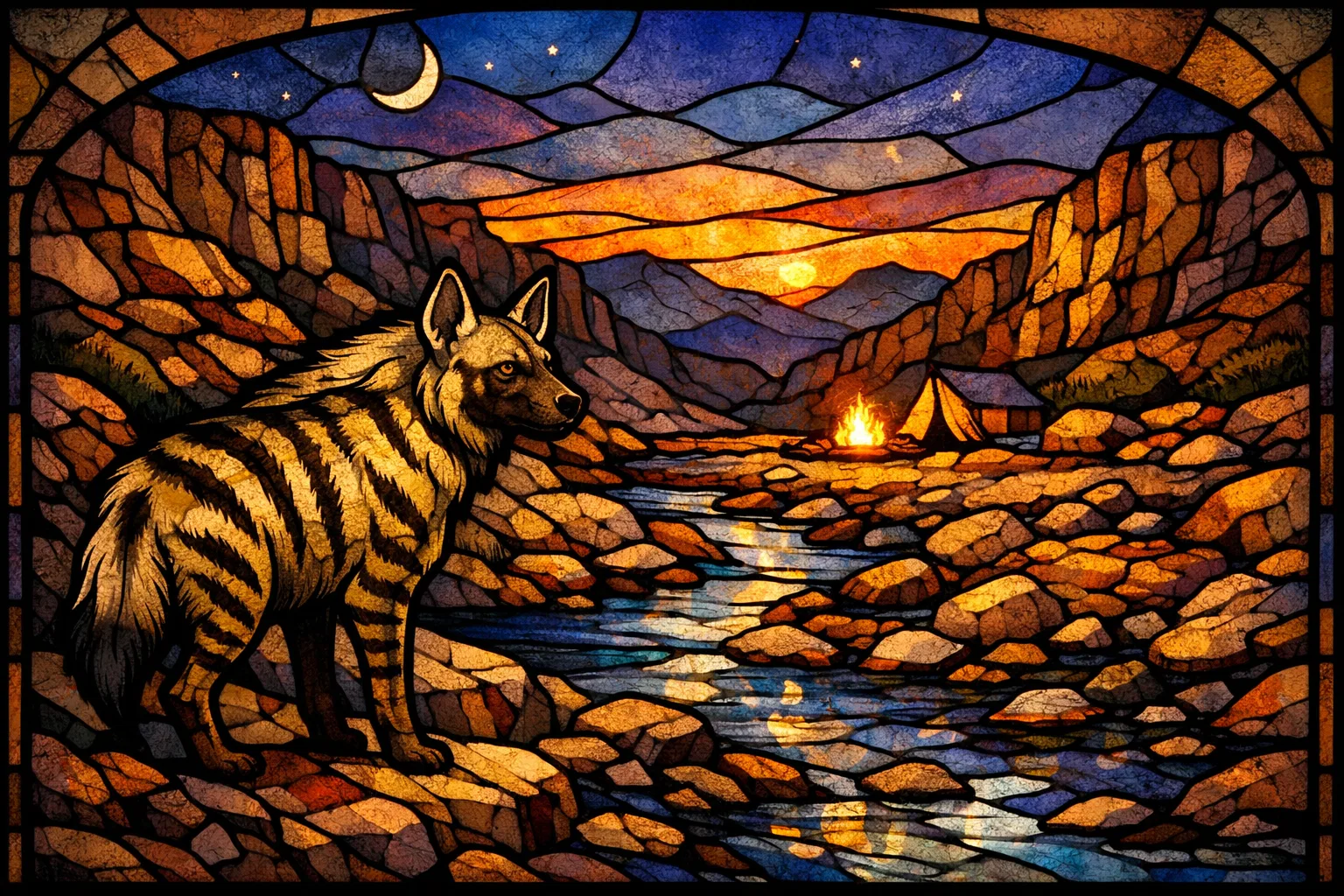
The striped hyena is probably the most important real animal behind Jordan’s mystery-beast atmosphere. It is native to the region, mainly nocturnal, wary of people, and associated with scavenging. Those traits alone are enough to give it a strange reputation: it appears at night, makes eerie sounds, visits carcasses, and may be glimpsed only briefly before disappearing.
Wildlife sources record striped hyenas among Jordan’s carnivores, alongside Arabian wolves, golden jackals, caracals, sand cats, wildcats and foxes.[Wikipedia]WikipediaWildlife of JordanWildlife of Jordan Studies of Jordanian carnivores also note that striped hyenas occur across the country’s zoogeographical regions and use safe refuges, while their diet can include remains of domestic animals as well as wild species.[ResearchGate]researchgate.netResearch Gate(PDF) Status and ecology of the Striped HyaenaResearch Gate(PDF) Status and ecology of the Striped Hyaena For folklore, that is a perfect recipe: a disliked scavenger, seen rarely, often near death, sometimes near livestock.
In a modern sceptical reading, many “monster” elements attached to hyenas can be understood as exaggerations of real features:
- The sound: hyena calls can seem human-like or distressed at night.
- The posture: the sloping back and mane-like ridge give the animal an odd silhouette.
- The setting: a hyena near a graveyard, rubbish site or carcass will look more sinister than the same animal in a field guide.
- The timing: nocturnal sightings are prone to size distortion and fear-driven interpretation.
- The folklore inheritance: once a culture already treats hyenas as uncanny, each new encounter is easier to retell as something more than animal.
This is where Jordan’s creature tradition becomes especially interesting. The likely explanation is not “people invented everything” or “there is a hidden species”. It is that a real animal with unusual habits became a bridge between ecology and story.
Wolves, jackals and the desert night
The Arabian wolf is another natural candidate for Jordanian mystery-animal reports. Like the hyena, it is real, elusive and culturally charged. Dana Biosphere Reserve is officially described by Jordan’s tourism authority as containing endangered species including the sand cat and Syrian wolf, while UNESCO records Dana as a major biodiversity reserve with 833 plant species, 215 bird species and 38 mammal species.[Visit Jordan]international.visitjordan.comVisit Jordan Dana Biosphere Reserve & FeynanVisit Jordan Dana Biosphere Reserve & Feynan
Wolves are not cryptids, but wolf stories often become cryptid-like when they move through oral tradition. A distant howl, paw prints at dawn, missing livestock, or a pale shape crossing a track can easily turn into a “beast” story, especially where sightings are rare. The same applies to jackals and foxes. Jordan’s carnivore list includes golden jackals, fennec foxes, Arabian red foxes, Blanford’s foxes and Rüppell’s foxes, giving the country a varied cast of small to medium nocturnal animals that can be misread in poor visibility.[Wikipedia]WikipediaWildlife of JordanWildlife of Jordan
The key point is scale. Jordan’s plausible mystery beasts are not lake monsters or giant apes. They are night animals made larger by distance, darkness and fear. In a rocky wadi or open desert, even a normal animal can become hard to judge. Without trees, buildings or familiar reference points, size estimates become unreliable. Add a howl, a half-seen face, a sudden movement across a camp light, and a real wolf becomes a story-beast before morning.
Wadi Rum and Dana are natural legend factories
Jordan’s strongest sighting landscapes are the places where wildlife, tourism and dramatic terrain overlap. Wadi Rum and Dana are the obvious centres.
Wadi Rum Protected Area covers 74,000 hectares in southern Jordan near the Saudi border. UNESCO describes it as a mixed natural and cultural World Heritage site, with narrow gorges, natural arches, cliffs, caverns, petroglyphs, inscriptions and archaeological remains showing 12,000 years of human occupation and interaction with the environment.[UNESCO World Heritage Centre]whc.unesco.orgWorld Heritage Centre Wadi Rum Protected AreaWorld Heritage Centre Wadi Rum Protected Area That combination matters for folklore: people have been moving through, marking and narrating this landscape for millennia.
Wadi Rum’s wildlife is often difficult to see. Local wildlife guides list rare or elusive mammals such as Arabian wolves, jackals, caracals, sand cats, Nubian ibex and striped hyenas, with many animals active at night or deep in the desert.[Wadi Rum Desert Eyes]wadirumdeserteyes.comWadi Rum Desert Eyes Wildlife in Wadi Rum DesertWadi Rum Desert Eyes Wildlife in Wadi Rum Desert Such places produce stories because they create partial encounters. A visitor may not see a wolf clearly, but may hear it. A guide may find tracks. A camp may catch eye-shine in torchlight. The experience is real, but the interpretation remains open.
Dana works differently. It is less famous in pop culture than Wadi Rum, but ecologically it is one of Jordan’s richest landscapes. UNESCO records that Dana contains seven of Jordan’s 13 vegetation types and supports a major share of the country’s plants, birds and mammals.[UNESCO]unesco.orgOpen source on unesco.org. Visit Jordan records 800 plant species and 449 animal species in the reserve, including endangered species such as the sand cat, Syrian wolf, lesser kestrel and spiny-tailed lizard.[Visit Jordan]international.visitjordan.comVisit Jordan Dana Biosphere Reserve & FeynanVisit Jordan Dana Biosphere Reserve & Feynan
For a cryptid reader, Dana’s lesson is simple: when a country has real elusive carnivores, deep valleys and a living hiking culture, mystery-beast stories do not require unknown animals. They can grow from real biodiversity.

The Dead Sea is eerie, but not a lake-monster habitat
The Dead Sea looks like it should have a monster. It is ancient, heavy with salt, bordered by desert cliffs, and associated with biblical and historical imagination. Yet it is one of the least plausible places in Jordan for a large aquatic cryptid.
The reason is biological. The Dead Sea’s extreme salinity prevents fish and aquatic plants from flourishing, although specialised microbes can exist there. USGS describes the Dead Sea as the lowest natural land or water surface on Earth, more than 400 metres below sea level, and notes that its level continues to fall because inflowing water is diverted and the basin is not quickly replenished.[USGS]eros.usgs.govOpen source on usgs.gov. Scientific work on Dead Sea microbial communities describes salinity exceeding 34%, making it an extreme halophilic environment.[PMC]pmc.ncbi.nlm.nih.govOpen source on nih.gov.
That does not kill the Dead Sea’s weirdness; it changes its form. The mystery here is not “what giant creature lives in the water?” but “why does this place feel so lifeless, heavy and otherworldly?” Its real strangeness is environmental. Floating easily, seeing salt formations, standing below sea level, and looking across a shrinking inland sea can feel uncanny without requiring a monster.
Biblical sea-monster imagery such as Leviathan belongs to the wider ancient Near Eastern world, not specifically to a modern Jordanian lake-monster tradition. Leviathan is best read as a mythic chaos creature rather than a zoological claim; biblical scholarship often connects it with older Near Eastern sea-monster motifs and the symbolic defeat of chaos.[Enter the Bible]enterthebible.orgOpen source on enterthebible.org. It can enrich Jordan-adjacent cultural interpretation, but it should not be mistaken for evidence of a Dead Sea cryptid.
Jinn stories explain places more than animals
Jinn are central to Arabic and Islamic supernatural tradition, but they do not fit neatly into cryptozoology because they are not usually treated as undiscovered animals. They are unseen beings, often linked to ruins, deserts, wells, caves, abandoned places and the margins of ordinary human life. In Jordanian folklore research, jinn appear alongside ghouls as figures that carry fear, caution and social teaching.[jcasc.com]jcasc.comOpen source on jcasc.com.
For a country-level cryptid page, jinn matter because they help explain why certain landscapes feel dangerous or charged. A ruined structure in the desert is not just old stone. A cave is not just geology. A lonely pass is not just a route. In oral tradition, these are places where the ordinary rules of village, family and daylight may not apply.
This is also where Jordan’s tourism landscape intersects with folklore. Wadi Rum, Petra’s surrounding terrain, Dana’s valleys and the Dead Sea escarpment are all intensely atmospheric. Modern visitors may describe them in cinematic terms; older storytelling might describe them as inhabited by unseen forces. The emotional response is similar even when the explanation changes.
The sceptical reading is not that people were foolish. It is that folklore gives names to risk. Dangerous heat, isolation, wild animals, strangers, cliffs, caves and night travel become easier to teach when gathered into a memorable being.
Are there modern Jordanian monster flaps?
Fresh web evidence does not show a major, well-documented modern Jordanian monster flap comparable with famous lake-monster, ape-man or phantom-cat traditions elsewhere. Searches for Jordanian cryptids tend to lead back to wider Arabic folklore, general jinn material, wildlife pages, or unrelated uses of the word “Jordan” in other countries. That absence is itself useful. It suggests that Jordan’s creature tradition is not built around a modern media cycle of repeated named sightings.
There are several reasons for this:
First, Jordan’s most charismatic mystery-creature material is older oral folklore rather than tabloid-style cryptid reporting. Ghouls and jinn belong to story, belief and cautionary teaching more than to “I photographed a monster” culture.
Second, Jordan’s real large animals are already known. Striped hyenas, wolves, caracals, jackals and sand cats supply enough strangeness without requiring a new species. Conservation literature and tourism sources focus on protecting rare animals, not chasing unknown ones.[Wikipedia]WikipediaWildlife of JordanWildlife of Jordan
Third, the country’s landscape encourages brief, ambiguous sightings rather than sustained observation. Nocturnal animals, rocky terrain, desert distance and low light all make ordinary wildlife harder to identify.
Finally, Jordan’s strongest international image is archaeological and sacred-historical: Petra, Wadi Rum, the Dead Sea, biblical geography and desert travel. Monster stories exist within that atmosphere, but they are not the country’s main tourism brand.

The most plausible explanations
Jordan’s mystery-creature reports and traditions are best explained as a layered mix rather than a single answer.
Real animals seen badly: Hyenas, wolves, jackals, foxes, caracals and feral dogs are all plausible sources for night-time beast stories. Jordan’s known carnivore fauna is varied, elusive and often nocturnal.[Wikipedia]WikipediaWildlife of JordanWildlife of Jordan
Folklore attached to risk: Ghouls and jinn make dangerous places memorable. They teach listeners to avoid isolated spaces, night wandering, strangers, graves, ruins and desert hazards. Jordanian oral-folklore research supports this role of supernatural figures as tools for transmitting caution and cultural values.[jcasc.com]jcasc.comOpen source on jcasc.com.
Hyena reputation: The striped hyena’s scavenging, nocturnal habits and unusual appearance give it a special place in uncanny animal lore. Its association with supernatural fear in Arabic tradition makes it a likely bridge between real wildlife and monster belief.[ResearchGate]researchgate.netResearch Gate(PDF) The Mythical Ghoul in Arabic CultureResearch Gate(PDF) The Mythical Ghoul in Arabic Culture
Landscape psychology: Wadi Rum, Dana and the Dead Sea are visually extreme places. Dramatic cliffs, salt water, caves, ruins and open desert amplify ordinary uncertainty. A small sound travels. A shadow looks alive. A rare animal becomes an omen.
Cultural inheritance: Jordan shares in wider Levantine, Arabic and Islamic monster traditions. Some figures are not uniquely Jordanian, but they become Jordanian when told in Jordanian places, dialects, families and travel routes.
What would stronger evidence look like?
Because Jordan’s creature lore is mostly folkloric and ecological, stronger evidence for a true cryptid would need to look different from a campfire story. A credible modern case would need repeated reports from a specific area, consistent descriptions from independent witnesses, tracks or biological traces that experts could examine, and a plausible habitat capable of supporting an unknown animal population.
For most Jordanian legends, that standard has not been met. The ghoul remains a folklore being. Jinn are spiritual and cultural figures, not zoological subjects. Hyena and wolf stories are better understood through known wildlife and oral tradition. The Dead Sea is environmentally fascinating but biologically hostile to large aquatic animals.
That does not weaken the page’s value. It clarifies it. Jordan’s monster tradition is not a failed search for a hidden beast. It is a record of how people experience wild country: with caution, humour, fear, memory and respect.
Why Jordan’s creature lore still matters
Jordan’s cryptid landscape is subtle, but it has a clear identity. It belongs to deserts, wadis, ruins and night roads rather than misty lakes or deep forests. Its creatures are not usually photographed monsters; they are warning figures, half-seen animals and old names for real danger.
The ghoul gives the tradition its most recognisable monster. The striped hyena gives it its strongest animal double. The wolf, jackal, caracal and sand cat give it plausible flashes of mystery. Wadi Rum and Dana provide the terrain. The Dead Sea supplies eerie atmosphere without being a credible monster habitat. Together, they make Jordan a country where the boundary between folklore and wildlife is more important than any single beast.
The final takeaway is evidence-aware but still wonderfully strange: Jordan’s monsters are best understood as creatures of encounter. They appear where the path thins, the light drops, the animal is only half seen, and the story begins doing what folklore has always done — turning uncertainty into something with teeth.
Amazon book picks
Further Reading
Books and field guides related to What Haunts Jordan's Desert Edges?. Use these as the next step if you want deeper reading beyond the article.
Arabian Sands
Captures the Arabian desert landscapes that underpin ghoul, jinn and wilderness folklore.
The Arabian Nights
Contains jinn, wilderness dangers and supernatural motifs central to regional folklore.
Mysterious Creatures
Places Jordanian mystery-creature traditions within wider cryptozoological literature.
![Cover for The Arabian Nights Entertainments [7 stories]](https://covers.openlibrary.org/b/id/1046897-M.jpg)
eBay marketplace picks
Marketplace Samples
Live-tested eBay searches with available results related to this page.
Endnotes
1.
Source: unesco.org
Link:https://www.unesco.org/en/mab/dana
2.
Source: whc.unesco.org
Title: World Heritage Centre Wadi Rum Protected Area
Link:https://whc.unesco.org/en/list/1377/
3.
Source: jcasc.com
Link:https://jcasc.com/index.php/jcasc/article/view/2703
4.
Source: jstor.org
Link:https://www.jstor.org/stable/40646532
5.
Source: researchgate.net
Title: 254289317 The Arabic Ghoul and its Western Transformation
Link:https://www.researchgate.net/publication/254289317_The_Arabic_Ghoul_and_its_Western_Transformation
6.
Source: researchgate.net
Title: Research Gate(PDF) The Mythical Ghoul in Arabic Culture
Link:https://www.researchgate.net/publication/277816715_The_Mythical_Ghoul_in_Arabic_Culture
7.
Source: Wikipedia
Title: Wildlife of Jordan
Link:https://en.wikipedia.org/wiki/Wildlife_of_Jordan
8.
Source: researchgate.net
Title: Research Gate(PDF) Status and ecology of the Striped Hyaena
Link:https://www.researchgate.net/publication/237574526_Status_and_ecology_of_the_Striped_Hyaena_Hyaena_hyaena_in_Jordan
9.
Source: eros.usgs.gov
Link:https://eros.usgs.gov/earthshots/dead-sea-israel-jordan-west-bank
10.
Source: pmc.ncbi.nlm.nih.gov
Link:https://pmc.ncbi.nlm.nih.gov/articles/PMC11197920/
11.
Source: Wikipedia
Title: List of cryptids
Link:https://en.wikipedia.org/wiki/List_of_cryptids
12.
Source: Wikipedia
Link:https://en.wikipedia.org/wiki/Ghoul
13.
Source: Wikipedia
Title: Arabian leopard
Link:https://en.wikipedia.org/wiki/Arabian_leopard
14.
Source: Wikipedia
Title: Bear Lake Monster
Link:https://en.wikipedia.org/wiki/Bear_Lake_Monster
15.
Source: Wikipedia
Title: Dead Sea
Link:https://en.wikipedia.org/wiki/Dead_Sea
16.
Source: Wikipedia
Link:https://en.wikipedia.org/wiki/Leviathan
17.
Source: Wikipedia
Link:https://en.wikipedia.org/wiki/Jinn
18.
Source: jcasc.com
Link:https://jcasc.com/index.php/jcasc/article/download/2703/807
19.
Source: researchgate.net
Title: 321062076 Nature Conservation of Jordan
Link:https://www.researchgate.net/publication/321062076_Nature_Conservation_of_Jordan
20.
Source: researchgate.net
Link:https://www.researchgate.net/publication/398306685_Perception_of_Fear_in_Jordanian_Oral_Folk_Tales_A_Cultural_and_Psychological_Perspective
21.
Source: researchgate.net
Link:https://www.researchgate.net/publication/361311982_The_Coding_of_Fear_in_Oral_Genres_A_Contribution_to_the_Study_of_Emotions_from_the_Folkloristic_Perspective
22.
Source: researchgate.net
Link:https://www.researchgate.net/figure/Statements-of-knowledge-of-Folk-tales_tbl2_398306685
23.
Source: researchgate.net
Link:https://www.researchgate.net/figure/Level-of-the-Relationship-Between-Jordanian-Folk-Stories-and-Gender-from-the-Perspective_tbl3_398306685
24.
Source: researchgate.net
Link:https://www.researchgate.net/figure/One-Way-ANOVA-for-Qualification_tbl6_398306685
25.
Source: researchgate.net
Title: Renad ALMOMANI
Link:https://www.researchgate.net/profile/Renad-Almomani
26.
Source: researchgate.net
Link:https://www.researchgate.net/publication/385685653_Safeguarding_the_Jordanian_Oral_Literature_by_Translation_in_Jerash_Province
27.
Source: usgs.gov
Link:https://www.usgs.gov/publications/recent-and-projected-changes-dead-sea-level-and-effects-mineral-production-sea
28.
Source: usgs.gov
Title: Saline Water and Salinity | U.S. Geological Survey Highly saline water
Link:https://www.usgs.gov/water-science-school/science/saline-water-and-salinity
29.
Source: pubs.usgs.gov
Link:https://pubs.usgs.gov/of/1978/0176/report.pdf
30.
Source: muhammad-azka.medium.com
Link:https://muhammad-azka.medium.com/the-deserts-hidden-dwellers-mystical-creatures-in-pre-islamic-arab-legends-805b579903c9
31.
Source: medium.com
Title: Al-Ghoul: Devilish Arabian Monster
Link:https://medium.com/teatime-history/al-ghoul-devilish-arabian-monster-6876c0a5b442
32.
Source: whc.unesco.org
Link:https://whc.unesco.org/en/tentativelists/5155/
33.
Source: whc.unesco.org
Link:https://whc.unesco.org/en/list/1377/documents/
34.
Source: international.visitjordan.com
Title: Visit Jordan Dana Biosphere Reserve & Feynan
Link:https://international.visitjordan.com/wheretogo/dana-feynan/
35.
Source: wadirumdeserteyes.com
Title: Wadi Rum Desert Eyes Wildlife in Wadi Rum Desert
Link:https://wadirumdeserteyes.com/blog/wildlife-in-wadi-rum
36.
Source: enterthebible.org
Link:https://enterthebible.org/passage/job-411-11-humans-are-helpless-before-the-ferocity-of-leviathan/
37.
Source: world-heritage-datasheets.unep-wcmc.org
Title: wadi rum protected area
Link:https://world-heritage-datasheets.unep-wcmc.org/datasheet/output/site/wadi-rum-protected-area
38.
Source: cryptidz.fandom.com
Link:https://cryptidz.fandom.com/wiki/Jinn
39.
Source: mythus.fandom.com
Link:https://mythus.fandom.com/wiki/Ghoul
40.
Source: cryptidz.fandom.com
Link:https://cryptidz.fandom.com/wiki/Ghoul
41.
Source: scribd.com
Link:https://www.scribd.com/document/1008950571/Leviathan
42.
Source: bereanunderground.org
Link:https://www.bereanunderground.org/p/leviathan
43.
Source: jordan.gov.jo
Title: Dead Sea
Link:https://jordan.gov.jo/EN/Pages/Dead_Sea
44.
Source: pmc.ncbi.nlm.nih.gov
Link:https://pmc.ncbi.nlm.nih.gov/articles/PMC1181833/
45.
Source: blog.education.nationalgeographic.org
Title: the dead sea
Link:https://blog.education.nationalgeographic.org/2010/04/26/the_dead_sea/
46.
Source: mythfolks.com
Link:https://www.mythfolks.com/cryptids
47.
Source: mammalwatching.com
Link:https://www.mammalwatching.com/gd_place/jordan/
48.
Source: international.visitjordan.com
Title: the dead sea
Link:https://international.visitjordan.com/wheretogo/the-dead-sea/
Additional References
49.
Source: youtube.com
Title: Who and What are Ghouls from Arabian Folklore?
Link:https://www.youtube.com/watch?v=x6FGvCfym1g
Source snippet
Jordan wildlife striped hyena arabian wolf wadi rum The best places to visit and travel to Jordan | Petra #Shorts كامتازيا تي في...
50.
Source: youtube.com
Title: Dana Biosphere Reserve: A Walk Through Jordan’s Natural Wonder
Link:https://www.youtube.com/watch?v=4D05eNBtH2E
Source snippet
Who and What are Ghouls from Arabian Folklore?...
51.
Source: academia.edu
Link:https://www.academia.edu/26073687/Status_and_conservation_of_carnivores_in_Jordan
52.
Source: academia.edu
Link:https://www.academia.edu/44906158/What_Was_Leviathan
53.
Source: deadsea.com
Link:https://deadsea.com/dead-sea-facts/
54.
Source: wadirumstillness.com
Link:https://www.wadirumstillness.com/wadi-rum-desert/
55.
Source: facebook.com
Link:https://www.facebook.com/ArabianLeopardProject/videos/hyena-and-a-wolf/2466286526826270/?locale=fo_FO
56.
Source: facebook.com
Link:https://www.facebook.com/tommylightfoot.garrett.77/posts/ghoulsthe-source-of-the-english-word-ghoul-the-gh%C5%ABls-of-arabian-myths-are-a-spec/765564735530362/
57.
Source: facebook.com
Link:https://www.facebook.com/groups/319043595258667/posts/1799553310541014/
58.
Source: geotoys.com
Link:https://geotoys.com/blogs/geotoys-blog/cryptids-across-continents-global-legends-of-mystery-and-myth?srsltid=AfmBOorHazWrIFbFxT1KhtSwglvgTXcnuO7H5Bchq50TdOx4es9Jor7k
Topic Tree
Follow this branch
Related pages 192
- Antigua Cryptids
- Maldives Monsters
- Malta Monsters
- Qatar Monsters
- Argentina Monsters
- +187 more in sidebar