Within North Korea Cryptids
Were North Korea's Monsters Really Wild Animals?
North Korea's thinner cryptid record may owe more to remembered tigers, bears and wolves than to unknown animals.
On this page
- Large animals in northern forests
- Misidentification and missing fieldwork
- Where folklore ends and zoology begins
Page outline Jump by section
Introduction
Many discussions of North Korean cryptids begin with mysterious creatures, but the more interesting question may be whether some of these stories preserve memories of real animals that once dominated northern Korean landscapes. Compared with countries that have long lists of lake monsters, wild-men and phantom beasts, North Korea has a relatively thin cryptid tradition. One reason may be that northern Korea genuinely had large, formidable wildlife for much of its history. Tigers, bears, wolves, leopards and dholes were not legendary creatures: they were real animals that people encountered, feared and remembered. As those species declined or disappeared, memories of them increasingly blended with folklore, exaggeration and mystery-animal stories.[unesco.org]unesco.orgMount PaektuMount Paektu - Man and the Biosphere Programme (MAB)Several taxa are rare or at risk, among them the tiger (Panthera tigris), dhole…
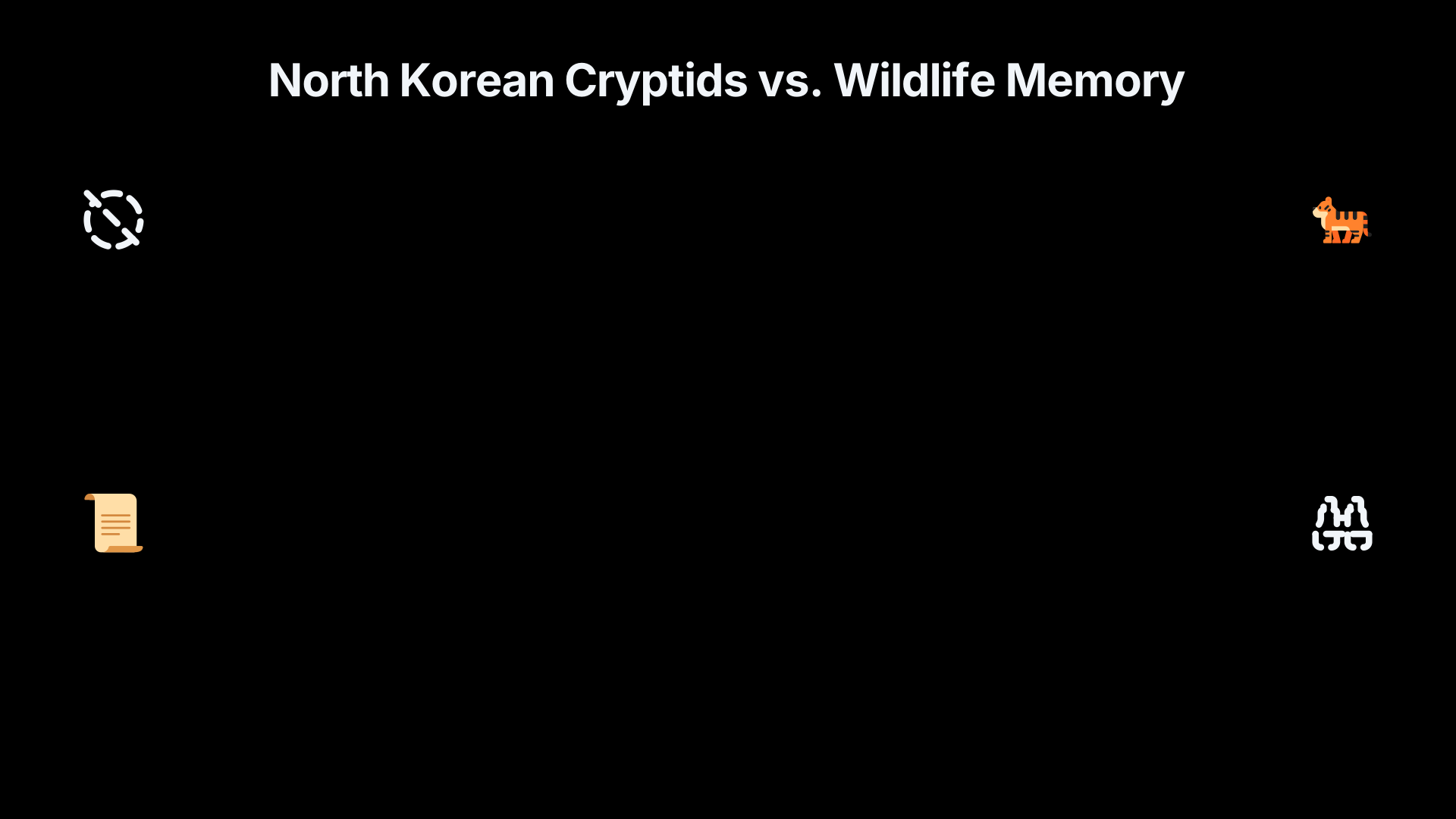
For readers interested in North Korea’s monster traditions, this wildlife memory offers an important clue. Some reports that sound cryptid-like today may be echoes of a landscape that once contained predators far larger and rarer than most modern Koreans have ever seen.[Association for Asian Studies]asianstudies.orgAssociation for Asian StudiesTHE SIBERIAN TIGER and the Country of Tiger TalesThis essay will concentrate on the Amur, or Siberian, a tig…
Large Animals in Northern Forests
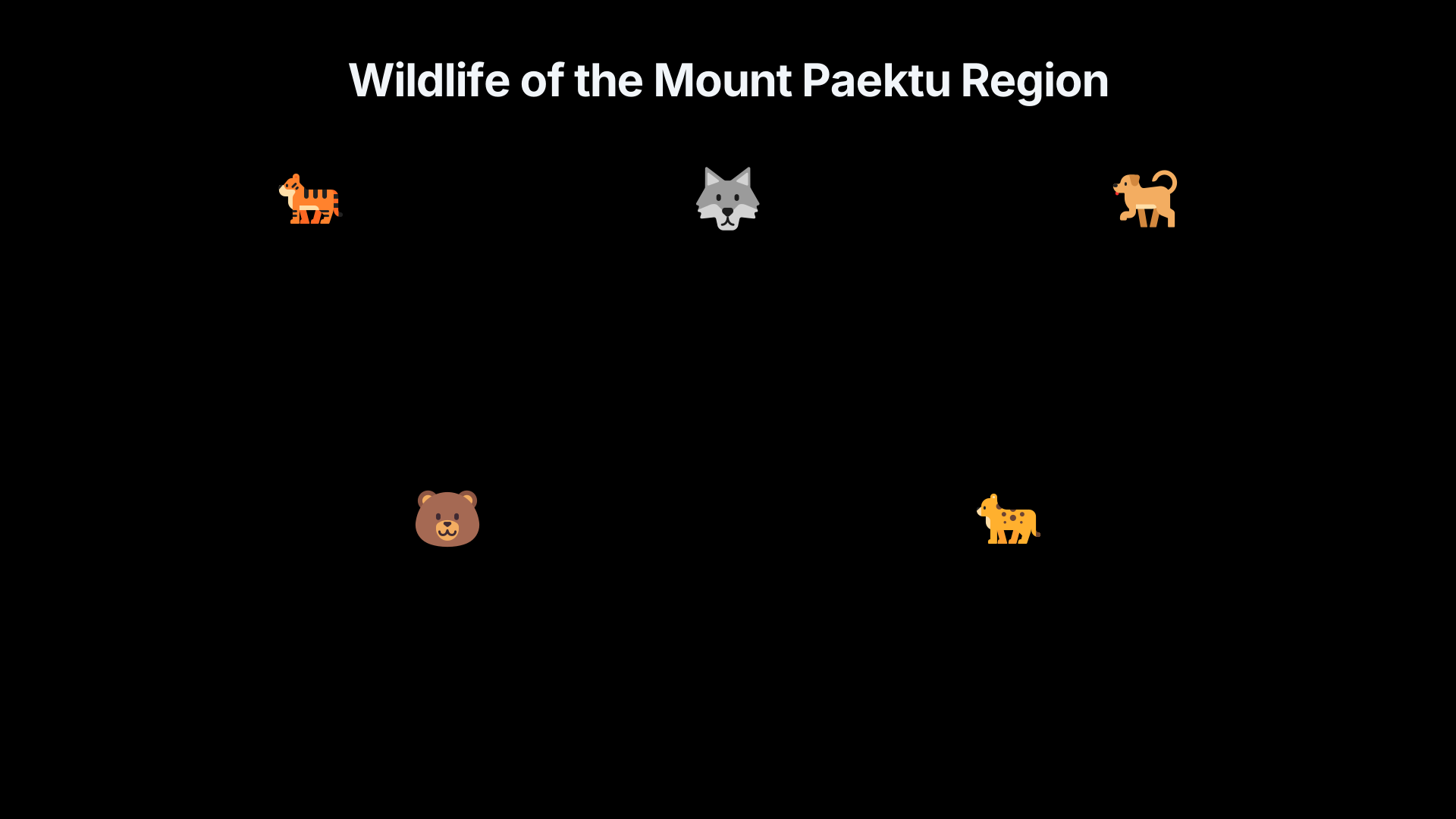
Northern Korea historically formed part of the wider forest ecosystem stretching into Manchuria and the Russian Far East. These forests supported Siberian tigers, wolves, bears, leopards and dholes. Even today, conservation descriptions of the Mount Paektu region identify tiger, grey wolf and dhole among the notable species associated with the area, while neighbouring Changbai forest ecosystems remain important habitat for large carnivores.[unesco.org]unesco.orgMount PaektuMount Paektu - Man and the Biosphere Programme (MAB)Several taxa are rare or at risk, among them the tiger (Panthera tigris), dhole…
To a modern observer, stories about huge striped beasts, shadowy predators or powerful mountain animals can sound like cryptid reports. Historically, however, such encounters may have involved genuine wildlife. Tigers were especially significant. They ranged across the Korean Peninsula for centuries and became deeply embedded in cultural memory. Historical and cultural studies describe the tiger as both a feared predator and a powerful symbolic figure in Korean life, appearing as protector, trickster, enemy and national emblem.[asianstudies.org]asianstudies.orgAssociation for Asian StudiesTHE SIBERIAN TIGER and the Country of Tiger TalesThis essay will concentrate on the Amur, or Siberian, a tig…
This creates a situation familiar in many parts of the world: when a once-common large animal disappears, later generations inherit stories but lose direct experience. The creature begins to occupy a grey zone between zoology and legend.
The Tiger as a “Monster” That Was Real
Among all animals associated with Korea, the tiger is the clearest example of wildlife memory becoming mythic. Historical sources indicate that tigers remained widespread on the peninsula until modern hunting campaigns, habitat loss and colonial-era extermination efforts drove them towards local extinction.[j-koreans.org]j-koreans.orgKorean Tigers Taken to JapanOne factor that accelerated the extinction process was the colonial pastime of “tiger hunting.” Records aboun…
Because tigers became culturally larger than life, stories about extraordinary tigers continued long after sightings became rare. In some contexts, reports of unusually large, unusually coloured or seemingly impossible tigers drifted into mystery-animal territory. Modern cryptozoology discussions occasionally treat surviving Korean tigers as cryptid candidates precisely because verified populations are no longer established across most of the peninsula.[Reddit]reddit.comThe Cryptids of North Korea: r/CryptozoologyThe Cryptids of North Korea: r/CryptozoologyOctober 20, 2023 — I'd argue that any tigers, not just blue ones, near the border betw…
The key point is that a tiger does not need to be imaginary to generate cryptid-like traditions. Once direct observation fades, memory can magnify size, ferocity and rarity.
Misidentification and Missing Fieldwork
Another reason wildlife memory matters in North Korea is the scarcity of independent biological surveys and public reporting. In countries with extensive wildlife monitoring, unusual sightings can often be checked against camera-trap records, museum collections or conservation databases. North Korea is much harder to study directly.[The Times]thetimes.co.ukThe Times Desperate North Koreans hunting animals to edge of extinctionThe collapse of the state distribution system during the 1990s famine forced citizens to rely on wild animals for food and income. Despit…
This creates several possibilities when unusual animal stories appear:
- A witness may have seen an uncommon but real species.
- A rare visitor from neighbouring China or Russia may have been misidentified.
- An old story may be repeated as a contemporary sighting.
- Folklore may become attached to a genuine animal encounter.
- A normal animal may appear extraordinary because few observers have experience with large predators.[unesco.org]unesco.orgMount PaektuMount Paektu - Man and the Biosphere Programme (MAB)Several taxa are rare or at risk, among them the tiger (Panthera tigris), dhole…
The lack of routine fieldwork does not prove the existence of unknown animals. Instead, it makes it harder to separate folklore, memory and zoological reality. This is particularly relevant in mountainous northern regions where historical predator populations were once concentrated.[UNESCO]unesco.orgMount PaektuMount Paektu - Man and the Biosphere Programme (MAB)Several taxa are rare or at risk, among them the tiger (Panthera tigris), dhole…
Wolves, Bears and the Persistence of Old Stories
Wolves provide a useful example. Historical research indicates that wolves were once abundant in Korea before disappearing from much of the peninsula during the twentieth century through hunting, habitat disruption and broader ecological changes.[Wiley Online Library]onlinelibrary.wiley.comWiley Online LibraryCase studies of the history and politics of wild canid…18 Aug 2015 — Wild canids were historically abundant in Kor…
Yet wolves remained vivid figures in stories long after their numbers collapsed. Similar patterns occur with bears. Even where populations became fragmented or scarce, memories of dangerous forest animals survived in local traditions. A tale about a mysterious creature in remote mountains may therefore preserve cultural memories of predators that earlier generations knew firsthand.[Wikipedia]WikipediaWildlife of KoreaWildlife of Korea
Where Folklore Ends and Zoology Begins
One useful way to understand North Korean cryptids is to imagine a spectrum rather than a sharp boundary.
At one end are documented animals: tigers, wolves, bears and other species known to have lived in northern Korean forests. At the other end are purely mythical beings with no zoological basis. Between them lies a middle ground where folklore and wildlife memory overlap.[UNESCO]unesco.orgMount PaektuMount Paektu - Man and the Biosphere Programme (MAB)Several taxa are rare or at risk, among them the tiger (Panthera tigris), dhole…
Research on folktales more broadly suggests that stories often preserve practical knowledge about real animals and ecological relationships. Animal folklore is not simply fantasy; it can carry cultural memories of predators, prey and survival in particular landscapes.[arXiv]arxiv.orgSystematic quantitative analyses reveal the folk-zoological knowledge embedded in folktalesJuly 9, 2019…
This perspective helps explain why North Korea has relatively few famous cryptids despite possessing landscapes that seem suitable for them. The country’s strongest monster traditions may not have developed around entirely unknown creatures. Instead, they may reflect generations of experience with very real animals that became rare, remote and increasingly legendary.
Why the Wildlife-Memory Explanation Matters
For North Korea, the simplest explanation is often the strongest. The country’s forests once contained some of East Asia’s most impressive predators. As these animals declined, memories of them remained embedded in stories, symbols and occasional mystery-animal reports.[unesco.org]unesco.orgMount PaektuMount Paektu - Man and the Biosphere Programme (MAB)Several taxa are rare or at risk, among them the tiger (Panthera tigris), dhole…
That does not mean every unusual sighting can be explained away. North Korea remains one of the least studied regions in Asia from a wildlife perspective, and questions about surviving large mammals occasionally reappear. However, the evidence points more strongly towards remembered tigers, wolves and bears than towards undiscovered monster species.[wiley.com]onlinelibrary.wiley.comWiley Online LibraryCase studies of the history and politics of wild canid…18 Aug 2015 — Wild canids were historically abundant in Kor…
Viewed this way, North Korea’s cryptid tradition is less a story of hidden beasts and more a story of disappearing wildlife. The monsters of the northern mountains may be remarkable not because they were unknown, but because they were once real.[asianstudies.org]asianstudies.orgAssociation for Asian StudiesTHE SIBERIAN TIGER and the Country of Tiger TalesThis essay will concentrate on the Amur, or Siberian, a tig…
Amazon book picks
Further Reading
Books and field guides related to Were North Korea's Monsters Really Wild Animals?. Use these as the next step if you want deeper reading beyond the article.
Where the Wild Things Were
Explores the disappearance of large animals and their ecological legacy.
eBay marketplace picks
Marketplace Samples
Live-tested eBay searches with available results related to this page.



Endnotes
1.
Source: unesco.org
Title: Mount Paektu
Link:https://www.unesco.org/en/mab/mount-paektu
Source snippet
Mount Paektu - Man and the Biosphere Programme (MAB)Several taxa are rare or at risk, among them the tiger (Panthera tigris), dhole...
2.
Source: onlinelibrary.wiley.com
Link:https://onlinelibrary.wiley.com/doi/10.1111/rec.12256
Source snippet
Wiley Online LibraryCase studies of the history and politics of wild canid...18 Aug 2015 — Wild canids were historically abundant in Kor...
3.
Source: Wikipedia
Title: Wildlife of Korea
Link:https://en.wikipedia.org/wiki/Wildlife_of_Korea
4.
Source: Wikipedia
Title: Mount Paektu
Link:https://en.wikipedia.org/wiki/Mount_Paektu
Source snippet
Mount PaektuFlora and fauna 5. Many wild birds such as black grouse, owls, and woodpecker are known to inhabit the area. The mountain...
5.
Source: archiv.hkw.de
Link:https://archiv.hkw.de/de/tigers_publication/taxidermy_of_time_tigers_as_the_chronotope_of_continual_coloniality_in_korea__yongwoo_lee/taxidermy_of_time_tigers_as_the_chronotope_of_continual_coloniality_in_korea__yongwoo_lee.php
Source snippet
as the Chronotope of Continual Coloniality in Koreaby Y Lee · Cited by 5 — This chronotopic transformation of the allegorical tiger as a...
6.
Source: j-koreans.org
Link:https://www.j-koreans.org/en/exhibit/exhibit_23.html
Source snippet
Korean Tigers Taken to JapanOne factor that accelerated the extinction process was the colonial pastime of “tiger hunting.” Records aboun...
7.
Source: reddit.com
Title: The Cryptids of North Korea: r/Cryptozoology
Link:https://www.reddit.com/r/Cryptozoology/comments/17ccqfh/the_cryptids_of_north_korea/
Source snippet
The Cryptids of North Korea: r/CryptozoologyOctober 20, 2023 — I'd argue that any tigers, not just blue ones, near the border betw...
Published: October 20, 2023
8.
Source: reddit.com
Link:https://www.reddit.com/r/korea/comments/1gzyfse/how_do_koreans_feel_about_the_extinction_of_wild/
Source snippet
the Korean peninsula some time between 1910 and 1945, which was during the Japanese...Read more...
9.
Source: arxiv.org
Link:https://arxiv.org/abs/1907.03969
Source snippet
Systematic quantitative analyses reveal the folk-zoological knowledge embedded in folktalesJuly 9, 2019...
Published: July 9, 2019
10.
Source: Wikipedia
Link:https://en.wikipedia.org/wiki/Korea
Source snippet
KoreaSouth Korea is a regional power and a developed country, with its economy ranked as the world's fourteenth-largest by GDP (PPP).R...
11.
Source: Wikipedia
Title: Korean language
Link:https://en.wikipedia.org/wiki/Korean_language
Source snippet
Korean languageKorean is the native language for about 81 million people, mostly of Korean descent. [a] It is the national language of...
12.
Source: Wikipedia
Title: Fauna of South Korea
Link:https://en.wikipedia.org/wiki/Fauna_of_South_Korea
Source snippet
Fauna of South KoreaInitially, the wild Tiger, which inhabited on the Korean Peninsula was a Siberian tiger subspecies. Although it wa...
13.
Source: whc.unesco.org
Link:https://whc.unesco.org/en/tentativelists/6961/
Source snippet
unesco.orgMt. MyohyangThe nominated property is located in the range of Mt. Myohyang in the north-western part of the Democratic People's...
14.
Source: unesco.org
Title: designates 11 new biosphere reserves 1
Link:https://www.unesco.org/en/articles/unesco-designates-11-new-biosphere-reserves-1
Source snippet
UNESCO designates 11 new biosphere reserves5 Jul 2024 — This biosphere reserve features four distinct ecosystems which harbour 88 avian s...
15.
Source: unesco.org
Link:https://www.unesco.org/en/articles/twenty-four-new-sites-join-unescos-world-network-biosphere-reserves
Source snippet
Twenty-four new sites join UNESCO's World Network of...The terrestrial part of the biosphere reserve is home to a small number of plant...
16.
Source: unesco.org
Link:https://www.unesco.org/en/iggp/mt-paektu-unesco-global-geopark
17.
Source: unesco.org
Title: Gangwon Eco-Peace
Link:https://www.unesco.org/en/mab/gangwon-eco-peace
Source snippet
Man and the Biosphere Programme...Wild animals documented in the area include 17 mammal species across 10 families, among them the Amur...
18.
Source: korea.kr
Link:https://www.korea.kr/
19.
Source: korea.net
Link:https://www.korea.net/NewsFocus/Culture/view?articleId=123878
Source snippet
n Peninsula was 'a land of leopards'Dec 16, 2014 — One may think of tigers as the fiercest animal that ever lived on the Korean Peni...
20.
Source: asianstudies.org
Link:https://www.asianstudies.org/publications/eaa/archives/the-siberian-tiger-and-the-country-of-tiger-tales/
Source snippet
Association for Asian StudiesTHE SIBERIAN TIGER and the Country of Tiger TalesThis essay will concentrate on the Amur, or Siberian, a tig...
21.
Source: oneearth.org
Link:https://www.oneearth.org/ecoregions/changbai-mountains-mixed-forests/
Source snippet
Changbai Mountains Mixed ForestsThis protected area is an important conservation area for the endangered Siberian tiger, Asiatic black be...
22.
Source: thetimes.co.uk
Title: The Times Desperate North Koreans hunting animals to edge of extinction
Link:https://www.thetimes.co.uk/article/north-korea-trade-endangered-species-69ws9s0n3
Source snippet
The collapse of the state distribution system during the 1990s famine forced citizens to rely on wild animals for food and income. Despit...
23.
Source: traveltomorrow.com
Title: unesco designates mount paektu in north korea as a global geopark
Link:https://traveltomorrow.com/unesco-designates-mount-paektu-in-north-korea-as-a-global-geopark/
Source snippet
UNESCO designates Mount Paektu in North Korea as a...17 Apr 2025 — UNESCO has recently designated the North Korean side of the active st...
24.
Source: biodb.com
Title: north korea
Link:https://biodb.com/region/north-korea/
Source snippet
Biodiversity and Nature ConservationBiosphere by UNESCO in 2009, These areas are home to coniferous and mixed forests that host species s...
Additional References
25.
Source: researchgate.net
Link:https://www.researchgate.net/publication/352477673_Journal_Pre-proof_National_Parks_Protected_Areas_and_Biodiversity_Conservation_in_North_Korea_Opportunities_for_International_Collaboration_National_Parks_Protected_Areas_and_Biodiversity_Conservation
Source snippet
(PDF) Journal Pre-proof National Parks, Protected Areas...Nov 6, 2025 — In this paper we utilize a remote sensing approach to explore No...
26.
Source: facebook.com
Title: in the early 1900s the northern part of the korean peninsula was the domain of t
Link:https://www.facebook.com/thekoreatimes/posts/in-the-early-1900s-the-northern-part-of-the-korean-peninsula-was-the-domain-of-t/4804004606374002/
Source snippet
The Korea Times5 Feb 2022 —... Predators to Repopulate this Area like Brown Bears, Black Bears, Korean Leopards, Leopard Cats, Korean Wo...
27.
Source: researchgate.net
Title: 388376333 Thinking Through the Tiger Korean Cultural Identity Space and Time
Link:https://www.researchgate.net/publication/388376333_Thinking_Through_the_Tiger_Korean_Cultural_Identity_Space_and_Time
Source snippet
ResearchGate(PDF) Thinking Through the Tiger: Korean Cultural Identity...Jan 16, 2025 — During the Japanese colonial period, tigers wer...
28.
Source: youtube.com
Link:https://www.youtube.com/watch?v=Iz-BXhSmz8s
Source snippet
Korean Tigers, myth and realityToday he gives us the highlights of his research on Korean tigers, dead and alive. Hunting and Trade of Ti...
29.
Source: aa.com.tr
Title: north korea seeks un recognition for sacred mt paektu
Link:https://www.aa.com.tr/en/asia-pacific/north-korea-seeks-un-recognition-for-sacred-mt-paektu/1859809
Source snippet
North Korea seeks UN recognition for 'sacred' Mt Paektu31 May 2020 — “The Mt Paektu area is drawing attention of the international geolog...
Published: May 2020
30.
Source: education.turpentinecreek.org
Title: the enduring symbolism of tigers in korean culture
Link:https://education.turpentinecreek.org/2025/05/24/the-enduring-symbolism-of-tigers-in-korean-culture/
Source snippet
Enduring Symbolism of Tigers in Korean Culture24 May 2025 — Korea continues to weave tigers into the fabric of modern Korean culture, rep...
Published: May 2025
31.
Source: facebook.com
Title: Korea’s wild population is considered extirpated
Link:https://www.facebook.com/ConserveWildCats/posts/in-korean-folktales-stories-often-open-with-back-when-tigers-used-to-smoke-meani/1210557351106705/
Source snippet
The tiger...In Korean folktales, stories often open with "Back when tigers used to smoke" meaning a very long time ago. Tigers are promi...
32.
Source: dongascience.com
Link:https://www.dongascience.com/en/news/9109
Source snippet
동아사이언스[The Tiger] How Korea's Tigers Were Driven from Their...“According to various records, tigers were common on the Korean Peninsula...
33.
Source: mdpi.com
Link:https://www.mdpi.com/2076-0787/14/2/19
Source snippet
Thinking Through the Tiger: Korean Cultural Identity...by E Yi · 2025 · Cited by 2 — Tigers, though now eliminated in the wild, remain...
34.
Source: youtube.com
Link:https://www.youtube.com/watch?v=CNRCMjyZu7s
Source snippet
East Asia's Biosphere Exploration: "Amur" | Part 2: The Soul of the Taiga...
Topic Tree