Within Zambia Cryptids
What Was Zambia's Horned Water Beast?
Chipekwe stories describe several different horned or reptilian water creatures rather than one consistent animal.
On this page
- The earliest Bangweulu accounts
- Why descriptions of chipekwe conflict
- How later writers turned it into a dinosaur
Page outline Jump by section
Introduction
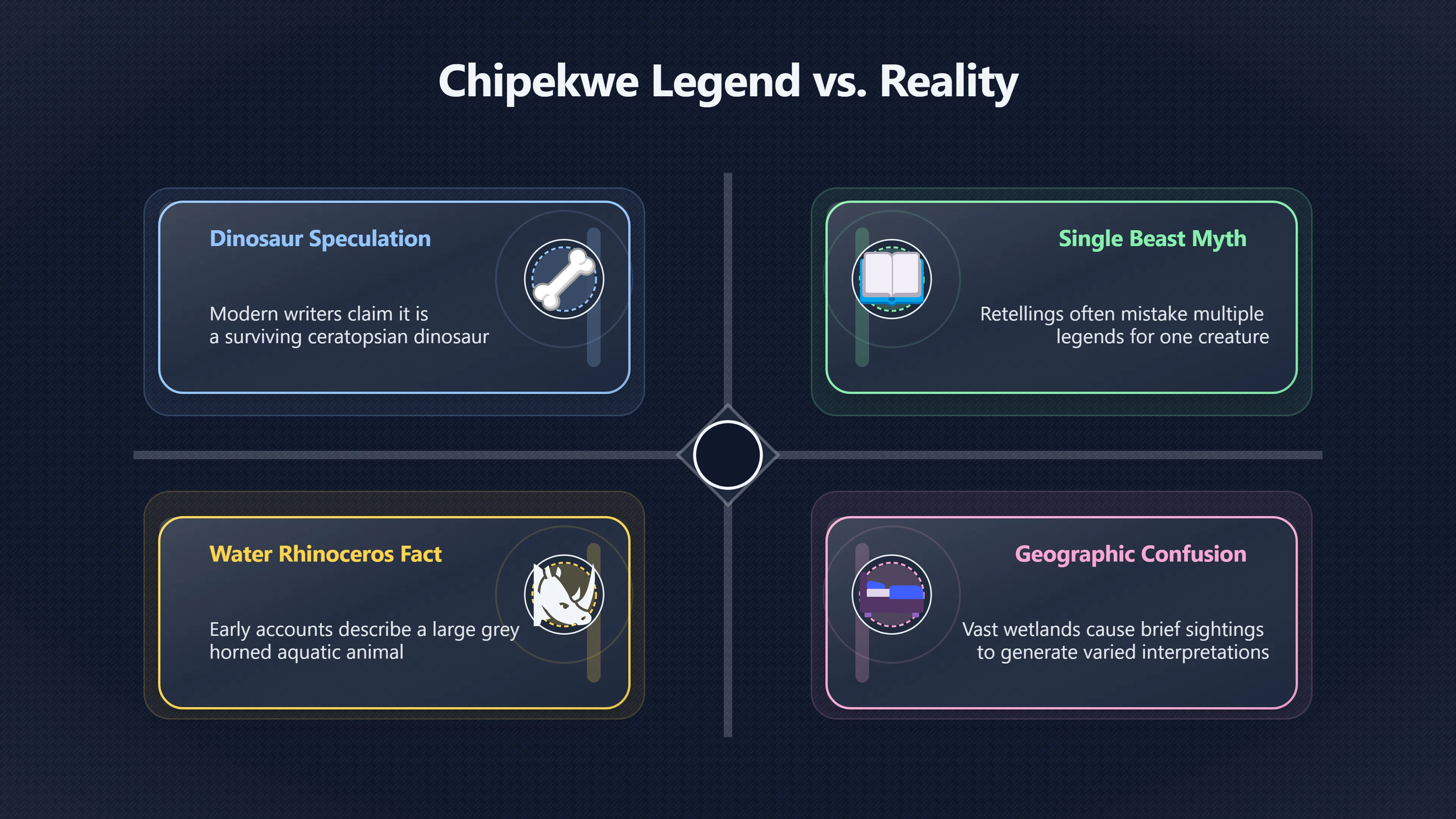
The chipekwe is one of Zambia’s most intriguing monster traditions, but it is also one of the most misunderstood. Modern retellings often present it as a single mysterious beast lurking in the Bangweulu wetlands, sometimes even as a surviving dinosaur. The older accounts tell a more complicated story. “Chipekwe” appears to have been applied to several different creatures and legends, all associated with lakes, rivers and swamps around Lake Bangweulu and neighbouring waterways. Some descriptions resemble a giant water rhinoceros with a single horn, others a reptilian monster, and still others a dangerous guardian of remote wetlands. The contradictions are not a flaw in the tradition; they are one of its most important clues.[Cryptid Wiki]cryptidz.fandom.comCryptid Wiki ChipekweCryptid WikiChipekwe - Cryptid Wiki - FandomChipekwe is a Bemba word roughly equivalent to monster, used to refer to at least three diffe…

The Earliest Bangweulu Accounts
The best-known early references to the chipekwe emerged during the colonial period, when travellers, administrators and hunters recorded stories from communities around Lake Bangweulu and the Luapula River system. These accounts generally described a large amphibious animal associated with swamps and shallow lakes rather than open water.[Genesis Park]genesispark.comGenesis ParkOther African Horned DinosaursAn enormous beast with a single ivory horn living in the waters of Lakes Bangweulu and the surr…
One of the earliest widely circulated reports appeared in a 1919 letter by C. G. James, who described stories of an enormous creature living in the waters and marshes around Bangweulu. According to his account, local people referred to the beast as a chipekwe and described it as possessing a single prominent horn. Later writers repeated the story and expanded it, helping establish the creature in African mystery-animal literature.[Genesis Park]genesispark.comGenesis ParkOther African Horned DinosaursAn enormous beast with a single ivory horn living in the waters of Lakes Bangweulu and the surr…
Another influential source was J. E. Hughes, whose 1933 book about life around Lake Bangweulu included references to a strange horned animal reportedly killed near the Luapula River. By this stage the chipekwe had become associated with an unusual combination of features: elephant-like size, rhinoceros-like weaponry and a preference for aquatic habitats.[Wikipedia]WikipediaOpen source on wikipedia.org.
What is striking about these early reports is that they rarely describe a classic “lake monster”. Instead, they focus on a powerful semi-aquatic animal capable of attacking large mammals, particularly hippopotamuses or elephants. This is one reason later researchers compared the stories to similar traditions elsewhere in Central Africa.[Cryptid Archives]cryptidarchives.fandom.comCryptid Archives ChipekweCryptid ArchivesChipekwe - Encyclopaedia of Cryptozoology - FandomThe chipekwe was a cryptid ungulate reported from freshwater habitats i…
Why Descriptions of Chipekwe Conflict
Readers searching for a definitive description quickly encounter a problem: there is no single chipekwe.
Some accounts portray a huge grey beast resembling a rhinoceros that spends much of its time in water. Others describe a reptilian creature with a long tail. A few versions present it as a carnivore capable of killing and eating large animals, while others portray it as a territorial herbivore that attacks intruders.[Cryptid Archives]cryptidarchives.fandom.comCryptid Archives ChipekweCryptid ArchivesChipekwe - Encyclopaedia of Cryptozoology - FandomThe chipekwe was a cryptid ungulate reported from freshwater habitats i…
Several factors may explain these contradictions.
First, the name itself appears to have been used broadly. Later researchers noted that “chipekwe” could function more as a label for a dangerous water monster than as the name of one specific species. In some collections of folklore, entirely different creatures from the Bangweulu region ended up grouped under the same heading.[Cryptid Wiki]cryptidz.fandom.comCryptid Wiki ChipekweCryptid WikiChipekwe - Cryptid Wiki - FandomChipekwe is a Bemba word roughly equivalent to monster, used to refer to at least three diffe…
Second, the Bangweulu wetlands are vast and difficult to navigate. They contain channels, floodplains, reed beds and isolated lagoons where sightings are often brief and conditions are poor. In such environments, unusual encounters can easily generate multiple interpretations.[Cryptidnomicon]cryptidnomi.comcon ChipekweconChipekwe - The CryptidnomiconThe Chipekwe emerges from Bemba, Aushi, and Kaonde oral traditions as a quintessential water g…
Third, stories evolved as they travelled. A local warning tale about a dangerous stretch of water might become a report of a giant animal when retold by travellers, then transform again when repeated in newspapers or adventure books. By the mid-twentieth century, accounts from different regions and cultures were often merged into a single creature profile.[Wikipedia]WikipediaOn the Track of Unknown AnimalsOn the Track of Unknown Animals
The result is a family of related legends rather than a coherent zoological description.
The Water Rhinoceros Connection
Among the many versions of the chipekwe, the most persistent is the “water rhinoceros”.
Witnesses and storytellers frequently described a large grey animal with one horn that lived partly in water and was reputed to attack elephants, hippos or other large animals. Some cryptozoologists later linked these reports to the Central African creature known as emela-ntouka, another legendary horned beast sometimes translated as “elephant killer”. In several collections of reports, the two names are treated as referring to the same creature or closely related traditions.[Cryptid Archives]cryptidarchives.fandom.comCryptid Archives ChipekweCryptid ArchivesChipekwe - Encyclopaedia of Cryptozoology - FandomThe chipekwe was a cryptid ungulate reported from freshwater habitats i…
This comparison helped spread the chipekwe story beyond Zambia. Instead of being viewed as a local Bangweulu legend, it became part of a broader network of Central African stories about large horned animals inhabiting swamps and remote waterways.[Wikipedia]WikipediaOpen source on wikipedia.org.
Sceptics have suggested that some reports may have originated in observations of known animals viewed under unusual conditions. Hippopotamuses, crocodiles and rhinoceroses can all appear surprisingly unfamiliar when partly submerged, seen at dusk or described through oral tradition. A dangerous animal encountered in a remote wetland may gradually acquire exaggerated features as stories spread. No specimen, skeleton, verified photograph or biological evidence has ever confirmed the existence of a giant unknown water rhinoceros in Bangweulu.[Cryptid Archives]cryptidarchives.fandom.comCryptid Archives ChipekweCryptid ArchivesChipekwe - Encyclopaedia of Cryptozoology - FandomThe chipekwe was a cryptid ungulate reported from freshwater habitats i…
How Later Writers Turned It Into a Dinosaur
The transformation of the chipekwe from regional water beast to supposed dinosaur largely occurred in twentieth-century cryptozoological literature.
As interest grew in stories of surviving prehistoric animals, writers began comparing the chipekwe to extinct horned dinosaurs. The creature’s reported size, aquatic habits and single horn encouraged speculation that it might resemble a ceratopsian such as Monoclonius or Centrosaurus. These comparisons were imaginative rather than evidence-based, but they proved extremely popular.[Wikipedia]WikipediaOpen source on wikipedia.org.
The influence of writers such as Roy Mackal and other promoters of African “living dinosaur” traditions further encouraged the idea that reports from Zambia, Congo and neighbouring regions all referred to relic populations of prehistoric animals hidden in swamps and forests. Within this framework, the chipekwe became grouped with creatures such as mokele-mbembe and emela-ntouka, regardless of the substantial differences between the original accounts.[uchicago.edu]mag.uchicago.eduroy mackals wild speculationroy mackals wild speculation
By this stage, many retellings no longer focused on the specific Bangweulu stories. Instead, the chipekwe became a character in a larger narrative about lost worlds and surviving dinosaurs. The local folklore context was often reduced or omitted entirely.[Wikipedia]WikipediaOn the Track of Unknown AnimalsOn the Track of Unknown Animals
What the Chipekwe Tradition Probably Represents
The most useful way to understand the chipekwe is not as a single mystery animal but as a cluster of overlapping traditions connected to dangerous wetlands and powerful aquatic creatures.
The stories reflect the realities of life around Bangweulu: vast swamps, hidden channels, large wildlife and waterways capable of causing sudden death. In that environment, legends about territorial water beasts serve practical as well as cultural functions. They mark hazardous places, explain unusual events and express respect for landscapes that can overwhelm human visitors.[Cryptidnomicon]cryptidnomi.comcon ChipekweconChipekwe - The CryptidnomiconThe Chipekwe emerges from Bemba, Aushi, and Kaonde oral traditions as a quintessential water g…
From a cryptozoological perspective, the evidence for an unknown giant animal remains extremely weak. The accounts vary dramatically, no physical specimen has ever appeared, and later descriptions were heavily shaped by adventure literature and dinosaur speculation. Yet the legend remains valuable because it reveals how folklore, eyewitness testimony, colonial-era reporting and modern monster culture can combine to create a creature that is simultaneously local, regional and global.[fandom.com]cryptidarchives.fandom.comCryptid Archives ChipekweCryptid ArchivesChipekwe - Encyclopaedia of Cryptozoology - FandomThe chipekwe was a cryptid ungulate reported from freshwater habitats i…
In Zambia’s monster tradition, the chipekwe is therefore less a single beast than a window into how stories about the unknown evolve. The horned water beast of Bangweulu survived not because anyone captured it, but because every generation imagined it a little differently.[Cryptid Wiki]cryptidz.fandom.comCryptid Wiki ChipekweCryptid WikiChipekwe - Cryptid Wiki - FandomChipekwe is a Bemba word roughly equivalent to monster, used to refer to at least three diffe…
Amazon book picks
Further Reading
Books and field guides related to What Was Zambia's Horned Water Beast?. Use these as the next step if you want deeper reading beyond the article.
In Witch-bound Africa
Captures the era in which many Central African creature stories were recorded.
On the Track of Unknown Animals
Discusses mystery animals and water-monster traditions.
eBay marketplace picks
Marketplace Samples
Live-tested eBay searches with available results related to this page.


Endnotes
1.
Source: Wikipedia
Link:https://fr.wikipedia.org/wiki/Emela-ntouka
2.
Source: Wikipedia
Link:https://en.wikipedia.org/wiki/Emela-ntouka
3.
Source: Wikipedia
Title: On the Track of Unknown Animals
Link:https://en.wikipedia.org/wiki/On_the_Track_of_Unknown_Animals
4.
Source: brill.com
Link:https://brill.com/downloadpdf/display/title/5607.pdf?srsltid=AfmBOopGu82Fsfq8AT0kGLXH7QRHiR8J1U_REZa2Bl-guRur97_N0BhG
5.
Source: mag.uchicago.edu
Title: roy mackals wild speculation
Link:https://mag.uchicago.edu/science-medicine/roy-mackals-wild-speculation
6.
Source: youtube.com
Title: Lake Bangweulu
Link:https://www.youtube.com/watch?v=b3tCB79XHyU
Source snippet
3 Bangweulu wetlands...
7.
Source: youtube.com
Title: Bangweulu wetlands
Link:https://www.youtube.com/watch?v=P2yh6KpwZzs
Source snippet
4 The Hidden Cryptids of Africa...
8.
Source: cryptidz.fandom.com
Title: Cryptid Wiki Chipekwe
Link:https://cryptidz.fandom.com/wiki/Chipekwe
Source snippet
Cryptid WikiChipekwe - Cryptid Wiki - FandomChipekwe is a Bemba word roughly equivalent to monster, used to refer to at least three diffe...
9.
Source: cryptidarchives.fandom.com
Title: Cryptid Archives Chipekwe
Link:https://cryptidarchives.fandom.com/wiki/Chipekwe
Source snippet
Cryptid ArchivesChipekwe - Encyclopaedia of Cryptozoology - FandomThe chipekwe was a cryptid ungulate reported from freshwater habitats i...
10.
Source: genesispark.com
Link:https://genesispark.com/exhibits/cryptozoological-evidence/the-ceratopsian-enclave/other-african-horned-dinosaurs/
Source snippet
Genesis ParkOther African Horned DinosaursAn enormous beast with a single ivory horn living in the waters of Lakes Bangweulu and the surr...
11.
Source: cryptidnomi.com
Title: con Chipekwe
Link:https://cryptidnomi.com/entries/chipekwe
Source snippet
conChipekwe - The CryptidnomiconThe Chipekwe emerges from Bemba, Aushi, and Kaonde oral traditions as a quintessential water g...
12.
Source: abookofcreatures.com
Link:https://abookofcreatures.com/2020/05/29/chipekwe/
13.
Source: brickthology.com
Link:https://brickthology.com/tag/dinosaurs/
14.
Source: naturerules1.fandom.com
Link:https://naturerules1.fandom.com/wiki/Chipekwe
Additional References
15.
Source: pinterest.com
Link:https://www.pinterest.com/pin/chipekwe–857513585294772105/
Source snippet
ChipekweThe chipekwe was a cryptid ungulate reported from freshwater habitats in Zambia, particularly around the Bangweulu Wetla...
16.
Source: thecrestedjay.wordpress.com
Title: thecrestedjay Legendary monsters of Africa
Link:https://thecrestedjay.wordpress.com/2011/11/13/legendary-monsters-of-africa/
Source snippet
horn living in the waters of Lakes Bangweulu and the surrounding lakes and swamps. James said this animal was called “Chipekwe” by the na...
17.
Source: abookofcreatures.com
Link:https://abookofcreatures.com/tag/african-folklore/page/2/
18.
Source: facebook.com
Link:https://www.facebook.com/groups/262465067275533/posts/1648940578627968/
19.
Source: facebook.com
Link:https://www.facebook.com/groups/544175310009545/posts/1529996918094041/
20.
Source: youtube.com
Title: The Monsters of Lake Tanganyika
Link:https://www.youtube.com/watch?v=iW7Wa0VRwVA
Source snippet
2 Lake Bangweulu - Where Sky and Water Meet...
21.
Source: karlshuker.blogspot.com
Title: shukernatures top ten living dinosaurs
Link:https://karlshuker.blogspot.com/2013/01/shukernatures-top-ten-living-dinosaurs.html
22.
Source: youtube.com
Title: The Hidden Cryptids of Africa
Link:https://www.youtube.com/watch?v=9oapB6fKz5A
Source snippet
5 Mokele Mbembe & African Dinosaurs...
23.
Source: youtube.com
Title: Mokele Mbembe & African Dinosaurs
Link:https://www.youtube.com/watch?v=2EGLh4r1Qrs
24.
Source: abookofcreatures.com
Title: pachyderm slayers
Link:https://abookofcreatures.com/tag/pachyderm-slayers/
Topic Tree