Strange Creature Lore from Seychelles Stories
Seychelles does not have a well-documented equivalent of the Loch Ness Monster or Bigfoot. There is no strong archival trail of repeated mystery-animal sightings, physical evidence or organised searches for an unknown species.
Page outline Jump by section
Introduction
The most important distinction is therefore between folklore creatures, which belong to inherited stories, and reported animals, which witnesses claim to have encountered in real places. In Seychelles, the former category is far better supported. The islands’ monster traditions are especially valuable because they preserve traces of East African, Malagasy, Asian and European storytelling carried across the Indian Ocean through migration, trade, colonialism and slavery.[seychellesresearchjournal.com]seychellesresearchjournal.comSeychelles Research JournalSeychelles Research Journal
Why Seychelles has folklore rather than a classic cryptid flap
Permanent settlement of Seychelles began only in 1770. The population that developed afterwards brought together settlers, enslaved Africans, people from Madagascar and later arrivals from elsewhere around the Indian Ocean. In 1835, when slavery was abolished in the colony, 6,521 of roughly 7,500 inhabitants were enslaved people. That history matters because stories travelled with the people who were forced or encouraged to move between Africa, Madagascar, the Mascarene Islands and Seychelles.[OUP Academic]academic.oup.comAcademic History of the SeychellesOUP AcademicHistory of the Seychelles - Oxford Academic19 Oct 2022 — Slavery, Slave Trading, and the Seychellois Economy. The history of…
Folklorist Theresia Penda Choppy describes Seychellois monster tales as products of “island hopping”: characters crossed the ocean, changed names and meanings, and became part of a new Creole tradition. A creature that began as an African hare might be remembered as something more monkey-like; a Malagasy spirit might become a European-style wolf; and a regional water maiden might merge with an imported fairy-tale plot. These are cultural transformations, not evidence that unknown animals once inhabited the archipelago.[Seychelles Research Journal]seychellesresearchjournal.comSeychelles Research Journal
This helps explain a common online mistake. Some cryptid lists label Soungoula as an ape-like Seychelles creature, as though it were a reported primate hiding in the forests. The stronger folkloric evidence shows that Soungoula is a story character whose form changed during transmission. There are no native monkeys, apes or wolves in Seychelles, and the tales are not presented in the University of Seychelles folklore archive as zoological case files.[brilliantmaps.com]brilliantmaps.comBrilliant Maps Cryptids By Country World Map: List Of Most PopularMonster A sea serpent described similarly to a plesiosaur Bolivia … live in caves, and are very rarely…
Soungoula: trickster, survivor and accidental “ape-man”
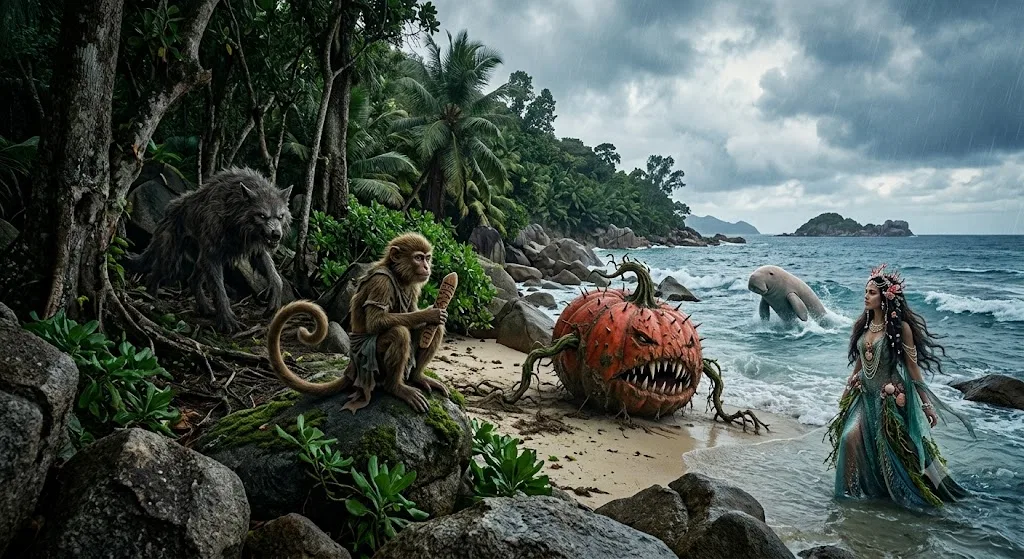
Soungoula is probably the Seychelles creature most likely to appear on modern cryptid websites. He is often pictured or described as monkey-like, dirty, tailed and partly human. In individual stories he steals food, breaks rules, tricks authority figures and escapes punishment through quick thinking. The University of Seychelles archive preserves episodes in which he quarrels with Monkey, steals bananas, enters a king’s whale to eat its fat and turns danger back upon his rivals.[folklore.unisey.ac.sc]folklore.unisey.ac.scTrickster ArchivesPage 2 of 3Soungoula secretly goes inside the King's whale to eat its fat. Monkey convinces him to let him join in, but monkey cuts the w…
Yet Soungoula’s roots point away from an unknown ape. Choppy connects the name to words for “hare” in Yao and Swahili traditions. As the original meaning was lost in Seychelles Creole, the character acquired a new body and became a hybrid trickster rather than an identifiable local animal. The academic interpretation is especially revealing: Soungoula survives by wit, makes fools of powerful people and can be read as carrying memories of enslavement, resistance and adaptation.[Seychelles Research Journal]seychellesresearchjournal.comSeychelles Research Journal
That makes Soungoula culturally richer than a simple “Seychelles ape cryptid”. There is no known sighting cluster, spoor, hair sample, photograph or expedition attached to him. His natural habitat is the folktale, where impossible behaviour is part of the point. Treating him as a flesh-and-blood animal strips away the history that made the character meaningful.
Loulou and the monster that eats everything
Loulou is a more openly threatening figure. In many modern retellings he resembles a wolf, despite wolves never having lived naturally in Seychelles. The apparent contradiction comes from language. Choppy argues that the name is connected to the Malagasy word for a spirit and was later reinterpreted through the similar-sounding French expression for “the wolf”. Over time, a malevolent supernatural being became visually understandable as the familiar fairy-tale predator.[Seychelles Research Journal]seychellesresearchjournal.comSeychelles Research Journal
The best-known Loulou episode ends with a particularly strange transformation. After Loulou is burnt, a pumpkin vine grows from his ashes. Its single fruit expands rapidly, breaks free and rolls after the hero with snapping jaws, trying to swallow him. Closely related devouring-pumpkin tales occur in East African traditions, supporting the view that the Seychelles version developed from material carried across the western Indian Ocean.[Seychelles Research Journal]seychellesresearchjournal.comSeychelles Research Journal
Other Seychellois swallowing monsters include cannibal humans, predatory trees, snakes and people transformed by forbidden food. Their common feature is uncontrolled appetite: they consume animals, children or whole communities and grow larger as they feed. Such tales appear to work as warnings about strangers, disobedience, greed and broken taboos rather than descriptions of a single recurring beast.[Seychelles Research Journal]seychellesresearchjournal.comSeychelles Research Journal
The older spirit beneath Loulou’s wolf disguise never disappears completely. In one story, eating Loulou’s eggs causes a fatal illness; in another, a fragment of claw places a princess in a deathlike sleep. The danger can therefore attack from inside the body or through magical contamination, behaviour far removed from that of an ordinary predator.[Seychelles Research Journal]seychellesresearchjournal.comSeychelles Research Journal
Sea queens, mermaids and the dugong explanation
Seychellois folklore includes women associated with the sea, but the documented material is closer to the widespread “water maiden” tradition than to a modern cryptid sighting report. Two collected tales feature a Queen of the Sea. In one she grants wishes; in another she marries a mortal man. Related stories across Madagascar and the wider Indian Ocean feature beautiful, otherworldly wives who disappear when a husband breaks a taboo. Choppy cautions that the exact route of transmission is uncertain because Indian and Malagasy story traditions may both have contributed.[Seychelles Research Journal]seychellesresearchjournal.comSeychelles Research Journal
Tourism articles now commonly turn this material into a Seychelles mermaid legend and add claims of sightings along reefs or lagoons. These accounts are picturesque but rarely provide names, dates, original testimony or newspaper references. They should be read as modern promotional folklore unless a traceable historical source is supplied.[aquaexpeditions.com]aquaexpeditions.compirates mermaids seychellespirates mermaids seychelles
The dugong offers a plausible animal behind at least some mermaid-like impressions. Dugongs are large marine mammals with rounded bodies, paddle-like forelimbs and smooth surfacing movements. They were once widespread in Seychelles waters but were heavily reduced by hunting and habitat loss. The Seychelles Islands Foundation states that the country’s only remaining population is now at remote Aldabra, where a large shallow lagoon and extensive seagrass beds provide suitable habitat.[Seychelles Islands Foundation]sif.scOpen source on sif.sc.
Aldabra records show how elusive a real “mermaid animal” can be. Historical observations have often involved single dugongs or pairs, with sightings influenced by season and water conditions. Research based on the atoll’s records has focused on mapping where the animals occur, not on proving that an unknown humanoid species exists.[sif.sc]sif.scSeychelles Islands Foundation Dugong sightings at AldabraSeychelles Islands Foundation Dugong sightings at Aldabra
The dugong explanation remains plausible rather than case-closing because the old mermaid reports are generally too vague to test. A distant animal seen briefly at the surface can be reshaped by expectation, poor light and repeated storytelling. The documented Queen of the Sea tales, meanwhile, clearly behave like folktales, complete with magical gifts, marriages and broken taboos.

Real animals that already look legendary
Seychelles needs no undiscovered monster to produce extraordinary encounters. Its waters and outer islands contain animals large or unfamiliar enough to generate monster-like first impressions.
Whale sharks, the world’s largest fish, gather seasonally off the western coast of Mahé, usually between August and November. The Marine Conservation Society Seychelles identifies individuals by their spot patterns, tags them to follow long-distance movements and collects sightings from boats, divers and tourism operators. A huge spotted shape passing beneath a small vessel could easily sound monstrous in a story, although it is a harmless filter-feeder rather than an unknown predator.[Marine Conservation Society Seychelles]mcss.scOpen source on mcss.sc.
Aldabra supports roughly 150,000 giant tortoises, the largest surviving concentration of these reptiles. Their size, longevity and slow, heavy movement give them an almost prehistoric appearance. Yet they are among the most intensively recognised symbols of Seychelles wildlife, not cryptids. Their survival also shows how easily island fauna can move from everyday reality into legend: giant tortoises disappeared from many other Indian Ocean islands after exploitation by sailors and settlers.[World Heritage Outlook]worldheritageoutlook.iucn.orgOpen source on iucn.org.
Even well-known species can behave unexpectedly. A giant tortoise on Frégate Island was filmed deliberately killing and eating a seabird chick, challenging the popular image of tortoises as strictly gentle plant-eaters. An isolated eyewitness account of such behaviour, without video or biological context, might have developed into a tale of a predatory monster tortoise.[Wikipedia]WikipediaSeychelles giant tortoiseSeychelles giant tortoise
The wider ocean can also produce whales, manta rays, large sharks, floating carcasses and unusually shaped deep-sea fish. Distance removes scale; waves hide most of the body; several animals travelling together can resemble one long creature; and decomposition can erase familiar features. These ordinary problems of observation are enough to explain many sea-monster reports worldwide, although no major, well-sourced Seychelles sea-serpent case has emerged from the available historical record.
Where the evidence is strong—and where it is thin
The Seychelles material falls into three fairly clear levels.
Well documented folklore: Soungoula, Loulou, swallowing monsters and sea-associated women appear in collected stories, scholarly analysis and the University of Seychelles folklore archive. Their histories can be compared with African, Malagasy, Indian and European tale traditions.[unisey.ac.sc]folklore.unisey.ac.scUniversity Of SeychellesCome delve into the rich pool of Seychellois Creole stories, which represents the Seychellois people's multi-ethn…
Plausible animal influence: Dugongs provide a credible natural model for some mermaid imagery, while whale sharks, giant tortoises and other large marine animals explain why the local environment can feel populated by creatures from legend. The biological evidence confirms the animals, but usually not a direct line from a particular sighting to a particular tale.[sif.sc]sif.scOpen source on sif.sc.
Weak modern cryptid claims: Online maps and travel pages sometimes repackage folktale characters as if they were unidentified animals or imply centuries of mermaid sightings without presenting verifiable cases. Repetition across websites is not independent evidence, especially when the accounts lack witnesses, dates, locations and contemporary records.[brilliantmaps.com]brilliantmaps.comBrilliant Maps Cryptids By Country World Map: List Of Most PopularMonster A sea serpent described similarly to a plesiosaur Bolivia … live in caves, and are very rarely…
No convincing body of evidence currently supports a surviving unknown ape, wolf, humanoid sea creature or giant land predator in Seychelles. Nor is there a clearly defined “monster flap” involving many independent witnesses over a short period. The mystery lies less in zoology than in how stories changed as they crossed languages, islands and generations.

The changing story around Seychelles’ cryptid traditions
The earliest transformations happened through oral transmission. A hare became a vaguely monkey-like trickster; a Malagasy spirit became a wolf; swallowing-monster motifs were fitted to new characters; and sea-maiden stories absorbed elements from different Indian Ocean traditions. Creolisation did not merely preserve old folklore—it created distinctly Seychellois versions.[Seychelles Research Journal]seychellesresearchjournal.comSeychelles Research Journal
A second change came through recording and education. Stories once passed mainly by performance were collected, transcribed and placed in archives. That helped preserve them, but written versions also made individual descriptions appear fixed even though oral characters naturally vary between narrators and islands. The University of Seychelles digital collection now presents the tales primarily as cultural heritage.[folklore.unisey.ac.sc]folklore.unisey.ac.scTrickster ArchivesPage 2 of 3Soungoula secretly goes inside the King's whale to eat its fat. Monkey convinces him to let him join in, but monkey cuts the w…
The latest transformation is commercial and digital. Mermaid stories fit the imagery of tropical lagoons, while an “ape-like Seychelles cryptid” fits online monster maps. Tourism and social media favour a recognisable creature with a simple label, even when the underlying tradition is more complicated. The result is an afterlife in which folklore, wildlife and cryptozoology blur together.
The most credible reading of Seychelles’ mystery creatures
Seychelles’ principal legendary creatures are not failed zoological discoveries. They are evidence of cultural movement. Soungoula carries an African trickster heritage reshaped by Creole language and the experience of unequal power. Loulou combines the devouring monster, the dangerous spirit and the imported image of the wolf. Queens of the Sea belong to a regional family of water-maiden stories, while the dugong supplies a believable natural source for occasional mermaid-like impressions.
That does not make the tales less strange. It makes their strangeness more meaningful. The creatures reveal how island communities adapted inherited stories to new forests, reefs, languages and social realities. In Seychelles, the most compelling monster trail leads not into an undiscovered cave or lagoon, but across the Indian Ocean routes by which people, memories and stories arrived.
Amazon book picks
Further Reading
Books and field guides related to What Strange Creatures Haunt Seychelles Stories?. Use these as the next step if you want deeper reading beyond the article.
The Book of Imaginary Beings
Places island monster stories in a global folklore context.
The Annotated African American Folktales
Demonstrates how African-origin tales evolve across new cultural settings.
Encyclopedia of Things that Never Were
Explores legendary creatures similar to those found in island folklore.
eBay marketplace picks
Marketplace Samples
Live-tested eBay searches with available results related to this page.
Endnotes
1.
Source: seychellesresearchjournal.com
Title: Seychelles Research Journal
Link:https://seychellesresearchjournal.com/wp-content/uploads/2023/07/monsters_mythical_creatures_and_island_hopping_in_seychellois_folktales-theresia_penda_choppy-seychelles_research_journal-5-2.pdf
2.
Source: academic.oup.com
Title: Academic History of the Seychelles
Link:https://academic.oup.com/edited-volume/61663/chapter/553412868?searchresult=1
Source snippet
OUP AcademicHistory of the Seychelles - Oxford Academic19 Oct 2022 — Slavery, Slave Trading, and the Seychellois Economy. The history of...
3.
Source: folklore.unisey.ac.sc
Title: Trickster Archives
Link:https://folklore.unisey.ac.sc/story/category/trickster/page/2/
Source snippet
Page 2 of 3Soungoula secretly goes inside the King's whale to eat its fat. Monkey convinces him to let him join in, but monkey cuts the w...
4.
Source: folklore.unisey.ac.sc
Title: Trickster Archives
Link:https://folklore.unisey.ac.sc/story/category/trickster/page/3/
Source snippet
Page 3 of 3Soungoula and Monkey fight over bananas. Monkey cheats Soungoula out of his share of stolen bananas. Soungoula gets his own ba...
5.
Source: folklore.unisey.ac.sc
Link:https://folklore.unisey.ac.sc/
Source snippet
University Of SeychellesCome delve into the rich pool of Seychellois Creole stories, which represents the Seychellois people's multi-ethn...
6.
Source: story-seychelles.com
Title: the enigma of the seychelles mermaid
Link:https://story-seychelles.com/blog/experiences/the-enigma-of-the-seychelles-mermaid/
7.
Source: Wikipedia
Title: Seychelles giant tortoise
Link:https://en.wikipedia.org/wiki/Seychelles_giant_tortoise
8.
Source: seychelles.com
Title: enigmatic coco de mer fascinating journey through science and lore
Link:https://seychelles.com/blog-details/2186/highlights/enigmatic-coco-de-mer-fascinating-journey-through-science-and-lore
9.
Source: seychelles.com
Title: freedom remembered honouring past shaped nation
Link:https://seychelles.com/blog-details/16259/highlights/seychelles-freedom-remembered-honouring-past-shaped-nation
10.
Source: Wikipedia
Title: Sea serpent
Link:https://en.wikipedia.org/wiki/Sea_serpent
11.
Source: Wikipedia
Link:https://en.wikipedia.org/wiki/Dugong
12.
Source: Wikipedia
Link:https://en.wikipedia.org/wiki/Songoula
13.
Source: Wikipedia
Title: Slavery in Seychelles
Link:https://en.wikipedia.org/wiki/Slavery_in_Seychelles
14.
Source: seychellesnationalmuseums.org
Link:https://seychellesnationalmuseums.org/exhibitions/slavery/
Source snippet
Seychelles National MuseumHistory of slaveryIn 1835, when the abolition of slavery came into force in all British colonies, 6,521 slaves...
15.
Source: brilliantmaps.com
Title: Brilliant Maps Cryptids By Country World Map: List Of Most Popular
Link:https://brilliantmaps.com/cryptids-by-country/
Source snippet
Monster A sea serpent described similarly to a plesiosaur Bolivia … live in caves, and are very rarely...
16.
Source: aquaexpeditions.com
Title: pirates mermaids seychelles
Link:https://www.aquaexpeditions.com/blog/pirates-mermaids-seychelles
17.
Source: sif.sc
Link:https://www.sif.sc/aldabra
18.
Source: iucn.org
Title: aldabra atoll unesco world heritage
Link:https://iucn.org/news/commission-ecosystem-management/201803/aldabra-atoll-unesco-world-heritage
19.
Source: sif.sc
Title: Seychelles Islands Foundation Dugong sightings at Aldabra
Link:https://www.sif.sc/sites/default/files/downloads/SIF%20newsletter%20September%202014.pdf
20.
Source: tandfonline.com
Link:https://www.tandfonline.com/doi/abs/10.1080/13658816.2011.616510
21.
Source: sif.sc
Title: drones considered conservation tool aldabra
Link:https://www.sif.sc/news/2016/07/drones-considered-conservation-tool-aldabra
22.
Source: mcss.sc
Link:https://www.mcss.sc/whale-sharks-project
23.
Source: worldheritageoutlook.iucn.org
Link:https://worldheritageoutlook.iucn.org/node/993
24.
Source: seychellesresearchjournal.com
Link:https://seychellesresearchjournal.com/archive-5-2/
25.
Source: sif.sc
Link:https://www.sif.sc/sites/default/files/downloads/Aldabra%27s%20Dugongs.pdf
26.
Source: sif.sc
Link:https://www.sif.sc/sites/default/files/downloads/SIF%20Newsletter%20Aug%202016.pdf
27.
Source: sif.sc
Title: major projects
Link:https://www.sif.sc/major-projects
28.
Source: sif.sc
Title: aldabra listed important marine mammal area imma sixth international designation
Link:https://www.sif.sc/news/2020/01/aldabra-listed-important-marine-mammal-area-imma-sixth-international-designation
29.
Source: sif.sc
Title: Treasured territory
Link:https://www.sif.sc/sites/default/files/downloads/2014%2005_Asian%20Diver_Treasured%20Territory.pdf
30.
Source: sif.sc
Link:https://www.sif.sc/downloads?category=7&order=title&sort=asc
31.
Source: sif.sc
Title: dugong project officer
Link:https://www.sif.sc/jobs/dugong-project-officer
32.
Source: portals.iucn.org
Link:https://portals.iucn.org/library/sites/library/files/documents/2002-001.pdf
33.
Source: worldheritageoutlook.iucn.org
Link:https://worldheritageoutlook.iucn.org/node/993/pdf/en?year=2017
34.
Source: worldheritageoutlook.iucn.org
Link:https://worldheritageoutlook.iucn.org/node/993/pdf?year=2020
35.
Source: portals.iucn.org
Link:https://portals.iucn.org/library/sites/library/files/documents/2004-096.pdf
36.
Source: worldheritageoutlook.iucn.org
Link:https://worldheritageoutlook.iucn.org/fr/node/993/pdf
37.
Source: portals.iucn.org
Title: Marine News3
Link:https://portals.iucn.org/library/sites/library/files/documents/MarineNews3.pdf
38.
Source: portals.iucn.org
Link:https://portals.iucn.org/library/sites/library/files/documents/RL-267-001-En.pdf
39.
Source: portals.iucn.org
Title: IUCN 2004 069
Link:https://portals.iucn.org/library/sites/library/files/documents/IUCN-2004-069.pdf
40.
Source: seychellesresearchjournal.com
Link:https://seychellesresearchjournal.com/wp-content/uploads/2019/08/the-use-of-aldabra-and-its-protected-waters-by-marine-mammals-jennifer-appoo-et-al..pdf
41.
Source: sayongsquare.com
Link:https://www.sayongsquare.com/archives/4449/
Additional References
42.
Source: thecreolemeltingpot.com
Link:https://www.thecreolemeltingpot.com/the-main-characters-of-seychellois-folktales/
Source snippet
The Creole Melting PotThe Main Characters of Seychellois Folktales4 Nov 2025 — The wolf, or Loulou in Seychelles, originates from the Mal...
43.
Source: youtube.com
Title: Best Cultural & Historical places in Seychelles
Link:https://www.youtube.com/watch?v=eWcIaoPRMFg
Source snippet
Seychelles folklore stories tales legends Swallowed WHOLE into the GROUND!! (Seychelles) 🇸🇨 African Folk Stories...
44.
Source: youtube.com
Title: Two Sisters Discover a Necklace’s Dark Secrets in the Seychelles
Link:https://www.youtube.com/watch?v=4vsYM5oEFPg
Source snippet
Seychelles Explained in 12 minutes (History, Geography, And Culture)...
45.
Source: youtube.com
Title: Swallowed WHOLE into the GROUND!! (Seychelles) 🇸🇨
Link:https://www.youtube.com/watch?v=upml1RH2eoI
Source snippet
Two Sisters Discover a Necklace's Dark Secrets in the Seychelles...
46.
Source: academia.edu
Link:https://www.academia.edu/41560258/Postcolonial_Seychelles
47.
Source: researchgate.net
Link:https://www.researchgate.net/publication/357598116_Mountain_Turtles_and_Giant_Crabs_Cosmological_Implications_and_Supernatural_Understandings_of_Rare_Creatures_on_an_Eastern_Indonesian_Island
48.
Source: holidify.com
Link:https://www.holidify.com/pages/history-of-seychelles-679.html
49.
Source: facebook.com
Link:https://www.facebook.com/wildheart500/posts/a-deep-sea-creature-almost-never-seen-by-humans-suddenly-appears-on-a-quiet-iris/951355137888137/
50.
Source: facebook.com
Link:https://www.facebook.com/tourism.seychelles/posts/a-relatively-young-nation-the-seychelles-islands-celebrated-its-250-years-on-aug/1488037761390686/
51.
Source: seychellesnewsagency.com
Link:https://www.seychellesnewsagency.com/public/articles/19685/biggest-animal-on-earth-blue-whales-discovered-in-seychelles-waters
Topic Tree
Follow this branch
Related pages 192
- Antigua Cryptids
- Maldives Monsters
- Malta Monsters
- Qatar Monsters
- Argentina Monsters
- +187 more in sidebar