Within Iran Monsters
Why Iranian Dragons Belong Everywhere
Iran's dragon lore moves between mountains, seas, caves and heroic tales, making it the country's most flexible monster tradition.
On this page
- Dragons in air, earth and sea
- Hero tales and monster battles
- Qeshm Island and modern afterlives
Page outline Jump by section
Introduction
Among all the monsters associated with Iran, none is more adaptable than the Persian dragon. Unlike the dragons of many European traditions, which are often tied to a single cave, mountain or treasure hoard, Iranian dragons appear almost everywhere. They can dwell beneath the earth, soar through the air, emerge from the sea, lurk in mountain wilderness, or take on symbolic roles connected to drought, chaos and cosmic disorder. This flexibility is why the Persian dragon remains one of Iran’s most enduring monster traditions. Rather than being a single creature, it is a shape-shifting category of monster that has continually reinvented itself across mythology, folklore, literature and modern popular culture.[Iranica Online]iranicaonline.orgIranica OnlineAŽDAHĀAŽDAHĀ “dragon,” various kinds of snake-like, mostly gigantic, monsters living in the air, on earth, or in the sea es…

For readers interested in Iran’s mystery-beast traditions, the dragon is important not because there is evidence for a hidden animal, but because it shows how one monster image could attach itself to almost any landscape. Mountains, deserts, coastlines, caves and islands all became potential dragon territory, allowing the creature to survive for centuries while constantly changing form.[Iranica Online]iranicaonline.orgIranica OnlineAŽDAHĀAŽDAHĀ “dragon,” various kinds of snake-like, mostly gigantic, monsters living in the air, on earth, or in the sea es…
Why Iranian Dragons Belong Everywhere
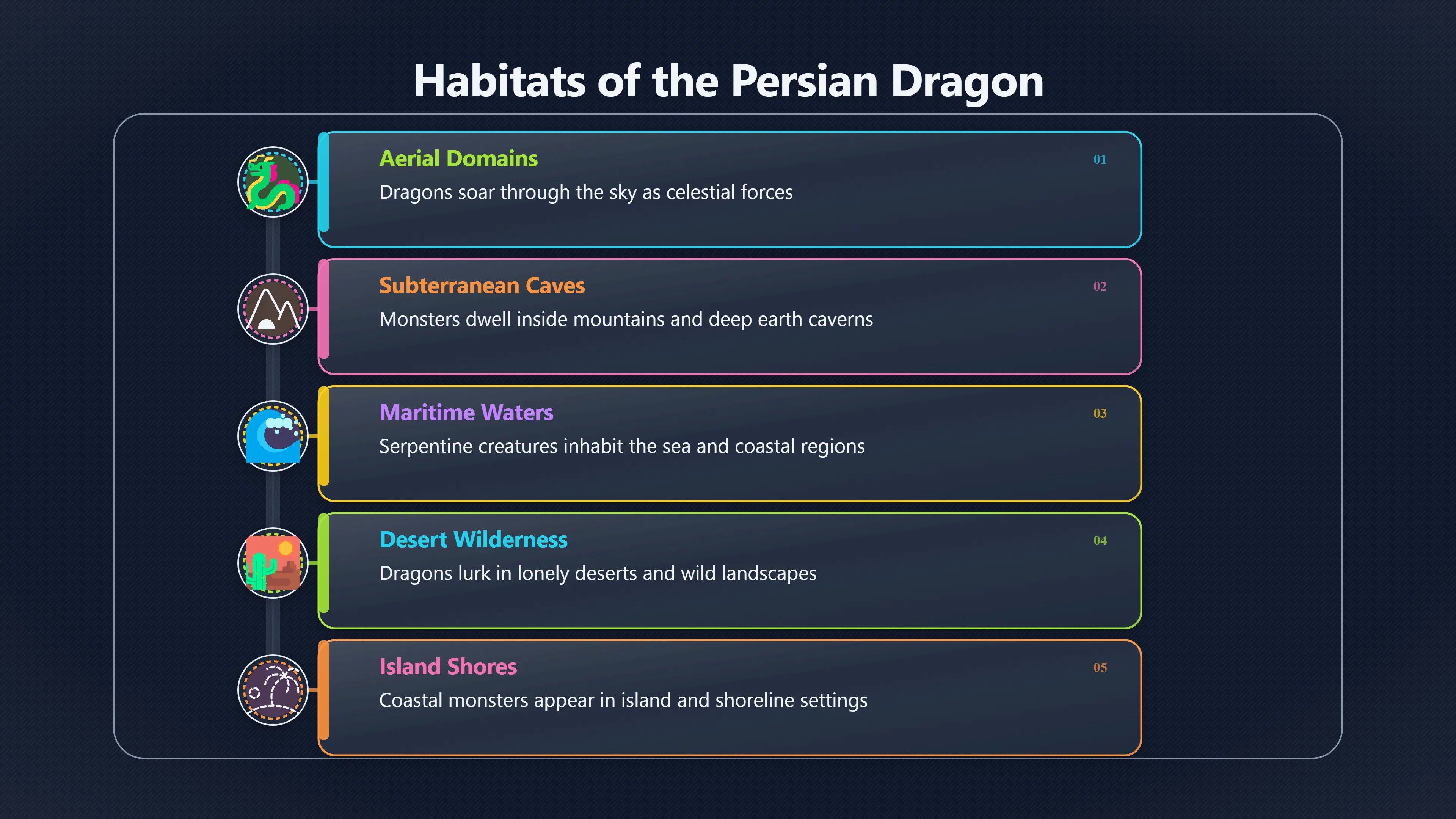
The defining feature of the Persian dragon is its lack of a fixed habitat. Encyclopaedia Iranica describes the dragon as a class of gigantic, mostly serpentine monsters living “in the air, on earth, or in the sea.” That description is unusually broad compared with many dragon traditions elsewhere and helps explain why dragons became woven into so many Iranian stories.[Iranica Online]iranicaonline.orgIranica OnlineAŽDAHĀAŽDAHĀ “dragon,” various kinds of snake-like, mostly gigantic, monsters living in the air, on earth, or in the sea es…
Rather than representing a specific species, the dragon functioned as a monster-shaped expression of danger. A threatening mountain pass might acquire a dragon legend. A violent storm could be imagined as the work of a dragon. An unexplained cave, a dangerous stretch of coastline or a lonely desert could all become settings for dragon encounters.
The creature’s appearance was equally flexible. Some traditions imagined a gigantic snake. Others described a winged reptile or lizard-like beast. In older religious and mythological material, dragons could even take on multi-headed forms with supernatural powers.[Iranica Online]iranicaonline.orgIranica OnlineAŽDAHĀ i. In Old and Middle IranianAz[i]dahāg, spelled ʾcydhʾk, or Dahāg) belongs to the realm of mythologized history or h…
This adaptability helped the dragon survive cultural changes. As beliefs evolved, the monster could shift from a cosmic enemy in ancient religious stories to a literary beast in epic poetry, and later to a folkloric monster inhabiting local landscapes.
Dragons in Air, Earth and Sea
Sky Dragons and Signs in Nature
Some Iranian dragon traditions linked the creature to dramatic natural events. Ancient and medieval sources connected dragons with storms, rain and eclipses, suggesting that unusual celestial or weather phenomena could be interpreted through dragon imagery.[Iranica Online]iranicaonline.orgIranica OnlineAŽDAHĀAŽDAHĀ “dragon,” various kinds of snake-like, mostly gigantic, monsters living in the air, on earth, or in the sea es…
In these stories, the dragon was not merely an animal. It was a force capable of disrupting the normal order of the world. This connection between dragons and natural disturbances made them useful symbols for explaining frightening events that seemed beyond human control.
Dragons Beneath the Ground
Many dragon stories place the creature inside mountains, caves or the earth itself. The underground dragon became a convenient explanation for hidden dangers and mysterious places. Deep caverns, earthquake-prone regions and strange geological formations could all acquire associations with buried monsters.
This idea remains surprisingly resilient. Modern Iranian storytelling still returns to the image of something immense sleeping beneath the land, waiting to disturb the surface world.[Cinema Iranica]cinema.iranicaonline.orga dragon arrives azhdaha varid mishavadCinema IranicaA Dragon Arrives! (2016)October 17, 2024 —… movie, reflecting the complex beliefs and relationships on the island with t…
Sea Dragons and Coastal Monsters
The Persian dragon was also capable of becoming a sea monster. Medieval accounts sometimes described dragons that originated as gigantic serpents before being cast into the sea, where they grew even larger and developed fin-like structures. These stories transformed a land monster into a maritime terror capable of disturbing entire coastlines.[Wikipedia]WikipediaOpen source on wikipedia.org.
This ability to move between environments is unusual. In many cultures, sea monsters and dragons become separate categories. In Iran, they often overlap. The result is a monster tradition that naturally extends from inland mountains to the Persian Gulf and beyond.
Hero Tales and Monster Battles
The most famous Iranian dragon stories are not eyewitness accounts but heroic confrontations. Dragons appear repeatedly in epic literature as obstacles that test courage, intelligence and moral strength.[Iranica Online]iranicaonline.orgIranica OnlineAŽDAHĀ ii. In Persian literaturea giant snake or lizard with wings. The dragon in Iranian mythology is a destructive demoni…
In these stories, the dragon is less important as an individual creature than as a challenge. The hero enters a dangerous landscape, confronts a seemingly unstoppable monster and restores order through victory. The dragon becomes a narrative tool for measuring heroic greatness.
Several recurring themes appear:
- The dragon as chaos: The monster threatens people, animals or the natural order.
- The dragon as drought: Some traditions associate dragons with destructive forces that withhold or corrupt life-giving water.[Iranica Online]iranicaonline.orgIranica OnlineAŽDAHĀ ii. In Persian literaturea giant snake or lizard with wings. The dragon in Iranian mythology is a destructive demoni…
- The dragon as a border guardian: Heroes often encounter dragons at the edge of civilisation, in wild or dangerous places.
- The dragon as a test: Defeating the creature proves a hero’s worth rather than documenting a real animal encounter.
One particularly influential figure is the dragon-like monster known from ancient Iranian tradition as Aži Dahāka, a terrifying being described with multiple heads, mouths and eyes. Over time, this ancient monster influenced later dragon imagery and helped establish the idea of the dragon as an embodiment of destructive power.[Iranica Online]iranicaonline.orgIranica OnlineAŽDAHĀ i. In Old and Middle IranianAz[i]dahāg, spelled ʾcydhʾk, or Dahāg) belongs to the realm of mythologized history or h…
From Myth to Folklore
A notable feature of Iranian dragon traditions is their movement from formal mythology into local folklore. Iranica notes that dragons appear widely in folktales and legends, especially stories involving magic and extraordinary adventures.[Iranica Online]iranicaonline.orgIranica OnlineAŽDAHĀ iii. In Iranian folktalesIn Persian folklore, the dragon (aždahā) appears mostly in tales of magic and in legends. I…
As these stories travelled, dragons became more localised. Instead of threatening the entire cosmos, they might inhabit a particular valley, cave or mountain. The creature became easier to place on a real landscape.
This process helps explain why dragons can feel surprisingly close to cryptid traditions despite their obvious mythological origins. A traveller hears of a dangerous cave. A mountain acquires a reputation for strange events. A monster story becomes attached to a physical place. Over generations, the distinction between symbolic beast and local legend can blur.
Yet unlike classic cryptids such as Bigfoot or the Loch Ness Monster, there is no substantial body of modern eyewitness reports suggesting an unknown dragon-like animal in Iran. The evidence points overwhelmingly toward folklore, literature and cultural symbolism rather than zoological mystery.[Iranica Online]iranicaonline.orgIranica OnlineAŽDAHĀAŽDAHĀ “dragon,” various kinds of snake-like, mostly gigantic, monsters living in the air, on earth, or in the sea es…
Qeshm Island and the Modern Dragon
One of the most interesting modern reinventions of the Iranian dragon appears on Qeshm Island in the Persian Gulf. The 2016 Iranian film A Dragon Arrives! places the idea of a dragon beneath the island’s landscape, blending mystery, local belief, history and geology.[Cinema Iranica]cinema.iranicaonline.orga dragon arrives azhdaha varid mishavadCinema IranicaA Dragon Arrives! (2016)October 17, 2024 —… movie, reflecting the complex beliefs and relationships on the island with t…
The film does not present a straightforward monster hunt. Instead, it uses the dragon as a symbol hidden beneath the earth, connected to buried secrets and unexplained disturbances. Cinema Iranica describes the story as involving a strange monster living at the heart of the earth, drawing on local supernatural traditions while reimagining the dragon for a modern audience.[Cinema Iranica]cinema.iranicaonline.orga dragon arrives azhdaha varid mishavadCinema IranicaA Dragon Arrives! (2016)October 17, 2024 —… movie, reflecting the complex beliefs and relationships on the island with t…
Qeshm is an especially fitting setting because it already possesses dramatic landscapes, unusual rock formations and a reputation for local folklore. The island demonstrates how dragon imagery can survive even in a modern, sceptical age. The creature no longer needs to be presented as a literal beast. It functions as a way of expressing mystery itself.
Why the Dragon Endured
Many legendary creatures fade when the social conditions that created them disappear. The Persian dragon survived because it was never confined to a single form.
It could be:
- A cosmic enemy in ancient religious narratives.
- A giant serpent in heroic epics.
- A cave monster in local legends.
- A sea beast along the coast.
- A symbol of drought and destruction.
- A metaphor for hidden forces beneath the land.
- A modern cultural icon in film and popular imagination.[Iranica Online]iranicaonline.orgIranica OnlineAŽDAHĀAŽDAHĀ “dragon,” various kinds of snake-like, mostly gigantic, monsters living in the air, on earth, or in the sea es…
That adaptability makes the dragon the closest thing Iran has to a national monster tradition. While many countries have a famous creature tied to one lake, forest or mountain range, Iran’s dragon belongs everywhere at once. It shifts between habitats, stories and meanings while remaining recognisably the same monster. For that reason, the Persian dragon is less a single beast than a centuries-old framework through which Iranians have imagined danger, wilderness, mystery and heroic struggle.[Iranica Online]iranicaonline.orgIranica OnlineAŽDAHĀAŽDAHĀ “dragon,” various kinds of snake-like, mostly gigantic, monsters living in the air, on earth, or in the sea es…
eBay marketplace picks
Marketplace Samples
Live-tested eBay searches with available results related to this page.
Endnotes
1.
Source: Wikipedia
Link:https://en.wikipedia.org/wiki/Azhdaha
2.
Source: Wikipedia
Title: A Dragon Arrives!
Link:https://en.wikipedia.org/wiki/A_Dragon_Arrives%21
Source snippet
A Dragon Arrives!A Dragon Arrives is a 2016 Iranian period mystery supernatural thriller film directed by Mani Haghighi. It was select...
3.
Source: iranicaonline.org
Link:https://www.iranicaonline.org/articles/azdaha/
Source snippet
Iranica OnlineAŽDAHĀAŽDAHĀ “dragon,” various kinds of snake-like, mostly gigantic, monsters living in the air, on earth, or in the sea es...
4.
Source: iranicaonline.org
Link:https://www.iranicaonline.org/articles/azdaha/azdaha-ii-in-persian-literature/
Source snippet
Iranica OnlineAŽDAHĀ ii. In Persian literaturea giant snake or lizard with wings. The dragon in Iranian mythology is a destructive demoni...
5.
Source: iranicaonline.org
Link:https://www.iranicaonline.org/articles/azdaha/azdaha-iii-in-iranian-folktales/
Source snippet
Iranica OnlineAŽDAHĀ iii. In Iranian folktalesIn Persian folklore, the dragon (aždahā) appears mostly in tales of magic and in legends. I...
6.
Source: iranicaonline.org
Link:https://www.iranicaonline.org/articles/azdaha/azdaha-i-in-old-and-middle-iranian/
Source snippet
Iranica OnlineAŽDAHĀ i. In Old and Middle IranianAz[i]dahāg, spelled ʾcydhʾk, or Dahāg) belongs to the realm of mythologized history or h...
7.
Source: cinema.iranicaonline.org
Title: a dragon arrives azhdaha varid mishavad
Link:https://cinema.iranicaonline.org/article/a-dragon-arrives-azhdaha-varid-mishavad/
Source snippet
Cinema IranicaA Dragon Arrives! (2016)October 17, 2024 —... movie, reflecting the complex beliefs and relationships on the island with t...
Published: October 17, 2024
8.
Source: cinema.iranicaonline.org
Title: Mansoor Behnam 07
Link:https://cinema.iranicaonline.org/wp-content/uploads/2024/10/Mansoor-Behnam-07.pdf
Source snippet
Dragon Arrives! (2016) - Cinema Iranica11 Jul 2025 — ” This includes the representation of a strange monster living at the heart of the e...
9.
Source: iranicaonline.org
Link:https://www.iranicaonline.org/articles/iran-iv-myths-and-legends/
Source snippet
IRAN iv. MYTHS AND LEGENDSAži Dahāka (Azdaha, q.v.) is described as a dragon “who had three mouths, three heads, six eyes, a thousand ski...
10.
Source: iranicaonline.org
Link:https://www.iranicaonline.org/articles/div/
Source snippet
DĪV - Encyclopaedia IranicaFolk tradition makes demons responsible for a number of mental and physical maladies. The very Persian word dī...
11.
Source: youtube.com
Link:https://www.youtube.com/watch?v=rH1Yo5tO5Zk
Source snippet
A DRAGON ARRIVES! | TrailerA Dragon Arrives! Iran 105 mins “A meta-cinematic detective story set in 1960s Iran, shot through with counter...
12.
Source: rottentomatoes.com
Title: a dragon arrives
Link:https://www.rottentomatoes.com/m/a_dragon_arrives
Source snippet
!On Jan. 22, 1965, the day before the Iranian prime minister is assassinated, a car drives up to a shipwreck. Inside the wreck, a banishe...
13.
Source: genshin-impact.fandom.com
Link:https://genshin-impact.fandom.com/wiki/Azhdaha
Source snippet
Genshin Impact Wiki - FandomIn Iranian mythology, Azhdaha is a mythical creature roughly equivalent to a dragon, though it is still con...
14.
Source: mythus.fandom.com
Link:https://mythus.fandom.com/wiki/Azhdaha
Source snippet
Myth and Folklore Wiki - FandomAzdaha is a Persian version of the Dragon that takes the form of either the European version or a form sim...
15.
Source: filmfrasor.no
Title: A Dragon Arrives!
Link:https://www.filmfrasor.no/en/film/2018/a-dragon-arrives
Source snippet
Films from the SouthThe year is 1964: Hafizi, an investigator from the secret police, is sent to the desert island of Qeshm to investigat...
Additional References
16.
Source: facebook.com
Link:https://www.facebook.com/ToddAndrewPronovost/posts/azhdaha-azhdahak-ezhdeha-persian-%D8%A7%DA%98%D8%AF%D9%87%D8%A7-or-azhdar-%D8%A7%DA%98%D8%AF%D8%B1-is-a-mythical-creature-in-/1255490833246313/
Source snippet
Azhdaha, Azhdahak, Ezhdeha (PersianAzhdaha, Azhdahak, Ezhdeha (Persian: اژدها) or Azhdar (اژدر) is a mythical creature in Iranian mytholo...
17.
Source: reddit.com
Link:https://www.reddit.com/r/PrinceOfPersia/comments/19dekzi/azhdahah_who_is_she_persian_lore/
Source snippet
Azhdahah- who is she? (Persian lore)🤘🤘: r/PrinceOfPersiaSo in Persian Lore and translation, Azhdahah means dragon/serpent. now in the Sh...
18.
Source: facebook.com
Link:https://www.facebook.com/TheFolklorePodcast/posts/today-has-been-national-appreciate-a-dragon-day-and-so-todays-creature-is-here-f/1376499274490989/
Source snippet
The Folklore PodcastThe Azhdaha is a dragon from Iranian mythology. In Persia, they are depicted as enormous winged serpents. There are a...
19.
Source: hunara.org
Link:https://www.hunara.org/article_173300_b715bd6eb2d81ea6f32c1b103256554d.pdf
Source snippet
en dragons and water, this paper explores whether dragon-slaying myths can be further connected to the Iranian...Read more...
20.
Source: reddit.com
Link:https://www.reddit.com/r/Genshin_Impact/comments/msoxte/fun_fact_the_name_azhdaha_means_dragon_in_farsi/
Source snippet
(Pronounced Ezhdeha in Farsi) I doubt it but I really hope there's an ancient Persia area in the...Read more...
21.
Source: facebook.com
Link:https://www.facebook.com/groups/persianversion/posts/1239874113376285/
Source snippet
c snake or lizard-like crestures sometime associated with rains...
22.
Source: eranshahr.com
Title: AŽDAHĀ (Dragon) — Mythical Creatures of Iran
Link:https://www.eranshahr.com/myths/category/A%C5%BDDAH%C4%80%2B%28Dragon%29
Source snippet
This volume explores primordial creatures, mythical birds, marine creatures, jinns, deevs, and more. Material and...Read more...
23.
Source: spatial-humanities.library.utoronto.ca
Link:https://spatial-humanities.library.utoronto.ca/exhibits/show/khaitan-mst201/khaitan-literary-monster
Source snippet
Monster · MST201 (A2.2) - KhaitanThe Persian dragon, revered as the formidable "Azhdaha," stands as a prominent figure in Iranian mytholo...
24.
Source: iranian-filmfestival.com
Title: a dragon arrives اژدها وارد می شود
Link:https://www.iranian-filmfestival.com/en/a-dragon-arrives-%D8%A7%DA%98%D8%AF%D9%87%D8%A7-%D9%88%D8%A7%D8%B1%D8%AF-%D9%85%DB%8C-%D8%B4%D9%88%D8%AF/
Source snippet
1965: Commissioner Hafizi gets off his orange Chevrolet Impala to investigate the enigmatic death of a dissident on the island Qeshm in t...
25.
Source: uk.pinterest.com
Link:https://uk.pinterest.com/pin/in-iranian-mythology-azhdaha-is-a-mythical-creature-roughly-equivalent-to-a-dragon–3518505954018907/
Source snippet
Iranian mythology, Azhdaha is a mythical creature...In Iranian mythology, Azhdaha is a mythical creature roughly equivalent to a dragon...
Topic Tree