Within Kuwait Monsters
Why Did Kuwait Imagine a Noon Monster?
Hemarat Al-Gayla is a donkey-woman tale that made midday heat feel dangerous enough for children to remember.
On this page
- The donkey woman of midday roads
- Heat, childhood safety and old neighbourhood life
- Why her details change but the warning stays
Page outline Jump by section
Introduction
Hemarat Al-Gayla is one of Kuwait’s best-known monster figures, but it was never really a mystery beast in the zoological sense. Instead, it was a practical warning wrapped in a frightening story. In old Kuwaiti neighbourhoods, parents and grandparents described a terrifying donkey-woman who appeared at midday, stalking roads and alleys when the sun was at its hottest. Children who wandered outside alone risked being followed, seized or eaten. The tale sounds supernatural, yet its purpose was deeply practical: keeping children indoors during the dangerous afternoon heat of the Gulf summer. Over time the creature’s appearance changed from one telling to another, but the core message remained remarkably consistent. Hemarat Al-Gayla shows how Kuwaiti folklore transformed an environmental danger into a memorable monster that children would not easily forget.[Kuwait Times]kuwaittimes.comKuwait TimesKuwaiti mythical creatures that can still cast a spellAugust 29, 2024 — 29 Aug 2024 — “Hemarat” means a female donkey, and "a…
Why Did Kuwait Imagine a Noon Monster?
Unlike many famous monsters that haunt forests, lakes or remote wilderness, Hemarat Al-Gayla was tied to a specific time of day. The creature belonged to noon itself. The name is commonly explained as combining a word for a female donkey with a term referring to midday or noon, directly linking the legend to the hottest hours of the day. According to folklore accounts collected in Kuwait, people believed that a donkey-like being could harm anyone encountered on the road at noon, especially children.[Kuwait Times]kuwaittimes.comKuwait TimesKuwaiti mythical creatures that can still cast a spellAugust 29, 2024 — 29 Aug 2024 — “Hemarat” means a female donkey, and "a…
This timing is important. Before air conditioning transformed daily life, the midday heat in Kuwait could be genuinely dangerous. Summer temperatures routinely reached levels where dehydration, heat exhaustion and heatstroke became real risks. In communities where children spent much of their time outdoors, parents needed effective ways to enforce rest during the hottest hours. A monster that hunted only at noon was easier for a child to remember than a lecture about body temperature and hydration.
The result was a creature perfectly adapted to its social function. Hemarat Al-Gayla was not everywhere. She was not active all night. She appeared exactly when adults wanted children to stay indoors.
The Donkey-Woman of Midday Roads
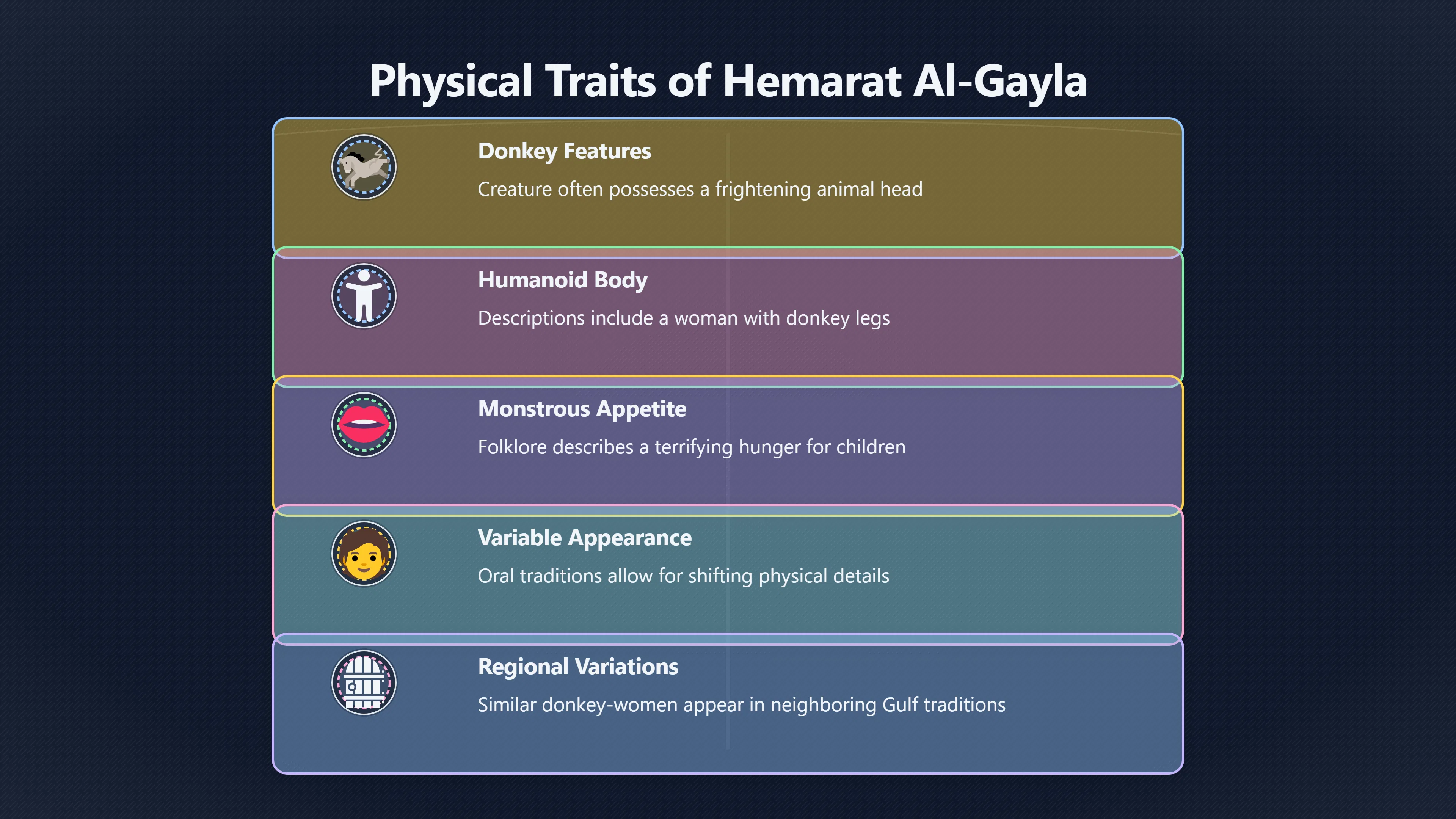
Descriptions of Hemarat Al-Gayla vary considerably. Some versions portray a woman with donkey legs. Others describe a half-human, half-donkey creature with a frightening face. In some retellings she resembles an old woman with donkey features, while other versions emphasise her animal head, hooves or monstrous appetite for children.[Kuwait Times:48AM]kuwaittimes.comKuwait TimesKuwaiti mythical creatures that can still cast a spellAugust 29, 2024 — 29 Aug 2024 — “Hemarat” means a female donkey, and "a…
Despite these differences, several elements appear repeatedly:
- She is associated with noon or the early afternoon.
- She targets children who wander outside.
- Roads, paths and neighbourhood spaces are common settings.
- Encountering her leads to harm, disappearance or being eaten.
- The story functions as a warning rather than a report of a real creature.[Kuwait Times:48AM]kuwaittimes.comKuwait TimesKuwait's favorite historical folktales'Hemarat Al-Gayla' (afternoon's donkey) is a mythical creature from the Kuwaiti folklor…
The donkey imagery is also notable. Donkeys were familiar animals in everyday Gulf life, making the creature recognisable and unsettling at the same time. Folklore often creates monsters by combining ordinary features with human traits, producing something that is close enough to reality to feel possible but strange enough to inspire fear.
In some Gulf traditions outside Kuwait, closely related donkey-woman figures are said to knock on doors, call to children or roam while adults are resting during the midday lull. These regional parallels suggest that the basic idea travelled across Gulf societies while adapting to local customs and storytelling styles.[Wikipedia]WikipediaQatari folkloreQatari folklore

Heat, Childhood Safety and Old Neighbourhood Life
The most revealing aspect of Hemarat Al-Gayla is not what she looked like but what she accomplished.
In older Kuwaiti communities, children often moved around neighbourhoods with considerable freedom. Adults could not supervise every alley, courtyard or roadside. Folklore therefore acted as an informal safety system. A frightening creature could accomplish what repeated instructions sometimes could not.
The warning addressed several risks at once:
Extreme heat. The strongest and most widely recognised purpose of the tale was preventing children from spending long periods outdoors under the midday sun. Numerous modern retellings explicitly connect the legend to avoiding heat exhaustion and heat-related illness.[2:48AM:48AM]248am.com2:48AMHorrifying Kuwaiti Mythical CreaturesDecember 26, 2023 — 26 Dec 2023 — Hemarat Algayla This terrifying monster also goes by the simpler name Um Homar (Donkey Lady) and tells…
Road dangers. Older settlements contained animals, carts and later motor vehicles. A story about a monster lurking on roads encouraged children to stay close to home during quieter hours.
Unsupervised wandering. Midday often coincided with adults resting after morning work. The monster provided a simple explanation for why children should remain indoors even when no adult was actively watching them.[Wikipedia]WikipediaQatari folkloreQatari folklore
Because the legend solved practical problems, it survived for generations. The story was not merely entertainment. It was a behavioural tool embedded in everyday life.
Why Her Details Change but the Warning Stays
One striking feature of Hemarat Al-Gayla is how inconsistent her appearance can be. Folklore researchers have noted that many traditional Kuwaiti stories survive primarily through oral transmission rather than fixed written texts. As stories pass between grandparents, parents and children, details evolve.[ResearchGate]researchgate.netdonkey died, the snake (almost) survived kuwaiti folktales…March 31, 2023 — 17 Jan 2026 — DONKEY DIED, THE SNAKE (ALMOST)…
For Hemarat Al-Gayla, the changing details mattered less than the underlying lesson. Whether she had donkey feet, a donkey head, an old woman’s face or some combination of all three, the audience understood the essential rule: do not wander outside at noon.
This flexibility helped the legend endure. Storytellers could adjust the creature to suit local fears, personal imagination or the temperament of particular children. The monster became a framework rather than a fixed character.
The persistence of the warning alongside shifting physical descriptions is a clue that the legend functioned primarily as social folklore rather than as a claimed sighting tradition. People remembered what the creature meant more than exactly what it looked like.
From Childhood Fear to Cultural Memory
Today, few Kuwaitis treat Hemarat Al-Gayla as a literal being. The figure survives mainly as cultural heritage, remembered through storytelling, artwork, newspaper features and discussions of traditional folklore. Images and sculptures depicting the creature have appeared in exhibitions exploring Kuwaiti folk traditions, showing how a once-feared childhood warning has become part of the country’s cultural memory.[Kuwait Times]kuwaittimes.comKuwait TimesKuwait's favorite historical folktales'Hemarat Al-Gayla' (afternoon's donkey) is a mythical creature from the Kuwaiti folklor…
This transformation is common in folklore. As living conditions change and the original practical need weakens, the monster shifts from active warning to historical symbol. Air-conditioned homes, modern schools and greater awareness of heat safety reduced the need for a donkey-woman enforcing afternoon rest. Yet the story remains memorable because it captures an older Kuwait, when climate shaped daily routines and monsters were used to teach survival.
For readers interested in Kuwait’s strange creatures, Hemarat Al-Gayla is significant not because of eyewitness evidence or claims of an unknown animal, but because she demonstrates how folklore can turn a very real danger into a vivid, unforgettable monster. In that sense, the noon donkey-woman may be Kuwait’s most effective creature legend: generations of children remembered her, and that was exactly the point.[Kuwait Times:48AM]kuwaittimes.comKuwait TimesKuwaiti mythical creatures that can still cast a spellAugust 29, 2024 — 29 Aug 2024 — “Hemarat” means a female donkey, and "a…
Amazon book picks
Further Reading
Books and field guides related to Why Did Kuwait Imagine a Noon Monster?. Use these as the next step if you want deeper reading beyond the article.
The Uses of Enchantment
Helps explain why societies create frightening figures to teach safety lessons.
The Element Encyclopedia of Magical Creatures
Provides comparative examples of cautionary and supernatural beings.

The great cat massacre
First published 1984. Subjects: Civilization, Folklore, French National characteristics, France, intellectual life, France, civilization,...
Dr. Bruno Bettelheim Reads "the Struggle for Meaning" and "Ha...
First published 1985.
eBay marketplace picks
Marketplace Samples
Live-tested eBay searches with available results related to this page.


Endnotes
1.
Source: 248am.com
Title: kuwaiti horrifying mythical creatures
Link:https://248am.com/mark/interesting/kuwaiti-horrifying-mythical-creatures/
Source snippet
Horrifying Kuwaiti mythical creatures25 Jun 2011 —... Hemarat Algayla (painting pictured above) Half Woman/Half Donkey creature which hu...
2.
Source: Wikipedia
Title: Qatari folklore
Link:https://en.wikipedia.org/wiki/Qatari_folklore
3.
Source: 248am.com
Title: 2:48AMHorrifying Kuwaiti Mythical Creatures
Link:https://248am.com/mark/interesting/horrifying-kuwaiti-mythical-creatures/
Source snippet
December 26, 2023 — 26 Dec 2023 — Hemarat Algayla This terrifying monster also goes by the simpler name Um Homar (Donkey Lady) and tells...
Published: December 26, 2023
4.
Source: 248am.com
Link:https://248am.com/category/interesting/page/3/
Source snippet
Interesting – Page 314 Jan 2024 — Hemarat Algayla This terrifying monster also goes by the simpler name Um Homar (Donkey Lady) and tells...
5.
Source: researchgate.net
Link:https://www.researchgate.net/publication/369811575_DONKEY_DIED_THE_SNAKE_ALMOST_SURVIVED_KUWAITI_FOLKTALES_WHAT_HAPPENED_TO_HEMARAT_AL_GHAYLA_AND_NESOP
Source snippet
donkey died, the snake (almost) survived kuwaiti folktales...March 31, 2023 — 17 Jan 2026 — DONKEY DIED, THE SNAKE (ALMOST)...
Published: March 31, 2023
6.
Source: kuwaittimes.com
Link:https://kuwaittimes.com/article/18387/lifestyle/art-fashion/kuwaiti-mythical-creatures-that-can-still-cast-a-spell/
Source snippet
Kuwait TimesKuwaiti mythical creatures that can still cast a spellAugust 29, 2024 — 29 Aug 2024 — “Hemarat” means a female donkey, and "a...
Published: August 29, 2024
7.
Source: kuwaittimes.com
Link:https://kuwaittimes.com/kuwaits-favorite-historical-folktales/
Source snippet
Kuwait TimesKuwait's favorite historical folktales'Hemarat Al-Gayla' (afternoon's donkey) is a mythical creature from the Kuwaiti folklor...
Additional References
8.
Source: academia.edu
Title: the donkey died, the snake (almost) survived; kuwaiti
Link:https://www.academia.edu/99392974/THE_DONKEY_DIED_THE_SNAKE_ALMOST_SURVIVED_KUWAITI_FOLKTALES_WHAT_HAPPENED_TO_HEMARAT_AL_GHAYLA_AND_NES%C3%93P
Source snippet
folklore, with many stories now forgotten. For instance, figures like Hemarat Al Gayla are barely recognized by the contemporary Kuwaiti...
9.
Source: readersfavorite.com
Title: Readers’ Favorite Author Services
Link:https://readersfavorite.com/articles/kuwait-mythical-monsters
Source snippet
Author Services - Readers' Favorite: Book Reviews and...Hemarat Algayla is a monster with the body of a human female, but the neck and h...
10.
Source: instagram.com
Link:https://www.instagram.com/p/C1TpEVyshIw/?hl=en
Source snippet
He goes out hunting...Read more...
11.
Source: youtube.com
Title: Arabian Mythology: 12 Strange Legends And Mythical Creatures
Link:https://www.youtube.com/watch?v=mLhpSk00hmE
Source snippet
Kuwaiti Mythical Creatures That Still Cast a Spell...
12.
Source: youtube.com
Title: Arabic Folklore’s Most Terrifying Creature: The Ghoul
Link:https://www.youtube.com/watch?v=ZdljTiX4aNk
Source snippet
Arabian Mythology: 12 Strange Legends And Mythical Creatures...
13.
Source: youtube.com
Title: Monsters and Mythical Creatures of the Emirates
Link:https://www.youtube.com/watch?v=RrPrz5bW4ro
Source snippet
Arabic Folklore's Most Terrifying Creature: The Ghoul...
14.
Source: creatures-of-myth.fandom.com
Title: Creatures of Myth Noon Donkey
Link:https://creatures-of-myth.fandom.com/wiki/Noon_Donkey
Source snippet
The imaginary image of the noon...Read more...
15.
Source: youtube.com
Title: Why Do Seafarers Fear Bu Daryah?
Link:https://www.youtube.com/watch?v=pXmrmLR7SkU
Source snippet
Monsters and Mythical Creatures of the Emirates...
16.
Source: youtube.com
Title: Kuwaiti Mythical Creatures That Still Cast a Spell
Link:https://www.youtube.com/watch?v=MS4W_DD3LQU
Topic Tree