Creature Lore of Mexico's Landscapes and Legends
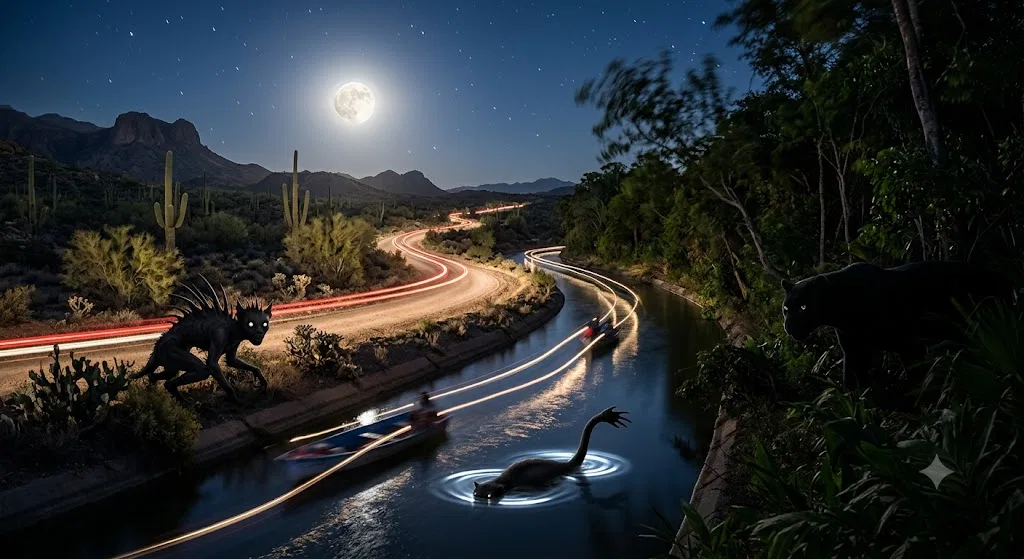
Mexico’s mystery-creature tradition is less a single “national cryptid” story than a layered bestiary: colonial-era water monsters, Indigenous animal doubles, modern livestock panics, phantom cats, winged witch-owls, and local lake rumours.
Page outline Jump by section
Why Mexico has so many creature stories
Mexico is an unusually rich setting for monster traditions because its geography gives stories many places to hide: deserts, volcanic lakes, mangrove coasts, cloud forests, cattle country, old roads, caves, and canal systems. It is also home to real animals that already feel legendary to outsiders: jaguars, pumas, ocelots, spider monkeys, black bears, coyotes, crocodiles, owls, and the endangered axolotl. When a nocturnal animal is glimpsed badly, when livestock are killed, or when a body of water behaves strangely, folklore supplies a shape before science supplies an explanation.
That does not mean the legends are “just mistakes”. Many are cultural stories first and animal claims second. The Digital Florentine Codex, created in the sixteenth century by Bernardino de Sahagún with Nahua elders, authors, and artists, is treated by the Getty as one of the most important sources for Mexica culture and natural knowledge; its animal material sits in the same broad intellectual world as later creature lore, where observation, warning, ritual meaning, and symbolic geography often overlap.[florentinecodex.getty.edu]florentinecodex.getty.eduDigital Florentine CodexDigital Florentine Codex
Mexico’s cryptid field therefore falls into three broad types. First are folkloric beings, such as the ahuizotl or nahual, whose main evidence is tradition, manuscript record, oral history, and ritual belief. Second are mystery-animal claims, such as the onza, where witnesses describe something that might be an unusual real animal. Third are media flaps, especially the chupacabra, where scattered livestock deaths become a travelling monster story through newspapers, television, radio, and now social media.
The chupacabra in Mexico: imported monster, local panic
The chupacabra is often treated internationally as a Mexican monster, but its modern fame began in Puerto Rico in 1995. Sceptical investigator Benjamin Radford notes that the creature first gained real notoriety there, before being widely reported in Mexico, Chile, Nicaragua, Argentina, Brazil, Florida, and elsewhere during its late-1990s heyday.[benjaminradford.com]benjaminradford.comTracking the Chupacabra | Benjamin RadfordTracking the Chupacabra | Benjamin Radford
Mexico mattered because it gave the story a huge second life. In May 1996, the Los Angeles Times reported that, after sheep deaths in Sinaloa, Mexican media were full of chupacabra stories, with the creature blamed for attacks on animals and even people in many states.[Los Angeles Times]latimes.comLos Angeles Times Tales of Bloodthirsty Beast Terrify MexicoLos Angeles TimesTales of Bloodthirsty Beast Terrify MexicoMay 19, 1996 — 19 May 1996 — In the weeks since the Sinaloa sheep deaths, the… The Washington Post described the same moment as a national media frenzy, beginning with reports of goats, lambs, and roosters allegedly drained of blood and marked by fang wounds.[The Washington Post]washingtonpost.comThe Washington PostMEXICO HEARS A SUCKING SOUNDMay 11, 1996 — 10 May 1996 — MEXICO CITY, MAY 10 – First came the reports of goats, then…
The details shifted as the story travelled. The Puerto Rican version was often described as a spined, bipedal, almost alien creature. In northern Mexico and the south-western United States, the “chupacabra” increasingly became a hairless, dog-like animal. That shift matters because it is where the strongest sceptical explanation enters: mange. Texas A&M AgriLife’s wildlife explanation is straightforward: many reported chupacabras match coyotes or other canids in late-stage mange, a disease that can strip fur, darken skin, change behaviour, and make an animal look shockingly unlike its healthy self.[AgriLife Today]agrilifetoday.tamu.eduAgri Life Today From spooky lore to science fact: Unmasking the ‘chupacabra’AgriLife TodayFrom spooky lore to science fact: Unmasking the ‘chupacabra’ - AgriLife Today…
The livestock evidence is also weaker than the legend suggests. Predators often leave puncture marks, and animals assumed to have been “drained” may simply show blood loss, clotting, scavenging, or poor examination after death. The useful takeaway is that the Mexican chupacabra is not one stable creature claim. It is a media-shaped container for several things: real livestock losses, fear of rural vulnerability, diseased wild or feral canids, older bloodsucker folklore, and the appeal of a monster that seemed to arrive everywhere at once.

The ahuizotl: Mexico’s old water monster
The ahuizotl is one of Mexico’s strongest candidates for a true country-rooted monster tradition. It belongs to Mexica and broader central Mexican lore and is associated especially with watery places such as the former Lake Texcoco region. It is usually described as an aquatic predator with dog-like or otter-like features and a strange hand at the end of its tail. In later retellings, it cries like a baby to lure people to the water, drags victims under, and leaves the body marked by missing eyes, nails, or teeth.
The story’s power comes from its setting. The Valley of Mexico was once a lake world, and Tenochtitlan itself rose from that environment. A water monster in such a landscape is not decorative; it turns canals, marshes, and lake edges into moral and practical danger zones. The Florentine Codex is especially important here because it records Indigenous natural and cultural knowledge rather than a modern fantasy version of the creature. The Getty describes the manuscript as a searchable, illustrated sixteenth-century source created in parallel Nahuatl and Spanish columns, with nearly 2,500 images.[florentinecodex.getty.edu]florentinecodex.getty.eduDigital Florentine CodexDigital Florentine Codex
Modern explanations usually look for a real animal behind the image. Some writers have compared the ahuizotl to otters, water opossums, or other semi-aquatic mammals, especially because the “hand” motif may reflect dexterous paws or a prehensile tail rather than a literal human hand. But the creature should not be flattened into a zoological puzzle. Its role is also mythic: it polices dangerous water, explains drownings, and links death by water to sacred geography.
Nahuals and animal doubles: when the monster is also a person
Mexico’s shapeshifting traditions are often more important than any single beast. The nahual is not simply “a were-animal”. In Mesoamerican and colonial Mexican contexts, the idea can involve ritual specialists, animal companions, transformation, healing, harm, weather, and social authority. A 2021 article in The Americas explains that colonial sources describe ritual specialists who could control animals, heal or harm, predict events, or transform from humans into animals, while others were understood to possess animal companions.[Cambridge University Press & Assessment]cambridge.orgCambridge University Press & AssessmentExhuming the Nahualli: Shapeshifting, Idolatry, and Orthodoxy in Colonial Mexico | The Americas |…
That makes nahual stories different from a lake monster sighting. A witness might report a coyote, owl, dog, jaguar, turkey, or other animal behaving strangely, but the point of the story is not only “what animal was it?” The question is often “who sent it?”, “who became it?”, or “what social wrong does it reveal?” In village storytelling, the animal may be a clue to hidden power.
This tradition also creates a bridge between older folklore and newer cryptid claims. A mysterious black dog, a huge bird, or a goat-like thing seen at night may be interpreted through nahual belief rather than as an unknown species. That is why Mexico’s monster map cannot be read only through zoology. Some stories are about animals; others are about people using animal forms.
The Yucatán’s goat-beast and the southern shapeshifter pattern
In the Yucatán Peninsula, one of the best-known night creatures is the goat-like shapeshifter often described as a sorcerer-beast. It is associated with Yucatán, Campeche, and Quintana Roo, and is commonly said to appear as a goat, dog, deer, or horned black creature with bright eyes. Popular retellings connect it to lonely roads, ranches, jungles, cemeteries, and livestock attacks.[Terror & Leyendas]terroryleyendas.comOther people claim to haveTerror & LeyendasHuay Chivo: Yucatan's most terrifying Mayan legendMay 9, 2026 — 9 May 2026 — In some accounts, the Huay Chivo attacks fa…
This creature is best understood as a regional form of the wider Mesoamerican shapeshifter complex. It sits close to nahual traditions, but with a more local Yucatán flavour and a strong livestock-nightmare function. In modern retellings it sometimes blends with the chupacabra, because both are blamed for dead goats, chickens, or other farm animals. That blending is a good example of how legends evolve: an older shapeshifter frame can absorb a newer media monster without disappearing.
The likely explanations vary by case. Some sightings may come from dogs, goats, deer, feral animals, or night-time misperception. Others are not really sightings at all, but cautionary tales about roads, outsiders, envy, witchcraft, or the danger of travelling after dark. A sceptical reading does not erase the legend’s value; it shows why the story has survived.
The onza: Mexico’s mystery cat with a scientific sting
The onza is one of Mexico’s more zoological cryptid claims: a long, slender, powerful cat said to differ from ordinary pumas and jaguars. It is usually placed in north-western Mexico, especially Sonora and Sinaloa, and has been described as a lean, cheetah-like or puma-like animal with long legs and unusual markings.
The famous modern case came in 1986, when a large cat killed in Sinaloa was promoted as a possible onza. The claim was exciting because it seemed to offer a body, not just a story. But later summaries of the case report that molecular examination found the specimen to be a normal puma, not a distinct hidden species.[ScotCats]scotcats.online.frOnzasA cat shot in Mexico's western Sierra Madre in 1986 and suspected to be the mysterious "Mexican Onza" has been proved by mol…
That does not make the onza uninteresting. It shows how cryptid traditions can grow around real variation in known animals. Mexico has real big cats, and their presence creates room for mystery. Jaguars range from Mexico into South America and are the largest cats in the Western Hemisphere; pumas also occur across a wide range of habitats.[Panthera]panthera.orgOpen source on panthera.org. Recent camera-trap work and conservation reporting show that Mexico’s jaguar population remains a serious conservation concern even when numbers improve, with threats including habitat loss, poaching, trafficking, roads, and conflict with ranchers.[Reuters]reuters.commexicos jaguar population is up 30 since 2010 still riskThe Yucatan Peninsula leads with 1,699 jaguars, followed by the South Pacific (1,541), Northeast and Central Mexico (813), North Pacific…
A strange cat seen briefly in thorn forest or mountain country can become a monster without being a new species. It may be an unusually built puma, a jaguar glimpsed in poor light, a jaguarundi exaggerated by distance, or a story sharpened over repeated retelling. The onza sits in that fascinating middle ground: more grounded than a winged witch, but not supported as a separate animal.

Winged beings, owls, and the borderland imagination
Mexico’s winged-creature tradition is dominated less by pterodactyl-style cryptids than by owl-witch and shapeshifter stories. The best-known is the giant owl-woman tradition common in northern Mexico and Mexican-American folklore. Texas Standard describes the story as well known in northern Mexico and South Texas, and notes a 1970s wave of hysteria around one version of the legend.[Texas Standard]texasstandard.orgla lechuza legend cautionary tale story revengela lechuza legend cautionary tale story revenge
This creature is usually not framed as an undiscovered bird. It belongs to the same family of ideas as the nahual: a person, witch, spirit, or omen appearing in animal form. The owl’s real-world qualities help the legend work. Owls are nocturnal, pale-faced, silent in flight, and capable of eerie calls. A barn owl glimpsed at night can seem human-faced even before folklore does any work.
The winged-monster category therefore needs care. Mexico has many stories of flying beings, but the strongest evidence usually points to folklore, omen tradition, and misidentified birds rather than biological mystery animals. The legend remains culturally important because it turns an ordinary night sound into a message: danger, punishment, grief, or warning.
Lake monsters and aquatic rumours: why Mexico’s waters produce fewer famous “Nessies”
Given Mexico’s lakes, lagoons, cenotes, and canals, it might seem surprising that the country has no globally famous lake monster on the level of Loch Ness. There are local rumours, including modern internet discussion of a creature sometimes called “Chan” and claims around crater lakes or Lake Chapala, but the evidence is thin and often circular. One Lake Chapala-based writer even joked that, as far as they could tell, the lake had no established monster legend despite being large enough to deserve one.[Casa Luna de Miel - Honeymoon House]casalunademiel.wordpress.comCasa Luna de MielCasa Luna de Miel
The stronger Mexican aquatic monster tradition is older and more symbolic: the ahuizotl, drowned beings, mermaid-like marsh stories, and lake-edge dangers. Some modern lake-monster claims seem to borrow the international “Nessie” template: a blurry image, a long shape in water, a rumour after an earthquake, or a local name applied after the fact. That does not mean every story is false, but it does mean Mexico’s lake cryptids are generally weaker as evidence-based mystery-animal cases than its better-documented folklore.
Mexico’s real aquatic creatures may be more remarkable than the rumours. The axolotl, native to the Xochimilco system, is not a cryptid, but it behaves like a creature from myth: permanently larval-looking, feathery-gilled, regenerative, and culturally iconic. It is also critically endangered in the wild. Conservation International summarises IUCN estimates at only 50 to 1,000 wild individuals, while recent reporting has highlighted the uncomfortable contrast between the axolotl’s mascot fame and its near-disappearance from Xochimilco’s canals.[Conservation International]conservation.orgOpen source on conservation.org.
Ape-like creatures and jungle misidentifications
Mexico does not have a strong, well-evidenced Bigfoot-style tradition comparable to the Pacific Northwest. Reports of ape-like creatures are more often connected to wider Latin American “wild man” or giant monkey stories, or to misreadings of real primates in southern Mexico. Spider monkeys, for example, occur in southern Mexican states including Veracruz, Oaxaca, Chiapas, Tabasco, Yucatán, and Quintana Roo, and their long limbs, agility, and canopy movement can look startling to people unfamiliar with them.[New England Primate Conservancy]neprimateconservancy.orgOpen source on neprimateconservancy.org.
This is an area where ecological context helps. Mexico’s tropical forests are real primate habitat, but not habitat for unknown giant apes in the sense often imagined by cryptid fans. The more plausible mystery here is not a hidden gorilla-like animal, but how known monkeys, night sounds, local forest spirits, and travelling cryptid labels become mixed together.
Claims of “large monkeys” should therefore be treated cautiously. They may reflect genuine encounters with spider monkeys or howler monkeys, stories imported from Central or South American cryptid traditions, or folklore about forest beings rather than a distinct Mexican mystery primate.
How Mexican cryptid stories usually get explained
The most common explanations are not boring; they are the mechanisms that make the stories travel.
Known predators: Coyotes, feral dogs, pumas, jaguars, ocelots, and smaller carnivores can all generate strange carcasses or frightening encounters. Mange can make canids look monstrous, especially in the chupacabra tradition.[AgriLife Today]agrilifetoday.tamu.eduAgri Life Today From spooky lore to science fact: Unmasking the ‘chupacabra’AgriLife TodayFrom spooky lore to science fact: Unmasking the ‘chupacabra’ - AgriLife Today…
Real big-cat ecology: Mexico’s jaguars and pumas are elusive, mostly nocturnal, and often involved in conflict with livestock owners. That creates perfect conditions for phantom-cat stories, exaggerated cat reports, and legendary names such as the onza.[ScienceDirect]sciencedirect.comOpen source on sciencedirect.com.
Water danger: Drownings, marsh gases, currents, canals, and lake-edge accidents can produce stories like the ahuizotl. The monster makes a dangerous environment memorable.
Oral tradition and social warning: Nahual, owl-witch, and goat-shapeshifter stories often warn against night travel, betrayal, envy, witchcraft, or disrespecting community boundaries. They are not trying to function like field guides.
Media acceleration: The chupacabra shows how quickly a local livestock panic can become international folklore once newspapers, radio, television, and now social media begin repeating a name and image.
Tourism and pop culture: Monsters survive partly because they are useful. They appear in local storytelling, Halloween content, children’s media, murals, tourist writing, podcasts, and internet lists. A creature can lose evidential credibility while gaining cultural life.
What evidence would change the picture?
For a Mexican cryptid to move from legend to zoological possibility, it would need evidence that survives ordinary scrutiny: a body or tissue sample with clear chain of custody, repeated camera-trap images from a defined area, DNA not matching known species, expert veterinary or zoological examination, and records that do not depend solely on retelling.
The onza case shows why this matters. It had a body, which is far better than a rumour, yet the biological result still pointed to puma. The chupacabra has produced many carcasses, but the strongest explanations point to diseased canids, domestic dogs, ordinary predation, or misinterpretation. The ahuizotl and nahual, by contrast, are not waiting for DNA tests in the same way, because their main importance is folkloric and historical.
Mexico’s creature traditions are therefore best read with two questions in mind: “What animal, if any, might explain this?” and “What work is the story doing for the people who tell it?” The first question keeps the account honest. The second keeps it human.
The lasting shape of Mexico’s monster map
Mexico’s cryptids endure because they sit at the crossing point of real wildlife and powerful storytelling. The chupacabra turns livestock anxiety into a modern monster. The ahuizotl makes lake danger sacred and memorable. The nahual and Yucatán goat-beast turn animals into signs of hidden human power. The onza keeps alive the possibility that even familiar cats may still surprise us. Winged owl-witches and black dogs show how ordinary nocturnal animals become omens when seen through older belief.
The evidence for undiscovered large animals is generally weak. The evidence for rich, regionally varied monster tradition is very strong. That is what makes Mexico such an important country in cryptid history: not because it has one proven beast waiting in the shadows, but because its legends show how landscapes, animals, fear, faith, newspapers, and pop culture can keep making monsters feel newly alive.
Amazon book picks
Further Reading
Books and field guides related to What Creatures Haunt Mexico's Landscapes and Legends?. Use these as the next step if you want deeper reading beyond the article.
Gods and Symbols of Ancient Mexico and the Maya
Provides context for many mythic beings and symbols behind creature lore.
Aztec Thought and Culture
Explains the worldview that produced many central Mexican legends.
The Mythology of Mexico and Central America
Covers a wide range of regional myths, beings and traditions.
eBay marketplace picks
Marketplace Samples
Live-tested eBay searches with available results related to this page.



Endnotes
1.
Source: florentinecodex.getty.edu
Title: Digital Florentine Codex
Link:https://florentinecodex.getty.edu/
2.
Source: benjaminradford.com
Title: Tracking the Chupacabra | Benjamin Radford
Link:https://benjaminradford.com/tracking-the-chupacabra/
3.
Source: cambridge.org
Link:https://www.cambridge.org/core/journals/americas/article/exhuming-the-nahualli-shapeshifting-idolatry-and-orthodoxy-in-colonial-mexico/EBAFF9FB819F4020208B762696C3A02F
Source snippet
Cambridge University Press & AssessmentExhuming the Nahualli: Shapeshifting, Idolatry, and Orthodoxy in Colonial Mexico | The Americas |...
4.
Source: panthera.org
Link:https://panthera.org/cat/jaguar
5.
Source: reuters.com
Title: mexicos jaguar population is up 30 since 2010 still risk 2025 08 27
Link:https://www.reuters.com/business/environment/mexicos-jaguar-population-is-up-30-since-2010-still-risk-2025-08-27/
Source snippet
The Yucatan Peninsula leads with 1,699 jaguars, followed by the South Pacific (1,541), Northeast and Central Mexico (813), North Pacific...
6.
Source: casalunademiel.wordpress.com
Title: Casa Luna de Miel
Link:https://casalunademiel.wordpress.com/2013/04/29/chapala-pogo/
7.
Source: conservation.org
Link:https://www.conservation.org/learning/axolotl-conservation
8.
Source: reuters.com
Title: In Mexico City, axolotl salamanders are everywhere before the World Cup
Link:https://www.reuters.com/sports/soccer/mexico-city-axolotl-salamanders-are-everywhere-before-world-cup-except-wild-2026-06-08/
Source snippet
Locals and scientists criticize the use of the axolotl as a marketing tool, contending it deflects attention from the city's poor environ...
9.
Source: sciencedirect.com
Link:https://www.sciencedirect.com/science/article/abs/pii/S0006320712004594
10.
Source: reuters.com
Link:https://www.reuters.com/article/business/environment/mexicos-axolotl-a-cartoon-hero-and-genetic-marvel-fights-for-survival-idUSKCN1NP0F5/
11.
Source: reuters.com
Link:https://www.reuters.com/video/watch/idRW698508062026RP1/
12.
Source: sciencedirect.com
Link:https://www.sciencedirect.com/science/article/abs/pii/S1617138115300315
13.
Source: sciencedirect.com
Link:https://www.sciencedirect.com/science/article/pii/S2351989423001282
14.
Source: sciencedirect.com
Link:https://www.sciencedirect.com/science/article/abs/pii/S0006320709003103
15.
Source: cambridge.org
Link:https://www.cambridge.org/core/journals/latin-american-antiquity/article/ritual-transformation-deity-embodiment-and-nagualism-in-formative-period-oaxaca-mexico/A070B1C7756CC73193656531EACA6340
16.
Source: conservation.org
Title: axolotls are on the brink can we bring them back
Link:https://www.conservation.org/news/axolotls-are-on-the-brink-can-we-bring-them-back
17.
Source: ndl.ethernet.edu.et
Link:https://ndl.ethernet.edu.et/bitstream/123456789/46979/1/George%20M.%20Eberhart.pdf
18.
Source: youtube.com
Link:https://www.youtube.com/watch?v=1JjgJRh8iF0
Source snippet
Uncovering the Chilling Folklore That Still Haunts Northern Mexico...
19.
Source: latimes.com
Title: Los Angeles Times Tales of Bloodthirsty Beast Terrify Mexico
Link:https://www.latimes.com/archives/la-xpm-1996-05-19-mn-5916-story.html
Source snippet
Los Angeles TimesTales of Bloodthirsty Beast Terrify MexicoMay 19, 1996 — 19 May 1996 — In the weeks since the Sinaloa sheep deaths, the...
Published: May 19, 1996
20.
Source: washingtonpost.com
Link:https://www.washingtonpost.com/archive/politics/1996/05/11/mexico-hears-a-sucking-sound/58a0292a-567d-48d8-8651-639eba510be3/
Source snippet
The Washington PostMEXICO HEARS A SUCKING SOUNDMay 11, 1996 — 10 May 1996 — MEXICO CITY, MAY 10 -- First came the reports of goats, then...
Published: May 11, 1996
21.
Source: agrilifetoday.tamu.edu
Title: Agri Life Today From spooky lore to science fact: Unmasking the ‘chupacabra’
Link:https://agrilifetoday.tamu.edu/2024/10/15/unmasking-the-chupacabra/
Source snippet
AgriLife TodayFrom spooky lore to science fact: Unmasking the ‘chupacabra’ - AgriLife Today...
22.
Source: terroryleyendas.com
Title: Other people claim to have
Link:https://terroryleyendas.com/en/huay-chivo-mayan-legend/
Source snippet
Terror & LeyendasHuay Chivo: Yucatan's most terrifying Mayan legendMay 9, 2026 — 9 May 2026 — In some accounts, the Huay Chivo attacks fa...
Published: May 9, 2026
23.
Source: scotcats.online.fr
Link:https://scotcats.online.fr/abc/catspecies/onza.html
Source snippet
OnzasA cat shot in Mexico's western Sierra Madre in 1986 and suspected to be the mysterious "Mexican Onza" has been proved by mol...
24.
Source: texasstandard.org
Title: la lechuza legend cautionary tale story revenge
Link:https://texasstandard.org/stories/la-lechuza-legend-cautionary-tale-story-revenge/
25.
Source: neprimateconservancy.org
Link:https://neprimateconservancy.org/mexican-spider-monkey/
26.
Source: cryptidz.fandom.com
Title: Lake Monsters
Link:https://cryptidz.fandom.com/wiki/Lake_Monsters
27.
Source: cryptidz.fandom.com
Link:https://cryptidz.fandom.com/wiki/Onza
28.
Source: monster.fandom.com
Link:https://monster.fandom.com/wiki/Ahuizotl
29.
Source: monster.fandom.com
Link:https://monster.fandom.com/wiki/Nahual
30.
Source: cryptidz.fandom.com
Link:https://cryptidz.fandom.com/wiki/Lechuza
31.
Source: Wikipedia
Link:https://en.wikipedia.org/wiki/Onza
32.
Source: Wikipedia
Link:https://en.wikipedia.org/wiki/Chupacabra
33.
Source: Wikipedia
Link:https://en.wikipedia.org/wiki/Jaguar
34.
Source: Wikipedia
Title: Florentine Codex
Link:https://en.wikipedia.org/wiki/Florentine_Codex
35.
Source: jstor.org
Link:https://www.jstor.org/stable/536346
36.
Source: jstor.org
Link:https://www.jstor.org/stable/40463191
37.
Source: jstor.org
Link:https://www.jstor.org/stable/3269663
38.
Source: jstor.org
Link:https://www.jstor.org/stable/535752
39.
Source: jstor.org
Link:https://www.jstor.org/stable/27762564
40.
Source: ielc.libguides.com
Link:https://ielc.libguides.com/sdzg/factsheets/axolotl/population
41.
Source: utrgv.libguides.com
Link:https://utrgv.libguides.com/legends/lechuza
42.
Source: reutersconnect.com
Link:https://www.reutersconnect.com/item/world-cup-axolotl-fever-in-mexico-city-sparks-debate-over-conservation/dGFnOnJldXRlcnMuY29tLDIwMjY6bmV3c21sX1ZBNjg0NjA4MDYyMDI2UlAx/dGFnOnJldXRlcnMuY29tLDIwMjY6bmV3c21sX0xWQTAwMzY4NDYwODA2MjAyNlJQMQ
43.
Source: reutersconnect.com
Link:https://www.reutersconnect.com/item/world-cup-axolotl-fever-in-mexico-city-sparks-debate-over-conservation/dGFnOnJldXRlcnMuY29tLDIwMjY6bmV3c21sX1ZBNjg0NjA4MDYyMDI2UlAx/dGFnOnJldXRlcnMuY29tLDIwMjY6bmV3c21sX0xWQTAwMTY4NDYwODA2MjAyNlJQMQ
44.
Source: study.com
Title: The Florentine Codex | History, Language & Illusrations
Link:https://study.com/academy/lesson/video/aztec-florentine-codex-summary-history.html
45.
Source: cryptidnomi.com
Link:https://cryptidnomi.com/entries/ahuizotl
46.
Source: dictionary.com
Link:https://www.dictionary.com/culture/fictional-characters/lechuza
47.
Source: latinxproject.nyu.edu
Title: digital florentine codex
Link:https://www.latinxproject.nyu.edu/intervenxions/digital-florentine-codex
48.
Source: ocelotworkinggroup.wixsite.com
Link:https://ocelotworkinggroup.wixsite.com/website/mexico
49.
Source: terroryleyendas.com
Title: what is a nahual
Link:https://terroryleyendas.com/en/what-is-a-nahual/
50.
Source: cdn-dynmedia-1.microsoft.com
Title: Conservation International Case Study
Link:https://cdn-dynmedia-1.microsoft.com/is/content/microsoftcorp/microsoft/msc/documents/presentations/CSR/Conservation-International-Case-Study.pdf
51.
Source: archive.org
Link:https://archive.org/stream/Cryptozoology_201608/Cryptozoology_djvu.txt
Additional References
52.
Source: instagram.com
Link:https://www.instagram.com/p/CiqUsOGpqkb/?hl=en
53.
Source: instagram.com
Link:https://www.instagram.com/p/DU_TYlUj7GA/
54.
Source: x.com
Link:https://x.com/BestCryptids/status/1944397879520424172
55.
Source: facebook.com
Link:https://www.facebook.com/abby.kube/posts/ahuizotl-a-monster-of-aztec-myths-for-the-october-drawing-challenge-heres-this-c/10238801814129217/
56.
Source: facebook.com
Link:https://www.facebook.com/groups/officialmidjourney/posts/535608575397378/
57.
Source: atozmonsters.com
Link:https://atozmonsters.com/ahuizotl/
58.
Source: nightbringer.se
Link:https://nightbringer.se/myths-and-legends/mythic-ahuizotl/
59.
Source: facebook.com
Link:https://www.facebook.com/61588798427036/posts/ahuizotl-comes-from-mexica-and-aztec-tradition-where-it-was-remembered-as-a-dang/122115504897293280/
60.
Source: crazyalchemist.com
Link:https://www.crazyalchemist.com/bestiary/ahuizotl/
61.
Source: jstor.org
Link:https://www.jstor.org/stable/jj.8500740
Topic Tree
Follow this branch
Related pages 192
- Antigua Cryptids
- Maldives Monsters
- Malta Monsters
- Qatar Monsters
- Argentina Monsters
- +187 more in sidebar