Strange Creatures of France's Monster Map
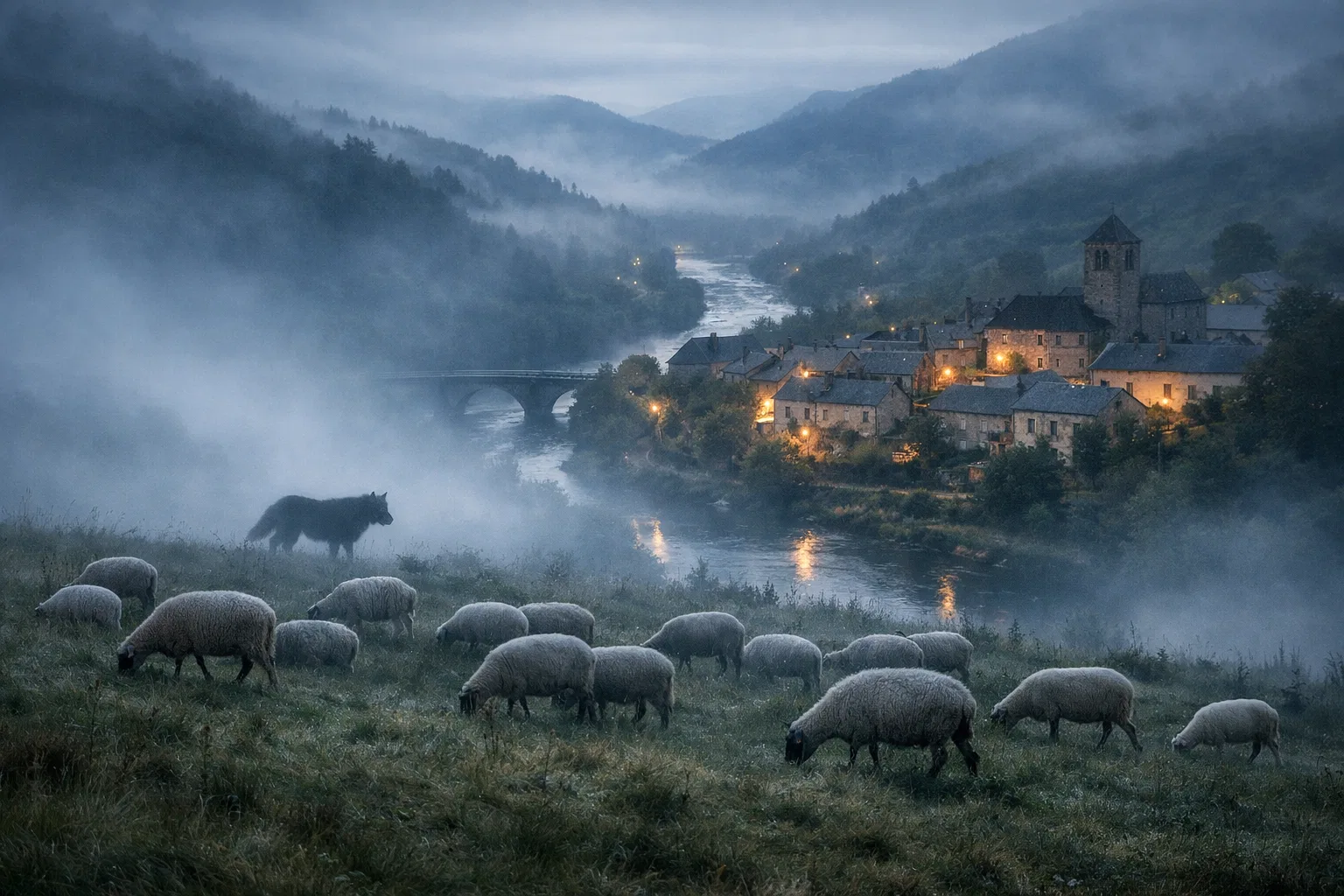
France’s monster tradition is not built around one neat national creature. It is a layered mix of documented animal attacks, medieval dragon legends, playful mountain hoaxes, newspaper-fed panics, and modern escaped-pet scares.
Page outline Jump by section
Introduction
The useful way to read France’s cryptid map is not “which monsters are real?” but “which stories came from folklore, which came from witness reports, and which were amplified by newspapers, tourism, or fear of known predators?” France gives unusually good examples of all four.
Why France’s monsters often begin with wolves, rivers, and mountains
France has the right landscape for mystery-animal stories: high grazing country, deep forests, limestone caves, fast rivers, Alpine and Pyrenean terrain, and old routes where villages, livestock, and wild predators met. For centuries, the frightening animal in French rural life was not an unknown ape or lake reptile but the wolf. Historian Jean-Marc Moriceau’s work on wolf attacks in France is often cited because it treats the wolf not only as a fairy-tale villain but as a historical danger in particular periods and places; a review of his study describes a long record of attacks on humans from the fifteenth to twentieth centuries.[Environment & Society Portal]environmentandsociety.orgOpen source on environmentandsociety.org.
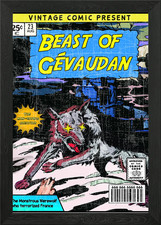
That matters because many French monster reports grew from the borderland between real predation and imaginative interpretation. A wolf attack on a child, a strange animal glimpsed at dusk, a carcass damaged after death, or a predator described by frightened witnesses could become something more than a wolf in the telling. The Beast of Gévaudan is the clearest case: the deaths were real, but the identity and number of attacking animals became unstable as reports, rumours, prints, and official hunts accumulated.[Smithsonian Magazine]smithsonianmag.comSmithsonian Magazine When the Beast of Gévaudan Terrorized FranceSmithsonian Magazine When the Beast of Gévaudan Terrorized France
| Modern France also complicates the old wolf story because wolves have returned. The Office français de la biodiversité estimated the French wolf population at about 1,082 individuals at the end of winter 2024–2025, with an uncertainty range of 989 to 1,187. Le loup en France | Le loup en France[loupfrance.fr]loupfrance.frsituation du loup en francesituation du loup en france That does not mean eighteenth-century monster legends are simply “explained” by today’s wolves, but it does remind readers that the animals behind old rural fears were not imaginary. |
The Beast of Gévaudan: France’s great mystery-beast case
The Beast of Gévaudan is the centrepiece of French cryptid history because it sits in an unusual position: it is a monster legend built on a documented series of attacks. Between 1764 and 1767, people in the old province of Gévaudan, now associated mainly with Lozère and parts of Haute-Loire, were killed or injured by one or more predatory animals. Local tourism bodies give the attack period as 30 June 1764 to 19 June 1767 and estimate between 82 and 124 victims.[Mende - Cœur de Lozère]mende-coeur-lozere.frMendeMende Smithsonian’s account gives the broader shape familiar to English-language readers: three years of terror, roughly 100 killed, and many more injured.[Smithsonian Magazine]smithsonianmag.comSmithsonian Magazine When the Beast of Gévaudan Terrorized FranceSmithsonian Magazine When the Beast of Gévaudan Terrorized France
The first widely cited official victim was Jeanne Boulet, a 14-year-old shepherdess killed near Saint-Étienne-de-Lugdarès in June 1764. The pattern that followed was especially frightening because many victims were children or young people watching livestock away from the village. In a region of scattered farms, upland pasture, and difficult travel, the Beast became a practical terror before it became a legend.
What made Gévaudan different from an ordinary wolf-attack cluster was the speed with which the story became national news. The Public Domain Review notes that the case first broke in the nearby Courrier d’Avignon, then moved through Parisian papers and into foreign prints.[The Public Domain Review]publicdomainreview.orgthe beast of gevaudanthe beast of gevaudan A Courtauld Institute essay on the Beast’s imagery records that the Gazette ran its first story on 16 November 1764, describing a “cruel animal” in the parishes of Gévaudan, and that Louis XV sent military men and royal hunters south in response to the panic.[Courtauld]courtauld.ac.ukOpen source on courtauld.ac.uk.
The Beast was described in contradictory ways: wolf-like but not quite a wolf, tawny or reddish, unusually large, fast, sometimes striped, sometimes with an odd tail or powerful claws. Those details are exactly what make the case attractive to cryptid writers, but they are also what make it hard to use as evidence. Witnesses were frightened, sightings were brief, descriptions were filtered through officials and newspapers, and animal knowledge varied. In an age before photography, the Beast became partly an animal and partly a printed image.
Several explanations have been proposed:
A large wolf or several wolves. This remains the most cautious explanation. Wolves were present in eighteenth-century France, and wolf attacks on humans were historically recorded. A single unusually bold predator, several problem wolves, or a sequence of attacks later grouped under one name could explain much of the pattern.
A wolf-dog hybrid or escaped exotic animal. The Beast’s reported size and unusual appearance have led to theories involving a hybrid, hyena, lion, or other captive animal. These theories are colourful but need stronger evidence than the surviving record provides.
Media exaggeration and official pressure. The court, provincial authorities, local clergy, newspapers, and frightened villagers all had reasons to frame the animal as extraordinary. Once the Beast became a national embarrassment, every failed hunt made it seem more monstrous.
Human involvement. Some later retellings suggest a trained animal, a murderer, or a cover-up. These ideas are popular in fiction, especially because they give the story a villain, but they are much harder to prove from contemporary evidence.
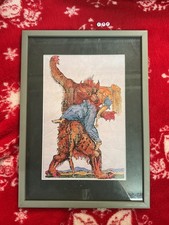
The closest thing to a physical endpoint came in June 1767, when Jean Chastel killed an animal said to be the Beast. A notarial examination known as the Marin report described the carcass as wolf-like but unusual in proportions, and later summaries note that the dental details point broadly towards a canid.[Wikipedia]WikipediaBeast of GévaudanBeast of Gévaudan This is not proof that every attack was committed by that one animal. It does, however, pull the case back from pure fantasy towards the world of large predators, frightened communities, and imperfect records.

Why Gévaudan still feels unresolved
The Beast of Gévaudan survives because the evidence is strong enough to prove something happened, but not strong enough to settle exactly what happened. There were real deaths. There were official hunts. There were contemporary newspaper reports. There were images, rumours, church responses, and royal interventions. But there is no photograph, no preserved specimen, no modern DNA sample, and no clean chain of evidence linking every attack to one animal.
That ambiguity has made the Beast unusually durable in popular culture. It is not like a lake monster based mainly on sightings; it is a historical trauma that later became a monster story. The 2001 film Brotherhood of the Wolf helped export the legend to a global audience by turning it into an action-horror mystery with political and exotic-animal elements. Modern travel writing still treats the Margeride and Lozère landscape as part of the story, with museums, wolf parks, and local attractions keeping the memory visible.[The Times]thetimes.co.ukThe Times I searched for a mythical beast in a remote French regionThe region now celebrates the legend through museums, sculptures, and tourist sites such as the Fantastic Museum in Saugues and a sound-a…
The sceptical reading does not make the story duller. It makes it more interesting. Gévaudan shows how a real predator can become a national monster when attacks occur in the right terrain, during the right media moment, under the eye of a monarchy anxious to prove control.
The Tarasque: the dragon France parades through town
If the Beast of Gévaudan is France’s great animal-attack mystery, the Tarasque is its great civic dragon. The legend belongs to Tarascon in Provence, near the Rhône. In medieval Christian tradition, the creature terrorised the riverside landscape until Saint Martha subdued it. The monster is usually imagined as a composite beast: part dragon, part turtle, part lion, part river nightmare.
Unlike Gévaudan, the Tarasque is not best understood as a cryptid claim. It is folklore, ritual, and local identity. UNESCO lists the Tarasque tradition within “Processional giants and dragons in Belgium and France”, a heritage element involving large-scale models of mythical animals, heroes, and legendary figures carried or paraded in public festivities.[UNESCO Intangible Cultural Heritage]ich.unesco.orgOpen source on unesco.org. Regional heritage sources note that the Tarasque festivities were proclaimed as part of humanity’s oral and intangible heritage in 2005 and later included in the French inventory of intangible cultural heritage.[Provence-Alpes-Côte d'Azur Tourisme]provence-alpes-cotedazur.comProvence-Alpes-Côte d'Azur Tourisme Tarasque of TarasconProvence-Alpes-Côte d'Azur Tourisme Tarasque of Tarascon
The story’s power comes from place. A river monster on the Rhône makes symbolic sense: rivers flood, carry trade, drown travellers, and connect towns to wider danger. The Tarasque gives those fears a body. The parade then domesticates the creature. What once devoured the countryside becomes a festival figure pulled through the streets.
For a France cryptid page, the Tarasque matters because it shows a different category of monster evidence. There is no need to ask whether a turtle-shelled dragon literally lived near Tarascon. The real evidence is cultural: medieval legend, civic ritual, repeated performance, and a named town that has made the beast part of its public identity.
The Velue and other river beasts: when dragons become local ecology
The Velue, sometimes called the Peluda in later retellings, is another French composite monster, associated with the Huisne valley and La Ferté-Bernard in Sarthe. The name means something like “the hairy one” or “shaggy one”. Descriptions give it a serpent’s head or tail, an ox-sized body, green hair, poisonous spines, and destructive power over crops, animals, and people.[Wikipedia]WikipediaOpen source on wikipedia.org.
Local tourism still uses the Velue as a heritage creature. La Ferté-Bernard’s tourist office presents it as a medieval legend of a beast living along the river, devastating farms and threatening children and young women.[Tourisme La Ferté-Bernard]tourisme-lafertebernard.frOpen source on tourisme-lafertebernard.fr. That modern tourism framing is important: the Velue is not a live mystery-animal case with recurring evidence, but a regional dragon adapted into local storytelling.
The Velue resembles the Tarasque in several ways. Both are hybrid monsters. Both are tied to water. Both threaten ordinary rural life: livestock, fields, crossings, children. Both also become safer once absorbed into heritage. A creature that once explained danger now helps a town explain itself to visitors.
These river beasts probably endure because they translate environmental anxiety into memorable form. Floods, disease, livestock losses, dangerous crossings, and unexplained deaths are hard to narrate. A shaggy dragon in the river is easier to remember.
The Vouivre: a serpent of springs, caves, and treasure
The Vouivre belongs to a wider French and neighbouring Alpine tradition of serpentine dragons. It is especially associated with eastern regions such as Franche-Comté, Burgundy, the Jura, and Savoie. Modern summaries describe it as a fiery or winged serpent haunting springs, wells, caves, ponds, and ruined places.[A Book of Creatures]abookofcreatures.comA Book of Creatures VouivreA Book of Creatures Vouivre
The Vouivre’s habitat is the key to its meaning. It is not a random monster wandering the country; it belongs to thresholds: water sources, underground spaces, ruins, and remote mountain country. In folklore, such places often hold danger and wealth at the same time. The serpent may guard treasure, possess a jewel, or punish the greedy. That places the Vouivre closer to dragon folklore than to a modern cryptid report.
Still, it belongs on France’s mystery-creature map because it shows how local monster traditions cluster around geography. The French east, with mountains, forests, springs, and borderland cultures, produces a different kind of beast from the wolf-haunted Massif Central or the Rhône-side Tarasque.
The Dahu: France’s mountain cryptid that knows it is a joke
The Dahu is one of France’s most charming “cryptids” because the joke is part of the creature. It is usually described as a mountain goat-like animal with legs shorter on one side than the other, allowing it to stand comfortably on steep slopes but making it vulnerable if tricked into turning around. It is known in French-speaking mountain regions, including the Alps and Jura, and is often linked to chamois or ibex-like animals.[Wikipedia]WikipediaOpen source on wikipedia.org.
Unlike the Beast of Gévaudan, the Dahu is not a grim claim about unexplained attacks. It is a folklore prank, often used on tourists, children, or newcomers. The imaginary “Dahu hunt” works because the mountains already contain real agile ungulates, steep terrain, and enough darkness for a story to feel possible for a moment.
The Dahu is useful because it marks one end of the French cryptid spectrum: a creature everyone half-knows is invented, but which still functions as local identity. It is closer to a campfire test than a zoological mystery. In country-level cryptid history, that matters. Not every mystery animal is believed in the same way.
Phantom cats and escaped exotics in modern France
Modern France has had its share of big-cat scares: panthers, lynx-like animals, and other “large feline” sightings reported outside expected contexts. These stories often resemble British “alien big cat” reports, but the French examples show how quickly a mystery can become mundane once an animal is captured or traced.
In 2019, a black panther was filmed and reported on rooftops in Armentières, near Lille. News reports said the animal had escaped from a private home and was tranquillised after being seen moving across buildings.[The Independent]independent.co.ukThe Independent Black panther spotted prowling French rooftopsThe Independent Black panther spotted prowling French rooftops In 2020, another French case involved a supposed lynx-like animal in Seine-Maritime; animal-welfare reporting said the captured animal was identified as a caracat, a rare hybrid involving a caracal and domestic cat.[Eurogroup for Animals]eurogroupforanimals.orgOpen source on eurogroupforanimals.org.
These cases are important because they show that not all “phantom cat” reports are pure fantasy. Sometimes the explanation is an illegally or irresponsibly kept exotic pet. Sometimes it is a hybrid cat. Sometimes it is probably a large domestic cat, a dog, a fox, a brief glimpse, or poor scale judgement. The category remains cryptid-adjacent because the first report is often “there is a panther loose”, while the final explanation may be “there was a captive animal where it should not have been”.
France’s real wild cat context also matters. The Eurasian lynx is present but endangered in France, especially in eastern regions. Recent reporting on conservation efforts notes that fewer than 200 lynx remain in France and that road deaths, fragmentation, genetic weakness, and illegal killing are serious pressures.[Le Monde.fr]lemonde.frFrance plans a trial lynx release in 2027 to boost genetic diversity and repopulate suitable regions. Some conservationists applaud the m… A genuine lynx is not a cryptid, but public unfamiliarity with large native carnivores can feed mystery-cat reports.
Lake monsters and sea serpents: why France is quieter than Scotland
France has lakes, coasts, deep rivers, and maritime folklore, but it does not have a single lake monster with the international profile of Loch Ness. There are local water legends, such as Lake Annecy’s haunted lady or siren-like traditions, and stories around Lake Bourget’s Dent du Chat, where a rescued kitten becomes a monster in legend.[Lake Annecy Tourist Office]en.lac-annecy.comOpen source on lac-annecy.com. These are better treated as folklore than as sustained cryptozoological sighting traditions.
That relative quiet is revealing. A famous lake monster usually needs more than water: it needs repeated sightings, press attention, tourist infrastructure, ambiguous photographs, local branding, and a simple creature-name outsiders can remember. France’s strongest monster stories developed elsewhere: in wolf country, dragon festivals, mountain jokes, and regional river legends.
Sea-serpent traditions do touch France indirectly through the wider European and Atlantic culture of nineteenth-century marine monster reports. Research from the University of St Andrews has argued that nineteenth-century sea-monster sightings were influenced by discoveries of ancient marine reptiles, meaning that people learned new visual templates for what a “sea monster” might look like.[St Andrews News]news.st-andrews.ac.ukSt Andrews News Sea serpent sightings influenced by ancient marine reptileSt Andrews News Sea serpent sightings influenced by ancient marine reptile That helps explain why French readers encountered sea-serpent imagery in the same broader print culture as other European readers, even if France’s own best-known monsters remained land-and-river creatures.
How French monster stories change over time
French cryptid traditions tend to pass through four stages.
First comes local danger. A wolf attack, flood, drowning, livestock loss, or frightening landscape feature creates a need for explanation. Gévaudan begins here, as do many river-dragon tales.
Second comes story-shaping. Witnesses, clergy, officials, storytellers, and newspapers give the danger a form. The Beast becomes a named Beast. The river becomes home to a shaggy monster. A mountain prank becomes the Dahu.
Third comes public performance. The monster appears in prints, festivals, tourism trails, museums, films, or local branding. UNESCO’s recognition of processional giants and dragons shows how some legendary beasts become protected cultural practice rather than disputed animal evidence.[UNESCO Intangible Cultural Heritage]ich.unesco.orgOpen source on unesco.org.
Finally comes sceptical sorting. Modern readers ask what kind of claim they are looking at. Is it a documented animal attack? A saint’s legend? A civic parade? A tourist prank? An escaped exotic pet? A misidentified native carnivore? Good French monster history does not flatten these categories. It keeps them separate while enjoying the strangeness.
The best evidence-aware reading of France’s cryptids
France’s mystery-creature tradition is strongest when read as a set of regional case types rather than a single monster catalogue.
The Beast of Gévaudan is the closest thing to a true historical cryptid case: real attacks, official documents, a named region, competing explanations, and no final zoological certainty. The most cautious reading is that one or more canids, probably wolves or wolf-like animals, were responsible for at least many attacks, while media panic and political pressure transformed the case into a monster legend.
The Tarasque, Velue, and Vouivre are folklore creatures rooted in place. They are not failed zoology; they are cultural animals. Their “evidence” lies in legend, ritual, iconography, tourism, and local memory.
The Dahu is a knowingly playful mountain beast. It belongs with hoaxes, initiation jokes, and landscape humour rather than serious animal mystery.
Modern phantom-cat reports occupy the border between folklore and news. France has produced real escaped-exotic cases, but those confirmed incidents also make people more likely to interpret uncertain sightings as panthers or pumas.
Taken together, France’s cryptids show that monster stories do not need to be believed literally to matter. They preserve old fears of wolves and wild country, turn dangerous rivers into dragons, give mountain communities a prank animal of their own, and show how quickly a strange sighting can become a national story when it arrives with enough witnesses, anxiety, and imagination.
Amazon book picks
Further Reading
Books and field guides related to What Haunts France's Monster Map?. Use these as the next step if you want deeper reading beyond the article.
The Discovery of France
Helps readers understand the landscapes and local traditions behind French monster lore.
The Penguin Book of Dragons
Includes the type of dragon traditions that shaped French legends.
The Book of Imaginary Beings
Places French creatures within a wider tradition of legendary beings.
eBay marketplace picks
Marketplace Samples
Live-tested eBay searches with available results related to this page.

Endnotes
1.
Source: loupfrance.fr
Title: situation du loup en france
Link:https://www.loupfrance.fr/suivi-du-loup/situation-du-loup-en-france/
2.
Source: mende-coeur-lozere.fr
Link:https://www.mende-coeur-lozere.fr/en/explore-lozere/[gevaudan/beast
3.
Source: Wikipedia
Title: Beast of Gévaudan
Link:https://en.wikipedia.org/wiki/Beast_of_G%C3%A9vaudan
4.
Source: ich.unesco.org
Link:https://ich.unesco.org/en/RL/processional-giants-and-dragons-in-belgium-and-france-00153
5.
Source: Wikipedia
Link:https://en.wikipedia.org/wiki/Peluda
6.
Source: Wikipedia
Link:https://en.wikipedia.org/wiki/Dahu
7.
Source: Wikipedia
Title: French language
Link:https://en.wikipedia.org/wiki/French_language
8.
Source: Wikipedia
Link:https://en.wikipedia.org/wiki/Tarasque
9.
Source: Wikipedia
Title: Bête Noire
Link:https://en.wikipedia.org/wiki/B%C3%AAte_Noire
10.
Source: Wikipedia
Title: Processional giants and dragons in Belgium and France
Link:https://en.wikipedia.org/wiki/Processional_giants_and_dragons_in_Belgium_and_France
11.
Source: Wikipedia
Title: Processional giants and dragons in Belgium and France
Link:https://dag.wikipedia.org/wiki/Processional_giants_and_dragons_in_Belgium_and_France
12.
Source: Wikipedia
Link:https://en.wikipedia.org/wiki/Loire
13.
Source: Wikipedia
Title: Phantom cat
Link:https://en.wikipedia.org/wiki/Phantom_cat
14.
Source: Wikipedia
Title: Loire (department)
Link:https://en.wikipedia.org/wiki/Loire_%28department%29
15.
Source: Wikipedia
Link:https://en.wikipedia.org/wiki/Guivre
16.
Source: wolf.org
Link:https://wolf.org/wow/europe/france/
17.
Source: ich.unesco.org
Title: photo pop up 00973
Link:https://ich.unesco.org/en/photo-pop-up-00973?call=film&id=41682&include=film_inc.php&width=700
18.
Source: ich.unesco.org
Title: photo pop up 00973
Link:https://ich.unesco.org/en/photo-pop-up-00973?photoID=00666
19.
Source: medieval.eu
Title: tarascon and the tarasque
Link:https://www.medieval.eu/tarascon-and-the-tarasque/
20.
Source: environmentandsociety.org
Link:https://www.environmentandsociety.org/mml/review-histoire-du-mechant-loup-history-big-bad-wolf-jean-marc-moriceau
21.
Source: smithsonianmag.com
Title: Smithsonian Magazine When the Beast of Gévaudan Terrorized France
Link:https://www.smithsonianmag.com/history/beast-gevaudan-terrorized-france-countryside-180963820/
22.
Source: publicdomainreview.org
Title: the beast of gevaudan 1764 1767
Link:https://publicdomainreview.org/collection/the-beast-of-gevaudan-1764-1767/
23.
Source: courtauld.ac.uk
Link:https://courtauld.ac.uk/research/research-resources/publications/courtauld-books-online/apocalypse/monstrous-ecology-regional-iconographies-and-bourbon-authority-in-depictions-of-the-beast-of-gevaudan-1764-5/
24.
Source: thetimes.co.uk
Title: The Times I searched for a mythical beast in a remote French region
Link:https://www.thetimes.co.uk/article/lozere-france-wild-massif-central-jms53nt6d
Source snippet
The region now celebrates the legend through museums, sculptures, and tourist sites such as the Fantastic Museum in Saugues and a sound-a...
25.
Source: provence-alpes-cotedazur.com
Title: Provence-Alpes-Côte d’Azur Tourisme Tarasque of Tarascon
Link:https://provence-alpes-cotedazur.com/en/things-to-do/culture-and-heritage/traditions/tarasque/
26.
Source: abookofcreatures.com
Link:https://abookofcreatures.com/2019/01/18/velue/
27.
Source: tourisme-lafertebernard.fr
Link:https://www.tourisme-lafertebernard.fr/en/coups-de-coeur/the-legend-of-la-velue/
28.
Source: abookofcreatures.com
Title: A Book of Creatures Vouivre
Link:https://abookofcreatures.com/2015/12/11/vouivre/
29.
Source: independent.co.uk
Title: The Independent Black panther spotted prowling French rooftops
Link:https://www.independent.co.uk/news/world/europe/black-panther-roof-france-video-pictures-armentieres-a9112351.html
30.
Source: eurogroupforanimals.org
Link:https://www.eurogroupforanimals.org/news/very-rare-big-cat-caught-french-police
31.
Source: lemonde.fr
Link:https://www.lemonde.fr/en/environment/article/2026/05/15/orphaned-lynx-released-into-the-wild-the-fight-to-save-france-s-wildcats_6753477_114.html
Source snippet
France plans a trial lynx release in 2027 to boost genetic diversity and repopulate suitable regions. Some conservationists applaud the m...
32.
Source: en.lac-annecy.com
Link:https://en.lac-annecy.com/webzine/the-legend-of-the-damsel-and-the-lake/
33.
Source: news.st-andrews.ac.uk
Title: St Andrews News Sea serpent sightings influenced by ancient marine reptile
Link:https://news.st-andrews.ac.uk/archive/sea-serpent-sightings-influenced-by-ancient-marine-reptile-fossil-finds/
34.
Source: youtube.com
Title: The Beast of Gévaudan
Link:https://www.youtube.com/watch?v=nuiPCScilpU
35.
Source: mythus.fandom.com
Link:https://mythus.fandom.com/wiki/Tarasque
36.
Source: creatures-of-myth.fandom.com
Link:https://creatures-of-myth.fandom.com/wiki/Dahu
37.
Source: dragons.fandom.com
Link:https://dragons.fandom.com/wiki/Vouivre
38.
Source: mythus.fandom.com
Link:https://mythus.fandom.com/wiki/Peluda
39.
Source: rewildingeurope.com
Link:https://rewildingeurope.com/rewilding-in-action/wildlife-comeback/wolf/
40.
Source: lemonde.fr
Title: the number of wolves in france is no longer increasing 6736057 114
Link:https://www.lemonde.fr/en/environment/article/2024/12/14/the-number-of-wolves-in-france-is-no-longer-increasing_6736057_114.html?srsltid=AfmBOooNdiyThVEcgnS16D4_0P2m7DBpK_WoyUglHjoLXMGL29jazzQk
41.
Source: rubell.wordpress.com
Link:https://rubell.wordpress.com/tag/vouivre/
42.
Source: devon-cornwall.police.uk
Link:https://www.devon-cornwall.police.uk/foi-ai/devon–cornwall-police/disclosure-logs/2025-disclosures/big-cat-sightings/
43.
Source: blackdrago.com
Link:https://www.blackdrago.com/species/vouivre.htm
Additional References
44.
Source: youtube.com
Title: Cursed Legends and Strange Creatures: France’s mysteries
Link:https://www.youtube.com/watch?v=jikXcNmmegs
Source snippet
France's Most Terrifying Mystery - Re-examining the Beast of Gévaudan...
45.
Source: youtube.com
Title: France’s Most Terrifying Mystery
Link:https://www.youtube.com/watch?v=z_FR5sn0AAE
Source snippet
The Beast of Gévaudan: Chasing The Werewolf-Creature That Terrorized France | Full Documentary...
46.
Source: youtube.com
Link:https://www.youtube.com/watch?v=pcB3z5FdOOU
Source snippet
The Tarasque: France's Dragon That Terrified Provence...
47.
Source: youtube.com
Title: A Guide to French Folklore | Human Voiced, No Ads
Link:https://www.youtube.com/watch?v=hysLYFLGnOg
Source snippet
Cursed Legends and Strange Creatures: France's mysteries - Full Documentary - HD - MG...
48.
Source: youtube.com
Title: The Terrifying Reign of the Beast of Gevaudan | Monstrum
Link:https://www.youtube.com/watch?v=4fsklQe8Y1U
Source snippet
A Guide to French Folklore | Human Voiced, No Ads...
49.
Source: researchgate.net
Link:https://www.researchgate.net/publication/394540394_Estimating_wolf_population_size_in_France_using_non-invasive_genetic_sampling_and_spatial_capture_recapture_models
50.
Source: annecy-town.com
Link:https://www.annecy-town.com/legends-annecy-haute-savoie/
51.
Source: reddit.com
Link:https://www.reddit.com/r/creepy/comments/br2xpj/annecy_france/
52.
Source: reddit.com
Link:https://www.reddit.com/r/Cryptozoology/comments/1ingh0x/do_you_believe_big_cat_sightings_in_australia_and/
53.
Source: facebook.com
Link:https://www.facebook.com/SwissEmbassyUSA/posts/do-you-know-the-goat-le-dahu-the-dahu-is-a-mountain-goat-found-in-the-swiss-alps/10153117462808563/
Topic Tree
Follow this branch
Related pages 192
- Antigua Cryptids
- Maldives Monsters
- Malta Monsters
- Qatar Monsters
- Argentina Monsters
- +187 more in sidebar