Cryptids of Spain's Wildest Places
Spain has no single national cryptid to rival the Loch Ness Monster or Bigfoot.
Page outline Jump by section
Introduction
The evidence for unknown large animals is weak. Spain’s best-known cases generally belong to one of four categories: traditional folklore, short-lived eyewitness flaps, media-amplified misidentifications, or real wildlife seen under confusing conditions. That does not make the stories worthless. They show how landscape, local memory and modern news culture turn an uncertain sighting into a monster — and how quickly a monster can become a mascot, tourist attraction or regional symbol.
Spain’s mystery-creature map
Reports and legends tend to cluster in environments that naturally encourage uncertainty. Northern Spain supplies misty forests, limestone caves and mountain lakes. The Atlantic coast produces unfamiliar carcasses and deep-water animals. The Canary Islands add isolated ravines, pools and distinctive local traditions. Rural districts elsewhere provide the setting for phantom cats and unexplained livestock deaths.
The country’s strongest creature traditions can be grouped broadly as follows:
- Forest humanoids and giants: especially the shaggy lord of the woods in Basque tradition and related wild-man figures.
- Dragons and giant serpents: common in Asturian, Catalan and festival folklore, often guarding treasure, occupying caves or being subdued by a saint.
- Water monsters: including the Hairy Eel of Tenerife, the Lake Banyoles dragon and the short-lived Lake Enol scare.
- Phantom predators: mainly alleged black panthers or other large cats reported in rural districts.
- Marine monsters made real: giant squid and other unusual sea creatures found off Spain’s northern coast.
- Imported modern legends: most notably the chupacabra, whose Spanish appearances followed the creature’s rise in Puerto Rico and the wider Spanish-speaking media.
This variety matters because folklore, witness testimony and zoological claims are not the same kind of evidence. A dragon represented in an annual procession is a cultural tradition, not a report of a surviving reptile. A blurred photograph of a dark animal is a claim requiring identification. A preserved giant squid is a documented species that helps explain why older sailors believed enormous sea monsters could exist.

The Hairy Eel of Tenerife
The Hairy Eel is one of Spain’s clearest examples of a genuinely local cryptid-like tradition. It was said to inhabit a deep pool in a remote ravine at Punta de Anaga, in north-eastern Tenerife. The creature was remembered as an eel of enormous size, with a hideous, hair-covered head and an unnerving gaze directed at anyone bold enough to approach its pool.
The story was recorded in the nineteenth century by Tenerife historian Manuel de Ossuna y Van Den Heede, whose 1897 work on Anaga described the tradition as already old. In the account, local people treated the animal not merely as an oversized fish but as something demonic. A religious intervention was supposedly required before it died or disappeared. The legend also became attached to the landscape through the name Charco de la Anguila, or Eel Pool, in the Palmital ravine.[andresrayaramos.com]andresrayaramos.comAndrés Raya Ramos La leyenda de la anguila peludaAndrés Raya RamosApril 30, 2022 — 30 Apr 2022 — Según cuentan, esta anguila era un monstruo; su cabeza horrible estaba cubierta de pelo y…
This is better understood as folklore with a possible zoological seed than as a continuing series of sightings. European eels can enter freshwater channels and pools, and an unusually large individual glimpsed in dark water could acquire exaggerated features in repeated storytelling. “Hair” might describe weed, damaged skin, fungal growth or simply the monstrous decoration added by oral tradition. There is no specimen, photograph or modern chain of reports suggesting that an unknown giant eel population survives in Anaga.
What gives the story value is its deep connection to place. It is not a generic monster casually relocated to Tenerife. The ravine, pool, local fear and nineteenth-century record form a compact tradition in which an animal, a dangerous water hole and a supernatural warning have become inseparable.
Forest giants: folklore before cryptozoology
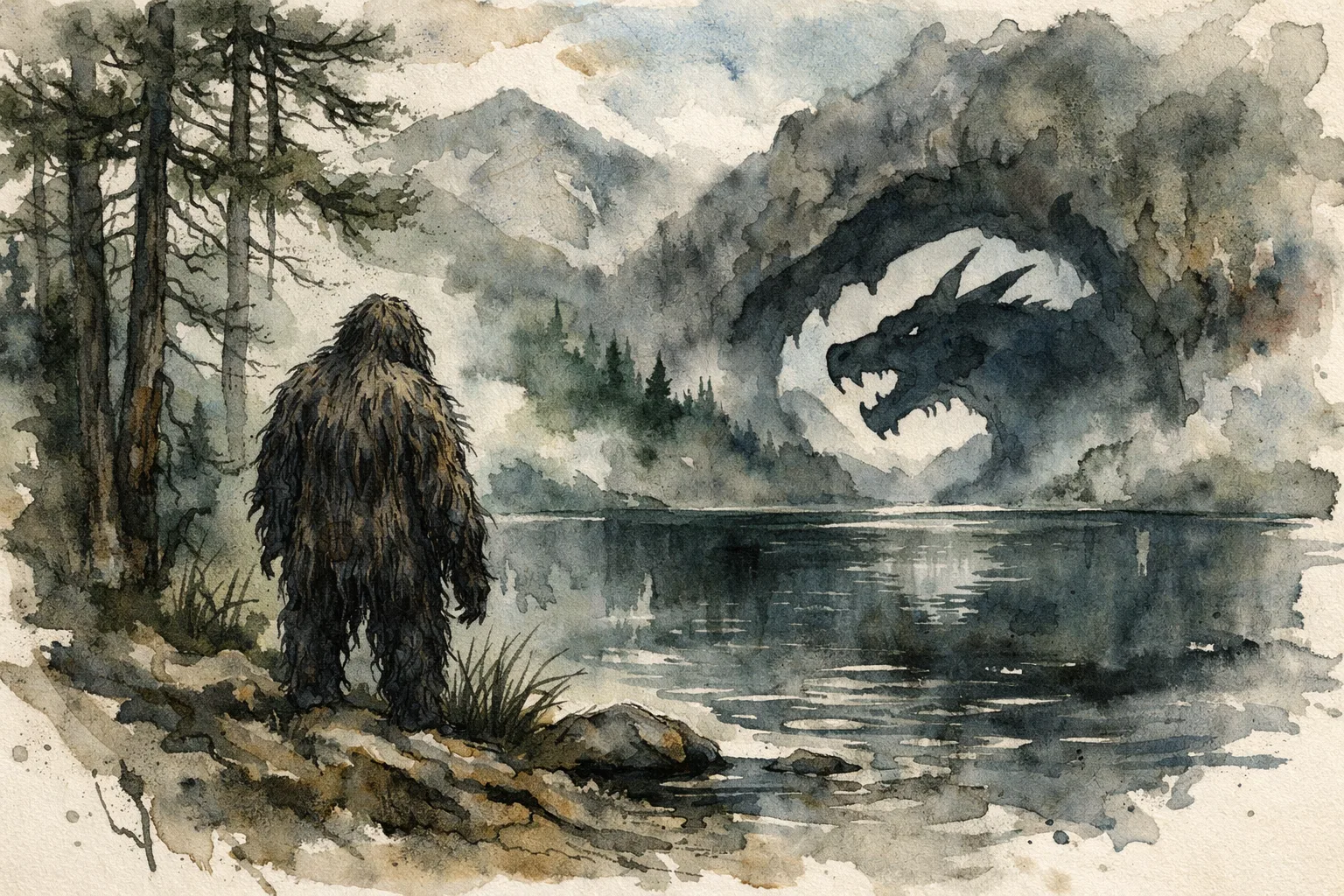
Northern Spain’s best-known wild-man figure is the Basque lord of the woods. He is commonly portrayed as a large, powerful and hairy being associated with remote forests, mountains, livestock and ancient knowledge. Official Basque cultural material presents him alongside other established mythological figures rather than as an animal currently sought by zoologists.[euskadi.eus]turismo.euskadi.eusTurismo UntitledEuskadi TurismoUntitled - Euskadi.eusJanuary 23, 2026 — Basque mythology and learn about the. "sorgiñas" (witches), "Basajaun" (lord of t…
Stories often cast the forest lord as a guardian, herdsman or keeper of technical secrets. One tradition tells how a clever human tricked him into revealing knowledge about making a saw or working metal. Such stories place the being at the boundary between wilderness and settlement: he possesses knowledge first, but human society eventually takes it from him.[Euskadi Turismo]turismo.euskadi.eusBasajaun de dientes triscados se propagóEuskadi Turismode los Gigantes Por las sendasApril 7, 2016 — Basajaun fabricaba sierras en su taller, y Martiniko deseaba conocer el secr…
His shaggy appearance has encouraged occasional comparisons with Bigfoot or the yeti. The resemblance is visual, but the traditions work differently. Bigfoot is commonly framed as an undiscovered primate supported by modern footprints, films and witness reports. The Basque forest lord belongs primarily to mythology: a speaking, culture-bearing figure embedded in tales about farming, craftsmanship and the dangers beyond the protected household. Research on Basque cultural space likewise treats wilderness as the realm of wild animals, threatening outsiders and mythic beings.[Euskadi]euskadi.eusEuskal jokoa eta jolasaEuskal jokoa eta jolasaJanuary 16, 2006 — 1 Dec 2005 — this risky space be a den to bandits, wild beasts and naturally mythologica…
Spain therefore has an ape-like legendary figure, but not a comparably strong modern record of an unknown ape roaming its mountains. Presenting the forest lord as simply “Spain’s Bigfoot” strips away the most distinctive part of the story: he is not merely a hidden animal but an older master of the landscape.
Dragons that belong to lakes, caves and streets
Dragon and giant-serpent traditions are far more widespread in Spain than modern lake-monster reports. In Asturias, the great winged serpent is remembered as a cave-dweller and guardian of treasure or captive people. Asturias’ official tourism material places this creature firmly within regional mythology, alongside spirits of forests, storms and water. It now appears on family trails and cultural routes, showing how an old frightening figure has become part of public heritage.[Turismo Asturias]turismoasturias.esOpen source on turismoasturias.es.
Lake Banyoles in Catalonia also has a monster legend. The creature is usually described as a dragon rather than a zoological lake animal. In the traditional story, a holy man draws it from the lake and renders it harmless. The structure is familiar from European saint-and-dragon tales: dangerous nature is confronted, subdued and absorbed into a Christian moral world.[Wikipedia]WikipediaBanyoles monsterBanyoles monster
These traditions should not be confused with repeated claims that physical monsters still inhabit the water. Their earliest purpose was not to document an unknown species. They explained dangerous places, celebrated holy power, warned children away from water and provided memorable stories for communities.
The same transformation from fear to celebration appears in Spain’s public festivals. Granada’s Corpus Christi celebrations feature the Tarasca, a woman carried above a subdued dragon-like monster. The city’s official account traces the figure to the wider legend of Saint Martha taming the monster of Tarascon and notes that Granada’s version became both a festive emblem and an annual fashion spectacle.[Turismo Granada]turismo.granada.orgTurismo Granada The Tarasca and the big headsTurismo Granada The Tarasca and the big heads
A creature can therefore have several lives at once: religious enemy, civic mascot, children’s character and tourist attraction. In Spain, these public afterlives are often better documented than any supposed eyewitness encounter with the beast itself.
The Lake Enol “monster” that lasted a few days
Spain’s most instructive modern lake-monster flap occurred at Lake Enol in Asturias in October 2021. Witnesses and circulated footage appeared to show a long grey form or disturbance moving through the water. Some reports estimated a length of about 15 metres, and comparisons with the Loch Ness Monster followed almost immediately.[La Voz de Asturias]lavozdeasturias.esOpen source on lavozdeasturias.es.
The case demonstrates how rapidly an ambiguous observation can grow. A disturbance becomes an animal; the animal becomes a giant serpent; and the serpent becomes a possible local Nessie. Once that framing is established, visitors and media outlets begin looking at the lake through the same interpretative lens.
Marine-fauna specialist Luis Laria reviewed the images and argued that the apparent movement was caused by gas escaping from beneath the lake bed. Rising bubbles and disturbed water created a sinuous surface effect that observers interpreted as a moving body. Local and national coverage subsequently treated the mystery as resolved.[lavozdeasturias.es]lavozdeasturias.esOpen source on lavozdeasturias.es.
The explanation is more persuasive than the monster claim because the footage did not show a distinct head, body, fins or repeated animal behaviour. Nor did the event produce tracks, biological material, sonar evidence or subsequent observations of a resident giant creature. Lake Enol remains important to Spanish monster history not because it probably held an unknown animal, but because it provides a near-perfect modern example of monster formation in real time.
Phantom panthers and the problem of scale
Large black cats are among Europe’s most persistent mystery animals. Spain has produced several alleged sightings, but the best-publicised recent case occurred near Ventas de Huelma in Granada in September 2020.
Several residents reported a large dark feline near the village. The authorities took the reports seriously enough to deploy environmental officers, the Civil Guard’s nature-protection service, patrols and a helicopter. Early coverage emphasised that no firm physical evidence had yet been found.[El País]elpais.comEl País La Guardia Civil organiza un dispositivo de búsqueda deEl País La Guardia Civil organiza un dispositivo de búsqueda de
The story escalated after photographs, possible footprints and further claims circulated. Some local statements treated tracks as confirmation, while an animal trainer who joined the search remained convinced that a panther had passed through the area. Yet the search produced no captured animal, carcass, DNA result or unambiguous image. Later reporting described a case rich in photographs, videos, noises and testimony but poor in decisive proof.[as.com]as.comOpen source on as.com.
A free-ranging exotic cat is not biologically impossible. Captive animals can escape or be released. The difficulty lies in proving that a distant black shape is one. Dogs, domestic cats, wild boar and other familiar animals can appear much larger when there is no reliable object for scale. Dark colouring also removes visible anatomical detail, while digital zoom makes an outline less trustworthy rather than more precise.
The Granada panther sits between cryptid story and practical wildlife alert. Authorities were right to investigate a potentially dangerous escaped animal. But public caution during a search is not the same as zoological confirmation. With no specimen or diagnostic evidence, the case remains an unresolved identification, not proof of a hidden Spanish big-cat population.
The chupacabra arrives through the media
The chupacabra is sometimes included in lists of Spanish cryptids, but it is not an old creature of Spain. The modern legend began in Puerto Rico in 1995 and spread quickly through television, newspapers and popular culture. Spanish reports emerged only after the creature had already acquired an international identity.
Stories typically involve livestock found dead with puncture wounds and an apparent lack of blood. Descriptions of the supposed attacker vary sharply, from a spiny reptilian biped to a hairless dog-like animal. That instability is important: a well-defined species should not change its basic anatomy according to region or news cycle.
A widely repeated Spanish claim concerns goats allegedly killed in Jaén in 2010. However, later popular accounts provide few verifiable details about veterinary examinations, official case files or preserved samples. The repetition of the story is much stronger than its publicly accessible evidential record.[ElHuffPost]huffingtonpost.esOpen source on huffingtonpost.es.
Claims that a carcass has been “drained of blood” are especially unreliable without a necropsy. Blood can pool internally or settle in the lower parts of a body after death, while puncture wounds may simply be canine tooth marks. Predators and dogs also sometimes kill more animals than they consume, particularly in enclosed flocks. In well-investigated chupacabra cases outside Spain, supposed creatures have repeatedly proved to be known canids, often with severe mange.[Wikipedia]WikipediaOpen source on wikipedia.org.
The Spanish chupacabra is therefore best viewed as an imported explanatory label. It gives a dramatic name to livestock deaths that may have several ordinary causes, including dogs, known wild predators, scavenging after death and mistaken assumptions about blood loss.
When the sea monster is real
Spain’s strongest connection to genuine “monster” animals lies off the coast of Asturias. Giant squid live in deep water and are rarely seen alive, but specimens have repeatedly washed ashore or been recovered from the north-eastern Atlantic. Scientific work has documented giant squid from waters around the Iberian Peninsula, including specimens delivered to researchers in Luarca.[ResearchGate]researchgate.netOpen source on researchgate.net.
Luarca’s Giant Squid Museum preserves this relationship between marine science and monster folklore. Asturias’ tourism authority describes its collection as the world’s largest devoted to a species that has generated myths and legends around the globe. A further giant squid was found on a beach at Llanes in October 2024, demonstrating that such strandings are not merely historical curiosities.[Turismo Asturias]turismoasturias.esOpen source on turismoasturias.es.
Giant squid do not validate every old report of a sea serpent or kraken. Their bodies are not serpentine, and a dead or damaged specimen can look very different from a living animal. Nevertheless, they show why marine-monster traditions cannot be dismissed as pure fantasy. Before deep-sea photography and modern taxonomy, a sailor encountering a many-metre-long squid, detached tentacle or decomposing carcass had little reason to describe it in restrained scientific language.
Other known animals can produce equally strange impressions. Oarfish are elongated, reflective and capable of reaching remarkable lengths. Basking sharks become grotesque “globsters” as their heads and gill structures decay. Groups of dolphins, floating weed, waves and lines of swimming fish can all create the appearance of humps or coils.
The sea remains the part of Spain’s monster landscape where unfamiliar large animals are most plausible. The crucial distinction is between an unusual known species and a claimed species for which no diagnostic remains exist.
Why Spanish monster stories persist
Spanish creature traditions survive because they do more than ask whether an animal exists. They give character to particular landscapes. The Hairy Eel belongs to an isolated Canarian pool. The Basque forest giant belongs beyond the safety of the farmhouse. Asturian dragons occupy caves and wooded valleys. The Lake Enol monster emerged from a famous mountain setting already suited to wonder.
Modern media add speed and standardisation. An unclear form in water is compared with Nessie; a dark animal becomes a panther; dead goats evoke the chupacabra. Familiar international monsters provide ready-made names before local evidence has been examined. The mystery then spreads through repeated images, condensed news reports and social media posts, often leaving behind the original uncertainty.
Tourism and festivals preserve older creatures in a more deliberate way. Mythological walking routes, giant-squid displays and dragon processions turn fearsome beings into accessible heritage. This does not necessarily cheapen the legends. In many cases, public performance is the reason the creature remains recognisable at all. Official tourism material in Asturias and the Basque Country now openly uses regional mythology to connect visitors with landscape and tradition.[Turismo Asturias]turismoasturias.esOpen source on turismoasturias.es.

What the evidence supports
Spain’s mystery-animal record does not currently support the existence of a large unknown land vertebrate, resident lake monster or surviving population of exotic black cats. The most famous modern incidents lack bodies, DNA, clear photographs and sustained patterns of observation.
The evidence supports a different and richer conclusion:
- Spain has strong regional traditions of forest beings, dragons, serpents and dangerous water creatures.
- A few local legends, especially Tenerife’s Hairy Eel, resemble cryptid accounts because they combine a named place with an allegedly animal-like monster.
- Modern sighting flaps can form quickly around ambiguous photographs, surface disturbances and uncertain scale.
- Phantom-cat reports deserve practical investigation because escaped exotic animals are possible, but individual reports rarely establish a breeding population.
- Chupacabra claims in Spain are a modern cultural import rather than an ancient Spanish animal tradition.
- Real giant squid provide the clearest reminder that nature can produce creatures as remarkable as folklore, while still requiring evidence before one unknown animal is used to explain another.
Spain’s monsters are therefore most revealing when the categories remain separate. Folklore explains what communities imagined and remembered. Eyewitness reports show what people believed they saw. Journalism records how a claim spread. Zoology tests whether an animal explanation fits. The strange story survives all four stages, but certainty usually does not.
Amazon book picks
Further Reading
Books and field guides related to Which Monsters Haunt Spain's Wildest Places?. Use these as the next step if you want deeper reading beyond the article.
The Element Encyclopedia of Magical Creatures
Includes European folklore creatures and related traditions.
The Lore of Scotland
Demonstrates how regional monster lore reflects landscape and culture.
Encyclopedia of Things that Never Were
Covers mythic beings and monster traditions similar to those found across Spain.
eBay marketplace picks
Marketplace Samples
Live-tested eBay searches with available results related to this page.

Endnotes
1.
Source: floradeanaga.blogspot.com
Title: fauna la anguila
Link:https://floradeanaga.blogspot.com/2008/08/fauna-la-anguila.html
Source snippet
Fauna: La anguila12 Aug 2008 — Se cuenta que existió un ejemplar monstruoso, denominada popularmente Anguila Peluda, que habitaba en un c...
2.
Source: Wikipedia
Title: Anguila peluda
Link:https://en.wikipedia.org/wiki/Anguila_peluda
3.
Source: turismo.euskadi.eus
Title: Turismo Untitled
Link:https://turismo.euskadi.eus/contenidos/recurso_tecnico/aa30_folletos/en_def/folletos/Basque-Country.pdf
Source snippet
Euskadi TurismoUntitled - Euskadi.eusJanuary 23, 2026 — Basque mythology and learn about the. "sorgiñas" (witches), "Basajaun" (lord of t...
Published: January 23, 2026
4.
Source: tourism.euskadi.eus
Link:https://tourism.euskadi.eus/contenidos/recurso_tecnico/aa30_folletos/en_def/folletos/2015/general_euskadi_ENG.pdf
Source snippet
Euskadi Tourismgeneral_euskadi_ENG.pdfLearn about the fantasy of Basque mythology at first hand, and thrill to the characters that fill t...
5.
Source: tourism.euskadi.eus
Title: Tourism Family Tourism
Link:https://tourism.euskadi.eus/contenidos/recurso_tecnico/aa30folletos/en_def/folletos/2019/19%20EUSKADI_FAMILIAR%20INGLES%202019.pdf
Source snippet
Euskadi TourismFamily Tourism - Euskadi TurismoaBasque Country is a land full of legends and mythology. You will hear. Basajaun or the Lo...
6.
Source: turismo.euskadi.eus
Title: Basajaun de dientes triscados se propagó
Link:https://turismo.euskadi.eus/contenidos/recurso_tecnico/aa30_folletos/es_def/folletos/2016/mitologia/erraldoiak.pdf
Source snippet
Euskadi Turismode los Gigantes Por las sendasApril 7, 2016 — Basajaun fabricaba sierras en su taller, y Martiniko deseaba conocer el secr...
Published: April 7, 2016
7.
Source: euskadi.eus
Title: Euskal jokoa eta jolasa
Link:https://www.euskadi.eus/contenidos/informacion/v2_publicaciones/eu_publicac/adjuntos/jokoa_eta_jolasa.pdf
Source snippet
Euskal jokoa eta jolasaJanuary 16, 2006 — 1 Dec 2005 — this risky space be a den to bandits, wild beasts and naturally mythologica...
Published: January 16, 2006
8.
Source: Wikipedia
Title: Banyoles monster
Link:https://en.wikipedia.org/wiki/Banyoles_monster
9.
Source: turismo.granada.org
Title: Turismo Granada The Tarasca and the big heads
Link:https://turismo.granada.org/en/tarasca-and-big-heads
10.
Source: as.com
Link:https://as.com/diarioas/2021/10/14/actualidad/1634190767_992112.html
11.
Source: as.com
Link:https://as.com/diarioas/2020/09/14/actualidad/1600058185_394666.html
12.
Source: as.com
Link:https://as.com/diarioas/2020/09/16/actualidad/1600256361_093503.html
13.
Source: Wikipedia
Link:https://es.wikipedia.org/wiki/Chupacabras
14.
Source: researchgate.net
Link:https://www.researchgate.net/profile/Angel-Gonzalez-11/publication/248716378_Records_of_giant_squid_in_the_north-eastern_Atlantic_and_two_records_of_male_Architeuthis_sp_of_the_Iberian_Peninsula/links/0f317534510c5092c6000000/Records-of-giant-squid-in-the-north-eastern-Atlantic-and-two-records-of-male-Architeuthis-sp-of-the-Iberian-Peninsula.pdf
15.
Source: tourism.euskadi.eus
Title: Tourism Family Tourism
Link:https://tourism.euskadi.eus/contenidos/recurso_tecnico/aa30_folletos/en_def/folletos/2023/EUSKADI_FAMILIAR_2023-EN.pdf
16.
Source: Wikipedia
Title: List of cryptids
Link:https://en.wikipedia.org/wiki/List_of_cryptids
17.
Source: Wikipedia
Title: Serpiente marina (mitología)
Link:https://es.wikipedia.org/wiki/Serpiente_marina_%28mitolog%C3%ADa%29
18.
Source: Wikipedia
Title: Macizo de Anaga
Link:https://en.wikipedia.org/wiki/Macizo_de_Anaga
19.
Source: Wikipedia
Title: Museo del Calamar Gigante
Link:https://en.wikipedia.org/wiki/Museo_del_Calamar_Gigante
20.
Source: Wikipedia
Title: Leyenda del lago de Sanabria
Link:https://es.wikipedia.org/wiki/Leyenda_del_lago_de_Sanabria
21.
Source: Wikipedia
Title: Dragon Festival
Link:https://en.wikipedia.org/wiki/Dragon_Festival
22.
Source: en.asturias.com
Title: museum of the giant squid luarca
Link:https://en.asturias.com/museum-of-the-giant-squid-luarca/
23.
Source: euskadi.eus
Title: Identidad, montaña y desarrollo
Link:https://www.euskadi.eus/contenidos/libro/liburua_2009/eu_def/adjuntos/lib2009.pdf
24.
Source: criptozoologos.blogspot.com
Link:https://criptozoologos.blogspot.com/2010/12/
25.
Source: andresrayaramos.com
Title: Andrés Raya Ramos La leyenda de la anguila peluda
Link:https://andresrayaramos.com/2022/04/30/la-leyenda-de-la-anguila-peluda/
Source snippet
Andrés Raya RamosApril 30, 2022 — 30 Apr 2022 — Según cuentan, esta anguila era un monstruo; su cabeza horrible estaba cubierta de pelo y...
Published: April 30, 2022
26.
Source: turismoasturias.es
Link:https://www.turismoasturias.es/en/cultura/historia-tradicion
27.
Source: turismoasturias.es
Title: rutas ideales en asturias para ir con peques
Link:https://www.turismoasturias.es/en/-/blogs/rutas-ideales-en-asturias-para-ir-con-peques
28.
Source: turismoasturias.es
Link:https://www.turismoasturias.es/documents/39908/11755381/Asturias-en-familia-EN.pdf
29.
Source: lavozdeasturias.es
Link:https://www.lavozdeasturias.es/noticia/viral/2021/10/11/teorias-misterio-sobre-monstruo-avistado-lago-enol/00031633949894508791346.htm
30.
Source: lavozdeasturias.es
Link:https://www.lavozdeasturias.es/noticia/viral/2021/10/12/resuelto-misterio-sobre-monstruo-lago-enol/00031634034304879182983.htm
31.
Source: elpais.com
Title: El País La Guardia Civil organiza un dispositivo de búsqueda de
Link:https://elpais.com/espana/2020-09-14/la-guardia-civil-organiza-un-dispositivo-de-busqueda-de-una-pantera-negra-en-un-pueblo-de-granada.html
32.
Source: elpais.com
Link:https://elpais.com/elpais/2020/10/05/mundo_animal/1601918923_379075.html
33.
Source: huffingtonpost.es
Link:https://www.huffingtonpost.es/sociedad/ni-monstruo-lago-ness-yeti-extrano-criptido-causa-terror-espana-latinoamerica-hpe1.html
34.
Source: turismoasturias.es
Link:https://www.turismoasturias.es/en/descubre/cultura/museos-y-espacios-culturales/espacios-culturales/centro-del-calamar-gigante
35.
Source: turismoasturias.es
Link:https://www.turismoasturias.es/en/senderismo/rutas/familias/familias/el-camin-encantau
36.
Source: science.howstuffworks.com
Link:https://science.howstuffworks.com/science-vs-myth/strange-creatures/cryptids.htm
37.
Source: turismoasturias.es
Title: 15 escenas para enamorarte del otono en asturias
Link:https://www.turismoasturias.es/en/-/blogs/15-escenas-para-enamorarte-del-otono-en-asturias
38.
Source: turismoasturias.es
Link:https://www.turismoasturias.es/en/-/blogs/aldeas-de-asturias-el-flechazo-del-turismo-rural
39.
Source: andresrayaramos.com
Link:https://andresrayaramos.com/2022/04/
Additional References
40.
Source: youtube.com
Title: Cryptids of Spain: Monsters, Witches, and Doorways to the Beyond
Link:https://www.youtube.com/watch?v=Pc190OJCTyQ
Source snippet
The Incredible Creatures of Spanish Folklore...
41.
Source: youtube.com
Title: Basajaun: The Lord of the Forests in Basque Folklore
Link:https://www.youtube.com/watch?v=7VORQGDdyyE
Source snippet
Paparrasolla: The Strange Bird-Woman of Spanish Folklore...
42.
Source: youtube.com
Title: Paparrasolla: The Strange Bird-Woman of Spanish Folklore
Link:https://www.youtube.com/watch?v=lNAjAk-AlZY
Source snippet
Legends of Basajaun: Course of Basque Mythology...
43.
Source: facebook.com
Link:https://www.facebook.com/9deDante/posts/cienciael-aka-allghoi-khorhoi-gusano-de-la-muerte-o-intestino-de-vaca-conocido-e/1133898140415547/
44.
Source: facebook.com
Link:https://www.facebook.com/vanguardia28/posts/alerta-por-supuesto-felino-conap-mantiene-monitoreos-e-investigan-veracidad-de-l/1400933468557936/
45.
Source: reddit.com
Link:https://www.reddit.com/r/askspain/comments/1kmshsx/are_there_any_mythical_creatures_or_folk_lore/
46.
Source: letrasdechile.cl
Link:https://letrasdechile.cl/wp1/wp-content/uploads/2021/06/images_pdf_brevestiario_2021.pdf
47.
Source: facebook.com
Link:https://www.facebook.com/groups/217092875144407/posts/2630199803833690/
48.
Source: geotoys.com
Link:https://geotoys.com/blogs/geotoys-blog/cryptids-across-continents-global-legends-of-mystery-and-myth?srsltid=AfmBOoq9wxEYdZs7IcDAeJ-SGYSDFvw8UcPN6q2OgUie0DNCf9_2kHNe
49.
Source: instagram.com
Link:https://www.instagram.com/reel/DUmSUZADNEc/?hl=en
Topic Tree
Follow this branch
Related pages 192
- Antigua Cryptids
- Maldives Monsters
- Malta Monsters
- Qatar Monsters
- Argentina Monsters
- +187 more in sidebar