Strange Creatures of Tajikistan's High Mountains
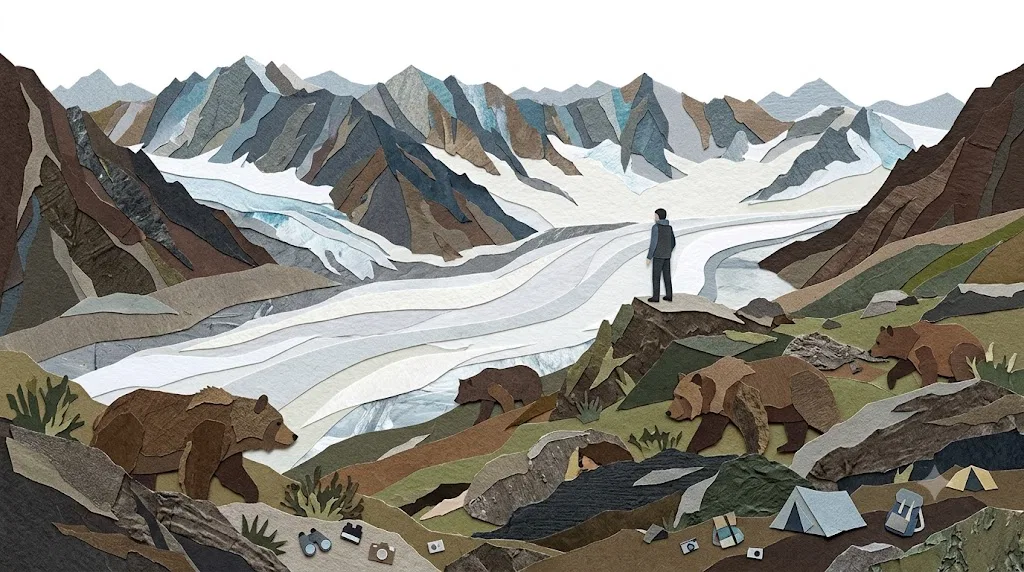
Tajikistan’s strongest mystery-creature tradition is not a lake monster or dragon but a supposed wild man of the Pamir Mountains. The story entered Soviet public life in 1957, when hydrologist Aleksandr Pronin claimed two encounters with a strange upright creature during fieldwork in the Tajik Pamirs.
Page outline Jump by section
Introduction
That makes Tajikistan an unusual cryptid country. Its central case is historically important because government-backed scientists genuinely investigated it, yet the surviving evidence remains almost entirely testimonial. Other beast traditions belong more clearly to folklore: serpents that guard homes or poison springs, dragon-like enemies in heroic tales, and legends attached to mountain lakes. The landscape encourages monster stories, but it also contains real brown bears, wolves, lynx and snow leopards capable of producing alarming, incomplete encounters.[ejournals.eu]ejournals.euOpen source on ejournals.eu.
The Pamir wild man
The creature associated most closely with Tajikistan was described in Soviet discussions as a Pamir counterpart to the Himalayan yeti. Local traditions recorded by botanist Kirill Staniukovich used the name Golub-yavan for a wild, humanlike being said to inhabit the mountains. The available historical account does not establish a single, consistent description; rather, it shows local stories being interpreted through the increasingly fashionable international idea of the “Abominable Snowman”.[Cryptozoological Reference Library]cryptozoologicalreferencelibrary.wordpress.comCryptozoological Reference Library
The claimed habitat was crucial. The Pamirs are enormous, sparsely populated and difficult to cross, with high plateaux, glaciated peaks, deep valleys and long periods of severe weather. Soviet investigators imagined that an unknown primate might have moved westwards from the Himalayas through the mountain systems of Central Asia. Their preferred search zones included the Lake Sarez basin and the Muk-Su river valley, both remote enough to make an elusive animal seem plausible to enthusiasts.[Cryptozoological Reference Library]cryptozoologicalreferencelibrary.wordpress.comCryptozoological Reference Library
This migration theory was speculative rather than zoologically demonstrated. No known population of non-human great apes inhabits Tajikistan, and the expedition programme never produced the physical evidence needed to establish one. The importance of the Pamirs lay less in proven biology than in their reputation as one of the Soviet Union’s last vast, poorly accessible spaces.
How one sighting became a Soviet investigation
In August 1957, Aleksandr Pronin reported seeing a strange creature twice during a Pamir expedition. The claim arrived at exactly the right cultural moment. British Himalayan yeti expeditions had attracted international press attention, and Soviet readers were asking whether the USSR might possess its own snowman. Pronin’s story was therefore treated not simply as an isolated traveller’s tale but as a question of national science and exploration.[Cryptozoological Reference Library]cryptozoologicalreferencelibrary.wordpress.comCryptozoological Reference Library
The Soviet Academy of Sciences established a special commission headed by Staniukovich, with geologist Sergei Obruchev and historian Boris Porshnev among its influential supporters. The commission assembled a report running to hundreds of pages and organised a major 1958 Pamir expedition intended to prove or disprove the creature’s existence. Its members included specialists from several disciplines, although some invited scientists declined because they considered the search implausible.[Cryptozoological Reference Library]cryptozoologicalreferencelibrary.wordpress.comCryptozoological Reference Library
The expedition found no decisive evidence. That failure mattered: the official phase of the Soviet search soon lost institutional momentum, while enthusiasts continued independently. In this respect, the Tajik case resembles many later cryptid investigations. A vivid eyewitness report creates a concentrated search; the search produces ambiguous impressions, stories and possible traces; but the expected specimen or repeatable observation never arrives.
The episode also reveals how cryptid stories can become attached to countries for reasons beyond folklore. Tajikistan became the Soviet snowman’s homeland because the Pamirs combined older wild-man traditions, apparent ecological remoteness and geopolitical prestige. A mysterious creature in an ordinary landscape might have remained a local anecdote. A mysterious creature at the “roof of the world” could become an expedition.
The volunteer expeditions and the 1987 claim
Interest revived around the end of the 1970s through Igor Tatsl, an activist associated with Soviet research into supposed surviving primitive hominids. In summer 1980, three groups totalling about 120 volunteers travelled to Tajikistan for fieldwork. They included students, engineers, teachers and workers rather than a single conventional zoological team. Tatsl reported two sightings, but the mainstream Soviet scientific community largely declined to endorse them.[Cryptozoological Reference Library]cryptozoologicalreferencelibrary.wordpress.comCryptozoological Reference Library
A still more widely reported episode followed in December 1987. Tatsl said members of his expedition had observed a shy, humanlike creature several times at night in the mountains. International news reports, drawing on the Soviet agency TASS, said the group came to within roughly 35 yards of it in the Gissar mountain region near Afghanistan. The published accounts offered little anatomical detail and no photograph, specimen or independently tested trace.[upi.com]upi.comScientist reports seeing Abominable SnowmanScientist reports seeing Abominable Snowman - UPI Archives20 Jan 1988 — Igor Tatsl, his expedition recorded 'several' nocturnal sighti…
Those omissions make the report difficult to assess. Distance estimates made at night are uncertain; repeated observations by members of one organised search group are not equivalent to independent encounters; and a witness already expecting a wild man may interpret an indistinct upright shape differently from an unprepared observer. The story is historically valuable as evidence of late-Soviet monster culture, but it is weak zoological evidence.
Why many scientists were unconvinced
Tajik archaeologist Vadim Ranov became one of the most prominent local critics. In a 1984 lecture in Dushanbe, he dismissed the repeated expeditions and the evolutionary theories used to justify belief in a surviving primitive hominid. His intervention attracted international press attention precisely because the snowman debate had become large enough to require public rebuttal.[Cryptozoological Reference Library]cryptozoologicalreferencelibrary.wordpress.comCryptozoological Reference Library
The basic evidential problem has never changed. A breeding population of large unknown primates would be expected to leave several kinds of material:
- bones, teeth or carcasses;
- hair or droppings yielding distinctive DNA;
- clear photographs from separate observers;
- tracks showing consistent anatomy rather than isolated impressions;
- repeated records from modern wildlife surveys or camera traps.
None of these has established a Pamir ape. Tajik surveys do record large mammals such as brown bears, wolves, lynx, ibex and snow leopards, including signs at very high elevations. The absence of an unknown primate from those surveys is not mathematical proof that none exists, but it steadily reduces the plausibility of a sizeable hidden population.[unesco.org]whc.unesco.orgIbex, and smaller numbers of Tibetan Wolf, Turkestan. Lynx, Tian Shan brown bear, and otter. 3…Read more…
Research on alleged yeti remains elsewhere in Asia strengthens the case for ordinary animals. A genetic study of supposed yeti samples found that they came from local bears and, in one case, a dog. Those specimens were not collected in Tajikistan, so they do not directly solve the Pamir reports. They do demonstrate, however, that impressive relics attributed to wild humanoids can have familiar zoological origins.[Reuters]reuters.comPurported yeti evidence came from bears, dogPurported yeti evidence came from bears, dog
Bears, shadows and difficult terrain
The Himalayan brown bear is the most obvious large-animal candidate for at least some encounters. Bears can stand on their hind legs, have roughly humanlike footprints after melting or overlapping steps, and may appear surprisingly tall when seen from below. Tajikistan’s protected mountain landscapes include brown bears, and field researchers have found their signs above 5,000 metres.[wwfcentralasia.org]wwfcentralasia.orgTAJIKISTA NTAJIKISTAN - WWFAmong the rare and protected animals are the snow leopard (irbis), markhor (screw-horned goat), Himalayan brown bear, Pam…
Not every report must have the same explanation. A distant herder, a person in heavy clothing, a bear briefly upright, or even rocks and shrubs seen under poor light can all contribute. Snow, loose scree and thawing ground can enlarge or distort tracks. Excitement then affects memory: witnesses may preserve the most humanlike features while uncertainty about posture, colour and distance fades.
The Pamirs also create unusually poor conditions for verification. A figure may vanish behind a ridge in seconds, and returning to a reported site can take hours or days. Weather destroys tracks, while the sheer scale of the mountains makes a failed follow-up feel less conclusive than it would in a small woodland. Remoteness does not prove a monster exists, but it protects a story from easy closure.
Snow leopards add another lesson. They are real, large and famously difficult to observe despite occupying extensive habitat across Tajikistan. Conservation estimates place hundreds in the country, yet even experienced visitors rarely see one. This genuine elusiveness makes the idea of another hidden animal intuitively attractive, although a solitary cat leaving identifiable DNA and camera-trap images is very different from an undocumented population of humanlike primates.[cami.cms.int]cami.cms.intOpen source on cms.int.

Serpents and dragons belong to folklore
Tajikistan’s serpent traditions are richer and better documented than many modern cryptid lists suggest, but they should not automatically be treated as reports of unknown reptiles. Research based on oral narratives from Tajik Badakhshan shows snakes appearing in several roles: dangerous antagonists, poisoners of water, bringers of water during drought, healers, generous donors and guardians of households.[eJournals]ejournals.euOpen source on ejournals.eu.
This variety matters. A snake in Pamir folklore is not simply a monster waiting to be identified as an oversized species. It can represent justice, danger, household fortune or the consequences of human behaviour. Some stories warn that a person who harms a protective snake will suffer in return; others portray serpents rewarding kindness or guarding children and homes.[eJournals]ejournals.euOpen source on ejournals.eu.
Dragon-like beings also sit within the wider Persian and Central Asian heroic tradition. Ancient art from Panjikent includes snake-associated figures, while Persian epics tell of heroes fighting enormous serpentine monsters. These creatures are best understood as mythic opponents and moral symbols rather than zoological eyewitness reports. Their presence nevertheless provides cultural scenery into which later rumours of giant snakes or mountain beasts can easily fit.[EdSpace]edspace.american.eduOpen source on american.edu.
What about Tajikistan’s lakes?
Tajikistan contains several lakes whose remoteness and dramatic settings seem ideal for monster traditions, especially Lake Sarez, Karakul and Iskanderkul. Yet no Tajik lake has produced a well-documented, continuing monster case comparable to Loch Ness or other famous “lake serpent” traditions.
Iskanderkul’s best-known legend concerns Alexander the Great’s horse drowning in the lake, not an unknown aquatic animal. The tale is promoted as part of the lake’s historical atmosphere and tourism appeal, while the site itself is a high mountain lake associated with hiking, birdwatching and scenery.[VisitSilkRoad]visitsilkroad.orgOpen source on visitsilkroad.org.
Lake Sarez enters Tajik cryptid history for a different reason: Soviet snowman investigators considered its isolated basin a promising place to search for a land-dwelling wild man. Its role was that of remote habitat, not a home for a clearly established lake monster tradition.[Cryptozoological Reference Library]cryptozoologicalreferencelibrary.wordpress.comCryptozoological Reference Library
Claims that Tajikistan possesses a famous ancient lake beast should therefore be treated cautiously unless they can be traced to a dated local account, newspaper report or recorded oral tradition. Modern travel writing often turns any mysterious mountain lake into a “legendary” place, but landscape folklore is not the same as a sequence of creature sightings.
How the Tajik legend changed
The Pamir wild man passed through three distinct stages. It began as a mixture of local wild-person traditions and scattered testimony. In the late 1950s it became an official scientific problem, shaped by Cold War competition, public enthusiasm and the prestige of unexplored mountain regions. By the 1980s it had shifted into volunteer expeditions, popular journalism and a broader Soviet fascination with anomalous phenomena.[Cryptozoological Reference Library]cryptozoologicalreferencelibrary.wordpress.comCryptozoological Reference Library
After Tajikistan became independent, the creature never developed into a major national tourism emblem. The country’s international wildlife image centres instead on real high-altitude animals, above all the snow leopard, Marco Polo sheep, ibex and brown bear. Cryptid websites and documentaries still revisit the Soviet reports, but they largely recycle the 1957, 1980 and 1987 episodes rather than presenting a strong modern sighting record.[wwfcentralasia.org]wwfcentralasia.orgTAJIKISTA NTAJIKISTAN - WWFAmong the rare and protected animals are the snow leopard (irbis), markhor (screw-horned goat), Himalayan brown bear, Pam…
That afterlife is revealing. The story survives because it offers a rare combination: local mountain lore, a government-backed expedition and a spectacular setting. Yet its fame rests more on the history of the search than on the quality of the evidence found.
The fairest verdict
Tajikistan has a genuine place in cryptozoological history because the Pamir wild man was once treated as a problem worthy of organised Soviet investigation. Pronin’s 1957 testimony, the Academy commission, the large Pamir search and Tatsl’s later volunteer expeditions are documented historical events. The creature itself remains unverified.[Cryptozoological Reference Library]cryptozoologicalreferencelibrary.wordpress.comCryptozoological Reference Library
The most economical explanation is a blend of older folklore, misidentified people or animals, difficult viewing conditions and the cultural influence of the international yeti craze. Brown bears provide a plausible animal source for some upright silhouettes and unusual tracks, while the documented failure of alleged yeti remains elsewhere to yield unknown-primate DNA weakens claims based on similar material.[Reuters]reuters.comPurported yeti evidence came from bears, dogPurported yeti evidence came from bears, dog
Tajikistan’s most interesting “monster” story is therefore not a hidden species waiting confidently in the mountains. It is the story of how a remote landscape, local oral tradition, Soviet science and mass enthusiasm briefly combined to make an elusive Pamir figure seem almost within reach.
Amazon book picks
Further Reading
Books and field guides related to What Really Haunts Tajikistan's High Mountains?. Use these as the next step if you want deeper reading beyond the article.
Abominable Science!
Covers wild-man traditions and the evidence behind alleged unknown creatures.
The field guide to Bigfoot, Yeti, and other mystery primates...
Includes global wild-man traditions comparable to the Pamir case.
Hunt for the Skinwalker
Appeals to the same audience interested in mountain mysteries and cryptids.
The Snow Leopard
Captures the atmosphere of Central Asian high mountains where such legends flourish.
eBay marketplace picks
Marketplace Samples
Live-tested eBay searches with available results related to this page.



Endnotes
1.
Source: cryptozoologicalreferencelibrary.wordpress.com
Title: Cryptozoological Reference Library
Link:https://cryptozoologicalreferencelibrary.wordpress.com/wp-content/uploads/2021/03/roeder-afinogenov-2018.pdf
2.
Source: ejournals.eu
Link:https://ejournals.eu/pliki_artykulu_czasopisma/pelny_tekst/01998675-1323-70b2-8abe-69de850d76f1/pobierz
3.
Source: wwfcentralasia.org
Title: TAJIKISTA N
Link:https://www.wwfcentralasia.org/en/what_we_do/tajikistan/
Source snippet
TAJIKISTAN - WWFAmong the rare and protected animals are the snow leopard (irbis), markhor (screw-horned goat), Himalayan brown bear, Pam...
4.
Source: cambridge.org
Link:https://www.cambridge.org/core/journals/oryx/article/first-biodiversity-survey-of-zorkul-reserve-pamir-mountains-tajikistan/F6E2DC41BE6875E5B44777A08A1DD58B
Source snippet
Cambridge University Press & AssessmentFirst biodiversity survey of Zorkul reserve, Pamir Mountains...by A Diment · 2012 · Cited by 13 —...
5.
Source: whc.unesco.org
Link:https://whc.unesco.org/document/152179
Source snippet
Ibex, and smaller numbers of Tibetan Wolf, Turkestan. Lynx, Tian Shan brown bear, and otter. 3...Read more...
6.
Source: upi.com
Title: Scientist reports seeing Abominable Snowman
Link:https://www.upi.com/Archives/1988/01/20/Scientist-reports-seeing-Abominable-Snowman/2361569653200/
Source snippet
Scientist reports seeing Abominable Snowman - UPI Archives20 Jan 1988 — Igor Tatsl, his expedition recorded 'several' nocturnal sighti...
7.
Source: upi.com
Title: The leader of a Soviet scientific expedition in search
Link:https://www.upi.com/Archives/1988/01/20/The-leader-of-a-Soviet-scientific-expedition-in-search/2007569653200/
8.
Source: reuters.com
Title: Purported yeti evidence came from bears, dog
Link:https://www.reuters.com/article/lifestyle/science/abominable-news-purported-yeti-evidence-came-from-bears-dog-idUSKBN1DT01W/
9.
Source: cami.cms.int
Link:https://cami.cms.int/news/tajikistan-developing-climate-smart-national-action-plan-conservation-snow-leopard-and-its
10.
Source: visitsilkroad.org
Link:https://visitsilkroad.org/destination/iskanderkul-lake/
11.
Source: cambridge.org
Link:https://www.cambridge.org/core/journals/oryx/article/status-assessment-of-the-endangered-snow-leopard-panthera-uncia-and-other-large-mammals-in-the-kyrgyz-alay-using-community-knowledge-corrected-for-imperfect-detection/BF34AA2847024AAC9AF648E51FE2FC8D
12.
Source: sarez.travel
Link:https://sarez.travel/en/whattosee/lakes/iskandarkul_lakes.php
13.
Source: youtube.com
Link:https://www.youtube.com/watch?v=nuKpLxZjKQ0
Source snippet
Trucking Through the Clouds | Deadliest Journeys...
14.
Source: latimes.com
Title: la xpm 1988 01 23 mn 9600 story
Link:https://www.latimes.com/archives/la-xpm-1988-01-23-mn-9600-story.html
Source snippet
Gissar range in Soviet Central Asia near the Afghanistan border.Read more...
15.
Source: globalsnowleopard.org
Link:https://globalsnowleopard.org/tajikistan/
16.
Source: edspace.american.edu
Link:https://edspace.american.edu/silkroadjournal/v16_2018_compareti/
17.
Source: Wikipedia
Link:https://en.wikipedia.org/wiki/Iskanderkul
18.
Source: Wikipedia
Link:https://en.wikipedia.org/wiki/Tajikistan
19.
Source: Wikipedia
Link:https://en.wikipedia.org/wiki/Dragon
20.
Source: naturetrek.co.uk
Link:https://www.naturetrek.co.uk/destinations/asia/tajikistan
21.
Source: ebsco.com
Link:https://www.ebsco.com/research-starters/geography-and-cartography/tajikistan
22.
Source: synapticspace.wordpress.com
Title: rediscovering the reptiles of my youth part 2 the dragons
Link:https://synapticspace.wordpress.com/2021/05/20/rediscovering-the-reptiles-of-my-youth-part-2-the-dragons/
Additional References
23.
Source: youtube.com
Title: At 5,000 Meters: Daily Life and Travel on the Pamir Highway | Full Documentary
Link:https://www.youtube.com/watch?v=PA1DNt57aiQ
Source snippet
Could Sarez Lake Destroy Central Asia | Shocking Discovery...
24.
Source: youtube.com
Title: Tajikistan: Trucking Through the Clouds | Deadliest Journeys
Link:https://www.youtube.com/watch?v=ku71rOD3MBo
Source snippet
At 5,000 Meters: Daily Life and Travel on the Pamir Highway | Full Documentary...
25.
Source: youtube.com
Title: Could Sarez Lake Destroy Central Asia | Shocking Discovery
Link:https://www.youtube.com/watch?v=Pzuetg2vkDc
Source snippet
Journey to the Rooftop of the World – Pamir Highway Travel Documentary...
26.
Source: hal.science
Link:https://hal.science/hal-05157871v1/document
27.
Source: researchgate.net
Link:https://www.researchgate.net/publication/330848500_Cold_War_Creatures_Soviet_Science_and_the_Problem_of_the_Abominable_Snowman
28.
Source: cbd.int
Link:https://www.cbd.int/doc/world/tj/tj-nr-01-p04-en.pdf
29.
Source: instagram.com
Link:https://www.instagram.com/reel/DSKNcJ8Clgd/
30.
Source: instagram.com
Link:https://www.instagram.com/reel/DYzlx1Vsidt/?hl=en
31.
Source: facebook.com
Link:https://www.facebook.com/groups/gallery.art.plus/posts/1802902963222117/
32.
Source: nightbringer.se
Link:https://nightbringer.se/nightbringer/lair_cryptid.html
Topic Tree
Follow this branch
Related pages 192
- Antigua Cryptids
- Maldives Monsters
- Malta Monsters
- Qatar Monsters
- Argentina Monsters
- +187 more in sidebar