Within Sudan Cryptids
Why Is the Lau Called a Sudanese Cryptid?
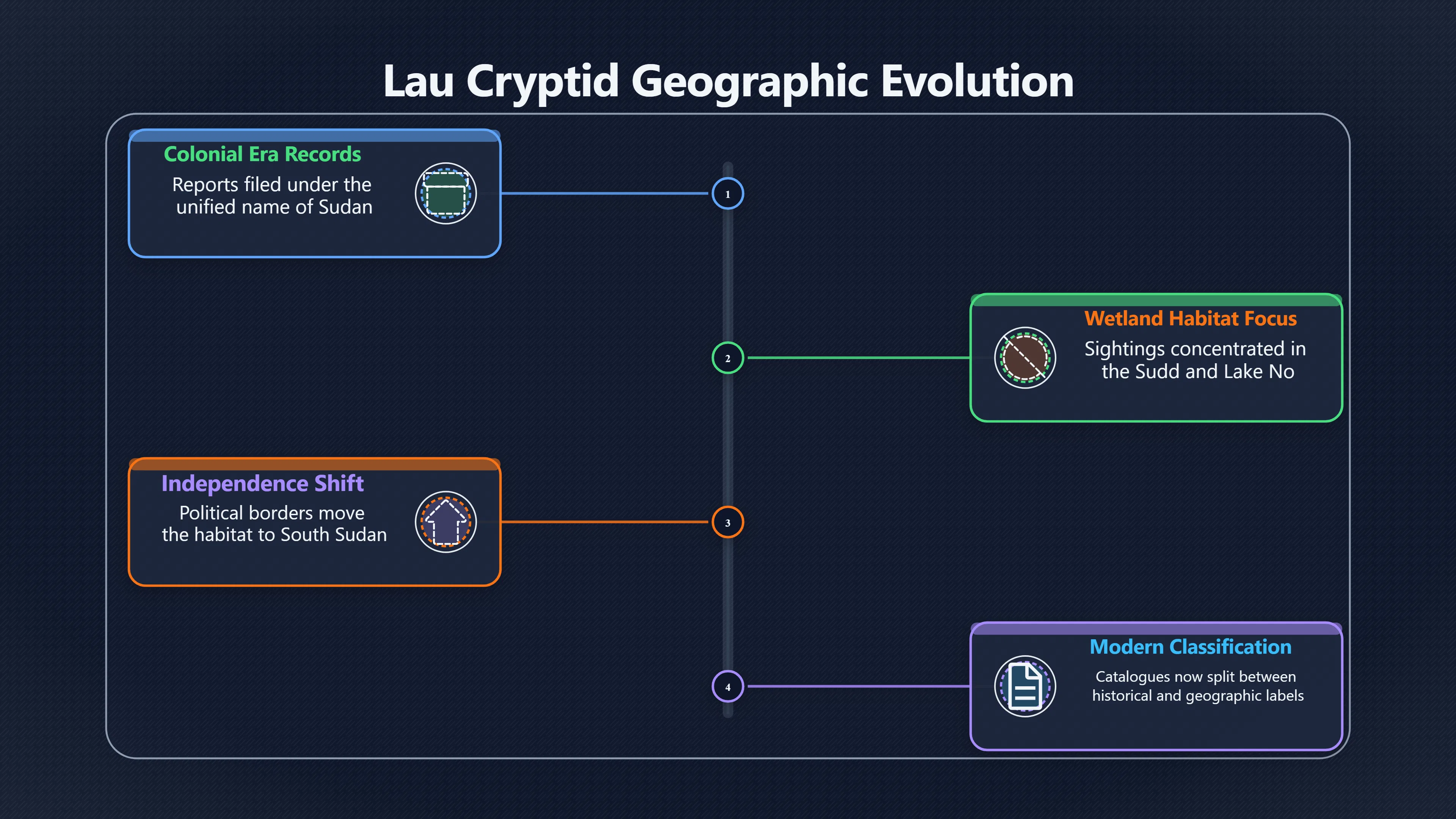
The lau became known as a Sudanese monster because old records used Sudan for wetlands that now lie mainly in South Sudan.
On this page
- Where early lau reports were recorded
- How South Sudan's independence changed the map
- Conflicting descriptions and likely animal inspirations
Page outline Jump by section
Introduction
The lau is often listed as a “Sudanese cryptid”, but that label is partly a historical accident. Most classic lau reports came from the immense White Nile wetlands that today lie within South Sudan, especially around the Sudd marshes, Lake No and the Bahr el Zeraf waterways. When many of the reports were collected and published, however, the entire region formed part of Anglo-Egyptian Sudan or later the Republic of Sudan. As a result, older books, newspaper references and cryptozoology catalogues routinely filed the creature under Sudan, even though the places associated with it are now largely across an international border.[fandom.com]cryptidarchives.fandom.comCryptid Archives LauCryptid ArchivesLau - Encyclopaedia of Cryptozoology - FandomThe lau was a cryptid reported from the marshes of the White Nile, in what i…
Understanding that shifting geography helps explain why the lau occupies an unusual place in Sudanese cryptid history. The legend did not move, but the map did. What modern readers encounter as a “Sudanese monster” is often a story rooted in wetlands that became part of South Sudan after independence in 2011.[Cryptid Archives]cryptidarchives.fandom.comCryptid Archives LauCryptid ArchivesLau - Encyclopaedia of Cryptozoology - FandomThe lau was a cryptid reported from the marshes of the White Nile, in what i…
Where Early Lau Reports Were Recorded
Descriptions of the lau consistently place it in the vast swamp and river systems of the upper White Nile. Reports mention locations such as Lake No, the Bahr el Zeraf and the marshlands of the Sudd, one of the world’s largest freshwater wetland complexes. These environments are difficult to navigate, seasonally flooded and historically remote, making them fertile ground for stories about hidden creatures.[fandom.com]cryptidz.fandom.comCryptid Wiki LauCryptid WikiLau - Cryptid Wiki - FandomSome years later a 12-foot Lau was allegedly seen in Bahr el Zeraf (which forms in the southern Su…
Older accounts described the lau as a long aquatic animal, sometimes serpent-like and sometimes possessing features more commonly associated with fish, including whisker-like barbels. Reported lengths varied dramatically, from around 12 feet to much larger estimates. Some stories portrayed it as aggressive towards fishermen or hunters, while others simply described strange sightings in the wetlands.[fandom.com]cryptidarchives.fandom.comCryptid Archives LauCryptid ArchivesLau - Encyclopaedia of Cryptozoology - FandomThe lau was a cryptid reported from the marshes of the White Nile, in what i…
The key geographical point is that these reports emerged from what colonial administrators, explorers and writers simply called “the Sudan”. Modern political borders did not yet separate Sudan from South Sudan. Consequently, later writers inherited a classification system based on historical administration rather than present-day geography.[fandom.com]cryptidarchives.fandom.comCryptid Archives LauCryptid ArchivesLau - Encyclopaedia of Cryptozoology - FandomThe lau was a cryptid reported from the marshes of the White Nile, in what i…
How South Sudan’s Independence Changed the Map
When South Sudan became an independent state in 2011, many locations associated with the lau suddenly belonged to a different country. The Sudd wetlands, Lake No and much of the White Nile marsh region linked to the creature are now recognised as South Sudanese landscapes.[Wikipedia]WikipediaOpen source on wikipedia.org.
This created an awkward situation for cryptid catalogues. Some continued to list the lau under Sudan because that was how the original reports had been archived. Others reassigned it to South Sudan to reflect the modern political map. Neither approach is entirely wrong.
From a historical perspective, the lau genuinely appeared in records from “Sudan” because that was the official name of the territory at the time. From a geographical perspective, the creature’s reported habitat lies mostly within present-day South Sudan. The result is a cryptid with a split identity: historically Sudanese in many publications, but geographically tied to South Sudan’s wetlands.[fandom.com]cryptidarchives.fandom.comCryptid Archives LauCryptid ArchivesLau - Encyclopaedia of Cryptozoology - FandomThe lau was a cryptid reported from the marshes of the White Nile, in what i…
This border shift also explains why discussions of Sudanese cryptids often seem to contain creatures from very different environments. Northern Sudan’s folklore centres heavily on the Nile and Nubian river traditions, while the lau belongs to a swamp ecosystem hundreds of kilometres farther south. The apparent contradiction reflects changing political boundaries rather than a single, unified monster tradition.[Wikipedia]WikipediaOpen source on wikipedia.org.

Why the Lau Was Easy to Reclassify
Unlike many folklore beings linked to a particular ethnic tradition or settlement, the lau was associated with waterways and wetlands. Its identity depended more on habitat than on a fixed cultural boundary.
The Sudd region itself is a maze of channels, lagoons, papyrus beds and floating vegetation. Seasonal flooding can dramatically alter the landscape. To outside observers, it was exactly the sort of place where rumours of unknown animals could flourish. Explorers and colonial officials frequently described the area as difficult to survey and only partly understood.[Wikipedia]WikipediaOpen source on wikipedia.org.
Because the creature was tied so strongly to this wetland environment, later writers naturally followed the habitat when political borders changed. The legend remained attached to the swamps even as those swamps ceased to be part of Sudan.[Cryptid Archives]cryptidarchives.fandom.comCryptid Archives LauCryptid ArchivesLau - Encyclopaedia of Cryptozoology - FandomThe lau was a cryptid reported from the marshes of the White Nile, in what i…
Conflicting Descriptions and Likely Animal Inspirations
One reason the lau remains difficult to interpret is that descriptions never settled into a single consistent form. Some accounts depict an enormous serpent. Others emphasise fish-like whiskers or facial appendages. Certain retellings even transformed it into a dinosaur-like survivor, a popular theme in twentieth-century cryptozoology.[fandom.com]cryptidarchives.fandom.comCryptid Archives LauCryptid ArchivesLau - Encyclopaedia of Cryptozoology - FandomThe lau was a cryptid reported from the marshes of the White Nile, in what i…
These contradictions suggest that the lau may not have originated from observations of one specific unknown animal. Several more ordinary explanations have been proposed:
- Large catfish: The repeated references to barbels resemble the whiskers of giant catfish, which can reach impressive sizes in African rivers.[Cryptid Archives]cryptidarchives.fandom.comCryptid Archives LauCryptid ArchivesLau - Encyclopaedia of Cryptozoology - FandomThe lau was a cryptid reported from the marshes of the White Nile, in what i…
- Large snakes: The elongated body and aquatic habitat fit stories inspired by pythons or other large snakes encountered in swamp country.[Cryptid Archives]cryptidarchives.fandom.comCryptid Archives LauCryptid ArchivesLau - Encyclopaedia of Cryptozoology - FandomThe lau was a cryptid reported from the marshes of the White Nile, in what i…
- Mixed reports: Different animals observed under difficult conditions may have become blended into a single legendary creature over time.[Cryptid Archives]cryptidarchives.fandom.comCryptid Archives LauCryptid ArchivesLau - Encyclopaedia of Cryptozoology - FandomThe lau was a cryptid reported from the marshes of the White Nile, in what i…
- Regional monster traditions: Some researchers have noted similarities between the lau and other East African water-monster traditions, including the lukwata of Lake Victoria, suggesting that related stories may have spread between regions.[Cryptid Archives]cryptidarchives.fandom.comCryptid Archives Lukwata | Encyclopaedia of CryptozoologyCryptid Archives Lukwata | Encyclopaedia of Cryptozoology
The lack of consistent physical evidence means the lau remains a legend rather than a documented species. What survives most clearly is not a zoological case file but a collection of stories shaped by a remarkable wetland landscape.
What the Lau Reveals About Sudan’s Cryptid History
The lau demonstrates how political geography can reshape the way monster traditions are classified. Modern readers searching for Sudanese cryptids often encounter the creature because older records used a broader definition of Sudan than exists today. The reports themselves did not migrate; only the border did.
That makes the lau a useful reminder that cryptid catalogues are also historical documents. They preserve not just stories about mysterious animals but the assumptions, maps and administrative boundaries of the eras in which those stories were recorded. In the case of the lau, the creature’s reputation as a Sudanese cryptid survives because the wetlands where it was reported once belonged to a country whose borders have since changed.[fandom.com]cryptidarchives.fandom.comCryptid Archives LauCryptid ArchivesLau - Encyclopaedia of Cryptozoology - FandomThe lau was a cryptid reported from the marshes of the White Nile, in what i…
Amazon book picks
Further Reading
Books and field guides related to Why Is the Lau Called a Sudanese Cryptid?. Use these as the next step if you want deeper reading beyond the article.
African Myths of Origin
Provides cultural context for creature traditions linked to the Nile basin.
The Hero with a Thousand Faces
Helps interpret legendary creatures as folklore rather than zoology.
eBay marketplace picks
Marketplace Samples
Live-tested eBay searches with available results related to this page.


Endnotes
1.
Source: Wikipedia
Link:https://en.wikipedia.org/wiki/Sudd
2.
Source: Wikipedia
Title: Bahr el Zeraf
Link:https://en.wikipedia.org/wiki/Bahr_el_Zeraf
3.
Source: philippe-coudray.com
Title: Philippe Coudray A GUIDEBOOK TO HIDDEN ANIMALS
Link:https://www.philippe-coudray.com/PDF/A%20GUIDEBOOK%20TO%20HIDDEN%20ANIMALS%20WEB.pdf
Source snippet
The lau is reported in the swamps of the. Upper Nile, in southern Sudan, especially in the swamps of the Adda, the rivers Bahr el.Read more...
4.
Source: reddit.com
Title: The lau is a cryptid from the marshes of South Sudan
Link:https://www.reddit.com/r/HighStrangeness/comments/164ku89/the_lau_is_a_cryptid_from_the_marshes_of_south/
Source snippet
It's...The lau is a cryptid from the marshes of South Sudan. It's described as a long serpent with barbs like a catfish. Reports of the...
5.
Source: Wikipedia
Title: Aliab Dinka
Link:https://en.wikipedia.org/wiki/Aliab_Dinka
6.
Source: Wikipedia
Title: Lado Enclave
Link:https://en.wikipedia.org/wiki/Lado_Enclave
7.
Source: Wikipedia
Title: Geography of South Sudan
Link:https://en.wikipedia.org/wiki/Geography_of_South_Sudan
8.
Source: cryptidarchives.fandom.com
Title: Cryptid Archives Lau
Link:https://cryptidarchives.fandom.com/wiki/Lau
Source snippet
Cryptid ArchivesLau - Encyclopaedia of Cryptozoology - FandomThe lau was a cryptid reported from the marshes of the White Nile, in what i...
9.
Source: cryptidz.fandom.com
Title: Cryptid Wiki Lau
Link:https://cryptidz.fandom.com/wiki/Lau
Source snippet
Cryptid WikiLau - Cryptid Wiki - FandomSome years later a 12-foot Lau was allegedly seen in Bahr el Zeraf (which forms in the southern Su...
10.
Source: cryptidarchives.fandom.com
Title: Cryptid Archives Lukwata | Encyclopaedia of Cryptozoology
Link:https://cryptidarchives.fandom.com/wiki/Lukwata
Additional References
11.
Source: nilebasin.org
Title: wbBaselineSudan chapter1 3
Link:https://nilebasin.org/sites/default/files/2023-09/wbBaselineSudan_chapter1-3.pdf
Source snippet
Nile Basin InitiativeWETLANDS AND BIODVERSITY IN SUDANby IN SUDAN · 1995 · Cited by 1 — The Nile basin consists of five sub- basins runni...
12.
Source: youtube.com
Link:https://www.youtube.com/watch?v=RYutO85MpgY
13.
Source: youtube.com
Title: WHA T IS THE LAU
Link:https://www.youtube.com/watch?v=5K2kvy-yFLA
14.
Source: abookofcreatures.com
Link:https://abookofcreatures.com/tag/african-folklore/page/2/
15.
Source: archive.org
Link:https://archive.org/stream/cryptidstuff/%28Cryptids%29%20On%20The%20Track%20Of%20Unknown%20Animals%20by%20Bernard%20Heuvelmans_djvu.txt
16.
Source: ndl.ethernet.edu.et
Link:https://ndl.ethernet.edu.et/bitstream/123456789/46979/1/George%20M.%20Eberhart.pdf
17.
Source: facebook.com
Link:https://www.facebook.com/Wearethetribe1/posts/sudd-wetland-south-sudan-mats-of-papyrus-thrive-in-the-sudd-part-of-the-nile-in-/1672140339797894/
18.
Source: facebook.com
Title: the lau is a creature reported from the south of sudan particularly in the area
Link:https://www.facebook.com/TheFolklorePodcast/photos/the-lau-is-a-creature-reported-from-the-south-of-sudan-particularly-in-the-area-/1466371188837130/
19.
Source: facebook.com
Link:https://www.facebook.com/TheFolklorePodcast/posts/the-lau-is-a-creature-reported-from-the-south-of-sudan-particularly-in-the-area-/1466371225503793/
20.
Source: facebook.com
Link:https://www.facebook.com/instituteofmetaphysics/photos/the-lau-is-an-cryptid-from-the-marshes-of-south-sudan-its-described-as-a-long-se/1321848656338004/
Topic Tree