Cryptids of Venezuela's Wildest Landscapes
Venezuela has no single national monster comparable with Scotland’s Loch Ness creature.
Page outline Jump by section
Introduction
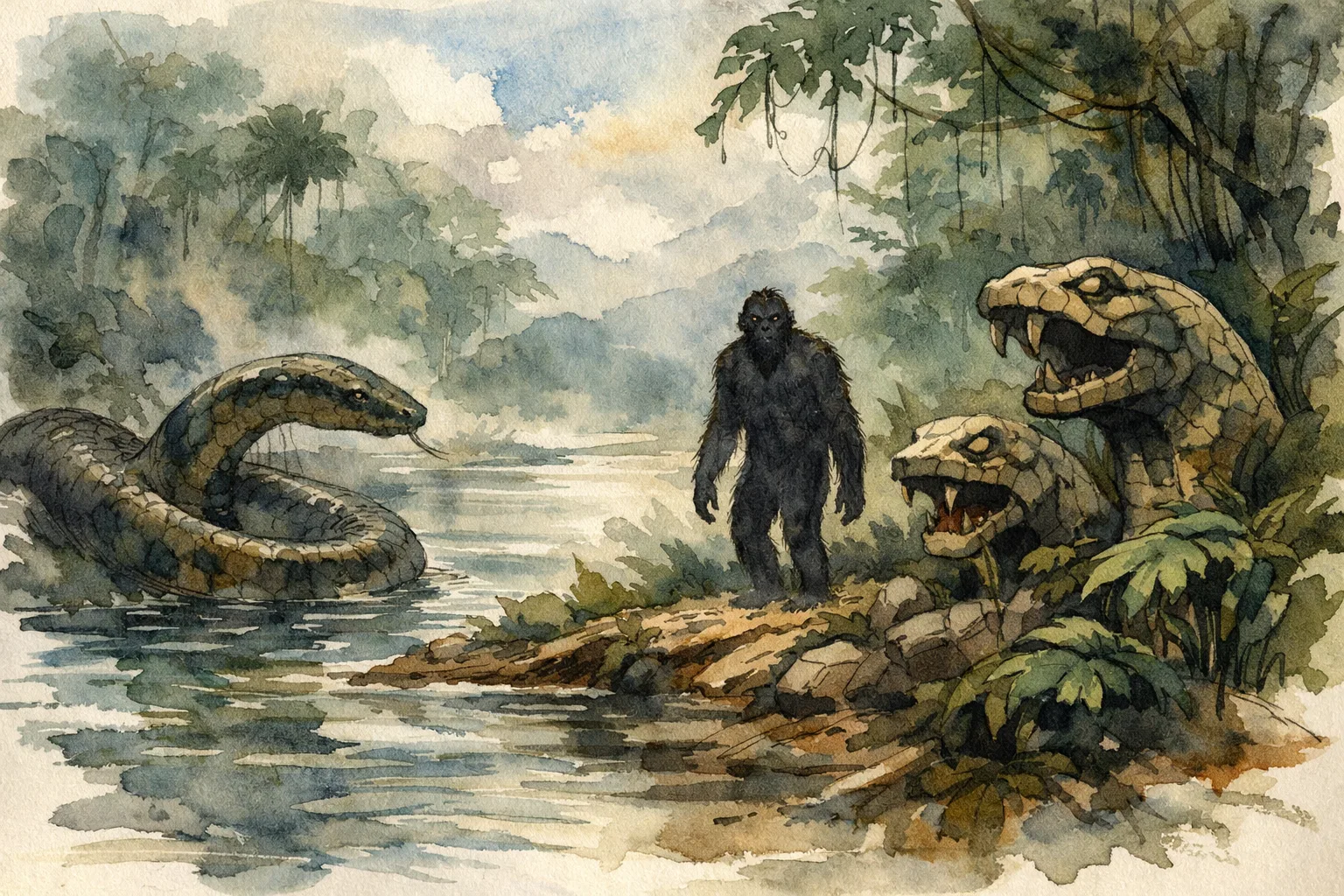
The evidence is generally thin. Venezuela’s best-known “cryptid” case is now widely regarded as a hoax involving an ordinary spider monkey, while stories of enormous anacondas usually enlarge a real and already formidable animal beyond verified measurements. Other creatures belong more clearly to folklore or internet culture than zoology. That distinction matters: a forest being remembered through oral tradition is not the same kind of claim as a photographed specimen, a newspaper panic or a misidentified animal. Venezuela’s unusual geography nevertheless gives all of them fertile ground. The country contains parts of the Andes, the Orinoco basin, Amazonian forest, vast wetlands, Caribbean coastline and the isolated tablelands of the Guiana Shield, one of the world’s richest regions for wildlife and endemic species.[Amazon Conservation Team]amazonteam.orgAmazon Conservation TeamThe Guiana Shield: One of the Last Wild Places on EarthThe Shield also comprises a biodiversity hotspot, home to…
The ape photograph that became Venezuela’s defining cryptid case
The creature most closely tied to Venezuelan cryptozoology is usually called De Loys’s ape. The story concerns an oil-prospecting expedition led by François de Loys in the forested borderlands between Venezuela and Colombia, probably in the late 1910s. According to the later published account, members of the party encountered two aggressive, upright apes. One was shot, placed on a crate and photographed with a stick supporting its head. Its body, skin and skeletal remains were supposedly lost, leaving a single image as the central piece of evidence.[Wikipedia]WikipediaDe Loys's apeDe Loys's ape
The tale did not become public immediately. In 1929, French-Swiss anthropologist George Montandon promoted the photograph as evidence of an unknown anthropoid and proposed the scientific name Ameranthropoides loysi. Montandon was not a neutral observer: he tried to fit the animal into a discredited theory claiming that different human populations had evolved separately from different apes. The purported discovery therefore became entangled with racial anthropology as well as zoological sensationalism.[Wikipedia]WikipediaDe Loys's apeDe Loys's ape
From the beginning, sceptics argued that the animal looked like a spider monkey. These are genuine South American primates with unusually long limbs, small heads and prehensile tails that may be longer than their bodies. The photograph does not clearly show the animal’s rear, making it impossible to confirm the dramatic claim that it lacked a tail. Nor does the crate provide a reliable scale: the photograph alone cannot establish the reported height of roughly five feet or more.[ifaw.org]ifaw.orgSpider monkeys: Lifestyle, threats, and interesting factsThey also have extremely long tails that can reach lengths of 88 centimetres…
The strongest evidence against the discovery came from Venezuelan physician Enrique Tejera, who had worked with de Loys. In a letter published by the Caracas newspaper El Universal in 1962, Tejera said the animal was de Loys’s pet spider monkey and that the photograph began as a joke after the monkey died. Later historical research into the expedition and its personnel has reinforced the interpretation that the celebrated ape was a staged specimen rather than an unknown species.[AAPG]aapg.orga monkeys photo a prankster petroleum geologist and a fraudulent anthropologistA Monkey's Photo, a Prankster Petroleum Geologist and…1 Nov 2020 — The definitive clue that the Ameranthropoides loysi story was a…
The case remains culturally durable because the photograph is so effective. The animal faces the camera, appears eerily human and is stripped of almost every clue that would reveal its ordinary size and anatomy. It is a useful lesson in how cryptid evidence can gain power through composition: one memorable image may outlive missing bones, contradictory testimony and the absence of any comparable specimen.
Why giant snakes feel plausible in the Orinoco country
Venezuela does not need an imaginary giant snake to produce an intimidating one. Green anacondas inhabit northern South America and are among the heaviest living snakes. Individuals several metres long are real, while exceptional animals can be considerably larger than most people will ever encounter. This biological foundation allows fishermen’s estimates, glimpses in muddy water and stories repeated along river routes to grow into claims of near-prehistoric serpents. Recent research on fossil anacondas from Venezuela’s Falcón State found that the snakes had already reached lengths of about four to five metres more than 12 million years ago—roughly comparable with common adult sizes today, rather than evidence of a vanished race of vastly larger monsters.[EurekAlert!]eurekalert.orgnews releasesnews releases
Reports of anacondas ten metres long or longer have circulated widely, but extraordinary measurements are rarely supported by an intact specimen taken under controlled conditions. Snakes seen partly submerged are especially difficult to judge: coils may be counted twice, separate sections may appear continuous, and witnesses naturally compare an unfamiliar body with nearby boats, logs or riverbanks of uncertain size. The sensible conclusion is not that every giant-snake report is invented, but that a genuinely large animal is particularly vulnerable to exaggeration.
Serpents also have a history in the Orinoco landscape that is much older than modern monster hunting. Archaeologists have documented monumental rock engravings along the Upper and Middle Orinoco, including snake figures tens of metres long. One Venezuelan example at Cerro Pintado extends for more than 40 metres. Researchers have suggested that these highly visible carvings may have marked routes, territories or culturally important places. The designs probably represent meaningful animals such as boas or anacondas, but they are symbolic works rather than records of snakes of matching size.[science.org]science.orggigantic snake carvings may have been ancient road signsgigantic snake carvings may have been ancient road signs
This distinction prevents two opposite mistakes. It would be careless to treat every serpent tradition as a zoological report, but equally careless to dismiss snake imagery as random decoration. Along the Orinoco, the serpent was large in cultural importance even where it was not literally monstrous in nature.
Forest beings are not simply undiscovered animals
Southern Venezuela lies within a broad Amazonian and Guiana Shield cultural zone in which forest beings may behave like animals, people, spirits or guardians without fitting neatly into Western categories. Online cryptid catalogues sometimes detach such figures from their original contexts and present them as eyewitness reports of surviving prehistoric mammals. That transformation can make an old narrative look more zoological than it originally was.
One example circulated in modern cryptid writing is the owhuama, described as a hairy or formidable being associated with Yanomami territory and often compared with the Brazilian mapinguari. Publicly accessible evidence for the Venezuelan name is limited, however, and much of what appears online is repeated through cryptozoology reference sites rather than well-documented Venezuelan ethnography. It is therefore safer to describe it as a reported forest tradition than as a firmly established, consistently defined creature.[Cryptid Archives]cryptidarchives.fandom.comCryptid Archives Owhuama | Encyclopaedia of CryptozoologyCryptid Archives Owhuama | Encyclopaedia of Cryptozoology
The wider mapinguari tradition has many forms across Amazonia. Modern versions often describe a huge, upright, foul-smelling animal and sometimes identify it with a surviving giant ground sloth. That suggestion is attractive because ground sloths once lived in South America, but no recent bones, hair, tissue or other physical evidence demonstrate their survival. Academic discussion of Amazonian traditions also shows that mapinguari-like beings can carry social, moral and cosmological meanings that disappear when they are reduced to a checklist of anatomical features.[Cambridge University Press & Assessment]resolve.cambridge.orgOpen source on cambridge.org.
Stories of dangerous forest beings may encode practical knowledge about remote places, hunting conduct, animal behaviour or boundaries that should not be crossed. They may also change through contact between communities, guides, missionaries, explorers, writers and tourists. Treating every account as either literal zoology or meaningless superstition misses the more interesting possibility: these narratives help organise human relationships with landscapes that are productive, dangerous and never fully visible.
The Venezuelan “poodle moth” and the making of an internet cryptid
The Venezuelan poodle moth illustrates a different pathway from unusual animal to modern legend. Zoologist Arthur Anker photographed an extremely furry white moth in Venezuela’s Gran Sabana in 2009. The image later spread online under a catchy unofficial name, often accompanied by claims that scientists had discovered a mysterious new species unlike anything previously known.[theskepticalmoth.com]theskepticalmoth.comThe Poodle Moth and the Problem of CryptozoologyThe Poodle Moth and the Problem of Cryptozoology
The photograph appears to show a real moth, probably within or near a known group of hairy moths. What remains uncertain is its precise identification. No widely recognised formal species description established “Venezuelan poodle moth” as a scientific name, and online posts have frequently mixed Anker’s photographs with unrelated images of silk moths from other countries. The mystery is therefore taxonomic and documentary, not evidence of a monster.[theskepticalmoth.com]theskepticalmoth.comThe Poodle Moth and the Problem of CryptozoologyThe Poodle Moth and the Problem of Cryptozoology
Its afterlife is revealing. A single striking picture, an appealing nickname and a claim of scientific bafflement were enough to produce an animal that many people now remember as a Venezuelan cryptid. Unlike De Loys’s ape, the moth was not necessarily fabricated. The exaggeration came afterwards, as uncertain identification became “unknown creature” and ordinary insect fur became something nearly fantastical.
Chupacabra stories arrived from elsewhere
Venezuela sometimes appears in lists of countries where the chupacabra has allegedly attacked livestock, but it was not the birthplace of the modern legend. The familiar story began in Puerto Rico in the 1990s and rapidly spread through television, newspapers and popular culture across Latin America. Its defining claim is that an unidentified predator kills goats, poultry or other domestic animals and removes their blood through small wounds.[Wikipedia]WikipediaOpen source on wikipedia.org.
The problem is that apparently bloodless carcasses are not proof that blood was extracted. After death, blood settles internally and may not be obvious during a casual inspection. Small punctures can be produced by ordinary predators, while scavengers and decomposition alter a carcass before it is examined. Investigations of alleged chupacabra victims outside Venezuela have repeatedly found dogs, coyotes or other known animals behind the attacks, and examinations have failed to demonstrate the extraordinary blood-draining mechanism described in the legend.[Wikipedia]WikipediaOpen source on wikipedia.org.
Hairless animals add another source of confusion. Mange, a skin disease caused by parasitic mites, can leave mammals with patchy fur, thickened skin and distorted proportions. A familiar dog or wild carnivore may then look remarkably alien, particularly at night or in poor video. Venezuela’s own large population of free-ranging dogs and diverse wild mammals provides no shortage of possible candidates before a new predator needs to be proposed.
The Venezuelan chupacabra is therefore best understood as a travelling media legend. Local livestock deaths can be real and economically serious, but the monster label supplies a ready-made explanation before veterinary examination, tracks, camera footage or predator behaviour have been properly assessed.
Why Venezuela produces convincing monster country
Several features make Venezuelan creature stories unusually believable at first hearing. Much of the south is forested, sparsely connected and biologically rich. The Orinoco and its tributaries create long corridors of dark water, flooded woodland and seasonal wetlands. The Guiana Highlands contain isolated plateaux with high levels of endemism, while the Gran Sabana’s cliffs, caves and waterfalls create landscapes that look almost designed for lost-world fiction. Venezuela is recognised as one of the planet’s megadiverse countries, with thousands of documented animal and plant species and many more invertebrates still poorly inventoried.[amazonteam.org]amazonteam.orgAmazon Conservation TeamThe Guiana Shield: One of the Last Wild Places on EarthThe Shield also comprises a biodiversity hotspot, home to…
That does not mean a giant ape or surviving ground sloth is likely to be hiding there. Large mammals leave broad evidence: carcasses, droppings, feeding traces, tracks, DNA and breeding populations. Even shy animals increasingly appear in camera-trap surveys. Remoteness can delay identification, especially for insects, fish, amphibians and small nocturnal species, but it does not remove the ecological requirements of a large-bodied animal.
Venezuela’s known wildlife also creates excellent raw material for mistakes. Spider monkeys can appear almost human when sitting upright. Giant anteaters have long snouts, heavy forelimbs and an awkward silhouette. Jaguars may be seen only as a dark shape crossing a track. River dolphins surface briefly in opaque water. Crocodiles, anacondas, manatees and floating vegetation can all produce fragmentary views in wetlands. The stranger the angle and shorter the encounter, the easier it becomes to remember the outline rather than the identifying detail.
How to judge a Venezuelan mystery-animal report
The most useful question is not simply whether a witness “saw something”. Most witnesses probably did. The task is to determine what kind of evidence the report preserves.
A folklore account may tell readers how a community understands a forest, river or dangerous place. Its value does not depend on proving that the being is a biological species.
An eyewitness report records perception and memory. It becomes stronger when the location, distance, lighting, duration and animal movements are described before a creature name is suggested.
A media flap occurs when repeated coverage encourages unrelated events to be interpreted through the same monster story. Chupacabra reports are especially prone to this pattern.
A specimen claim should be the easiest to test. Bones, tissue, hair and bodies can be examined independently. De Loys’s ape failed precisely here: everything allegedly collected disappeared, leaving only a photograph whose subject closely resembles a known monkey.
A plausible animal explanation need not account for every detail perfectly. Witness estimates made during surprise encounters are often inconsistent. An explanation becomes persuasive when it fits the habitat, known fauna, movement, size and physical traces better than an unknown species does.
What remains unresolved
Venezuela almost certainly contains species not yet formally described, particularly among insects, freshwater organisms and other small or poorly surveyed life. The poodle-moth photograph is a good reminder that an animal may be real while its exact classification remains unsettled. The country’s biodiversity makes further discoveries reasonable rather than extraordinary.[World Land Trust]worldlandtrust.orgWorld Land TrustVenezuelaMore than 16,000 plant species have been recorded in Venezuela, one of Earth's 17 megadiverse nations, together…
The famous large-creature claims are much weaker. De Loys’s ape is best explained as a posed spider monkey and probable prank. Giant-serpent reports extend the dimensions of a real animal without dependable measurements. Chupacabra cases inherit a travelling legend that commonly attaches itself to ordinary predation and diseased mammals. Amazonian forest beings deserve attention as traditions, but should not automatically be recast as zoological field reports.
Venezuela’s creature history is therefore most interesting not as a secret catalogue of undiscovered monsters, but as a meeting point between spectacular wildlife, difficult terrain, Indigenous relationships with the forest, exploration-era ambition and modern image culture. Its mysteries survive because the landscapes are genuinely vast and the animals genuinely strange—even when the monster itself dissolves under closer inspection.
Amazon book picks
Further Reading
Books and field guides related to Which Monsters Haunt Venezuela's Wildest Landscapes?. Use these as the next step if you want deeper reading beyond the article.
Field Guide To Bigfoot, Yeti, & Other Mystery Primates Worldwide
Covers mystery primates and related legends including South American cases.
Cryptozoology A To Z
Provides context for Venezuela's ape, serpent and monster traditions.
The Lost World
Inspired by the isolated landscapes and unexplored plateaus associated with the region.
eBay marketplace picks
Marketplace Samples
Live-tested eBay searches with available results related to this page.

Endnotes
1.
Source: Wikipedia
Title: De Loys’s ape
Link:https://en.wikipedia.org/wiki/De_Loys%27s_ape
2.
Source: aapg.org
Title: a monkeys photo a prankster petroleum geologist and a fraudulent anthropologist
Link:https://www.aapg.org/news-and-media/explorer/a-monkeys-photo-a-prankster-petroleum-geologist-and-a-fraudulent-anthropologist/?srsltid=AfmBOoqTw9GkHcLs3ZQcQvi71s21Ld_v_oSKgwQh5XePsZVYKeYYCNNp
Source snippet
A Monkey's Photo, a Prankster Petroleum Geologist and...1 Nov 2020 — The definitive clue that the Ameranthropoides loysi story was a...
3.
Source: ifaw.org
Link:https://www.ifaw.org/international/animals/spider-monkeys
Source snippet
Spider monkeys: Lifestyle, threats, and interesting factsThey also have extremely long tails that can reach lengths of 88 centimetres...
4.
Source: aapg.org
Title: a monkeys photo a prankster petroleum geologist and a fraudulent anthropologist
Link:https://www.aapg.org/news-and-media/explorer/a-monkeys-photo-a-prankster-petroleum-geologist-and-a-fraudulent-anthropologist/?srsltid=AfmBOooeGQHgwTaJgwpMW2YoKjitYFPFNf0FscO5FcOxL9-tAwePhoRE
5.
Source: eurekalert.org
Title: news releases
Link:https://www.eurekalert.org/news-releases/1107437
6.
Source: the-past.com
Title: monumental rock art in south america
Link:https://the-past.com/news/monumental-rock-art-in-south-america/
7.
Source: cambridge.org
Link:https://www.cambridge.org/core/journals/antiquity/article/monumental-snake-engravings-of-the-orinoco-river/147F83AA4381153C4D0F4EA4817B3766
8.
Source: resolve.cambridge.org
Link:https://resolve.cambridge.org/core/services/aop-cambridge-core/content/view/DE8D6568479E0BCE742EA420F3C37FC3/9780511542404c6_p101-136_CBO.pdf/primates_in_matsigenka_subsistence_and_world_view.pdf
9.
Source: theskepticalmoth.com
Title: The Poodle Moth and the Problem of Cryptozoology
Link:https://www.theskepticalmoth.com/2012/12/16/poodle-moth/
10.
Source: Wikipedia
Link:https://en.wikipedia.org/wiki/Chupacabra
11.
Source: Wikipedia
Title: Guiana Shield
Link:https://en.wikipedia.org/wiki/Guiana_Shield
12.
Source: Wikipedia
Title: List of cryptids
Link:https://en.wikipedia.org/wiki/List_of_cryptids
13.
Source: Wikipedia
Title: Spider monkey
Link:https://en.wikipedia.org/wiki/Spider_monkey
14.
Source: amazonteam.org
Link:https://amazonteam.org/maps/guiana-shield/
Source snippet
Amazon Conservation TeamThe Guiana Shield: One of the Last Wild Places on EarthThe Shield also comprises a biodiversity hotspot, home to...
15.
Source: worldlandtrust.org
Link:https://www.worldlandtrust.org/venezuela/
Source snippet
World Land TrustVenezuelaMore than 16,000 plant species have been recorded in Venezuela, one of Earth's 17 megadiverse nations, together...
16.
Source: primate.wisc.edu
Title: black spider monkey
Link:https://primate.wisc.edu/primate-info-net/pin-factsheets/black-spider-monkey/
Source snippet
Primate Research CenterBlack spider monkey26 Jun 2009 — There are currently seven species of spider monkeys recognized: A. belzebuth, A...
17.
Source: science.org
Title: gigantic snake carvings may have been ancient road signs
Link:https://www.science.org/content/article/gigantic-snake-carvings-may-have-been-ancient-road-signs
18.
Source: cryptidarchives.fandom.com
Title: Cryptid Archives Owhuama | Encyclopaedia of Cryptozoology
Link:https://cryptidarchives.fandom.com/wiki/Owhuama
19.
Source: cryptidz.fandom.com
Title: Venezuelan Hairy Dwarves
Link:https://cryptidz.fandom.com/wiki/Venezuelan_Hairy_Dwarves
20.
Source: cryptidz.fandom.com
Title: Lake Monsters
Link:https://cryptidz.fandom.com/wiki/Lake_Monsters
21.
Source: cryptidz.fandom.com
Title: Dey Loy’s Ape
Link:https://cryptidz.fandom.com/wiki/Dey_Loy%27s_Ape
22.
Source: cryptidarchives.fandom.com
Link:https://cryptidarchives.fandom.com/wiki/Mapinguari
23.
Source: biologyonline.com
Title: Ameranthropoides loysi
Link:https://www.biologyonline.com/articles/ameranthropoides-loysi
24.
Source: isu.edu
Title: Ameranthropoides loysi
Link:https://www.isu.edu/media/libraries/rhi/book-reviews/Ameranthropoides-loysi.pdf
25.
Source: science.howstuffworks.com
Link:https://science.howstuffworks.com/science-vs-myth/strange-creatures/cryptids.htm
26.
Source: futilitycloset.com
Title: ameranthropoides loysi
Link:https://www.futilitycloset.com/2005/06/21/ameranthropoides-loysi/
Additional References
27.
Source: animaldiversity.org
Link:https://animaldiversity.org/accounts/Ateles_hybridus/
Source snippet
Animal Diversity WebAteles hybridus (brown spider monkey) | INFORMATION21 Jun 2009 — They also have a long, thin, prehensile tail, which...
28.
Source: smithsonianmag.com
Link:https://www.smithsonianmag.com/smart-news/130-foot-snake-carving-found-among-2000-year-old-rock-art-along-south-american-river-180984469/
29.
Source: neprimateconservancy.org
Link:https://neprimateconservancy.org/brown-spider-monkey/
30.
Source: instagram.com
Link:https://www.instagram.com/p/DadS5islVG1/
31.
Source: facebook.com
Link:https://www.facebook.com/swissinfo/posts/creatures-like-the-yeti-in-the-himalayas-the-loch-ness-monster-in-scotland-and-b/1143856894456843/
32.
Source: facebook.com
Link:https://www.facebook.com/DDIndiaLive/posts/connectingthedots-the-biggest-snake-species-spotted-in-the-amazon-rainforestthe-/928104752653068/
33.
Source: theconspiratory.com
Link:https://www.theconspiratory.com/theory/chupacabra
34.
Source: facebook.com
Link:https://www.facebook.com/groups/1653910321314304/posts/9509870089051582/
35.
Source: reddit.com
Link:https://www.reddit.com/r/Cryptozoology/comments/1gxj6y6/here_is_one_of_the_many_postscripts_to_the_de/
36.
Source: facebook.com
Link:https://www.facebook.com/burtoncummings/posts/here-we-see-a-venezuelan-poodle-moth-rather-strange-looking-to-say-the-leasthow-/10151484883339991/
Topic Tree
Follow this branch
Related pages 192
- Antigua Cryptids
- Maldives Monsters
- Malta Monsters
- Qatar Monsters
- Argentina Monsters
- +187 more in sidebar