Within Belgian Monsters
Why Do Belgium's Rivers Have So Many Bogeys?
Walloon river monsters turn cold, deep water and winter danger into memorable creatures for children and travellers.
On this page
- Traicousse on the Semois and Ardennes waterways
- Colorobetch, frostbite and the Meuse
- How local hazards become monster stories
Page outline Jump by section
Introduction
Wallonia’s river monsters are rarely presented as undiscovered animals. Instead, they are warning creatures: bogeys created to give dangerous landscapes a face and a name. Along the Semois, the Meuse and the waterways of the Ardennes, stories told children that deep water could grab them, winter cold could injure them, and wandering too close to rivers could end badly. The result is a distinctive branch of Belgian folklore in which monsters are less about mystery zoology and more about survival. The creatures themselves are memorable—giant river crabs, red-beaked frost spirits and child-snatching water beings—but their real function was to make natural hazards impossible to ignore.[A Book of Creatures]abookofcreatures.comSource details in endnotes.
Unlike modern cryptid traditions built around alleged sightings, Walloon water bogeys are closely tied to particular rivers, valleys and communities. Their stories survive because they explain how local people understood the risks of life beside fast-flowing water and harsh winters.[HAL]hal.sciencehal 03170554Source details in endnotes.
Why Do Belgium’s Rivers Have So Many Bogeys?
The rivers of Wallonia cut through wooded valleys, steep banks and remote stretches of the Ardennes. Before modern safety measures, waterways were genuine hazards, especially for children. Folklore across Europe often transformed such dangers into supernatural figures, and Wallonia followed the same pattern. The difference is how strongly many of its creatures remained attached to specific rivers and settlements.[Ardenne Tourism Office]tourisme-valleesetplateaudardenne.comOpen source on tourisme-valleesetplateaudardenne.com.
In practical terms, a frightening monster was often a more effective warning than a lecture. A child might ignore advice about currents or cold weather, but a tale about a creature waiting beneath the waterline was easier to remember. These legends therefore worked as informal safety education long before the concept existed.[A Book of Creatures]abookofcreatures.comSource details in endnotes.
Traicousse on the Semois and Ardennes Waterways
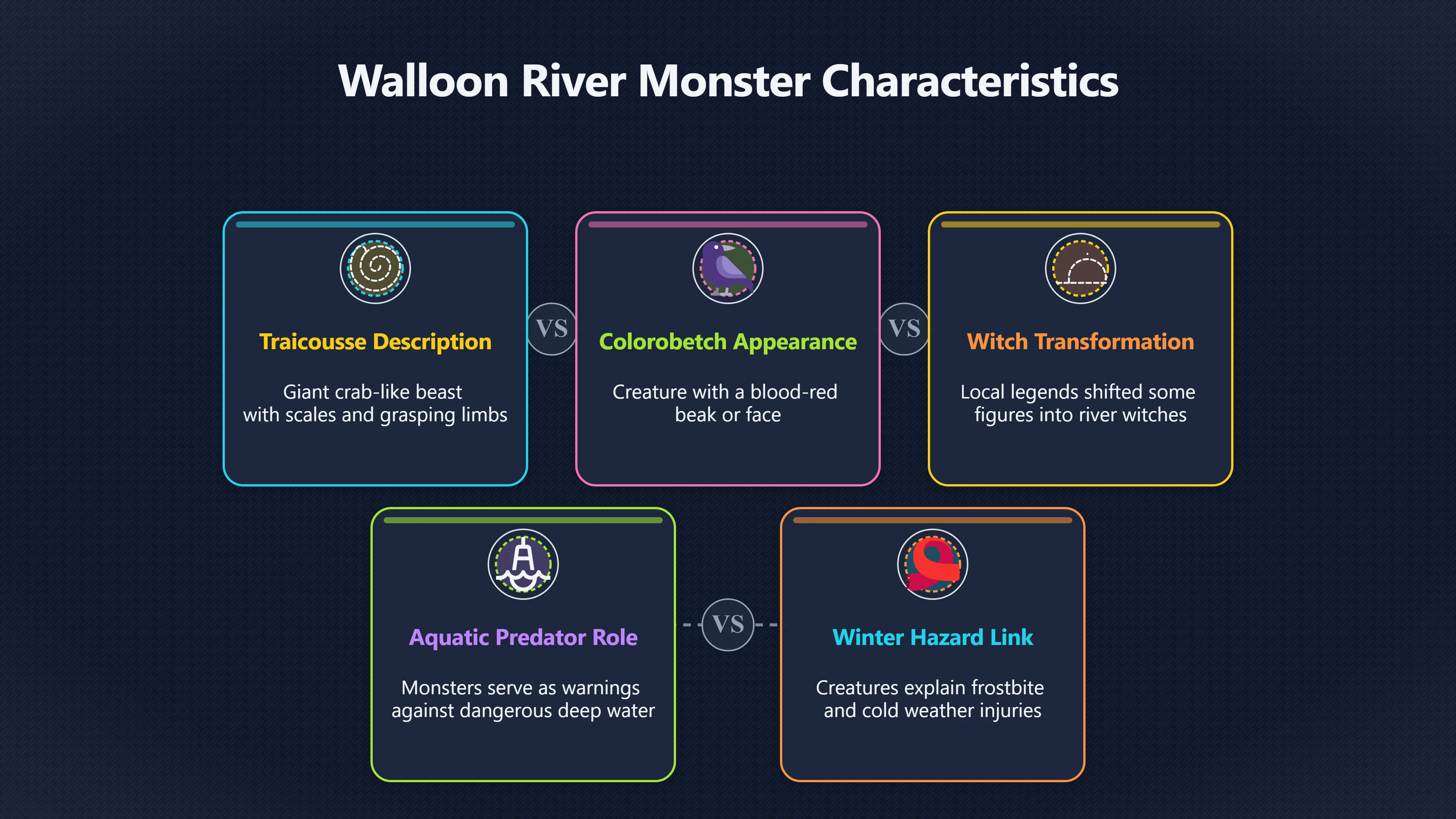
The best-known Walloon river bogey is the Traicousse, sometimes called Trécouche. Tradition places it in the waterways of the south-western Ardennes and especially around the Semois valley, including the area near Bohan on the Belgian side of the border. According to folklore, it lurks in rivers, ponds and quiet stretches of water, waiting for careless victims.[A Book of Creatures]abookofcreatures.comSource details in endnotes.
Descriptions vary, but the creature is usually portrayed as a monstrous aquatic predator. Some accounts depict a giant crab-like beast covered in scales, armed with numerous grasping limbs and a huge mouth. Other local traditions gradually transformed it into a witch-like river figure. The details changed from village to village, but the role remained remarkably consistent: it was the thing that dragged children into dangerous water.[A Book of Creatures]abookofcreatures.comSource details in endnotes.
What makes the Traicousse interesting is that it is attached to a real landscape. The Semois winds through steep valleys and wooded terrain that can appear mysterious even today. The river has long been one of the defining features of the Ardennes region, and folklore naturally accumulated around it.[destinationwallonia.be]destinationwallonia.beOpen source on destinationwallonia.be.
From a modern perspective, there is no evidence that the Traicousse was ever based on an unknown animal. It functions much more convincingly as a river-warning legend. The monster explains drownings, discourages risky behaviour and turns a natural hazard into a memorable story.[A Book of Creatures]abookofcreatures.comSource details in endnotes.

Colorobetch, Frostbite and the Meuse
Another notable Walloon bogey is Colorobetch, a figure that links winter dangers and river dangers in a single legend. In many versions, Colorobetch is associated with cold weather. The creature attacks poorly protected children, pinching exposed skin until faces and hands become red, cracked and bleeding—a folkloric explanation for frostbite and cold injury.[A Book of Creatures]abookofcreatures.comSource details in endnotes.
The image is striking. Accounts describe a being with a blood-red beak or face, though storytellers disagreed about whether it was a bird, a human or something in between. What matters is not biological consistency but symbolic power. Children who forgot scarves, gloves or hats risked a visit from Colorobetch.[A Book of Creatures]abookofcreatures.comSource details in endnotes.
In the town of Andenne, however, the creature acquired a second role. There it became a water bogey associated with the Meuse, dragging children into the river. This shift is revealing. The same legendary figure could be adapted to address whatever danger worried a community most: winter cold in one place, dangerous water in another.[A Book of Creatures]abookofcreatures.comSource details in endnotes.
Colorobetch therefore shows how flexible Walloon folklore could be. A single monster could explain frostbite, enforce sensible behaviour and reinforce respect for the river at the same time.[A Book of Creatures]abookofcreatures.comSource details in endnotes.
How Local Hazards Become Monster Stories
The most useful way to understand Walloon water bogeys is not as hidden animals but as storytelling mechanisms.
Several recurring patterns appear:
- Deep water becomes a creature. Rivers and ponds are given a lurking inhabitant that punishes recklessness.
- Environmental dangers become personalised. Frostbite, drowning and exposure are transformed into deliberate attacks by a monster.
- Local geography shapes the legend. The creature belongs to a particular valley, river bend or settlement rather than to Belgium as a whole.
- The story changes while the function stays the same. A monster may become a witch, a bird-like being or a giant aquatic beast, yet still serve as a warning.[A Book of Creatures]abookofcreatures.comSource details in endnotes.
This process helps explain why so many Ardennes legends are connected to rivers, caves, unusual rocks and dramatic landscapes. Folklore researchers studying the wider Ardennes tradition note that striking geological and natural features frequently acquire myths and supernatural narratives. The landscape itself encourages storytelling.[HAL]hal.sciencehal 03170554Source details in endnotes.
Folklore, Cryptids and the Thin Line Between Them
Readers interested in cryptids sometimes encounter creatures such as the Traicousse and wonder whether they belong in the same category as lake monsters or mystery beasts. The answer depends on how the term is used.
Walloon water bogeys are usually remembered as folklore first and cryptids second. There are no substantial modern sighting waves, no physical evidence and no serious zoological proposals explaining them as unknown species. Instead, they survive through oral tradition, local histories and regional folklore collections.[A Book of Creatures]abookofcreatures.comSource details in endnotes.
Yet they remain important to Belgium’s monster tradition because they reveal how communities interacted with their environment. The Traicousse and Colorobetch are not merely scary stories; they are cultural maps of risk. They show where the water was feared, where winter could be dangerous, and how generations of Walloons taught those lessons before modern safety campaigns existed.[A Book of Creatures]abookofcreatures.comSource details in endnotes.
In that sense, the enduring mystery is not whether these creatures existed, but why people found them so useful. The answer lies in the rivers themselves. The Semois, the Meuse and the waterways of the Ardennes were powerful enough to shape daily life, and powerful enough to create monsters that are still remembered today.[wikipedia.org]WikipediaOpen source on wikipedia.org.
Amazon book picks
Further Reading
Books and field guides related to Why Do Belgium's Rivers Have So Many Bogeys?. Use these as the next step if you want deeper reading beyond the article.
The Element Encyclopedia of Magical Creatures
Includes river spirits, bogeys, and water creatures.
eBay marketplace picks
Marketplace Samples
Live-tested eBay searches with available results related to this page.

Endnotes
1.
Source: hal.science
Title: hal 03170554
Link:https://hal.science/hal-03170554
Source snippet
"HAL[https://hal.science/hal-03170554..."](https://hal.science/hal-03170554...")...
2.
Source: Wikipedia
Link:https://en.wikipedia.org/wiki/Semois
3.
Source: Wikipedia
Link:https://fr.wikipedia.org/wiki/Folklore_belge
4.
Source: abookofcreatures.com
Link:https://abookofcreatures.com/2016/02/08/traicousse/
Source snippet
"A Book of Creatures[https://abookofcreatures.com/2016/02/08/traicousse/..."](https://abookofcreatures.com/2016/02/08/traicousse/...")...
5.
Source: abookofcreatures.com
Link:https://abookofcreatures.com/2016/03/21/colorobetch/
Source snippet
"A Book of Creatures[https://abookofcreatures.com/2016/03/21/colorobetch/..."](https://abookofcreatures.com/2016/03/21/colorobetch/...")...
6.
Source: tourisme-valleesetplateaudardenne.com
Link:https://www.tourisme-valleesetplateaudardenne.com/en/discover/destination-legends
7.
Source: abookofcreatures.com
Link:https://abookofcreatures.com/category/belgium/
8.
Source: destinationwallonia.be
Link:https://www.destinationwallonia.be/en/de-semois-vallei
9.
Source: visitwallonia.com
Link:https://visitwallonia.com/en-gb/content/discover-forest-massif-semois-and-houille
Additional References
10.
Source: youtube.com
Title: Exploring Antwerp’s Grote Markt | Legends of Brabo & [Lange Wapper]({{ ‘lange-wapper/’ | relative_url }})
Link:http://www.youtube.com/watch?v=q8eqntqcB_g
Source snippet
What Is The Legend Of Lange Wapper And Het Steen? - Exploring The Benelux...
11.
Source: youtube.com
Title: What Is The Legend Of Lange Wapper And Het Steen?
Link:http://www.youtube.com/watch?v=mV4zXrpnHxo
Source snippet
Exploring The Benelux: Folklore Tales in Luxembourg...
12.
Source: youtube.com
Title: Are There Traditional Fairy Tales In Luxembourg?
Link:http://www.youtube.com/watch?v=IHFuJOVoMA0
Source snippet
Belgian folklore "water spirit" [Kludde]({{ 'kludde/' | relative_url }}) - De Horla (Full Album) ThePsyfrost...
13.
Source: youtube.com
Title: Exploring The Benelux: Folklore Tales in Luxembourg
Link:http://www.youtube.com/watch?v=G0rB32cf5a0
Source snippet
Are There Traditional Fairy Tales In Luxembourg?...
14.
Source: youtube.com
Title: What is the Kludde?
Link:http://www.youtube.com/watch?v=LuJofyYBukU
Source snippet
Exploring Antwerp’s Grote Markt | Legends of Brabo & Lange Wapper...
15.
Source: biblio.ugent.be
Link:https://biblio.ugent.be/publication/8731246
Source snippet
"Biblio[https://biblio.ugent.be/publication/8731246..."](https://biblio.ugent.be/publication/8731246...")...
Topic Tree