Cryptids of Cuba's Waters
Cuba’s mystery-creature tradition is not dominated by one modern monster in the way Scotland has Loch Ness or Puerto Rico has the chupacabra. Its strongest “cryptid” material sits at the meeting point of rural folklore, water-haunting beings, oversized real animals, and island ecology.
Page outline Jump by section
Why Cuba’s monster lore is mostly water lore
The most repeated Cuban creature stories are not about an ape-man in the mountains or a lake monster photographed by tourists. They are about pools, rivers, springs, wetlands and lonely paths near water. That pattern matters. Cuban folklore preserves a strong association between hidden water and hidden beings: the güije lives around rivers and ponds, while the Madre de aguas is imagined as a huge serpent connected with bodies of water that do not dry up.[Wikipedia]WikipediaOpen source on wikipedia.org.
This emphasis also fits Cuba’s physical setting. The island contains coastal wetlands, mangroves, mountains, caves, rivers, freshwater marshes and semi-enclosed bays. The Convention on Biological Diversity profile for Cuba describes 42 ecosystem types and 23 landscape types, with mangroves covering a large share of forested surface and coasts. A landscape like that creates many “edge” spaces: dark pools, cane fields, forest streams, marsh margins and caves where animals are glimpsed briefly and stories can grow around them.[Convention on Biological Diversity]cbd.intConvention on Biological Diversity Main DetailsConvention on Biological Diversity Main Details
There is also a cultural reason. Cuban scholar Jesús Guanche Pérez argued that Cuban popular mythical beings should be read through the island’s mixed historical formation: Indigenous, Spanish, African and later Asian influences, combined through oral transmission and local practice. In that frame, Cuban monsters are not isolated curiosities. They are part of a wider process in which older beliefs were reshaped into national and regional folklore.[LaCult]lacult.unesco.orgLa Cult58-66-etnicidad-cubana-y-seres.cdrLa Cult58-66-etnicidad-cubana-y-seres.cdr
The güije: Cuba’s best-known little water being
The güije, also called jigüe or chichiricú in some accounts, is probably Cuba’s most recognisable folkloric creature. It is usually described as small, elusive and connected to rivers, pools or secluded water. Some descriptions make it playful or mischievous; others make it frightening, malicious or dangerous to travellers. The details vary, but the core image is consistent: a small being of the water and the bush, seen or feared at night, hard to catch, and deeply embedded in rural storytelling.[Wikipedia]WikipediaOpen source on wikipedia.org.
A Cuban cultural report from Camagüey calls the güije the best-known and most widespread myth in the country, adding that it is often understood as having Indigenous roots later transformed by African influence. The same source notes its afterlife in Cuban arts, including poetry, comics, film, television, ballet and music. That matters for a cryptid-style page because the güije is not just a “sighting claim”; it is a cultural character that has moved from oral tale to national image.[Adelante.cu]adelante.cuArtesanos preparan Fiesta del Güije en CamagüeyArtesanos preparan Fiesta del Güije en Camagüey
For readers asking whether the güije is treated like a real animal, the answer is mostly no. It is closer to a goblin, water spirit or folkloric little person than to a zoological mystery. Yet the setting of the stories is very creature-like: pools, muddy banks, hidden streams and night-time encounters. In some local versions, the güije becomes a warning about wandering near dangerous water, mistreating nature, or entering wild places without respect.[Wikipedia]WikipediaOpen source on wikipedia.org.
The Madre de aguas: giant snake, water guardian and possible boa memory
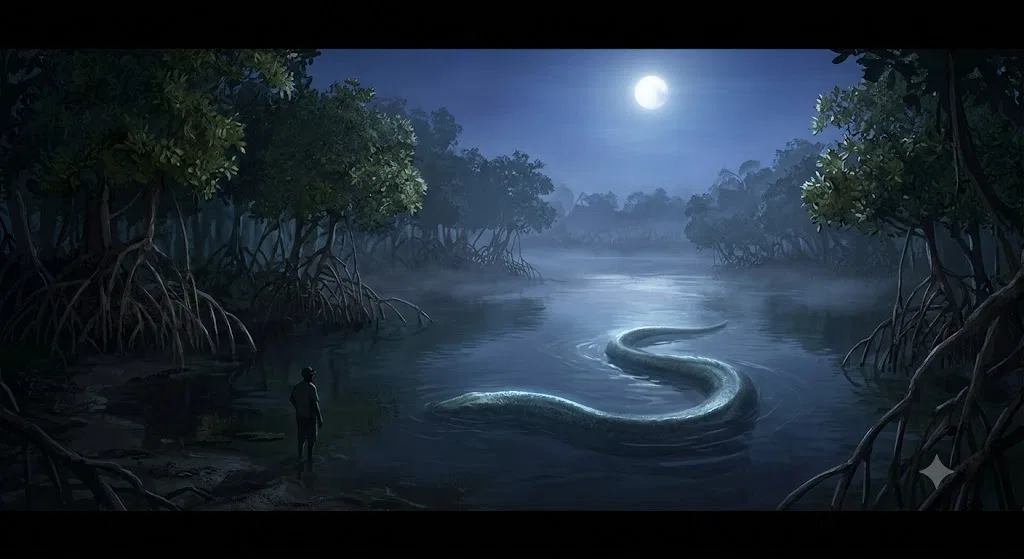
The Madre de aguas is the most cryptid-like figure in Cuban folklore because it looks, at least at first glance, like an exaggerated animal. The usual description is a vast water serpent, often linked with the Cuban boa or “majá”, but enlarged into something almost invulnerable: thick as a palm trunk, sometimes horned, with heavy scales and a supernatural connection to springs, rivers or pools. Some versions say the water where it lives will not dry up; others say attempts to kill or capture it bring death.[Wikipedia]WikipediaMadre de aguasMadre de aguas
That legend has an obvious natural anchor. Cuba really does have a large native boa, Chilabothrus angulifer, also known locally as the majá de Santa María. Modern zoological work describes the Cuban boa as a top terrestrial predator and an opportunistic generalist that can eat native animals, birds, mammals and, in human-altered settings, domestic animals. That is the kind of animal that can become legendary in rural memory, especially when seen near farms, caves, trees or water margins.[journals.ku.edu]journals.ku.eduTrophic Ecology of the Cuban Boa, Chilabothrus angulifer (Boidae) | Reptiles & Amphibians…
The Madre de aguas should not be reduced to “just a big snake”, though. Folklore gives it powers a real boa does not have: immortality, bulletproof scales, control over water, fatal consequences for hunters, and a protective role over ponds or springs. The better reading is that the legend combines real snake ecology with mythic water guardianship. The Cuban boa helps explain why a giant-serpent story feels locally plausible; the supernatural details show that the Madre de aguas belongs to folklore, not ordinary zoology.[Wikipedia]WikipediaMadre de aguasMadre de aguas
The cagüeiro: the shapeshifter at the edge of cryptid territory
The cagüeiro is not a cryptid in the strict “unknown animal” sense, but it belongs on a Cuban monster page because it blurs human, animal and outlaw folklore. In accounts linked to Samuel Feijóo’s work on Cuban mythology, the cagüeiro is a figure from eastern Cuba who can transform into animals such as a pig, goat, cow, rabbit or bird, and in some versions even into an inanimate object such as a fallen tree trunk.[La Otra Raíz]laotraraiz.cuLa Otra Raíz Cagüeiro: Decoding the Myth – The Other RootLa Otra Raíz Cagüeiro: Decoding the Myth – The Other Root
This is a different kind of mystery-beast tradition from the güije or Madre de aguas. The cagüeiro is less about a hidden species and more about rural fear, trickery and escape. He is described as someone who violates social rules, steals or deceives, then uses transformation to avoid capture. In other words, the animal form is not the creature’s true body; it is a disguise.[La Otra Raíz]laotraraiz.cuLa Otra Raíz Cagüeiro: Decoding the Myth – The Other RootLa Otra Raíz Cagüeiro: Decoding the Myth – The Other Root
For a sceptical reader, the cagüeiro shows how easily “animal sightings” can sit inside social storytelling. A strange goat on the road, a bird that appears at the wrong moment, a shadow in the bush, or a tree trunk mistaken in poor light can become part of a human-centred legend. The cagüeiro is therefore useful not because it suggests an undiscovered animal, but because it shows how Cuban rural lore turns ordinary animals into signs of secrecy, danger and cleverness.[Tiboko]tiboko.comMitos y leyendas cubanas la décima escrita (2</span>Mitos y leyendas cubanas la décima escrita (2</span>
What real Cuban animals may have fed the legends?
Cuba’s wildlife is unusual enough that some “monster” impressions do not need a monster. The country has high endemism: roughly half of plant species and 42% of animal species are found only in Cuba, and the island is described as a major centre of evolution and speciation in the Antilles. That makes Cuba a place where ordinary biodiversity can feel extraordinary, especially to outsiders or to people encountering rare animals briefly.[Convention on Biological Diversity]cbd.intConvention on Biological Diversity Main DetailsConvention on Biological Diversity Main Details
The most obvious candidate behind giant-snake lore is the Cuban boa. It is large, powerful, long-lived, active in different habitats and historically involved in conflict with rural people because it sometimes takes domestic animals. A 2020 study of Cuban boa diet identified 49 prey species from 351 prey items and found a marked shift between natural habitats and human-altered ones, where boas more often consumed livestock, pets and animals associated with people.[journals.ku.edu]journals.ku.eduTrophic Ecology of the Cuban Boa, Chilabothrus angulifer (Boidae) | Reptiles & Amphibians…
Another real animal that can seem almost folkloric is the Cuban solenodon. It is a rare, nocturnal, shrew-like mammal found in Cuba, with toxic saliva used to subdue prey. The IUCN Small Mammal Specialist Group describes it as evolutionarily ancient, very rare, limited today to eastern Cuba, and at times even considered extinct before later captures confirmed survival. A night-time glimpse of such an animal would not explain the güije directly, but it shows why Cuba’s forests can produce believable “what was that?” encounters.[small-mammals.org]small-mammals.orgCuban Solenodon – Small Mammals SGCuban Solenodon – Small Mammals SG
Crocodiles also matter, especially for water fear. The Cuban crocodile is a real, critically endangered species historically associated with Cuban freshwater marshes, especially the Zapata region. Although it is not usually framed as a Cuban cryptid, any country with large reptiles in wetlands has a ready-made ecological background for stories about dangerous water, disappearing animals and haunted marsh edges.[IUCN CSG]iucncsg.orgOpen source on iucncsg.org.
Chupacabra in Cuba: imported panic more than native tradition
The chupacabra is now part of popular Latin American monster culture, so it sometimes appears in Cuban-themed lists of scary creatures. But it is not Cuba’s strongest native mystery-animal tradition. The modern chupacabra story began in Puerto Rico in the mid-1990s, then spread through media, migration, jokes, sensational reports and internet retellings across Latin America and the United States.[National Geographic]nationalgeographic.com101028 chupacabra evolution halloween science monsters chupacabras picture101028 chupacabra evolution halloween science monsters chupacabras picture
That spread matters because Cuba shares the Caribbean media and cultural space in which the chupacabra became famous. But the evidence trail is much stronger for Puerto Rico, Mexico, the US Southwest and other heavily reported regions than for Cuba as an independent centre of chupacabra sightings. In Cuban material, the name often appears as a borrowed symbol, joke or general monster label rather than as a well-documented local flap with physical evidence.[Cubanet]cubanet.orgfidel es peor que el chupacabrasfidel es peor que el chupacabras
Sceptical explanations for chupacabra reports elsewhere are useful when reading any Cuban claim too. Texas A&M AgriLife explains that many common chupacabra descriptions match canids with severe mange: fur loss, thickened skin, gaunt bodies, exposed ridges and desperate behaviour near human settlements. That does not prove every rumour has the same cause, but it gives a strong ordinary explanation for “hairless monster” reports in livestock country.[AgriLife Today]agrilifetoday.tamu.eduAgri Life Today From spooky lore to science fact: Unmasking the ‘chupacabra’Agri Life Today From spooky lore to science fact: Unmasking the ‘chupacabra’
Why Cuba has fewer famous “cryptid cases” than some neighbours
Cuba has rich monster folklore, but comparatively few internationally famous cryptid cases with dates, named witnesses, photographs, newspaper trails and repeated modern investigations. That does not mean the island lacks strange stories. It means the stories that endured most strongly are traditional and regional rather than evidence-driven in the modern cryptozoological style. Feijóo’s Mitología cubana, originally published in the 1980s and later catalogued in a 1996 edition, is a folklore landmark rather than a casebook of zoological claims.[Internet Archive]archive.orgOpen source on archive.org.
There are also practical reasons. A modern cryptid flap often needs an active press cycle, easy circulation of witness claims, tourism marketing, amateur investigation and repeatable access to the alleged site. Cuban monster lore has often circulated through oral tradition, literature, cultural journalism and local memory instead. That makes it culturally deep but harder to turn into the kind of neat “case file” readers may expect from Bigfoot, Nessie or the Jersey Devil.[LaCult]lacult.unesco.orgLa Cult58-66-etnicidad-cubana-y-seres.cdrLa Cult58-66-etnicidad-cubana-y-seres.cdr
The result is a different kind of page. Cuba’s mystery-beast tradition is best approached as folklore with animal anchors: water beings shaped by Indigenous, African and rural influences; giant-serpent tales made plausible by real boas; shapeshifting legends that turn farm animals into signs of hidden human behaviour; and occasional imported monsters such as the chupacabra.[La Otra Raíz]laotraraiz.cuLa Otra Raíz Cagüeiro: Decoding the Myth – The Other RootLa Otra Raíz Cagüeiro: Decoding the Myth – The Other Root
How to read Cuban cryptid claims fairly
The most useful approach is to separate four layers that often get mixed together. First, there are true folklore beings, such as the güije, whose importance lies in story, identity and place rather than biological evidence. Second, there are legendary animals, especially the Madre de aguas, where a real species may have helped shape a supernatural image. Third, there are misidentification candidates: boas, crocodiles, solenodons, feral dogs, cats, mongooses, large fish, birds or animals seen briefly in poor light. Fourth, there are modern media imports, especially the chupacabra, which may attach to Cuba without beginning there.[wikipedia.org]WikipediaOpen source on wikipedia.org.
This does not make the stories less interesting. It makes them more legible. A güije tale tells us about fear of secluded water, children’s warnings, rural imagination and Cuban cultural memory. A Madre de aguas story tells us how a real island snake can become a guardian of springs and a symbol of untouchable nature. A cagüeiro story tells us how animal transformation can encode social suspicion, outlaw behaviour and survival in the countryside.[La Otra Raíz]laotraraiz.cuLa Otra Raíz Cagüeiro: Decoding the Myth – The Other RootLa Otra Raíz Cagüeiro: Decoding the Myth – The Other Root
The fairest conclusion is that Cuba’s “cryptids” are strongest as folklore, not as unresolved zoology. There is no strong mainstream evidence for an unknown Cuban monster species behind the major legends. But there is excellent evidence that Cuba’s landscapes, animals and mixed cultural history have produced a distinctive monster tradition: watery, rural, morally charged and often closer to a whispered warning than a tourist attraction.
Amazon book picks
Further Reading
Books and field guides related to What Monsters Haunt Cuba's Waters?. Use these as the next step if you want deeper reading beyond the article.
Monsters of the Gévaudan
Explores how monster legends emerge from real landscapes, animals and folklore.
Abominable Science!
Helps explain how folklore, sightings and real animals become monster stories.
The Book of Imaginary Beings
Covers legendary creatures and the cultural role of monsters.
Encyclopedia of Things that Never Were
Surveys legendary creatures from many traditions.
eBay marketplace picks
Marketplace Samples
Live-tested eBay searches with available results related to this page.
Endnotes
1.
Source: adelante.cu
Title: Artesanos preparan Fiesta del Güije en Camagüey
Link:https://www.adelante.cu/index.php/es/cultura/28434-artesanos-preparan-fiesta-del-gueije-en-camagueey
2.
Source: Wikipedia
Link:https://en.wikipedia.org/wiki/G%C3%BCijes
3.
Source: Wikipedia
Title: Madre de aguas
Link:https://en.wikipedia.org/wiki/Madre_de_aguas
4.
Source: Wikipedia
Link:https://es.wikipedia.org/wiki/G%C3%BCije
5.
Source: Wikipedia
Title: Madre de aguas
Link:https://es.wikipedia.org/wiki/Madre_de_aguas
6.
Source: journals.ku.edu
Link:https://journals.ku.edu/reptilesandamphibians/article/view/14176
Source snippet
Trophic Ecology of the Cuban Boa, Chilabothrus angulifer (Boidae) | Reptiles & Amphibians...
7.
Source: tiboko.com
Title: Mitos y leyendas cubanas la décima escrita (2)
Link:https://tiboko.com/wp-content/uploads/2023/07/leyendas-cubanas.pdf
8.
Source: small-mammals.org
Title: Cuban Solenodon – Small Mammals SG
Link:https://small-mammals.org/portfolio/cuban-solenodon/
9.
Source: iucncsg.org
Link:https://www.iucncsg.org/365_docs/attachments/protarea/0d9d442dc3fae1c58da7c4f460cb439c.pdf
10.
Source: Wikipedia
Link:https://en.wikipedia.org/wiki/Chupacabra
11.
Source: cubanet.org
Title: fidel es peor que el chupacabras
Link:https://www.cubanet.org/fidel-es-peor-que-el-chupacabras/
12.
Source: cubanet.org
Link:https://www.cubanet.org/htdocs/CNews/y97/apr97/14o6.htm
13.
Source: archive.org
Link:https://archive.org/details/mitologacubana0000samu
14.
Source: Wikipedia
Title: Amaru (mythology)
Link:https://en.wikipedia.org/wiki/Amaru_%28mythology%29
15.
Source: Wikipedia
Title: Cuban boa
Link:https://en.wikipedia.org/wiki/Cuban_boa
16.
Source: Wikipedia
Title: Cuban crocodile
Link:https://en.wikipedia.org/wiki/Cuban_crocodile
17.
Source: Wikipedia
Title: Cuban solenodon
Link:https://en.wikipedia.org/wiki/Cuban_solenodon
18.
Source: Wikipedia
Title: Samuel Feijóo
Link:https://en.wikipedia.org/wiki/Samuel_Feij%C3%B3o
19.
Source: Wikipedia
Title: Species (film)
Link:https://en.wikipedia.org/wiki/Species_%28film%29
20.
Source: Wikipedia
Title: List of mammals of Cuba
Link:https://en.wikipedia.org/wiki/List_of_mammals_of_Cuba
21.
Source: cubanet.org
Link:https://www.cubanet.org/htdocs/CNews/y07/nov07/print/27a9p.htm
22.
Source: cubanet.org
Link:https://www.cubanet.org/tag/revolucion/page/6/
23.
Source: cubanet.org
Link:https://www.cubanet.org/la-unica-cosa-que-se-puede-hacer-en-america-latina-es-emigrar/
24.
Source: cubanet.org
Title: CRIME N / Corta Caras al acecho
Link:https://www.cubanet.org/htdocs/CNews/y06/mar06/07a7.htm
25.
Source: small-mammals.org
Title: saving the cuban solenodon
Link:https://small-mammals.org/2021/08/04/saving-the-cuban-solenodon/
26.
Source: laotraraiz.cu
Title: La Otra Raíz Cagüeiro: Decoding the Myth – The Other Root
Link:https://www.laotraraiz.cu/en/cagueiro-decoding-the-myth/
27.
Source: cbd.int
Title: Convention on Biological Diversity Main Details
Link:https://www.cbd.int/countries/profile/?country=cu
28.
Source: lacult.unesco.org
Title: La Cult58-66-etnicidad-cubana-y-seres.cdr
Link:https://www.lacult.unesco.org/docc/oralidad_04_58-66-etnicidad-cubana-y-seres.pdf
29.
Source: nationalgeographic.com
Title: 101028 chupacabra evolution halloween science monsters chupacabras picture
Link:https://www.nationalgeographic.com/culture/article/101028-chupacabra-evolution-halloween-science-monsters-chupacabras-picture
30.
Source: agrilifetoday.tamu.edu
Title: Agri Life Today From spooky lore to science fact: Unmasking the ‘chupacabra’
Link:https://agrilifetoday.tamu.edu/2024/10/15/unmasking-the-chupacabra/
31.
Source: cryptidarchives.fandom.com
Link:https://cryptidarchives.fandom.com/wiki/G%C3%BCije
32.
Source: facebook.com
Title: national geographicfeeding on fear and fascination in equal measure the chupacab
Link:https://www.facebook.com/GoodWolfPAC/posts/national-geographicfeeding-on-fear-and-fascination-in-equal-measure-the-chupacab/1254586806699695/
33.
Source: iucnredlist.org
Link:https://www.iucnredlist.org/search/details.php/5670/all
34.
Source: books.google.com
Title: Mitología cubana
Link:https://books.google.com/books/about/Mitolog%C3%ADa_cubana.html?id=lu-AAAAAMAAJ
35.
Source: iucncsg.org
Link:https://www.iucncsg.org/365_docs/attachments/protarea/19_C-bc83b749.pdf
36.
Source: laotraraiz.cu
Title: Cagüeiro: decodificación del mito
Link:https://www.laotraraiz.cu/cagueiro-decodificacion-del-mito/
37.
Source: mammalwatching.com
Link:https://www.mammalwatching.com/gd_place/cuba/
38.
Source: brettpoza.com
Link:https://www.brettpoza.com/cuba.html
39.
Source: ecos.fws.gov
Link:https://ecos.fws.gov/ecp/species/157
40.
Source: animalia.bio
Title: Chilabothrus angulifer
Link:https://animalia.bio/chilabothrus-angulifer
41.
Source: animalia.bio
Title: Cuban Solenodon
Link:https://animalia.bio/cuban-solenodon?property=2
42.
Source: selwo.es
Link:https://www.selwo.es/en/especies-y-territorios/animales/boa-cubana
43.
Source: mountainbiodiversity.org
Title: Cuban solenodon
Link:https://mountainbiodiversity.org/species/1385
Additional References
44.
Source: youtube.com
Title: Mitología Cubana: Dioses, Espíritus y Criaturas Mágicas del Caribe
Link:https://www.youtube.com/watch?v=aYNqHPCQQso
Source snippet
El Cagüeiro: El Ladrón Cubano que se Transforma en Animal para Robar...
45.
Source: youtube.com
Title: Mitología Cubana: Los Güijes
Link:https://www.youtube.com/watch?v=MvlrQjZI27c
Source snippet
El Cagüeiro: El Ladrón Cubano que se Transforma en Animal para Robar | Mito y Realidad 🐷🐦 VITPlanet · 171 views...
46.
Source: youtube.com
Title: Madre de Aguas of Cuba | Full Audiobook
Link:https://www.youtube.com/watch?v=nYppaYIsI1c
Source snippet
Mitología Cubana: Dioses, Espíritus y Criaturas Mágicas del Caribe...
47.
Source: instagram.com
Link:https://www.instagram.com/p/CzE1lvLNqLZ/?hl=en
48.
Source: researchgate.net
Link:https://www.researchgate.net/publication/319213521_Biodiversity_and_conservation_of_Cuban_mammals_past_present_and_invasive_species
49.
Source: academia.edu
Link:https://www.academia.edu/49481120/Mitolog%C3%ADa_Cubana_por_Samuel_Feij%C3%B3o
50.
Source: dimecuba.com
Link:https://www.dimecuba.com/revista/cubanos/seres-de-mitologia-cubana/
51.
Source: ascecubadatabase.org
Link:https://www.ascecubadatabase.org/wp-content/uploads/2014/09/v10-ross.pdf
52.
Source: facebook.com
Link:https://www.facebook.com/grupoajau/posts/el-cag%C3%BCeirocarlos-evia-cervanteslos-mitos-de-los-hombres-que-se-transforman-en-a/2496212830510656/
53.
Source: facebook.com
Link:https://www.facebook.com/NationalTrustCaymanIslands/posts/bats-are-generally-considered-the-only-land-mammal-of-the-cayman-islands-however/4604961306181021/
Topic Tree
Follow this branch
Related pages 192
- Antigua Cryptids
- Maldives Monsters
- Malta Monsters
- Qatar Monsters
- Argentina Monsters
- +187 more in sidebar