Cryptids of Rwanda's Forests and Lakes
Rwanda does not have a single, well-documented national cryptid comparable to Scotland’s Loch Ness Monster or the Congo Basin’s dinosaur-like legends.
Page outline Jump by section
Introduction
That scarcity is itself important. Rwanda’s best-known “monsters” are often not claims about undiscovered zoological species at all. They are snake-like water spirits, dangerous lake beings, landscape-shaping giants or cautionary figures whose meaning lies in weather, fertility, floods and human conduct. Meanwhile, Rwanda’s real wildlife — gorillas in misty mountain forest, elusive leopards and recently restored lion populations — supplies more than enough raw material for mistaken glimpses and embellished memories.[newlinesmag.com]newlinesmag.comNew Lines Magazine The Promise and Threat of Lake KivuNew Lines MagazineThe Promise and Threat of Lake KivuNovember 11, 2024 — 11 Nov 2024 — Legends tell of a mysterious mermaid goddess purpo…
The ikimizi: Rwanda’s mystery spotted cat
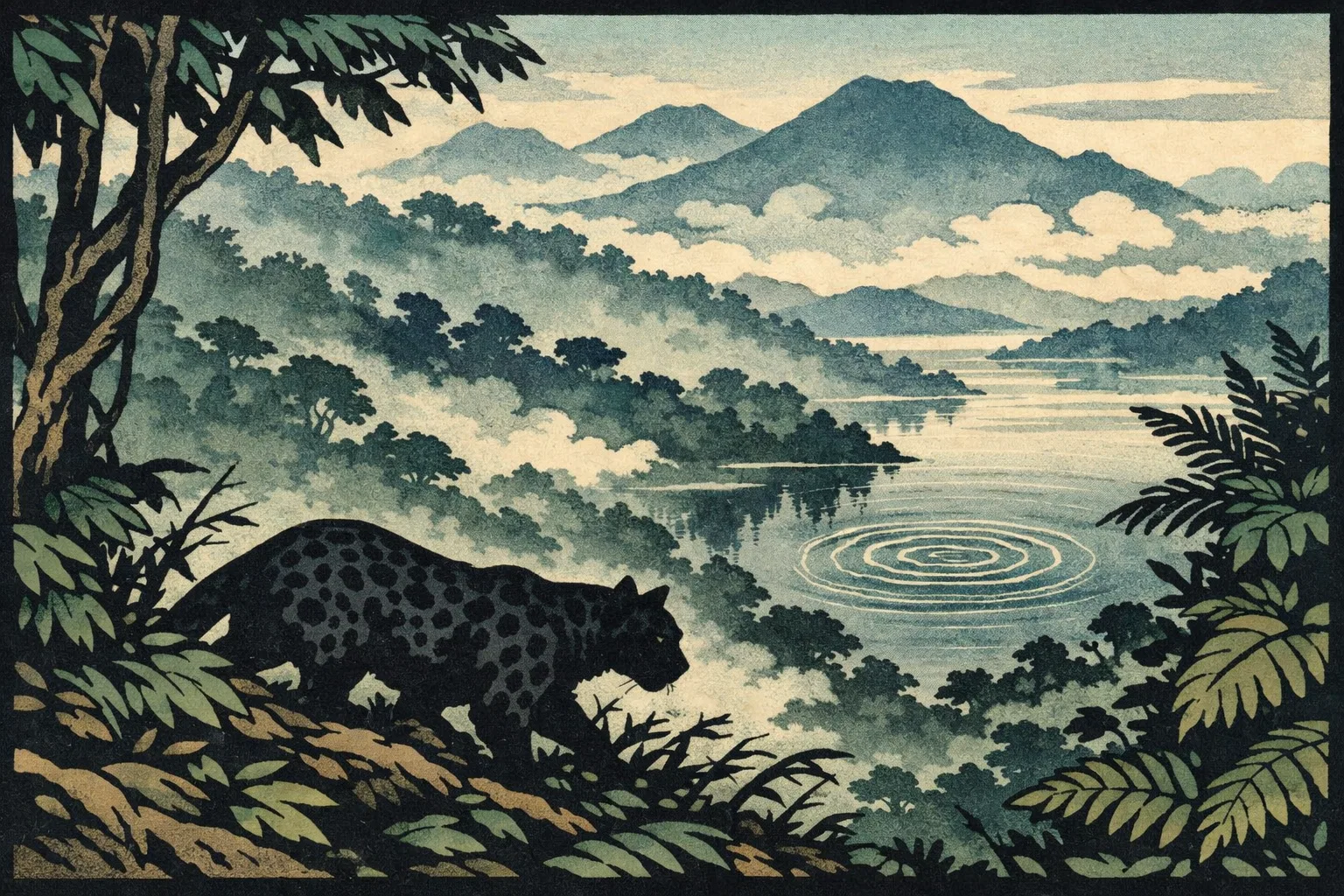
The creature most often listed as a specifically Rwandan cryptid is the ikimizi, described in modern cryptozoological catalogues as a large greyish cat with dark spots and sometimes a beard beneath its chin. It is usually placed in the forested mountains of north-western Rwanda, around the Virunga or formerly “Mufumbiro” volcanoes. Accounts portray it as intermediate in appearance between a lion and a leopard: larger or heavier than a leopard, but more spotted and less fully maned than a typical adult male lion.[fandom.com]cryptidarchives.fandom.comCryptid Archives IkimiziCryptid ArchivesIkimizi - Encyclopaedia of Cryptozoology - FandomThe ikimizi is a forest lion reported from Rwanda's remote Virguna Volca…
The problem is that nearly every readily traceable description repeats the same short formula. There is no accessible series of named Rwandan witnesses, no firmly dated local sighting file and no specimen reliably collected in Rwanda. Even the spelling and meaning of the name are poorly documented in the cryptozoological literature. The ikimizi therefore looks less like a well-established local sighting tradition and more like a Rwandan branch of the wider East African spotted-lion story.
That wider story is better known under the Kenyan name marozi. In the early twentieth century, hunters and officials reported unusually spotted, lightly maned lions in Kenya’s highlands. Two skins from animals shot in the Aberdare region attracted particular interest, and Kenneth Gandar Dower led an unsuccessful expedition in the 1930s to seek further evidence. Later writers extended the supposed animal’s range by listing different regional names, including ikimizi in Rwanda and another name in Uganda.[wikipedia.org]WikipediaOpen source on wikipedia.org.
This creates a major source problem. Evidence from Kenya cannot automatically prove that the same animal was known or seen in Rwanda. The name may preserve a genuine local category for an unusual cat, but the online record does not show how the term was collected, who supplied it or whether it originally referred to a lion, leopard, hybrid, malformed animal or something else entirely.
Was it an unknown lion, a hybrid or an ordinary animal?
Several explanations have been proposed for spotted-lion reports. None requires a new species.
Adult lions retaining juvenile markings are the simplest possibility. Lion cubs naturally carry spots or rosettes, and these can remain visible in some young adults. Zoologist Charles Albert Walter Guggisberg argued that the celebrated Kenyan skins did not demonstrate a distinct kind of lion, noting that young East African lions could retain conspicuous patterning longer than casual observers expected. Other twentieth-century commentators likewise favoured ordinary lions with unusually persistent cub markings.[Wikipedia]WikipediaOpen source on wikipedia.org.
A lion seen in poor conditions could also appear stranger than it was. A young male with a thin mane, viewed through rain, mist or dense vegetation, might resemble a large spotted cat of uncertain type. The Virunga landscape is particularly good at producing incomplete sightings: steep slopes, bamboo, cloud forest and rapidly changing visibility restrict how much of an animal can be seen at once.
A leopard is another credible source of confusion. Leopards are naturally spotted, secretive and capable of looking remarkably heavy when seen briefly. Size estimates made without a reliable object for comparison are notoriously uncertain. A leopard partly concealed by vegetation could be remembered as unusually large, shaggy or lion-like.
The frequently repeated suggestion of a wild lion–leopard hybrid is much weaker. Big cats can hybridise in captivity under artificial conditions, but an extraordinary hybrid claim in the wild would require strong evidence: a carcass, DNA, a skull, clear photographs or at least a consistent series of independently documented observations. None has emerged from Rwanda.
Ecology raises a further difficulty. Rwanda’s surviving lions are associated with the savannah and wetlands of Akagera National Park in the east, not the high volcanic forest in the north-west. Lions disappeared from Rwanda in the 1990s and were reintroduced to Akagera in 2015 after an absence of roughly two decades. The restoration programme brought seven animals from South Africa, followed by further conservation management and breeding.[African Parks]africanparks.orgafrican parks translocate reintroduce lions into akagera national park rwandaafrican parks translocate reintroduce lions into akagera national park rwanda
That does not prove that lions never entered Rwanda’s north-western mountains historically. It does, however, make the modern image of a surviving, isolated population of spotted forest lions around the volcanoes difficult to sustain without physical or camera-trap evidence.

Why the Virunga forests encourage monster stories
The reported home of the ikimizi is already one of the world’s most evocative wildlife landscapes. Volcanoes National Park contains mountain gorillas and rare golden monkeys amid thick, wet forest and steep volcanic terrain. Rwanda’s official tourism material describes gorilla tracking through dense rainforest alive with bird calls and fast-moving primates.[Visit Rwanda]visitrwanda.comOpen source on visitrwanda.com.
These animals are not cryptids, but they help explain why vague “ape-man” or forest-beast rumours from the region should be treated cautiously. A gorilla encountered unexpectedly — especially before gorilla behaviour and distribution were widely understood outside Central Africa — could readily inspire an account of a giant hairy being. Golden monkeys, moving quickly through foliage, can produce flashes of colour and apparent body shapes that disappear before an observer gains a clear view.
More importantly, Rwanda is a case where the romantic language of cryptozoology can obscure a major conservation success. Mountain gorillas were once treated by outsiders as near-mythical inhabitants of inaccessible forest. They are now intensively studied, monitored and visited under controlled conditions. The transformation from frightening forest rumour to scientifically documented animal offers a useful lesson: genuine discoveries produce repeatable observations, biological material and accumulating field data. The ikimizi has not crossed that threshold.
Lake Kivu’s beings are folklore, not zoological reports
Lake Kivu is the natural setting most likely to attract a lake-monster legend. It is vast, deep, volcanic and visually mysterious, lying along Rwanda’s western border with the Democratic Republic of the Congo. Yet there is no strong, continuous record of a large unknown animal repeatedly surfacing in its waters. Instead, reports focus on supernatural women, dangerous underwater places and water spirits.
A modern journalistic account records a Lake Kivu tradition about a mermaid-like goddess who draws men towards her and into a fatal cave. The story resembles many water-being traditions in which beauty, desire and danger are combined. It should not be read as eyewitness zoology: the figure operates as a supernatural character attached to a perilous landscape rather than as an animal described through tracks, feeding behaviour or repeated physical encounters.[New Lines Magazine]newlinesmag.comNew Lines Magazine The Promise and Threat of Lake KivuNew Lines MagazineThe Promise and Threat of Lake KivuNovember 11, 2024 — 11 Nov 2024 — Legends tell of a mysterious mermaid goddess purpo…
Another developing strand of lakeside storytelling links Lake Kivu’s formation to legendary human figures. Tourism-oriented retellings preserve the story of Nyiransibura, a woman whose fate is connected with the creation of the lake during the reign of a Rwandan king. Such narratives explain why the landscape exists and encode ideas about rain, power and catastrophe. They belong to origin legend rather than cryptozoology in the narrow sense.[visitlakekivu.com]visitlakekivu.comOpen source on visitlakekivu.com.
The distinction matters because internet summaries often flatten every uncanny lake tradition into a “lake monster”. In Rwanda, the better-supported pattern is not a Nessie-style creature with a long neck and a catalogue of modern sightings. It is a body of supernatural and historical storytelling in which the lake itself is powerful, unpredictable and morally charged.
The real danger beneath Lake Kivu
Lake Kivu has a genuinely extraordinary physical feature that can make its supernatural reputation feel unsettlingly plausible. It is a meromictic lake, meaning that its deep water does not routinely mix with the upper layers. Large quantities of dissolved carbon dioxide and methane are held in its depths. Scientists monitor the lake because a major disturbance could, in principle, release gas in a dangerous event known as a limnic eruption.[Wikipedia]WikipediaLake KivuLake Kivu
This is a striking example of folklore and geology occupying the same imaginative space without one proving the other. Stories of beings or lethal places beneath the water did not scientifically predict dissolved gas. Nor does the gas prove that mermaid tales describe literal encounters. But communities living beside deep, volcanic water may experience unexplained deaths, strange smells, bubbling zones, sudden weather and hazardous currents long before the mechanisms are understood in technical terms.
Lake Kivu’s ordinary fauna also limits some familiar monster explanations. The lake supports a relatively modest fish community, including cichlids, small sardine-like fish and catfish. It is an important source of fish for Rwanda, but available ecological summaries do not indicate an overlooked population of enormous aquatic vertebrates capable of supporting a classic lake-monster hypothesis.[agl-acare.org]agl-acare.orgOpen source on agl-acare.org.
A large floating log, a group of swimming otters, waves crossing at an angle or a distant fishing boat could still produce a momentary monster-like silhouette. So far, however, Lake Kivu lacks the essential ingredients of a durable zoological case: multiple independent reports with dates and locations, photographs that withstand examination, sonar contacts, carcasses or unexplained biological samples.
Serpent spirits and dangerous waters
Rwandan and wider Banyarwanda folklore includes snake-like beings associated with rivers and lakes. Modern summaries describe them as malevolent water creatures capable of influencing droughts or floods. They are closer to spirits governing environmental forces than to oversized pythons awaiting zoological classification.[folklore.earth]folklore.earthBanyarwanda MythologyIn addition, there are the Inzoka, snake-like creatures that inhabit rivers and lakes, believed to have the power to…
Serpent imagery is common across eastern and central African water traditions because snakes move between land, vegetation and water and can appear or vanish with startling speed. Large pythons are real animals, while floods, rainbows, whirlpools and winding rivers all lend themselves to serpent comparisons. A traditional water serpent can therefore combine several layers at once:
- a memory of genuine encounters with dangerous snakes;
- an explanation for floods, droughts or drowning;
- a guardian or owner of a particular water source;
- a warning against approaching hazardous places;
- a spiritual being connected with authority, fertility or punishment.
Calling every such figure a cryptid risks stripping away most of its cultural function. A witness who claims to have seen a giant physical snake is making a zoological claim. A story in which a serpent causes drought or controls a river is operating in a different category, even when the two traditions overlap.

Giants that made the landscape
Some summaries of Rwandan mythology describe primordial giants who helped shape rivers, lakes and the surrounding land. These figures are sometimes included in online lists of “mythical creatures”, but they are not mystery animals and should not be presented as though they were reported flesh-and-blood hominids. Their role is cosmological: they explain the scale and form of the country’s mountains and waters.[Wikipedia]WikipediaFolklore in RwandaFolklore in Rwanda
Rwanda’s terrain makes such stories intuitively powerful. The country contains volcanic peaks, deep valleys, crater-like formations, dense forests and large inland waters within a relatively compact area. A tale of giant builders translates immense geological processes into human-scale action. Similar motifs occur worldwide wherever striking landforms invite stories about beings strong enough to move earth and stone.
This is also where careless cryptid writing can create false claims. Once a landscape giant is removed from its original narrative and placed in a list beside Bigfoot, readers may assume there were modern sightings of a giant hairy creature. The available evidence does not support that interpretation for Rwanda.
Why Rwanda has no major modern “monster flap”
A monster flap is a concentrated period in which many sightings, newspaper stories and investigations build upon one another. Rwanda does not appear to have a well-sourced national example. There is no documented equivalent of the 1930s Loch Ness reports, the North American Bigfoot waves or the repeated twentieth-century expeditions for the Congo Basin’s most famous alleged animals.
Several factors may explain the thin record. Much Rwandan folklore was transmitted orally, so local stories were not necessarily preserved in newspapers or colonial natural-history journals. Later political upheaval, displacement and institutional loss also disrupted the survival of local archives. At the same time, international writing about mysterious African animals tended to concentrate on larger neighbouring territories, especially the Congo Basin, Kenya and the great lakes farther east and south.
The modern tourism image of Rwanda also follows a different route. The country promotes confirmed, closely managed wildlife encounters: mountain gorillas in Volcanoes National Park, primates in Nyungwe and restored large mammals in Akagera. These animals provide a stronger attraction than an invented lake monster would. Rwanda therefore has little commercial incentive to manufacture a national cryptid when its real fauna already has global recognition.[africanparks.org]africanparks.orgAfrican ParksAboutAfrican Parks successfully reintroduced seven lions into the park in 2015, bringing the species back to Rwanda after be…
How convincing is the evidence?
The available material falls into three distinct levels.
The ikimizi is an unresolved name attached to weak zoological evidence. It may reflect a local report of an unusual lion or leopard, but the accessible record lacks primary Rwandan testimony, dates, specimens and photographs. Its close attachment to the Kenyan marozi literature suggests that later writers may have expanded a regional spotted-lion story beyond what the original evidence can support.
Lake Kivu’s mermaid and water beings are genuine folklore traditions, but not evidence for unknown animals. Their value lies in what they express about dangerous water, desire, power, memory and the formation of the landscape.
Rwanda’s known wildlife offers sufficient explanations for most hypothetical sightings. Leopards can account for large spotted cats; young or unusually marked lions can explain some historical spotted-lion reports; gorillas and monkeys explain fleeting primate-like forms in mountain forest; and ordinary lake phenomena can produce momentary serpentine shapes.
The absence of proof does not establish that every story is false, but it changes what can responsibly be said. A plausible cryptozoological case would need an original witness account with a precise location and date, corroboration independent of later books, clear imagery or biological evidence, and serious comparison with Rwanda’s known fauna. None of Rwanda’s leading mystery-creature traditions currently meets that standard.
Rwanda’s real cryptid legacy
Rwanda’s place in cryptid history is interesting precisely because it resists a simple monster-of-the-week treatment. The ikimizi is a shadow at the edge of East Africa’s spotted-lion controversy, not a securely documented national beast. Lake Kivu’s uncanny inhabitants belong mainly to folklore, while the lake’s scientifically established gas reserves provide a real and more formidable hidden danger. Serpent spirits and landscape giants reveal how stories can encode water, weather and terrain without making literal biological claims.
The country also demonstrates how yesterday’s “mysterious beast” can become today’s protected wildlife. Mountain gorillas are no longer rumours from an inaccessible forest; they are studied animals whose numbers, family groups and movements are monitored. Lions, rather than surviving secretly in remote mountains, have been openly restored to Akagera through documented conservation work. Rwanda’s strongest monster stories therefore sit not in a catalogue of undiscovered species, but at the meeting point of oral tradition, difficult terrain, unusual animals and the human habit of giving dangerous places a face.
Amazon book picks
Further Reading
Books and field guides related to What Monsters Haunt Rwanda's Forests and Lakes?. Use these as the next step if you want deeper reading beyond the article.
Gorillas in the Mist
Shows the real animals and landscapes behind many Rwandan legends.

eBay marketplace picks
Marketplace Samples
Live-tested eBay searches with available results related to this page.



Endnotes
1.
Source: folklore.earth
Link:https://www.folklore.earth/culture/banyarwanda/
Source snippet
Banyarwanda MythologyIn addition, there are the Inzoka, snake-like creatures that inhabit rivers and lakes, believed to have the power to...
2.
Source: cryptidarchives.fandom.com
Title: Cryptid Archives Ikimizi
Link:https://cryptidarchives.fandom.com/wiki/Ikimizi
Source snippet
Cryptid ArchivesIkimizi - Encyclopaedia of Cryptozoology - FandomThe ikimizi is a forest lion reported from Rwanda's remote Virguna Volca...
3.
Source: messybeast.com
Link:https://messybeast.com/genetics/anomalous-bigcats.html
Source snippet
ANOMALOUS FELIDSThe Ikimizi (Mufumbiro Volcanoes, Rwanda, Africa) is said to be a cross between a lion and a leopard, grey in colour, wit...
4.
Source: Wikipedia
Link:https://en.wikipedia.org/wiki/Marozi
5.
Source: itsmth.fandom.com
Link:https://itsmth.fandom.com/wiki/Marozi
6.
Source: visitlakekivu.com
Link:https://visitlakekivu.com/the-mystical-tale-behind-lake-kivus-formation-learn-more-about-nyiransibura/
7.
Source: Wikipedia
Title: Lake Kivu
Link:https://en.wikipedia.org/wiki/Lake_Kivu
8.
Source: agl-acare.org
Link:https://www.agl-acare.org/resources/the-african-great-lakes/lake-kivu/
9.
Source: Wikipedia
Title: Folklore in Rwanda
Link:https://en.wikipedia.org/wiki/Folklore_in_Rwanda
10.
Source: cryptidarchives.fandom.com
Title: Lake Tanganyika monster
Link:https://cryptidarchives.fandom.com/wiki/Lake_Tanganyika_monster
11.
Source: cryptidarchives.fandom.com
Title: Category:Anomalous animals
Link:https://cryptidarchives.fandom.com/wiki/Category%3AAnomalous_animals
12.
Source: cryptidarchives.fandom.com
Title: Lake Chad monster
Link:https://cryptidarchives.fandom.com/wiki/Lake_Chad_monster
13.
Source: cryptidarchives.fandom.com
Link:https://cryptidarchives.fandom.com/wiki/Lukwata
14.
Source: creatures-of-myth.fandom.com
Link:https://creatures-of-myth.fandom.com/wiki/Ikimizi
15.
Source: cryptidarchives.fandom.com
Link:https://cryptidarchives.fandom.com/wiki/Marozi
16.
Source: Wikipedia
Link:https://en.wikipedia.org/wiki/Cryptozoology
17.
Source: Wikipedia
Link:https://en.wikipedia.org/wiki/Lukwata
18.
Source: newlinesmag.com
Title: New Lines Magazine The Promise and Threat of Lake Kivu
Link:https://newlinesmag.com/reportage/the-promise-and-threat-of-lake-kivu/
Source snippet
New Lines MagazineThe Promise and Threat of Lake KivuNovember 11, 2024 — 11 Nov 2024 — Legends tell of a mysterious mermaid goddess purpo...
Published: November 11, 2024
19.
Source: africanparks.org
Link:https://www.africanparks.org/the-parks/akagera/about
Source snippet
African ParksAboutAfrican Parks successfully reintroduced seven lions into the park in 2015, bringing the species back to Rwanda after be...
20.
Source: visitrwanda.com
Link:https://visitrwanda.com/destinations/volcanoes-national-park/
Source snippet
Visit RwandaVolcanoes National ParkTracking endangered mountain gorillas through the mysterious intimacy of the rain forest, alive with t...
21.
Source: africanparks.org
Title: african parks translocate reintroduce lions into akagera national park rwanda
Link:https://www.africanparks.org/newsroom/press-releases/african-parks-translocate-reintroduce-lions-into-akagera-national-park-rwanda
22.
Source: africanparks.org
Link:https://www.africanparks.org/newsroom/press-releases/lions-return-akagera-national-park-rwanda-after-absence-more-than-15-years
23.
Source: africanparks.org
Title: biodiversity conservation
Link:https://www.africanparks.org/the-parks/akagera/biodiversity-conservation
24.
Source: visitrwanda.com
Link:https://visitrwanda.com/itineraries/gorilla-tracking/
25.
Source: visitrwanda.com
Link:https://visitrwanda.com/interests/gorilla-tracking/
26.
Source: visitrwanda.com
Title: Visit Rwanda Trio of National Parks plus Lake Kivu Day 8
Link:https://visitrwanda.com/itineraries/national-park-trio-lake-kivu/
27.
Source: visitrwanda.com
Link:https://visitrwanda.com/one-day-experiences/
28.
Source: visitrwanda.com
Link:https://visitrwanda.com/tourism/destinations/national-parks/
29.
Source: visitrwanda.com
Link:https://visitrwanda.com/
30.
Source: visitrwanda.com
Link:https://visitrwanda.com/interests/primate-tracking/
31.
Source: visitrwanda.com
Title: TOURIST PRODUCTS BOOKING GUIDELINES compressed 1
Link:https://www.visitrwanda.com/wp-content/uploads/2019/06/TOURIST-PRODUCTS-BOOKING-GUIDELINES_compressed-1.pdf
32.
Source: visitrwanda.com
Link:https://visitrwanda.com/tourism/interests/responsible-tourism/
33.
Source: africanparks.org
Title: akagera ninety years renewal and restoration
Link:https://www.africanparks.org/akagera-ninety-years-renewal-and-restoration
34.
Source: africanparks.org
Link:https://www.africanparks.org/the-parks/akagera
35.
Source: africanparks.org
Title: rhinos return rwanda after ten year absence
Link:https://www.africanparks.org/newsroom/press-releases/rhinos-return-rwanda-after-ten-year-absence
36.
Source: africanparks.org
Title: save lions
Link:https://www.africanparks.org/save-lions
37.
Source: africanparks.org
Title: 20161013 Africa Parks Akagera Fact Sheet V6
Link:https://www.africanparks.org/sites/default/files/uploads/newsroom_file_upload/2017-05/20161013_Africa_Parks_Akagera_Fact_Sheet_V6.pdf
38.
Source: africanparks.org
Title: wilderness opens new lodge akagera
Link:https://www.africanparks.org/press-release/wilderness-opens-new-lodge-akagera
39.
Source: library.eshikshya.org
Link:https://library.eshikshya.org/kiwix/content/wikipedia_en_all_maxi_2023-05/A/Marozi
Additional References
40.
Source: philippe-coudray.com
Link:https://www.philippe-coudray.com/PDF/A%20GUIDEBOOK%20TO%20HIDDEN%20ANIMALS%20WEB.pdf
Source snippet
A GUIDEBOOK TO HIDDEN ANIMALS - Philippe Coudray15 Nov 2016 — The ikimizi of the volcanoes of rwanda: a gray version of the spotted lion...
41.
Source: youtube.com
Title: This Lake Can Cause a Disaster the World Has Never Seen
Link:https://www.youtube.com/watch?v=lsJZY8NLifQ
Source snippet
Win or Die | Akagera's Deadliest Predators Clash on Rwanda's Savage Plains...
42.
Source: facebook.com
Link:https://www.facebook.com/TanyaValentinOpera/videos/3agosto-lagrimas-de-uma-sereia-from-lake-kivu-rwanda-her-name-is-nyiramanzi-the-/2030811574411969/
43.
Source: facebook.com
Link:https://www.facebook.com/groups/905846124355680/posts/1262283828711906/
44.
Source: hemingways-collection.com
Link:https://www.hemingways-collection.com/stories/akagera-nyungwe-rwandas-lesser-known-wildlife-wonders/
45.
Source: akagerasafari.com
Link:https://www.akagerasafari.com/akagera-national-park/wildlife
46.
Source: akageranationalpark.net
Link:https://www.akageranationalpark.net/attractions/animals-wildlife/
47.
Source: facebook.com
Link:https://www.facebook.com/AfricanParks/videos/big-cat-sighting-an-inquisitive-leopard-was-recently-caught-on-camera-in-akagera/181950502693322/
48.
Source: lairweb.org.nz
Link:https://www.lairweb.org.nz/tiger/marozi.html
49.
Source: followalice.com
Link:https://followalice.com/knowledge/discover-lake-kivu
Topic Tree
Follow this branch
Related pages 192
- Antigua Cryptids
- Maldives Monsters
- Malta Monsters
- Qatar Monsters
- Argentina Monsters
- +187 more in sidebar