Within Libyan Monsters
Why Did Libya Become Snake Country?
Ancient writers turned Libya's real desert dangers into a lasting tradition of horned snakes, basilisks, and two-ended serpents.
On this page
- Herodotus and the first Libyan snake lists
- Medusa's blood and Lucan's venomous desert
- Horned vipers, basilisks, and plausible animal roots
Page outline Jump by section
Introduction
Libya’s most enduring monster tradition is not a giant beast lurking in a lake or a mysterious ape in the mountains. It is a landscape-wide reputation for deadly, uncanny snakes. For more than 2,000 years, Greek and Roman writers portrayed the Libyan desert as a place where venom seemed to flourish beyond normal limits. Horned serpents, basilisks, flying snakes and even two-headed reptiles became attached to North Africa’s deserts, creating one of the ancient world’s most influential monster traditions. The remarkable part is that this legacy did not emerge from pure fantasy. Real venomous desert snakes, especially horned vipers, lived alongside travellers’ tales, mythology and literary exaggeration. Over time, genuine environmental hazards were transformed into monsters whose influence stretched far beyond Libya itself.[lexundria.com]lexundria.comHerodotus, Histories 4.191These say that they are of the men who came from Troy. This country and the rest of Libya… snakes a…
Why Did Libya Become Snake Country?
Ancient Mediterranean cultures often treated deserts as places where ordinary rules broke down. Libya, which for Greek and Roman authors could mean much of North Africa, occupied a special place in that imagination. It was distant, difficult to cross and only partially understood by outsiders. The result was a geography of marvels.
Herodotus, writing in the fifth century BC, described western Libya as a land filled with wild beasts and extraordinary creatures. His account mixes recognisable animals with clearly legendary beings. Alongside lions and elephants appear enormous serpents, venomous snakes, horned asses, dog-headed people and other wonders. The combination is important because it shows how reports of genuine wildlife could become entangled with folklore and hearsay.[Lexundria]lexundria.comHerodotus, Histories 4.191These say that they are of the men who came from Troy. This country and the rest of Libya… snakes a…
For ancient readers, snakes were especially effective symbols of desert danger. Unlike lions or elephants, they could remain hidden beneath sand, strike suddenly and leave victims with symptoms that seemed mysterious or supernatural. In a landscape already associated with thirst, heat and isolation, venomous snakes became the perfect embodiment of the desert’s hostility.
Herodotus and the First Libyan Snake Lists
The earliest surviving descriptions of Libya’s snake reputation come from Herodotus. His writings do not describe a single famous monster. Instead, they establish a broader pattern: Libya as a place unusually rich in dangerous and strange reptiles.
One detail stands out. Herodotus mentions small horned snakes in North Africa, a description that modern readers immediately recognise as potentially linked to real horned vipers. While he was not writing modern zoology, his observations likely preserve fragments of genuine encounters with desert wildlife.[Lexundria]lexundria.comHerodotus, Histories 4.191These say that they are of the men who came from Troy. This country and the rest of Libya… snakes a…
This matters because it shows how a monster tradition can begin with a real animal. A traveller sees a snake with horn-like projections above its eyes, returns home with the story, and the account grows more dramatic with each retelling. By the time such stories circulated through the wider Mediterranean world, the snake could become something far more extraordinary than the original creature.
Herodotus therefore helped establish a lasting association between Libya and serpents. Later writers inherited that reputation and expanded it into something much larger.
Medusa’s Blood and Lucan’s Venomous Desert
The most influential expansion came centuries later in Lucan’s epic poem Pharsalia.
Lucan offered a mythological explanation for why Libya supposedly produced so many terrifying snakes. In his version of the Perseus story, the hero flies across Libya carrying the severed head of Medusa. Drops of blood fall onto the desert sands, and the scorching heat transforms that blood into venomous serpents.[Poetry in Translation]poetryintranslation.comPoetry in Translation Lucan (39–65from the blood-wet dripping head of Medusa. soaked with the foul dew of that savage blood. distilled by heat, and…
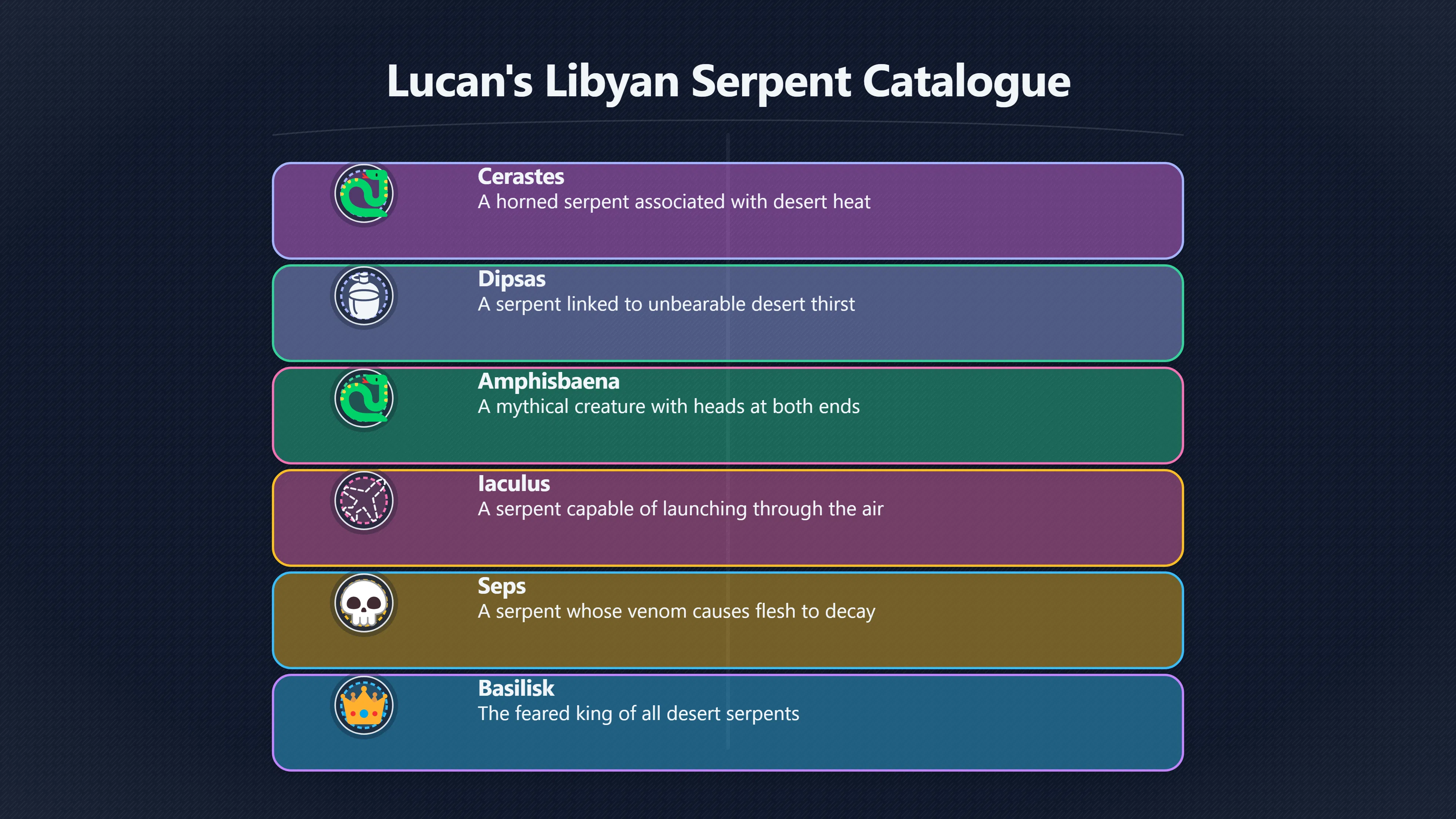
The result is one of antiquity’s greatest catalogues of monster snakes. Lucan’s Libyan desert contains:
- The cerastes, a horned serpent.[animaldiversity.org]animaldiversity.orgCommon in the Sahara desert.Read moreAnimal Diversity WebCerastes cerastes (Desert Horned Viper) | INFORMATIONCerastes cerastes is generally distributed all across North Afri…
- The dipsas, associated with unbearable thirst.
- The amphisbaena, a snake with a head at each end.
- The iaculus, a serpent said to launch itself through the air.
- The seps, whose venom supposedly caused flesh to decay.
- The basilisk, the feared “king of serpents”.[poetryintranslation.com]poetryintranslation.comPoetry in Translation Lucan (39–65from the blood-wet dripping head of Medusa. soaked with the foul dew of that savage blood. distilled by heat, and…
Modern readers should not treat these creatures as reports of actual animals. Lucan was writing literature, not natural history. Yet his work became enormously influential. Medieval writers, bestiaries and later folklore repeatedly recycled these Libyan serpent stories, ensuring that North Africa remained associated with monstrous reptiles long after the Roman world disappeared.
The Mystery of the Amphisbaena
Among Libya’s serpent monsters, the amphisbaena achieved one of the longest afterlives.
The creature was described as having a head at both ends of its body, allowing it to move in either direction. Ancient authors disagreed about its appearance and abilities, but the basic image remained remarkably consistent. Because Lucan placed the creature among the snakes born from Medusa’s blood in Libya, the amphisbaena became permanently linked with the North African desert tradition.[Poetry in Translation]poetryintranslation.comPoetry in Translation Lucan (39–65from the blood-wet dripping head of Medusa. soaked with the foul dew of that savage blood. distilled by heat, and…
Several explanations have been suggested for the legend’s origin:
- Some snakes have blunt tails that can resemble heads at a glance.
- Rapid movement through sand can make it difficult to determine which end of a snake is leading.
- Symbolic storytelling may have been more important than observation; a snake with two heads represented a creature that was doubly threatening.
Whatever its origin, the amphisbaena escaped its Libyan setting and entered European folklore, medieval manuscripts and later fantasy literature. Few ancient monster snakes achieved such a durable cultural career.
Horned Vipers, Basilisks and Plausible Animal Roots
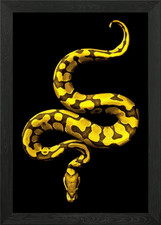
The strongest real-world candidate behind many Libyan serpent legends is the Saharan horned viper (Cerastes cerastes).
This venomous desert snake occurs across North Africa, including Libya. Its most striking feature is the pair of horn-like scales above its eyes, although some individuals lack them entirely. The snake often buries itself in sand with only its eyes and horns visible, making it appear suddenly and unexpectedly to travellers.[wikipedia.org]WikipediaOpen source on wikipedia.org.
Several features would have encouraged legendary interpretations:
- Its appearance is genuinely unusual. A horned snake already looks like something from folklore.
- It is highly camouflaged. People might notice it only when dangerously close.
- It is venomous. Serious bites reinforced stories about supernatural lethality.
- It inhabits exactly the landscapes that ancient writers associated with mystery and danger.[Wikipedia]WikipediaOpen source on wikipedia.org.
The basilisk probably emerged through a different process. No known Libyan animal matches the legendary basilisk’s powers. Instead, the basilisk appears to be a literary amplification of genuine fears surrounding venomous snakes. The creature became a symbolic concentration of every desert danger: poison, heat, death and isolation. In stories, the basilisk ruled over other serpents because it represented the ultimate version of the threat they posed.[Poetry in Translation]poetryintranslation.comPoetry in Translation Lucan (39–65from the blood-wet dripping head of Medusa. soaked with the foul dew of that savage blood. distilled by heat, and…

How Real Desert Conditions Created Monster Stories
Ancient travellers crossing North African deserts faced hazards that could easily be interpreted through the language of monsters.
Venomous snakes were only one danger among many. Heat exhaustion, dehydration, infections and long journeys through unfamiliar terrain could all produce frightening experiences. When a traveller died after a snakebite, witnesses often had little understanding of venom’s biological effects. Symptoms could seem inexplicable and therefore supernatural.
The desert itself encouraged exaggeration. Distances were vast, observation conditions were poor and stories travelled farther than the people who first told them. Each retelling could add new details. A venomous snake became an exceptionally venomous snake. A horned snake became a supernatural horned snake. Eventually, a dangerous animal evolved into a basilisk or amphisbaena.
This process helps explain why Libya became known less for one specific monster than for an entire ecosystem of legendary serpents.
The Legacy of Libya’s Serpent Monsters
The most important legacy of Libya’s serpent tradition is cultural rather than zoological. Ancient descriptions of Libyan snakes shaped medieval bestiaries, Renaissance monster books and later fantasy literature. Creatures such as the basilisk and amphisbaena survived for centuries because writers repeatedly returned to the image of the North African desert as a breeding ground for marvels.[Poetry in Translation]poetryintranslation.comPoetry in Translation Lucan (39–65from the blood-wet dripping head of Medusa. soaked with the foul dew of that savage blood. distilled by heat, and…
From a modern perspective, the tradition also illustrates how cryptid-like stories often develop. A foundation of real wildlife exists beneath the legends. Genuine horned vipers inhabit North African deserts, and Libya still supports several venomous snake species. Yet the leap from dangerous animal to legendary monster occurred through storytelling, myth-making and literary creativity rather than through evidence of unknown species.[wikipedia.org]WikipediaOpen source on wikipedia.org.
That combination of reality and imagination is what makes Libya’s desert serpents so enduring. The monsters themselves may never have existed, but the snakes that inspired them were real enough to leave a mark on the imagination of the ancient world.
Amazon book picks
Further Reading
Books and field guides related to Why Did Libya Become Snake Country?. Use these as the next step if you want deeper reading beyond the article.
eBay marketplace picks
Marketplace Samples
Live-tested eBay searches with available results related to this page.

Endnotes
1.
Source: lexundria.com
Link:https://lexundria.com/hdt/4.191/mcly
Source snippet
Herodotus, Histories 4.191These say that they are of the men who came from Troy. This country and the rest of Libya... snakes a...
2.
Source: Wikipedia
Link:https://en.wikipedia.org/wiki/Cerastes_cerastes
3.
Source: bestiary.ca
Link:https://bestiary.ca/prisources/pstexts964.htm
Source snippet
Encyclopedia: Lucan27 Nov 2025 — Drank in the poison of Medusa's blood, Dripping in dreadful dews upon the soil, And in the crumbling sa...
4.
Source: researchgate.net
Title: 320853495 Atlas of Reptiles of Libya
Link:https://www.researchgate.net/publication/320853495_Atlas_of_Reptiles_of_Libya
Source snippet
(PDF) Atlas of Reptiles of Libya4 Nov 2017 — Libya has one of the most depauperate reptile faunas in Africa, but it also remains one of t...
5.
Source: Wikipedia
Link:https://en.wikipedia.org/wiki/Lucan
Source snippet
LucanMarcus Annaeus Lucanus (3 November AD 39 – 30 April AD 65), better known in English as Lucan was a Roman poet, born in Corduba, H...
6.
Source: poetryintranslation.com
Title: Poetry in Translation Lucan (39–65)
Link:https://www.poetryintranslation.com/PITBR/Latin/PharsaliaIXmaster.php
Source snippet
from the blood-wet dripping head of Medusa. soaked with the foul dew of that savage blood. distilled by heat, and...
7.
Source: animaldiversity.org
Title: Common in the Sahara desert.Read more
Link:https://animaldiversity.org/accounts/Cerastes_cerastes/
Source snippet
Animal Diversity WebCerastes cerastes (Desert Horned Viper) | INFORMATIONCerastes cerastes is generally distributed all across North Afri...
8.
Source: imalqata.wordpress.com
Link:https://imalqata.wordpress.com/2012/02/28/the-horned-viper/
Source snippet
Horned Viper | iMalqata - A Joint ExpeditionFeb 28, 2012 — This species of viper is distinctive because the snake often has supraorbital...
9.
Source: abookofcreatures.com
Link:https://abookofcreatures.com/category/libya/
Source snippet
4 Dec 2020 — The Cerastes, “horned”, is one of the many snakes born from the blood of Medusa in the Libyan desert. It receives a passing...
10.
Source: amazon-invincible.fandom.com
Link:https://amazon-invincible.fandom.com/wiki/Lucan
Source snippet
Invincible Wiki - FandomLucan is a brutal but deeply loyal Viltrumite who lives by the Empire's belief that strength is everything. He ca...
11.
Source: villains.fandom.com
Link:https://villains.fandom.com/wiki/Lucan
Source snippet
Villains Wiki - FandomLucan was one of three warriors of Viltrumite who appeared in the skies above Thraxa when Omni-Man first attempted...
12.
Source: invinciblevs.com
Link:https://invinciblevs.com/lucan
Source snippet
Invincible VSLucan is a devoted soldier of the Viltrum Empire. Like most Viltrumites, he detests what he perceives as weakness and believ...
Additional References
13.
Source: a-z-animals.com
Link:https://a-z-animals.com/animals/horned-viper/
Source snippet
Horned Viper Animal FactsIn Egyptian hieroglyphs, the horned viper is a symbol that represents the phonic alphabet sound of “f.” This sna...
14.
Source: rottentomatoes.com
Link:https://www.rottentomatoes.com/m/lucan
Source snippet
LucanSynopsis Based on a real story, an English aristocrat stands accused of murdering his children's nanny. Director: Brian Grant. Genre...
15.
Source: penelope.uchicago.edu
Link:https://penelope.uchicago.edu/Thayer/E/Roman/Texts/Herodotus/4g%2A.html
Source snippet
• Herodotus — Book IV: Chapters 145‑205In that country are the huge snakes, and the elephants and bears and asps, the horned asses, the d...
16.
Source: shutterstock.com
Link:https://www.shutterstock.com/search/sahara-horned-viper
Source snippet
Sahara Horned Viper royalty-free imagesCerastes cerastes or Saharan Horned Viper, or Desert Horned Viper, is a venomous viper species fou...
17.
Source: saudipedia.com
Link:https://saudipedia.com/en/saharan-horned-viper
Source snippet
Saharan Horned ViperThe Saharan horned viper has a thick body and a triangular head, which is common among venomous snakes. It has a rela...
18.
Source: biodb.com
Link:https://biodb.com/species/saharan-horned-viper/
Source snippet
Saharan horned viper facts, distribution & populationThe Saharan horned viper, also known as Cerastes cerastes, is a fascinating snake th...
19.
Source: reddit.com
Link:https://www.reddit.com/r/Invincible/comments/1s6cx71/the_way_lucan_spoke_the_truth/
Source snippet
The Way Lucan Spoke The Truth: r/InvincibleLucan appears to be extremely strong, he is just an awful combatant with bad reaction time an...
20.
Source: facebook.com
Title: The Horned Viper, A Snake with Horns in Sahara desert
Link:https://www.facebook.com/LibyatheVision/posts/the-horned-viper-a-snake-with-horns-in-sahara-desertlibya-wildlife-snake-desert-/1222651819875946/
Source snippet
They can also be found in parts of North Africa including Libya, Egypt, and Sudan.... This is a sand viper (horned horned viper, Ceraste...
21.
Source: thehistorianshut.com
Title: the odd beings that herodotus suggested lived in libya
Link:https://thehistorianshut.com/2017/09/05/the-odd-beings-that-herodotus-suggested-lived-in-libya/
Source snippet
5 Sept 2017 — “It is here that the huge snakes are found—and lions, elephants, bears, asps, and horned asses, not to mention dog-headed m...
22.
Source: lucanfashion.com
Title: This is a capsule collection of coats, jackets,
Link:https://lucanfashion.com/
Source snippet
Lucan: Urban Wear & Country Cool - the award winning...Luxury outdoor wear, urban and country cool, that is equally well-tailored for co...
Topic Tree