Creature Lore of Senegal's Wild Places
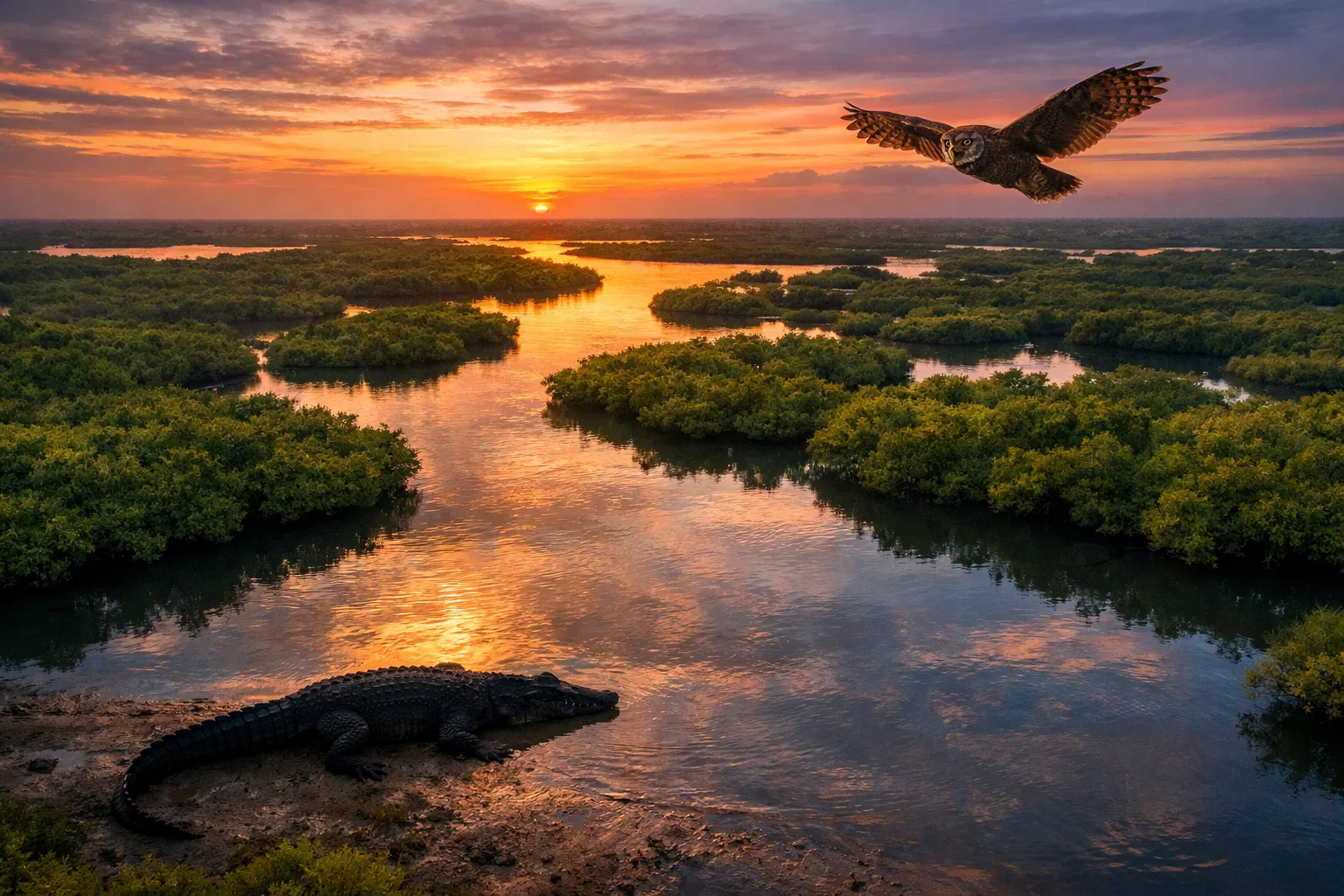
Senegal has no single nationally famous cryptid comparable with Scotland’s Loch Ness Monster. Its mystery-creature history is instead scattered across the wider Senegambian region: crowned serpents associated with dangerous bush and wetlands, terrifying owl-like beings, supernatural hyenas and uncertain sightings of marine mammals.
Page outline Jump by section
Introduction
The most important traditions are the Ninki Nanka, a feared serpent or dragon-like spirit known around the Gambia River basin, and the Kikiyaon, an enormous owl-like forest creature preserved mainly through cryptozoological retellings. A more scientific case is the so-called “Senegal dolphin”, once treated as a possibly distinctive animal but now generally interpreted as a known dolphin seen under difficult conditions. Together, these stories show how folklore, wildlife encounters and later monster literature can become entangled without being the same thing.
Why Senegal’s monster stories are regional
Senegal nearly surrounds The Gambia, while the Gambia River connects communities, forests and wetlands across the modern national boundary. Older stories therefore belong to cultural and ecological regions rather than neatly to one country. The Ninki Nanka is most strongly documented in Gambian and Mandinka tradition, but it belongs to a broader Senegambian setting in which rivers, swamps, large trees and unusual landforms could be regarded as the dwelling places of powerful spirits. Historian Assan Sarr notes that spirits in the Gambia River basin were believed to inhabit features such as trees, rocks, termite mounds, swamps and bodies of water, sometimes exercising ownership or influence over the surrounding land.[Cambridge University Press & Assessment]resolve.cambridge.orgpower of the wild spiritsCambridge University Press & Assessment3 The Power of the Wild SpiritsA 1906 commissioner's report vividly describes the ninki nanka: The…
This distinction matters. A creature may be relevant to Senegal because the people, landscape and river system associated with it cross the border, not because Senegalese newspapers produced a long sequence of dated sightings. Many online cryptid lists erase that difference and present regional folklore as though it described an undiscovered animal repeatedly reported within modern Senegal.
Senegal’s geography nevertheless provides convincing scenery for such traditions. The south-east contains the Gambia River, wooded river margins and savannah in Niokolo-Koba National Park. UNESCO describes the park as a well-watered mixture of gallery forest and savannah supporting lions, leopards, chimpanzees, elephants, birds, reptiles and amphibians.[UNESCO World Heritage Centre]whc.unesco.orgUNESCO World Heritage CentreNiokolo-Koba National ParkLocated in a well-watered area along the banks of the Gambia river, the gallery for… Farther west and south, estuaries, mangroves and creeks create places where animals can be partly seen, heard at night or confused with floating vegetation.
The Ninki Nanka: serpent, spirit or swamp warning?
The Ninki Nanka is the clearest monster tradition connected with the Senegambian region. It is usually portrayed as an immense serpent, reptile or dragon-like being inhabiting thick bush, wetlands or river country. Descriptions vary greatly: some accounts make it crocodile-like, others give it a long neck, horns, a crest or an assortment of features drawn from several animals.
One of the most valuable historical references appears in a British colonial commissioner’s report from 1906, quoted in modern historical scholarship. The account describes a Mandinka belief in a gigantic crowned serpent living in the densest bush. Seeing its body supposedly brought dangerous illness, while seeing its eyes or crown meant immediate death.[Cambridge University Press & Assessment]resolve.cambridge.orgpower of the wild spiritsCambridge University Press & Assessment3 The Power of the Wild SpiritsA 1906 commissioner's report vividly describes the ninki nanka: The… This is much closer to a dangerous spirit tradition than to an ordinary zoological sighting. The creature’s power lies not merely in its size but in the taboo surrounding its habitat and gaze.
That older description also helps explain why modern “river dragon” illustrations can mislead. There is no stable anatomical profile. The Ninki Nanka changes according to storyteller, locality and audience. Its most consistent features are that it is reptilian, associated with secluded or wet places, and perilous to encounter.
What testimony exists?
A 2006 expedition by the British Centre for Fortean Zoology travelled to The Gambia to gather reports. Interviewees offered conflicting descriptions, including a crocodile-like creature and a winged, fire-spitting snake. The expedition attracted international media attention but produced no specimen, clear photograph, trackway or biological sample.[Wikipedia]WikipediaNinki NankaA 1906 commissioner's report describes the creature: The Mandingoes are firm believers in genii; every village is supposed to have two of…
Such interviews show that the tradition remained culturally alive. They do not establish that every account referred to the same physical animal. Testimony gathered after investigators arrive with pictures and monster terminology can also be shaped by suggestion, memory and a desire to provide a satisfying story.
Plausible animal roots
Several real animals could contribute pieces of the legend without fully explaining it:
- Crocodiles fit the water, danger and reptilian appearance.
- Large snakes can account for the serpent form and fear of thick vegetation.
- Monitor lizards may look unexpectedly dragon-like when briefly observed.
- West African manatees are large, secretive mammals of estuaries, lagoons and river systems. Their rounded backs and nostrils may be visible only momentarily at the surface. The species occurs from the Senegal River southwards through West Africa and is classified as vulnerable.[CMS Convention]cms.intCMS ConventionTrichechus senegalensisWest African Manatee. Trichechus senegalensis. Species. West African Manatee. Trichechus senegalensi…
- Floating branches, vegetation and animal wakes can appear segmented or serpentine, especially in poor light.
None of these explanations proves that one species created the entire tradition. The crowned head, fatal gaze and supernatural consequences point towards a spirit narrative developed around genuinely hazardous environments. A story warning people away from deep water, swamp forest or predator habitat can be practically useful even when its monster is imaginary.
The Kikiyaon: Senegal’s supposed giant owl
The Kikiyaon is described in cryptozoological literature as a man-sized or larger owl-like creature with huge wings, powerful talons and sharp projections at its shoulders. It is also called a soul-eater or soul-cannibal and is said to produce a horrifying scream. Some versions describe a mixture of feathers, hair and human-like proportions.
Its connection with Senegal is less secure than many creature directories imply. Modern retellings usually attribute the belief to Bambara communities and place the creature somewhere in the forests of Senegal or The Gambia. The Bambara are a wider West African people, found principally in Mali but also in neighbouring countries including Senegal. The story therefore cannot confidently be treated as a creature reported throughout Senegal, much less as a national monster.
The best-known descriptions appear largely through later cryptozoological authors rather than a substantial body of accessible Senegalese oral-history research. Zoologist and cryptid writer Karl Shuker, drawing on earlier monster literature, describes the Kikiyaon as an enormous owl-like forest being feared by Bambara people.[karlshuker.blogspot.com]karlshuker.blogspot.comBURNHA M'S BEASTSBURNHAM'S BEASTS - THE SECRET WILDLIFE OF…14 May 2019 — No less deadly, or dreadful, than the guiafairo is the kikiyaon, which is said… The circulation of nearly identical wording across cryptid websites suggests repeated copying from a small number of secondary sources rather than numerous independent witnesses.
Could an owl explain it?
Senegal is home to genuinely impressive nocturnal birds. BirdLife records several owl species in the country, including greyish eagle-owls and Verreaux’s eagle-owls.[BirdLife DataZone]datazone.birdlife.orgBirdLife DataZoneSenegal Factsheet | BirdLife DataZone31 Jan 2024 — Northern White-faced Owl Ptilopsis leucotis. Eagle-owl Bubo cinerasce… A large owl glimpsed at close range can appear much bigger than expected when it spreads its wings. Its calls may be interpreted as groans, screams or human cries, particularly by someone who cannot see the bird.
That does not mean the Kikiyaon is simply a misidentified owl. Its human-like qualities, supernatural appetite and elaborate shoulder weapons belong to storytelling rather than ornithology. A more cautious interpretation is that owl encounters may have supplied the sensory core — wings, talons, darkness and disturbing calls — around which a frightening forest being developed.
The Kikiyaon is therefore best classified as thinly documented regional folklore amplified by cryptozoological books. Claims about precise wingspans, colouring or anatomy should be treated sceptically unless they can be traced to a named witness or a primary ethnographic record.
Hyenas, shapeshifters and the boundary between beast and person
Hyenas occupy a different part of Senegal’s monster tradition. They are real animals, but folklore can give them qualities that turn an ordinary predator or scavenger into something supernatural. Across parts of Africa, hyenas have been portrayed as greedy, morally inverted, sexually ambiguous or connected with sorcery. Beliefs differ sharply between communities, so a general “African werehyena” should not be imposed on every local tradition.
In southern Senegal, ethnographic summaries report that Kujamaat communities have regarded hyenas as inedible, greedy and hermaphroditic.[Wikipedia]WikipediaCultural depictions of spotted hyenasCultural depictions of spotted hyenas Cryptozoological retellings also describe a mysterious Senegalese hyena-like animal called the booa, sometimes interpreted locally as a transformed sorcerer. One version claims that a wounded animal’s blood trail would lead to a wounded human inside a house.[karlshuker.blogspot.com]karlshuker.blogspot.comOpen source on blogspot.com.
The booa material is difficult to evaluate because accessible accounts again depend heavily on specialist monster writers rather than dated Senegalese case records. It belongs more securely to shapeshifting folklore than to evidence for an unknown carnivore.
Real hyena behaviour helps explain why such stories remain powerful. Hyenas are active at night, make varied and unsettling sounds, scavenge carcasses and may appear near settlements. Darkness makes size and distance difficult to judge. A known animal encountered under emotionally charged circumstances can therefore acquire an identity far beyond its zoological one.
These beliefs should also be handled carefully because stories of human transformation can become accusations against marginalised people. A monster tale may entertain outsiders while carrying serious social consequences within the community where it is told.

The “Senegal dolphin”: a cryptid that moved back towards zoology
The Senegal dolphin is the country’s most interesting mystery-animal case because it arose from wildlife observation rather than supernatural folklore. Dutch mariner and cetacean observer Willem Frederik Jacob Mörzer Bruyns reported seeing a distinctive dolphin repeatedly off Senegal. Later cryptozoological catalogues treated it as a possible unknown form.
Descriptions placed it among the small, streamlined dolphins of the genus Stenella. Mörzer Bruyns himself apparently considered that it might be an Atlantic spotted dolphin rather than a new species.[cryptidarchives.fandom.com]cryptidarchives.fandom.comSenegal dolphin | Encyclopaedia of CryptozoologySenegal dolphin | Encyclopaedia of Cryptozoology Other zoological authors proposed that at least some records could have involved Clymene dolphins, a recognised species that can be difficult to distinguish from related dolphins at sea.[ResearchGate]researchgate.netResearch Gate(PDF) Cetaceans in Gambian coastal watersResearch Gate(PDF) Cetaceans in Gambian coastal waters
A major 2024 review of cetaceans along north-western Africa included the “Senegal dolphin” record in its assessment of historical observations. It treated the reports as part of a difficult identification history rather than evidence of a currently accepted new species.[Frontiers]frontiersin.orgOpen source on frontiersin.org.
This case illustrates a central problem in marine cryptozoology. Dolphin identification can depend on brief views of colour pattern, dorsal-fin shape, group behaviour and surfacing movement. Glare, distance and changing light can hide the markings needed to separate similar species. Early observers also worked before the region’s cetaceans were as well documented as they are today.
No type specimen, diagnostic photograph or genetic sample established the Senegal dolphin as a separate species. The balance of evidence favours an uncertain observation of known Stenella dolphins. Yet the reports retain historical value because they show how incomplete marine knowledge can temporarily create a plausible cryptid without any fraud or fantasy.
What Senegal’s landscapes contribute to the legends
Senegal’s creature traditions cluster naturally around three habitats.
Rivers and wetlands support crocodiles, large snakes, manatees and other animals that may surface briefly or remain hidden. They are also dangerous places where a cautionary serpent tradition can regulate behaviour.
Forests and wooded savannah provide cover for nocturnal birds, hyenas, leopards and primates. Niokolo-Koba alone contains an unusually rich mixture of large mammals, birds and reptiles.[UNESCO World Heritage Centre]whc.unesco.orgUNESCO World Heritage CentreNiokolo-Koba National ParkLocated in a well-watered area along the banks of the Gambia river, the gallery for… In such settings, a cry heard without seeing its source can become more memorable than a clear sighting.
The Atlantic coast produces a different kind of uncertainty. Dolphins, whales, sharks and decomposing carcasses are often observed from moving boats or after waves and scavengers have altered their appearance. The Senegal dolphin belongs to this maritime tradition of uncertain classification rather than to spirit folklore.
Environmental change can further complicate memory. Species become rarer, habitats shrink and direct familiarity with wildlife declines. A creature once recognised locally may later sound extraordinary, while a story about a dangerous place can survive after the original ecological circumstances have changed.
Hoaxes, evidence and repeated internet claims
There is little well-supported evidence of a major Senegalese monster hoax comparable with famous staged lake-monster photographs. The greater problem is repetition. A description copied through books, blogs and fan databases can appear to represent many sources when all versions descend from one brief passage.
The Kikiyaon is the clearest example. Online accounts often provide exact physical details but rarely identify the original speaker, date, settlement or interview conditions. The Ninki Nanka has stronger historical documentation, yet modern illustrations frequently combine incompatible descriptions into a single standard dragon.
A useful credibility test asks four questions:
- Is the account folklore or a claimed eyewitness observation? A traditional spirit story should not be converted automatically into a zoological report.
- Can the witness, date and location be identified? Anonymous summaries are difficult to verify.
- Was physical evidence preserved? Photographs, measurements, tissue or tracks matter more than repeated retellings.
- Were known animals considered first? Owls, crocodiles, manatees, hyenas and dolphins already explain many isolated features.
By these standards, Senegal has culturally meaningful monster traditions but no persuasive evidence for an undiscovered giant owl, dragon or shapeshifting carnivore.

How the legends changed
The Ninki Nanka began as a feared being connected with bush, water, illness and spiritual danger. Modern cryptozoology increasingly presents it as a physical “river dragon” that might be photographed, tracked or captured. Tourism has pushed the story further towards heritage entertainment: in The Gambia, routes and cultural encounters have used the creature as a way to introduce visitors to villages, landscapes and oral traditions. Although this tourism is primarily Gambian, it draws on the same cross-border Senegambian environment.
The name has also entered Senegalese popular culture. The Senegalese group Touré Kunda released a song titled “Ninki Nanka” on its 1984 album Casamance au clair de lune, helping move the creature from cautionary folklore into modern music and international cultural circulation.[Wikipedia]WikipediaNinki NankaA 1906 commissioner's report describes the creature: The Mandingoes are firm believers in genii; every village is supposed to have two of…
The Kikiyaon followed a different route. Its modern afterlife is dominated by monster encyclopaedias, television, gaming discussions and creature art. These formats favour a fixed visual design, even though the underlying tradition is poorly documented and probably varied. The result is a polished modern cryptid assembled from a much less certain folkloric foundation.
The Senegal dolphin moved in the opposite direction. It began as a potentially distinctive animal and gradually lost its cryptid status as marine zoology supplied more plausible identifications. That makes it one of the most instructive cases: mystery did not disappear because witnesses were mocked, but because better comparative knowledge narrowed the possibilities.
The most defensible reading
Senegal’s mystery-creature tradition is real as culture, but sparse as zoological evidence. The Ninki Nanka is best understood as a powerful Senegambian serpent-spirit tradition shaped by wetlands, dangerous wildlife and ideas about spiritually charged places. The Kikiyaon is an owl-like forest terror whose modern fame rests more on cryptozoological repetition than on a rich archive of Senegalese sightings. Supernatural hyenas belong to a broader set of beliefs about animal ambiguity and transformation, while the Senegal dolphin represents an unresolved field identification that probably involved known species.
These stories remain valuable without being treated as proof of monsters. They preserve attitudes towards risky landscapes, nocturnal animals and the limits of human perception. They also reveal how a creature can change category over time: spirit becomes cryptid, cryptid becomes tourist emblem, or supposed new species becomes an identification problem. In Senegal, the most interesting mystery is not which monster is hiding in the bush or water, but how real animals, environmental danger and storytelling repeatedly create something larger than any one of them.
Amazon book picks
Further Reading
Books and field guides related to What Creatures Haunt Senegal's Wild Places?. Use these as the next step if you want deeper reading beyond the article.
The Kingdon Field Guide to African Mammals
Explains real animals that may inspire monster reports.
eBay marketplace picks
Marketplace Samples
Live-tested eBay searches with available results related to this page.
Endnotes
1.
Source: resolve.cambridge.org
Title: power of the wild spirits
Link:https://resolve.cambridge.org/core/services/aop-cambridge-core/content/view/AB4AAAD4DE388EDACB3308F65F63C575/9781782048701c3_p84-110_CBO.pdf/power_of_the_wild_spirits.pdf
Source snippet
Cambridge University Press & Assessment3 The Power of the Wild SpiritsA 1906 commissioner's report vividly describes the ninki nanka: The...
2.
Source: whc.unesco.org
Link:https://whc.unesco.org/en/list/153/
Source snippet
UNESCO World Heritage CentreNiokolo-Koba National ParkLocated in a well-watered area along the banks of the Gambia river, the gallery for...
3.
Source: Wikipedia
Title: Ninki Nanka
Link:https://en.wikipedia.org/wiki/Ninki_Nanka
Source snippet
A 1906 commissioner's report describes the creature: The Mandingoes are firm believers in genii; every village is supposed to have two of...
4.
Source: cms.int
Link:https://www.cms.int/species/trichechus-senegalensis
Source snippet
CMS ConventionTrichechus senegalensisWest African Manatee. Trichechus senegalensis. Species. West African Manatee. Trichechus senegalensi...
5.
Source: bukhara-deer.cms.int
Link:https://bukhara-deer.cms.int/sites/default/files/document/WATCH_II_Doc5_draftManateeAP_E_0.pdf
Source snippet
DRAFT ACTION PLAN FOR THE CONSERVATION OF THE...The West African Manatee (Trichechus senegalensis) is a large aquatic mammal found in co...
6.
Source: karlshuker.blogspot.com
Title: BURNHA M’S BEASTS
Link:https://karlshuker.blogspot.com/2019/05/burnhams-beasts-secret-wildlife-of.html
Source snippet
BURNHAM'S BEASTS - THE SECRET WILDLIFE OF...14 May 2019 — No less deadly, or dreadful, than the guiafairo is the kikiyaon, which is said...
Published: May 2019
7.
Source: datazone.birdlife.org
Link:https://datazone.birdlife.org/country/factsheet/senegal
Source snippet
BirdLife DataZoneSenegal Factsheet | BirdLife DataZone31 Jan 2024 — Northern White-faced Owl Ptilopsis leucotis. Eagle-owl Bubo cinerasce...
8.
Source: datazone.birdlife.org
Link:https://datazone.birdlife.org/species/factsheet/greyish-eagle-owl-bubo-cinerascens
9.
Source: datazone.birdlife.org
Link:https://datazone.birdlife.org/species/factsheet/verreauxs-eagle-owl-bubo-lacteus
10.
Source: Wikipedia
Title: Cultural depictions of spotted hyenas
Link:https://en.wikipedia.org/wiki/Cultural_depictions_of_spotted_hyenas
11.
Source: Wikipedia
Link:https://en.wikipedia.org/wiki/Hyena
12.
Source: karlshuker.blogspot.com
Link:https://karlshuker.blogspot.com/2019/05/
13.
Source: cryptidarchives.fandom.com
Title: Senegal dolphin | Encyclopaedia of Cryptozoology
Link:https://cryptidarchives.fandom.com/wiki/Senegal_dolphin
14.
Source: researchgate.net
Title: Research Gate(PDF) Cetaceans in Gambian coastal waters
Link:https://www.researchgate.net/publication/262373720_Cetaceans_in_Gambian_coastal_waters
15.
Source: whc.unesco.org
Link:https://whc.unesco.org/document/152854
16.
Source: cryptidz.fandom.com
Link:https://cryptidz.fandom.com/wiki/Kikiyaon
17.
Source: cryptidarchives.fandom.com
Title: Ninki nanka
Link:https://cryptidarchives.fandom.com/wiki/Ninki_nanka
18.
Source: cryptidz.fandom.com
Link:https://cryptidz.fandom.com/wiki/Guiafairo
19.
Source: spore.fandom.com
Title: Creature:Ninki Nanka
Link:https://spore.fandom.com/wiki/Creature%3ANinki_Nanka
20.
Source: Wikipedia
Title: Mokele mbembe
Link:https://en.wikipedia.org/wiki/Mokele-mbembe
21.
Source: Wikipedia
Title: Bambara people
Link:https://en.wikipedia.org/wiki/Bambara_people
22.
Source: Wikipedia
Title: On the Track of Unknown Animals
Link:https://en.wikipedia.org/wiki/On_the_Track_of_Unknown_Animals
23.
Source: Wikipedia
Title: Niokolo Koba National Park
Link:https://en.wikipedia.org/wiki/Niokolo-Koba_National_Park
24.
Source: whc.unesco.org
Link:https://whc.unesco.org/en/activities/1103/
25.
Source: whc.unesco.org
Link:https://whc.unesco.org/document/8951
26.
Source: whc.unesco.org
Link:https://whc.unesco.org/document/167895
27.
Source: whc.unesco.org
Link:https://whc.unesco.org/en/news/357
28.
Source: whc.unesco.org
Title: org47 COM 7B.50
Link:https://whc.unesco.org/en/decisions/8774/
29.
Source: whc.unesco.org
Link:https://whc.unesco.org/en/decisions/8126
30.
Source: whc.unesco.org
Link:https://whc.unesco.org/en/decisions/6962/
31.
Source: whc.unesco.org
Link:https://whc.unesco.org/document/154175
32.
Source: cms.int
Title: wa awm ap inf.4.a science
Link:https://www.cms.int/sites/default/files/document/cms_wa_awm-ap_inf.4.a_science_summary_e_0.pdf
33.
Source: cms.int
Link:https://www.cms.int/aquatic-mammals/en
34.
Source: cms.int
Link:https://www.cms.int/sites/default/files/document/WA-AWM-Action-Plan_Doc.6_Fisheries_Environment_e.pdf
35.
Source: cms.int
Title: Saly Declaration corr e
Link:https://www.cms.int/sites/default/files/Saly%20Declaration_corr_e.pdf
36.
Source: cms.int
Link:https://www.cms.int/project/empowering-local-fishing-communities-conserve-coastal-dolphins-congo
37.
Source: cms.int
Link:https://www.cms.int/sites/default/files/document/cms_wa_awm-ap_inf.4.b_drivers_pressures_e.pdf
38.
Source: cms.int
Title: Seventh Meeting of the Conference of the Parties to CMSWest African Manatee
Link:https://www.cms.int/meeting/seventh-meeting-conference-parties-cms
39.
Source: cms.int
Title: côte divoire
Link:https://www.cms.int/country/c%C3%B4te-divoire
40.
Source: datazone.birdlife.org
Title: long crested eagle lophaetus occipitalis
Link:https://datazone.birdlife.org/species/factsheet/long-crested-eagle-lophaetus-occipitalis
41.
Source: datazone.birdlife.org
Link:https://datazone.birdlife.org/country/factsheet/benin
42.
Source: datazone.birdlife.org
Title: northern bald ibis geronticus eremita
Link:https://datazone.birdlife.org/species/factsheet/northern-bald-ibis-geronticus-eremita
43.
Source: datazone.birdlife.org
Link:https://datazone.birdlife.org/country/factsheet/niger
44.
Source: datazone.birdlife.org
Title: booted eagle hieraaetus pennatus
Link:https://datazone.birdlife.org/species/factsheet/booted-eagle-hieraaetus-pennatus
45.
Source: datazone.birdlife.org
Link:https://datazone.birdlife.org/country/factsheet/togo
46.
Source: karlshuker.blogspot.com
Title: GAMB O, THE GAMBIAN SEA SERPENT
Link:https://karlshuker.blogspot.com/2019/05/gambo-gambian-sea-serpent-or-how-very.html
47.
Source: forteanzoology.blogspot.com
Title: lindsay selby kikiyaon real or
Link:https://forteanzoology.blogspot.com/2011/01/lindsay-selby-kikiyaon-real-or.html
48.
Source: uk.whales.org
Title: clymene dolphin
Link:https://uk.whales.org/whales-dolphins/species-guide/clymene-dolphin/
49.
Source: researchgate.net
Title: 379174634 Heuvelmans the Heretic and Hidden Animals
Link:https://www.researchgate.net/publication/379174634_Heuvelmans_the_Heretic_and_Hidden_Animals
50.
Source: standard.gm
Link:https://standard.gm/dragons-of-the-gambia-2/
51.
Source: youtube.com
Title: The Ninki Nanka | West Africa’s Swamp Dragon
Link:https://www.youtube.com/watch?v=Wru7DkEfgVU
Source snippet
Yumboes: Senegal's Moonlit Spirits of Legend...
52.
Source: frontiersin.org
Link:https://www.frontiersin.org/journals/marine-science/articles/10.3389/fmars.2024.1427334/full
53.
Source: vigilife.org
Link:https://www.vigilife.org/en/senegal-the-rediscovery-of-a-river/
Additional References
54.
Source: youtube.com
Title: Ninki Nanka: The African Nessie | African Mythology | Mythlok | Podcast
Link:https://www.youtube.com/watch?v=Q5httIzu0gU
Source snippet
Serer Religion: The Ancient Spiritual Tradition of Senegal...
55.
Source: loc.gov
Link:https://www.loc.gov/aba/publications/Archived-LCSH36/V.pdf
56.
Source: senecacountyny.gov
Link:https://www.senecacountyny.gov/wp-content/uploads/2020/01/The-Sea-Serpent-of-Seneca-Lake-ADA.pdf
57.
Source: youtube.com
Title: Yumboes: Senegal’s Moonlit Spirits of Legend
Link:https://www.youtube.com/watch?v=_W-0VIYhERU
Source snippet
Ninki Nanka: The African Nessie | African Mythology | Mythlok | Podcast...
58.
Source: youtube.com
Title: Serer Religion: The Ancient Spiritual Tradition of Senegal
Link:https://www.youtube.com/watch?v=1UhsmvAu8QI
Source snippet
Mythical Creatures and Monsters of Africa...
59.
Source: joshuaproject.net
Link:https://joshuaproject.net/people_groups/10617/SG
60.
Source: reddit.com
Link:https://www.reddit.com/r/Cryptozoology/comments/111htr4/bernard_heuvelmans_was_a_belgianfrench_zoologist/
61.
Source: my-gambia.com
Link:https://www.my-gambia.com/mymagazine/ninki-nanka-a-legendary-creature-of-the-gambia/
62.
Source: instagram.com
Link:https://www.instagram.com/reel/DMvWhhyoscS/?hl=en
63.
Source: reddit.com
Link:https://www.reddit.com/r/AskHistorians/comments/orjjh0/i_randomly_came_across_hundreds_of_newspaper/
Topic Tree
Follow this branch
Related pages 192
- Antigua Cryptids
- Maldives Monsters
- Malta Monsters
- Qatar Monsters
- Argentina Monsters
- +187 more in sidebar