Creature Lore of Tonga's Natural History
Tonga does not have a famous national monster on the scale of Scotland’s Loch Ness creature or North America’s Bigfoot.
Page outline Jump by section
Introduction
Around that central case sits a wider world of sea snakes, protective sharks, animal-shaped spirits and memories of genuinely extinct giant reptiles and birds. These traditions should not all be called cryptid reports. Some are sacred or historical narratives; some describe known animals in supernatural roles; and some are modern attempts to identify an elusive species. Tonga’s monster history is therefore most interesting when folklore, ecology and extinction are kept distinct rather than forced into one sensational category.
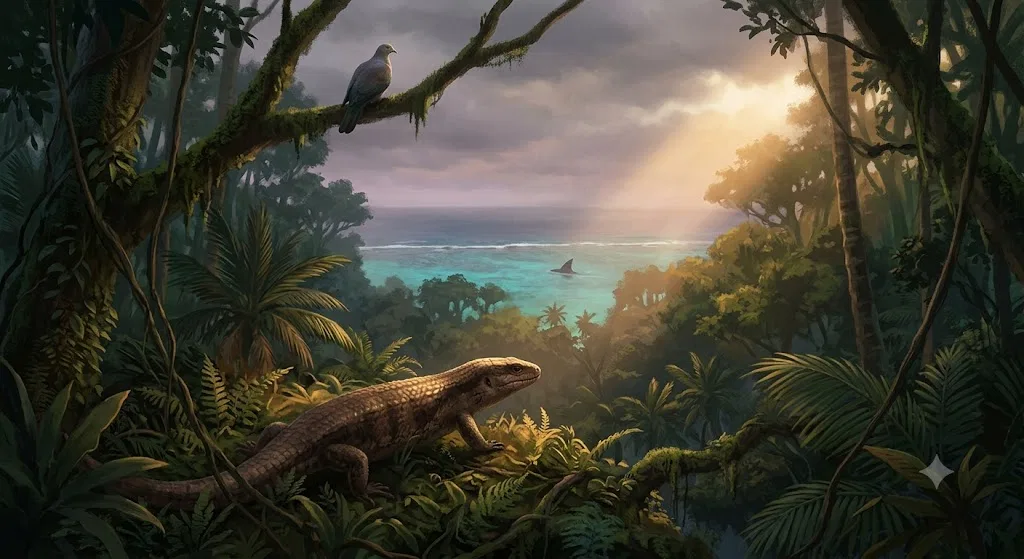
Tonga’s best cryptid candidate: the giant ground skink
The giant Tongan ground skink, Tachygyia microlepis, is not a creature invented from eyewitness gossip. Two preserved examples exist in the National Museum of Natural History in Paris. They were collected on Tongatapu during the 1826–29 voyage of the French corvette Astrolabe and formally described in 1839. The larger specimen measures 177 millimetres from snout to vent, excluding the tail, making it substantially bulkier than Tonga’s familiar living skinks.[Salamandra Journal]salamandra-journal.comOpen source on salamandra-journal.com.
That physical evidence gives the story an unusual foundation. The animal certainly existed, but nobody has produced an authenticated modern specimen, photograph, shed skin or genetic sample. The scientific question is therefore not whether the lizard was real, but whether a hidden population survived beyond the nineteenth century.
The case acquired its “Grey Ghost” flavour in 1986, when herpetologist John Gibbons visited Tonga and offered a reward of 100 Tongan dollars for a photograph or specimen. He suggested that the lizard might be nocturnal, partly subterranean or most active after heavy rain. Reports subsequently appeared in the Tonga Chronicle, but researchers Ivan Ineich and George Zug concluded that the descriptions were more likely to involve other large local skinks.[Salamandra Journal]salamandra-journal.comOpen source on salamandra-journal.com.
The reported sightings nevertheless show how easily a lost species becomes a cryptid. Witnesses described comparatively large ground-running lizards in plantations or isolated vegetation, yet size estimates made during brief encounters are unreliable. Tonga also supports several skinks capable of exceeding 10 centimetres in body length, including species that could look surprisingly large when seen at speed or from close range.[Salamandra Journal]salamandra-journal.comOpen source on salamandra-journal.com.

Why extinction remains the mainstream view
The strongest argument against survival is the long absence of verifiable evidence. Nearly two centuries have passed since the museum animals were collected. Dedicated interest, public rewards and fieldwork have not yielded a confirmed individual. The Reptile Database describes the species as apparently extinct, reflecting the conventional assessment in modern herpetology.[Reptile Database]reptile-database.reptarium.czThe first and only record of this Tongan lizard is from the early nineteenth-century report of the L'…Read more…
Tongatapu has also been transformed dramatically. The 2024 review estimated that the island is about 90 per cent deforested, with only a small proportion of its land retaining forest fragments. Agriculture, settlement and introduced predators can be especially destructive to slow-breeding ground reptiles on islands. Pacific rats have been transported throughout Polynesia since human expansion, while later introductions added further pressures to many island ecosystems.[Salamandra Journal]salamandra-journal.comOpen source on salamandra-journal.com.
Misidentification is more economical than survival when a report contains no diagnostic detail. A fleeting brown or green lizard may be enlarged by surprise, poor lighting or memory. The known giant skink had particular scale counts, proportions and eyelid features that a casual witness could not reliably establish from an animal disappearing into undergrowth. A story that merely says “very large lizard” cannot separate Tachygyia from an exceptional individual of a living species.
There is also no strong evidence for a continuing breeding population. A viable species would normally leave more than isolated anecdotes: road-killed animals, remains caught by cats, recognisable droppings, environmental DNA or repeated sightings within a defined habitat. None has yet been reported in a form accepted by mainstream zoology.
Why a new search is not entirely unreasonable
The 2024 reassessment did not claim that the Grey Ghost had been rediscovered. Instead, it argued that extinction may have been declared too confidently. The authors proposed that the skink’s body form resembles secretive terrestrial lizards elsewhere, suggesting a creature that could shelter under rocks, in rotten timber or in burrows and emerge only under favourable conditions. Such behaviour would make ordinary visual surveys less effective.[Salamandra Journal]salamandra-journal.comOpen source on salamandra-journal.com.
They also shifted attention away from heavily altered central Tongatapu. Small satellite islets, coastal vegetation and the more rugged island of ‘Eua may preserve habitats less disturbed than the skink’s recorded locality. Tonga’s geography — many scattered islands, reef islets and difficult pockets of vegetation — means that “not seen” is not always identical to “proved absent”.[Salamandra Journal]salamandra-journal.comOpen source on salamandra-journal.com.
Even so, the survival proposal remains a hypothesis. Morphological resemblance to burrowing Caribbean lizards can suggest where and how to search, but it cannot establish that the Tongan species shares the same behaviour. The sensible next step would be targeted biological work: nocturnal surveys after rain, camera traps close to ground shelters, searches beneath debris and non-invasive environmental-DNA sampling. Until such work produces evidence, “possibly overlooked” is more accurate than “still alive”.
A lizard that became an omen
The ground skink’s cultural afterlife is as important as its zoological status. Researchers recorded a Tongan belief that seeing the rare lizard foretold a major family event, such as a wedding or funeral. That tradition fits the creature’s apparent rarity: an animal encountered only occasionally can acquire significance precisely because its appearance feels exceptional.[Salamandra Journal]salamandra-journal.comOpen source on salamandra-journal.com.
This is not the same thing as a modern monster report. The lizard was not necessarily imagined as an aggressive beast, nor does the omen tradition prove that it survived into recent times. Folklore can preserve memories of an animal after it becomes scarce or extinct, while also changing its meaning. A real reptile may begin as part of everyday ecological knowledge and end as a sign associated with family destiny.
The Grey Ghost label further reshaped the story. It turned a poorly known museum species into a memorable quarry and gave newspaper readers a simple image: a large, secretive lizard hiding beneath Tonga’s cultivated landscape. That is a classic route into cryptid culture, where a scientific uncertainty acquires a nickname, a search narrative and a collection of loosely connected eyewitness claims.

Tonga once had genuine animal giants
The possibility of a large lost lizard seems less fanciful when Tonga’s prehistoric fauna is considered. Archaeological evidence shows that the islands once supported an extinct iguana, Brachylophus gibbonsi, substantially larger than living Pacific iguanas. Its remains have been found on Tongatapu and several Ha‘apai islands, often in cultural contexts indicating that people ate it. Research suggests that giant iguanas and several native birds vanished rapidly after human settlement.[pnas.org]pnas.orgOpen source on pnas.org.
Tonga also had an enormous fruit-eating pigeon, Tongoenas burleyi, known from subfossil bones found across several islands. It was about 51 centimetres long and appears to have swallowed unusually large fruits, making it an important seed disperser before its extinction roughly 2,800 years ago.[Wikipedia]WikipediaOpen source on wikipedia.org.
These discoveries matter because they change what “giant island animal” means. Tonga’s lost reptiles and birds were not fantasy creatures. They were products of island evolution in an ecosystem that differed sharply from the modern one. Human hunting, habitat change and introduced animals removed much of that fauna before written descriptions could be made.
However, prehistoric giants should not be used as automatic proof for every later sighting. The extinct iguana disappeared long before the nineteenth-century ground skinks were collected. Its bones explain Tonga’s ecological past, not present-day rumours. The useful lesson is narrower: local stories about unusually large animals arose in a country where unusually large endemic animals genuinely had existed.
Sea creatures: mythology rather than a serpent flap
Tonga’s ocean-centred traditions contain powerful animal figures, but the available record does not reveal a sustained modern “Tongan sea serpent” flap with a clear chronology, repeated location and body of independent witness testimony. That absence is worth stating. Generic lists of Pacific sea monsters often merge stories from Fiji, Samoa, New Zealand and other islands into a single regional mythology, obscuring which traditions are actually Tongan.
One genuinely Tongan creation account includes Hemoana, represented as a sea snake, who takes the sea while a dove figure takes the land. The narrative belongs to cosmology rather than zoological testimony: it explains relationships between domains of the world rather than claiming that an unknown species was recently observed.[JSTOR]jstor.orgOpen source on jstor.org.
Other traditions give sharks protective or ancestral roles. Seketo‘a, for example, is said to have entered the sea in fish form and to guard the waters around Niuatoputapu and Tafahi, responding when called through a sequence of suckerfish and sharks. Again, this is a sacred or chiefly tradition, not evidence for an unidentified shark.[Wikipedia]WikipediaOpen source on wikipedia.org.
The surrounding sea nevertheless offers plenty of raw material for monster impressions. Whales, rays, whale sharks, sea snakes, drifting logs and groups of dolphins can all produce strange silhouettes, especially from a small boat or in rough water. An animal surfacing in sections may appear serpentine; several animals swimming in line may look like one long creature; and a partly decomposed carcass can lose the features needed for easy identification. These are well-established mechanisms behind sea-monster reports generally, but no particular explanation should be assigned to Tonga without a well-documented local case.[Wikipedia]WikipediaSea serpentSea serpent

What belongs in Tonga’s cryptid history
Tonga’s mystery-creature material is best understood as four overlapping but different categories:
- A documented animal of uncertain survival: the giant Tongan ground skink.[Wikipedia]WikipediaTonga ground skinkTonga ground skink
- Unverified eyewitness claims: later large-lizard reports, most plausibly involving known skinks unless better evidence emerges.
- Traditional animal beings: sea snakes, sharks and animal-shaped powers whose meaning is religious, ancestral or ecological rather than cryptozoological.
- Extinct fauna: giant iguanas, pigeons and other island species known from specimens or archaeological remains.
Keeping these categories separate does not make the subject less intriguing. It reveals why the Grey Ghost is such a strong case. Tonga’s leading “cryptid” is neither pure folklore nor a completely hypothetical beast. It is a real species balanced on the boundary between extinction and rediscovery, surrounded by uncertain sightings and an omen tradition that helped preserve its memory.
For now, the most defensible verdict is that the giant ground skink is probably extinct, while a carefully designed search of less disturbed islands could still test the remaining doubt. Tonga’s broader monster heritage lies not in a crowded catalogue of invented beasts, but in the meeting point between oral tradition, lost island biodiversity and the enduring possibility that a small piece of the old fauna escaped notice.
Amazon book picks
Further Reading
Books and field guides related to What Creatures Haunt Tonga's Natural History?. Use these as the next step if you want deeper reading beyond the article.
Polynesian Mythology:
Provides cultural background relevant to Tonga and neighboring traditions.
eBay marketplace picks
Marketplace Samples
Live-tested eBay searches with available results related to this page.

Endnotes
1.
Source: salamandra-journal.com
Link:https://www.salamandra-journal.com/index.php/contents/2024-vol-60/2145-ineich%2C-i-w-b%C3%B6hme/file
2.
Source: pnas.org
Link:https://www.pnas.org/doi/10.1073/pnas.072079299
3.
Source: Wikipedia
Title: Brachylophus gibbonsi
Link:https://en.wikipedia.org/wiki/Brachylophus_gibbonsi
4.
Source: Wikipedia
Link:https://en.wikipedia.org/wiki/Tongoenas
5.
Source: jstor.org
Link:https://www.jstor.org/stable/1255675
6.
Source: Wikipedia
Link:https://en.wikipedia.org/wiki/Seketo%CA%BBa
7.
Source: Wikipedia
Title: Sea serpent
Link:https://en.wikipedia.org/wiki/Sea_serpent
8.
Source: Wikipedia
Title: Sea monster
Link:https://en.wikipedia.org/wiki/Sea_monster
9.
Source: Wikipedia
Title: Micronesian mythology
Link:https://en.wikipedia.org/wiki/Micronesian_mythology
10.
Source: Wikipedia
Link:https://en.wikipedia.org/wiki/Lusca
11.
Source: Wikipedia
Title: List of legendary creatures by type
Link:https://en.wikipedia.org/wiki/List_of_legendary_creatures_by_type
12.
Source: Wikipedia
Link:https://en.wikipedia.org/wiki/Megalania
13.
Source: Wikipedia
Title: Tonga ground skink
Link:https://en.wikipedia.org/wiki/Tonga_ground_skink
14.
Source: Wikipedia
Title: Tongan narrative
Link:https://en.wikipedia.org/wiki/Tongan_narrative
15.
Source: Wikipedia
Title: Kae and Longopoa
Link:https://en.wikipedia.org/wiki/Kae_and_Longopoa
16.
Source: reptile-database.reptarium.cz
Link:https://reptile-database.reptarium.cz/Tachygyia/microlepis
Source snippet
The first and only record of this Tongan lizard is from the early nineteenth-century report of the L'...Read more...
17.
Source: australian.museum
Link:https://australian.museum/publications/sharks/tonga/
18.
Source: tilife.org
Title: Sea Serpent
Link:https://tilife.org/BackIssues/Archive/tabid/393/articleType/ArticleView/articleId/2254/Sea-Serpent.html
Additional References
19.
Source: repository.si.edu
Link:https://repository.si.edu/bitstreams/2959a7f9-840a-49e1-8424-99683ed0a919/download
Source snippet
If You See A Grey. A grey ghost last seen here newly 150 years ago stalking about Tongstapo...
20.
Source: tonga-data.sprep.org
Link:https://tonga-data.sprep.org/system/files/late-island-feasibility-assessment-removal-pacific-rats.pdf
Source snippet
The Pacific rat. (Rattus exulans) originated in the Indo-Malayan region but...Read more...
21.
Source: artensterben.de
Link:https://www.artensterben.de/en/tongan-ground-skink/
Source snippet
Tonga ground skink (Tachygyia microlepis) extinct giant...20 Jul 2024 — As a result, scientists generally believe that the Tongan ground...
22.
Source: youtube.com
Title: Exploring Tonga’s Unique Flora and Fauna
Link:https://www.youtube.com/watch?v=W83DSYEyYLs
Source snippet
Wildlife of Tonga A Day in the Life of Tonga’s Wildlife #animal2024 #wildlife CuteAnimal_JC...
23.
Source: instagram.com
Link:https://www.instagram.com/p/DT6wu2YlsGh/
24.
Source: researchgate.net
Link:https://www.researchgate.net/publication/378215584_Was_it_premature_to_declare_the_giant_Tongan_Ground_Skink_Tachygyia_microlepis_extinct
25.
Source: instagram.com
Link:https://www.instagram.com/reel/DV9Nk7KDeW5/?hl=en
26.
Source: facebook.com
Link:https://www.facebook.com/groups/2030822207183428/posts/2264565557142424/
27.
Source: facebook.com
Link:https://www.facebook.com/groups/1455295428032915/posts/2388809281348187/
28.
Source: hangar1publishing.com
Link:https://hangar1publishing.com/blogs/cryptids/sea-monsters-cryptozoology?srsltid=AfmBOoovR3HX7-rZIsaIQCAswMFOJwPYbSzzmj4cBvOBWRlNKPM-xczg
Topic Tree
Follow this branch
Related pages 192
- Antigua Cryptids
- Maldives Monsters
- Malta Monsters
- Qatar Monsters
- Argentina Monsters
- +187 more in sidebar